
CAT 2026 is on November 29. That leaves you roughly 90 days. Not a lot of time, but also not too little. Here's the honest truth: coaching forums are full of students who started this late and still walked away with a 99+ percentile. What separates them from the rest isn't more hours. It's a tighter plan and less time wasted on the wrong things.
Lakshay Gupta, a CAT 2025 topper, scored a 99.56 percentile while working a full-time job and prepping only on weekends for three months. His approach was simple: know which questions to attempt first, and don't try to be a hero on every question. In VARC, he read the RC passages before anything else, because that was his strongest area.
Nishakar Kumar, a final-year engineering student at IIT Kharagpur, scored a 99.83 percentile with three months of prep while juggling his final-year coursework. He didn't have extra time either. He just used what he had well.
On CAT prep forums, students regularly report going from a cold start to a 97 percentile in about 90 days, as long as they stayed consistent and didn't skip mock analysis.None of this means 3 months is easy. It means it's doable if you stop wasting time on things that don't move the needle.
Table of Contents
CAT 2026 : Tips for Non Engineer
A common worry: "I'm from a non-math background, can I even do this in 3 months?" Coaching mentors who answer this on forums keep repeating the same advice: don't try to memorize a hundred formulas. Focus on arithmetic first, since it carries the most weight and needs the least "engineering brain." Revise it hard on weekends, and let the harder algebra and geometry come later, if at all.
If quant scares you, arithmetic is where you fight back first.
90-day plan for CAT 2026
Build Your Foundation In The First Month
- Week 1: Take 1 full mock test. Don’t study beforehand. Your score will show your current level and which section needs the most attention.
- Week 1–2: Understand the complete syllabus. Go through VARC, DILR and QA once. Focus on understanding the types of questions rather than trying to master everything.
- Week 2–4: Start topic-wise practice. Prioritise Arithmetic in QA, Para Jumbles & Summaries in VARC, and basic DI sets. These topics help you build accuracy before moving to tougher questions.
- From Week 3: Take 1 sectional test every week. After each test, spend time analysing your mistakes. Identify whether the problem was concept, calculation, time management or question selection.
- Keep an error log. Write down the questions you got wrong or couldn’t solve and revisit them every week. This prevents you from repeating the same mistakes.
By the end of Month 1: You should have covered the entire syllabus once, taken 1 full mock + 2 sectional tests, identified your weakest areas, and have a clear list of topics to improve in Month 2.
Check CAT 2026
Practice with Purpose For CAT Preparation
- Take 2 full mocks every week from Week 5. This will help you get comfortable with the exam pressure and improve your speed.
- Maintain an error log. After every mock, note down every mistake and the reason behind it concept problem, silly mistake, or lack of time.
- Work on your weakest 2–3 topics. Don’t waste time revising the entire syllabus. Focus on the areas where you are consistently losing marks.
- Practice DILR regularly. Try solving 3–5 sets every day, especially puzzles, tables and seating arrangements. The more different sets you solve, the better you’ll get at spotting patterns.
- Set your attempt strategy early. Find out how many questions you can solve accurately in each section without rushing. As a starting target, aim for around 20 good attempts in VARC, 17–18 in QA, and 4 solid DILR sets.
More Mock and More Revision
- 2–3 full mocks a week, but with real analysis after each one, not just a score check.
- Reduce new topics to almost zero. If you haven't touched a topic by now, it's not worth starting you'll lose more marks chasing it than you'd gain.
- Revise your formula sheet, shortcut notes, and error log every week.
- Cut down mocks to 1–2 a week in the final two weeks. More mocks at this stage just adds fatigue without adding learning.
Check CAT Previous Year Question Paper
Topper Insight
Every topper interview says some version of the same thing: don't cram in the last 72 hours. Light revision only formula sheet, error log, nothing new. Lakshay Gupta's own last-minute strategy was to stay calm, refresh a few key concepts, and protect his mental state going into the exam. That, more than any extra hour of study, is what carried him through.
Buy Arun Sharma Books here for CAT Preparation
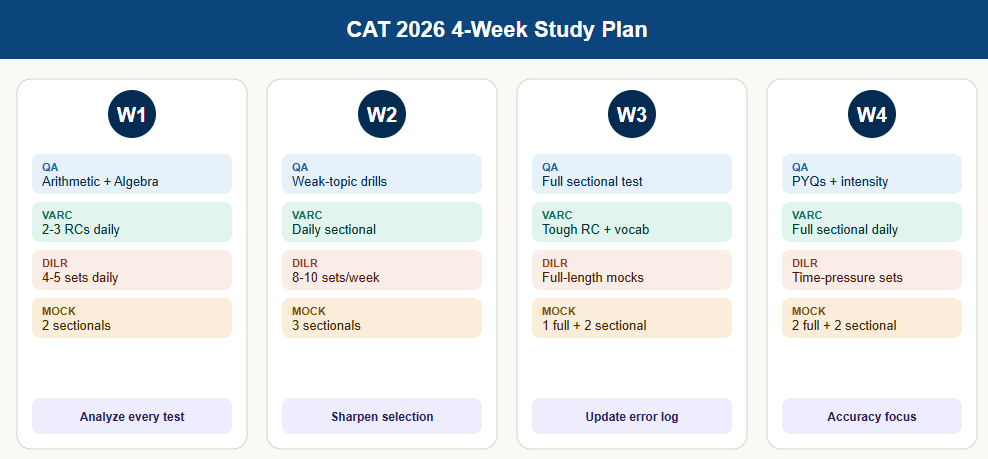
What actually separates a 90-percentile score from a 99-percentile one
It's rarely more hours. It's these four habits, repeated across all three months:
- Mock analysis over mock count. Toppers consistently say that reviewing one mock properly teaches you more than attempting three without review.
- Play to your strengths first. Know your strong section and attempt it first on exam day. Don't try to fix your weakest area in the exam hall , fix it in your prep, or accept it and move past it quickly.
- An error log, not a highlight reel. Write down mistakes, not just scores.
- A calm exam day. The students who stay composed consistently outperform their own mock averages. The ones who panic, don't.
FAQs on CAT 2026 Preparation
Can I prepare for CAT 2026 in 90 days?
Yes. Three months is enough to build a strong preparation strategy if you focus on important topics, practise regularly and analyse your mocks properly.
How many hours should I study daily for CAT 2026?
Aim for around 3–5 focused hours a day, depending on your schedule. Consistent practice and mock analysis are more important than simply studying for more hours.
How many mocks should I take for CAT 2026?
Take one diagnostic mock in the first week. From Week 5, take around two full-length mocks every week and analyse each one carefully. Reduce this to 1–2 mocks per week during the final two weeks.
Can non-engineering students crack CAT 2026 with three months of preparation?
Yes. Non-engineering students should start with easier, high-priority Quant topics such as Arithmetic and gradually move to tougher areas. A strong understanding of basics matters more than an engineering background.
What should I do if my mock scores are low?
Analyse the mock before taking another one. Identify whether your mistakes are due to concept gaps, silly mistakes, poor time management or wrong question selection, and work on those areas specifically.
How many DILR sets should I practise daily for CAT 2026?
Try solving 3–5 DILR sets every day. Practising different types of sets will help you recognise patterns faster and decide which sets to attempt during the actual exam.
What should I study in the last few days before CAT 2026?
Avoid starting new topics. Revise your formulas, important concepts and error log, and review questions you previously got wrong. Keep the final day light and focus on staying calm and well-rested.


