MTech in Biomedical Engineering is a two-year (4 Semester) postgraduate program that focuses on the intersection of engineering principles and medical science. The program covers several topics such as biomedical instrumentation, biomaterials, medical imaging, biomechanics, and the design of medical devices.
The qualification for Biomedical MTech requires the applicants to have a bachelor's degree (BE/BTech) in Biomedical Engineering, Biotechnology, Electronics, or any related branch with 50-60% marks from a recognized institution. The candidates are expected to pass entrance exams like GATE, or institute-specific tests to be eligible for admission.
The average tuition fees for the entire M Tech in Biomedical in India is between INR 40,000 to INR 3,30,000 based on whether the college is a private or government institution. Some of the best colleges providing MTech Biomedical Engineering are IIT Delhi, IIT BHU, NIT Calicut, Amrita Vishwa Vidyapeetam, Manipal Institute of Technology, and SRM Institute of Science and Technology.
Biomedical MTech graduates are employed across diverse sectors such as pharmaceuticals, hospitals, healthcare consultancy, and research organizations. They take on roles including Biomedical Engineers, Clinical Engineers, Biotech Analysts, Biomechanics Researchers, Healthcare Technology Consultants, and Biomedical Technical Specialists. The average salary for freshers starts from INR 3.5 LPA and can rise to INR 15 LPA or higher with advanced expertise.
Table of Contents
- MTech in Biomedical Engineering Key Highlights
- What is MTech in Biomedical Engineering?
- Why Study MTech in Biomedical Engineering?
- Is MTech in Biomedical Engineering Worth It?
- What is the Eligibility Criteria for MTech in Biomedical Engineering?
- What are the Entrance Exams Required for MTech in Biomedical Engineering?
- MTech in Biomedical Engineering Colleges
- What is the Cutoff for MTech in Biomedical Engineering?
- MTech in Biomedical Engineering Admission Process
- What is the MTech in Biomedical Engineering Syllabus?
- What is the MTech in Biomedical Engineering Salary?
- MTech in Biomedical Engineering vs Biotechnology
- MTech Biomedical Engineering FAQs
MTech in Biomedical Engineering Key Highlights
MTech in Biomedical Engineering is a two-year postgraduate programme that combines engineering, technology and medical sciences. The course focuses on areas such as medical devices, biomedical systems, biomechanics and healthcare technology. Given below are the key highlights of the MTech in Biomedical Engineering course:
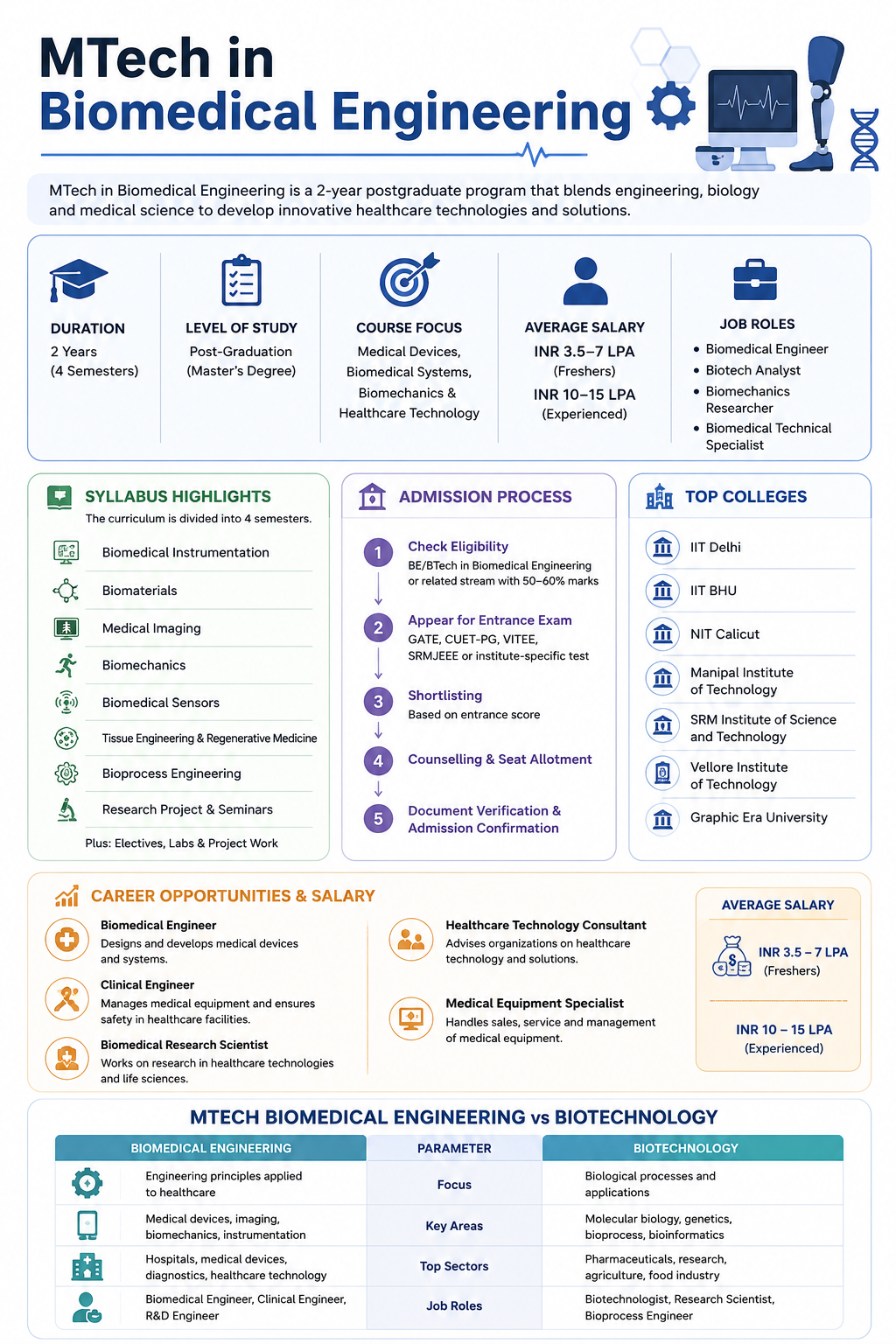
What is MTech in Biomedical Engineering?
MTech in Biomedical Engineering is a two year full-time postgraduate program that builds on core concepts of engineering, biology, and medicine to advance the development of healthcare technologies and systems. It equips students with specialized technical and research skills needed to solve complex medical problems and work in multidisciplinary environments that integrate engineering innovation with clinical applications. MTech in Biomedical emphasizes analytical thinking, system design, and the application of advanced technologies in healthcare.
Biomedical Engineering MTech curriculum includes topics such as Advanced Biomedical Signal Processing, Medical Imaging Systems, Biomaterials, Biomechanics, Tissue Engineering, Computational Biology, and Nanotechnology in Medicine, along with research projects and a thesis component. It strengthens problem-solving and research capabilities while fostering professionalism and ethical awareness, preparing graduates to work in hospitals, research institutions, healthcare organizations, and the medical device and biotechnology industries.
Why Study MTech in Biomedical Engineering?
MTech in Biomedical Engineering offers students the opportunity to build advanced technical knowledge while working at the intersection of engineering and healthcare. The course can open doors to research, innovation and specialised career opportunities. Some key benefits of pursuing an MTech in Biomedical Engineering are:
- Advanced Knowledge and Innovation: Students develop specialised knowledge of biomedical technologies and can work on medical devices, diagnostic systems and other healthcare solutions.
- Research Opportunities: The course provides opportunities to work on research and development in areas such as medical technology, regenerative medicine, biomedical systems and patient care.
- Wide Career Opportunities: Graduates can explore career opportunities in hospitals, healthcare companies, research institutions, medical device companies and government organisations.
- Interdisciplinary Learning: MTech in Biomedical Engineering combines engineering principles with medical sciences, allowing students to specialise in areas such as medical imaging, biomechanics, biomaterials and rehabilitation technology.
Is MTech in Biomedical Engineering Worth It?
Yes, pursuing an MTech in Biomedical Engineering in 2026 can be a good option for students interested in the intersection of engineering, healthcare and medical technology. The field offers opportunities in areas such as medical devices, biomaterials, clinical research, healthcare analytics and biomedical technology. The growing use of technology in healthcare is also creating demand for professionals with specialised skills.
However, the value of the degree largely depends on the college, specialisation, practical exposure and career goals of the student. Students who want to build careers in research, medical device development, healthcare technology or pursue further studies can benefit from the programme, particularly when it includes research projects, internships and industry exposure.
What is the Eligibility Criteria for MTech in Biomedical Engineering?
The eligibility criteria for MTech in Biomedical Engineering may vary across universities. Generally, candidates from engineering, medical and life science backgrounds can apply. Students can learn about eligibility criteria in the pointers mentioned below:
- Candidates should have a BE/BTech degree in Biomedical Engineering, Biotechnology, Biochemical Engineering, Electronics & Communication Engineering, Electrical Engineering, Instrumentation Engineering, Mechanical Engineering, Chemical Engineering, Bioinformatics or a related discipline.
- Candidates with MBBS, BDS, BPT, BOT or B.Pharm degrees may also be eligible at some institutions.
- Candidates with an MSc in Medical Physics, Biophysics, Biotechnology, Life Sciences or related disciplines can also apply.
- A minimum of 50-60% aggregate marks or equivalent CGPA may be required, depending on the institution.
- Candidates with valid GATE/CUET-PG scores may be given preference as per university norms.
What are the Entrance Exams Required for MTech in Biomedical Engineering?
Admission to MTech in Biomedical Engineering is generally offered through entrance examinations, with the specific exam requirements varying across universities. GATE is one of the commonly accepted entrance exams, while some institutions may also consider CUET-PG and other university-level entrance exams for admission. Check out the table given below for more details:
MTech in Biomedical Engineering Colleges
Some of the top colleges offering MTech in Biomedical Engineering in India include IIT Delhi, IIT Hyderabad, IIT BHU, SRM Institute of Science and Technology, Amrita Vishwa Vidyapeetham, LPU, Graphic Era University, Manipal Institute of Technology and Parul University. The total tuition fees for these colleges generally range from INR 40,000 to INR 3.5 lakh, depending on the institution and programme. Interested students can check out the table given below to learn more about colleges:
What is the Cutoff for MTech in Biomedical Engineering?
The MTech in Biomedical Engineering cutoff refers to the minimum GATE score required by institutes for admission. The cutoff can vary based on the institute, candidate category, qualifying discipline and admission year. Candidates should also note that the minimum qualifying cutoff may differ from the actual score required to secure admission.
For the IIT Bombay Biomedical Engineering MTech Cutoff, the minimum GATE score for the 2026-27 admission cycle is 400 for General/EWS candidates, 360 for OBC-NCL candidates, and 267 for SC/ST candidates. These are the minimum scores required for consideration, while the concerned academic unit may set a higher cutoff for the written test or interview based on the applications received.
MTech in Biomedical Engineering Admission Process
The admission process for MTech in Biomedical Engineering generally involves filling out the application form, appearing for the required entrance examination and completing the selection process. Candidates may be shortlisted based on their entrance exam scores, academic performance, written tests and interviews, depending on the institute’s admission criteria. For reference, the steps mentioned below follow the admission process of IIT Delhi:
Step 1: Fill the application form for the MTech Biomedical Engineering course available on the website of IIT Delhi and submit it along with the fee.
Step 2: Then, students have to register themselves for the GATE examination and appear for it on the scheduled date.
Step 3: Shortlisted candidates eligible for the GATE may be called for a written test and an interview conducted by the admission committee (depending on department norms and applicant category
Step 4: Candidates are selected based on eligibility criteria, qualifying exam scores (e.g., GATE), academic performance, or on a written test and an interview.
Step 5: Selected candidates will have to pay the admission charges and complete document verification to confirm their place in the MTech Biomedical Engineering program.
Required Documents
What is the MTech in Biomedical Engineering Syllabus?
The MTech in Biomedical Engineering syllabus is generally spread across four semesters, covering core subjects, laboratory work, electives and research projects. The curriculum followed by IIT Indore includes subjects related to biomedical instrumentation, biomaterials, tissue engineering and biomedical sensors, along with research work in the final year. The semester-wise syllabus is given below:
What is the MTech in Biomedical Engineering Salary?
The salary after completing an MTech in Biomedical Engineering varies based on the job role, experience, area of specialisation and type of organisation. Graduates can explore opportunities across biomedical research, clinical engineering, healthcare technology and medical equipment. The average salary ranges from INR 3.5 LPA to INR 15 LPA or more. Check out the table below to learn more:
MTech in Biomedical Engineering vs Biotechnology
MTech in Biomedical Engineering and MTech in Biotechnology are both interdisciplinary postgraduate programmes, but they differ in terms of their core subjects, applications and career opportunities. Biomedical Engineering focuses on applying engineering principles to healthcare, including medical devices, biomedical systems and diagnostic technologies, while Biotechnology focuses on biological processes, genetics, molecular biology and their applications in areas such as pharmaceuticals and research. The key differences between the two programmes are given in the table below:
MTech Biomedical Engineering FAQs
: What is MTech in Biomedical Engineering?
: MTech in Biomedical Engineering is a two-year postgraduate programme that combines engineering, biology and medical sciences to develop healthcare technologies and systems.
: What is the eligibility criteria for MTech in Biomedical Engineering?
: Candidates generally need a relevant BE/BTech degree with the required minimum marks. Some universities may also accept candidates from medical and life science backgrounds.
: Which entrance exam is required for MTech in Biomedical Engineering?
: GATE is one of the commonly accepted entrance exams, while some universities may also consider CUET-PG and other university-level entrance exams.
: What is the duration of MTech in Biomedical Engineering?
: MTech in Biomedical Engineering is generally a two-year postgraduate programme divided into four semesters.
: What is the average fee for MTech in Biomedical Engineering?
: The average tuition fee ranges from around INR 40,000 to INR 3.30 lakh, depending on the college and type of institution.
: Which are the top colleges for MTech in Biomedical Engineering?
: Some colleges include IIT Delhi, IIT Hyderabad, IIT BHU, SRM Institute of Science and Technology, Amrita Vishwa Vidyapeetham, LPU, Graphic Era University and Manipal Institute of Technology.
: What subjects are taught in MTech Biomedical Engineering?
: The course covers subjects such as biomedical instrumentation, biomaterials, biomedical sensors, tissue engineering, biomechanics and medical imaging, along with electives and research projects.
: What are the career options after MTech in Biomedical Engineering?
: Graduates can work as Biomedical Engineers, Clinical Engineers, Biomedical Research Scientists, Healthcare Technology Consultants and Biomedical Technical Specialists.
: What is the salary after MTech in Biomedical Engineering?
: The average salary can range from around INR 3.5 LPA to INR 15 LPA or more, depending on the job role, experience, specialisation and organisation.
: Is MTech in Biomedical Engineering worth pursuing in 2026?
: Yes, it can be a good option for students interested in healthcare technology, medical devices, research and innovation. However, the value of the degree depends on the college, specialisation, practical exposure and career goals.