Chandigarh University Lucknow has announced the launch of a Centre of Excellence (CoE) in Smart Healthcare during a one-day symposium on ‘AI in Governance: Policy, Practice, and People-Centric Transformation’ held at its campus in Uttar Pradesh.
The symposium brought together experts from government, academia, and industry to discuss how artificial intelligence is being used in governance and public services. With this step, CU Lucknow is expanding its work in AI and strengthening its focus on practical applications in healthcare and technology.
The new Centre is aligned with the state’s efforts to improve healthcare systems by using advanced technologies. It is expected to support faster diagnosis, better patient care, and improved healthcare delivery across Uttar Pradesh.
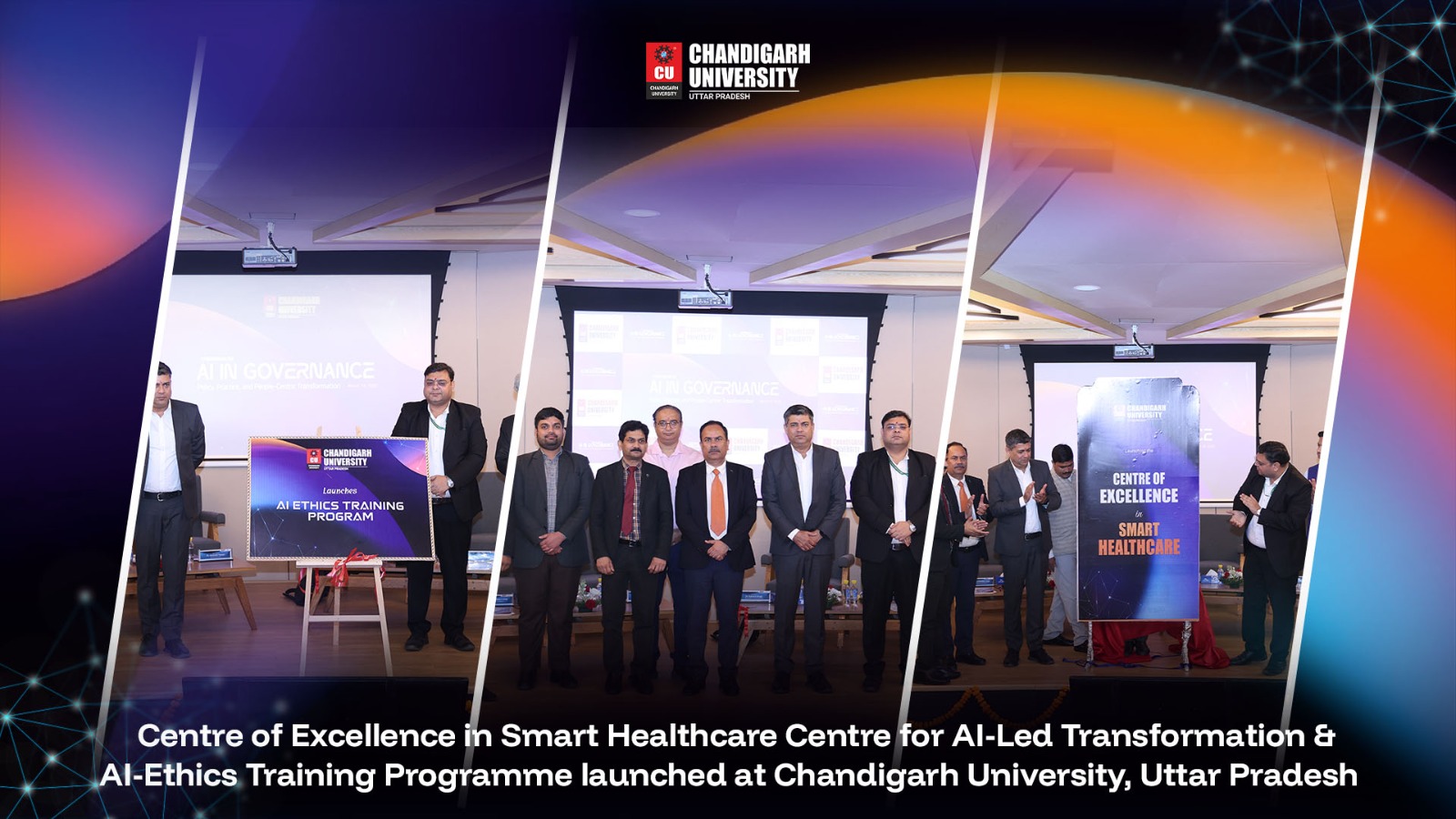
CoE and AI Ethics Training Programme Launch
During the symposium, Asim Arun, Ex-IPS and Minister of State (Independent Charge), Social Welfare, Uttar Pradesh, appreciated Chandigarh University, Uttar Pradesh for its continued work in AI-based development. He described the newly launched Centre of Excellence as an important step towards improving healthcare services at scale across the state.
The Centre will function under the leadership of Dr. Thipendra P Singh, Professor of AI and Pro Vice Chancellor, Chandigarh University, Uttar Pradesh. Alongside this, the university also introduced an AI Ethics Training Programme in collaboration with upGrad to promote responsible and inclusive use of artificial intelligence.
Under this programme, around 1.5 lakh youth across Uttar Pradesh will be trained over the next five years. The initiative is supported by the university’s advanced AI infrastructure, including a high-performance system based on NVIDIA Blackwell Architecture with 168 GB GPU memory, which will strengthen research and computing capabilities.
Healthcare Research and Industry Insights
The Centre of Excellence in Smart Healthcare will initially focus on collaborations with hospitals for model validation, research projects, and academic publications. Over the next two years, it also plans to support five AI startups, while working on key areas such as medical imaging, diagnostics, predictive analytics, precision medicine, and large healthcare datasets using tools like IoT and machine learning.
The symposium also included panel discussions on ‘AI Use Cases in Government: From Vision to Implementation’ and ‘Roadmap for AI-Enabled Governance’, where experts shared practical insights on improving public services through AI. Guest of Honour Dr. Amitabh Tewari, Head, Tata Consultancy Services (Lucknow & Indore), said that institutions focusing on AI and innovation will play an important role in future growth. He added that Chandigarh University, Uttar Pradesh has the potential to grow as a strong hub for innovation, entrepreneurship, and intellectual property development.
Chief Guest Dr. Rahul K Singh, CEO, Innovation Cell, GIMS, Greater Noida, emphasised that AI solutions in healthcare must be clinically validated, safe, and guided by medical professionals. He also highlighted the importance of incubation centres in supporting startups with the right data and direction. Speaking on the occasion, Dr. Thipendra P Singh said that healthcare and governance are evolving quickly with the use of AI. He added that Chandigarh University, Uttar Pradesh, is building an ecosystem where academics, research, and industry work together to prepare students for careers in health-tech and emerging technologies, while contributing to the broader vision of Viksit Bharat 2047.
Through these initiatives, Chandigarh University Lucknow continues to work towards using technology and innovation to improve healthcare and support long-term national development goals.


