
Three courses account for two-thirds of India's undergraduate students: B.A. with 38.6% of undergraduate enrolment, B.Sc. with 15.7% and B.Com. with 12.0%, according to the Ministry of Education's All India Survey on Higher Education (AISHE) 2023–24, released on 8 July 2026. These are also the courses most often filled on Class 12 marks, which is why most "no entrance exam" options sit within them.
The exception that catches students out is central universities. Since 2022 they admit undergraduates through CUET, so a B.A. at a central university needs an entrance score while the same B.A. at many state, private or open universities does not.
AISHE 2023–24 Enrolment Data
Of 4.50 crore students in higher education in 2023–24, 3.5 crore (76.8%) were at undergraduate level. Their distribution across programmes shows where seats, and merit-based admissions, are concentrated.
Combining honours and pass programmes, B.A. had 1.3 crore students, B.Sc. 53.4 lakh and B.Com. 40.8 lakh. Engineering (B.Tech. and B.E. together, 12.7%) is the largest course group that is almost always entrance-based.
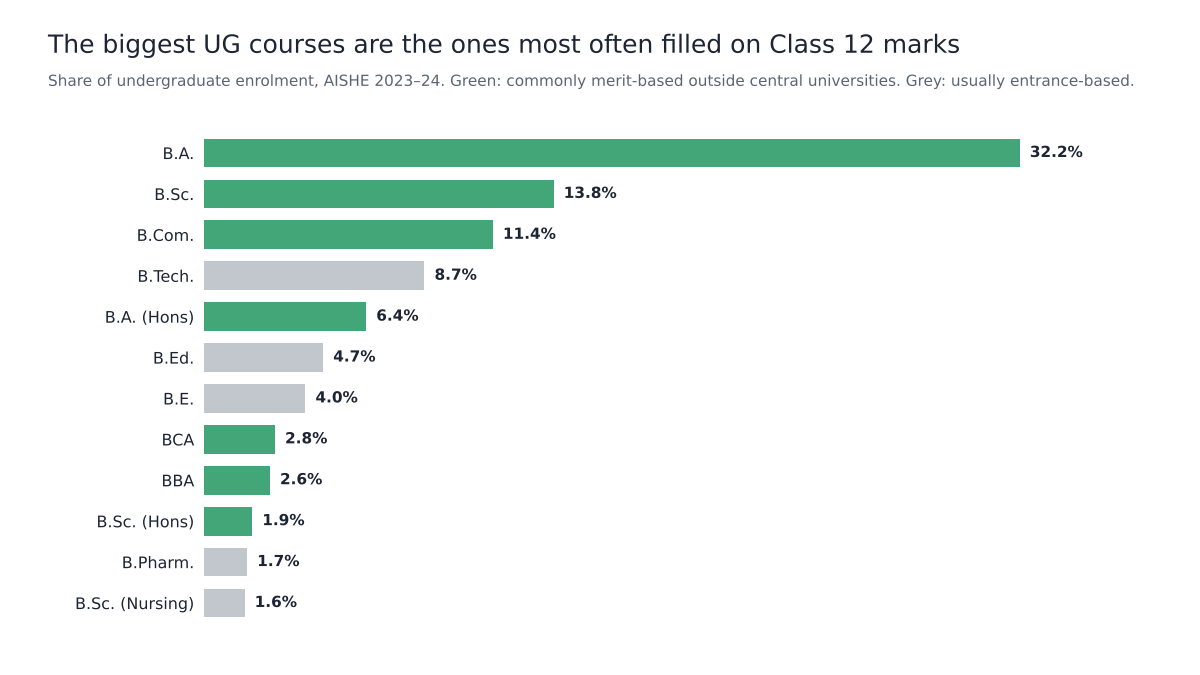
Source: Ministry of Education, AISHE 2023–24 (released 8 July 2026), programme-wise UG enrolment
Where Admission Is Merit-Based and Where It Is Not
Admission rules depend on the type of university more than on the course. Since 2022, every central university has used CUET UG for undergraduate admission; state, private and open universities set their own rules.
The same course name can sit in either column. Always check the admitting body's prospectus for the current year.
Degree Courses Commonly Offered on Class 12 Merit
The five courses below together make up about 72% of undergraduate enrolment, and each is widely available through merit-based admission outside central universities.
Under the four-year undergraduate structure many universities now follow, a fourth year leads to an honours or honours-with-research degree; the three-year exit remains available.
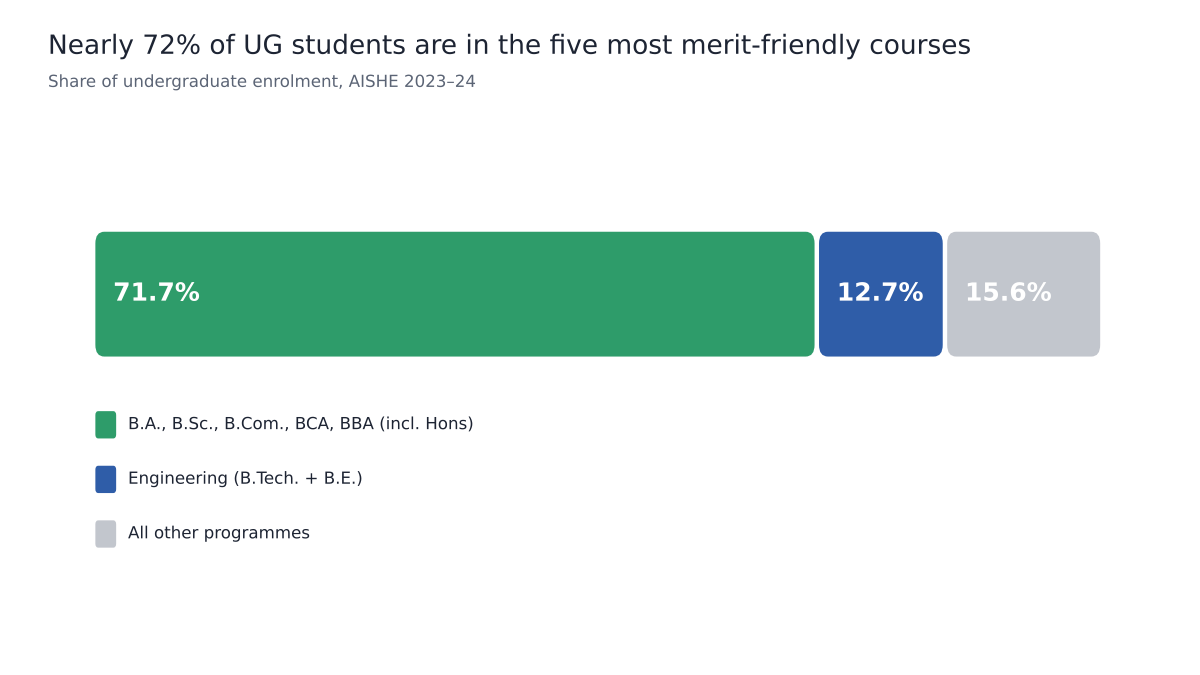
Source: Calculated from AISHE 2023–24 programme-wise UG enrolment shares
Diploma Courses After 12th
Diploma and certificate programmes account for 7.4% of all higher-education enrolment, according to AISHE 2023–24. Admission to most is merit-based.
For technical diplomas, confirm that the institute and programme are approved by AICTE for the current year.
A Worked Example: Non-Entrance Routes in Delhi
Delhi shows how narrow and how real these routes are. In 2026, the main non-entrance options were these:
Even in a CUET-dominated city, merit-based seats existed at every level from diploma to degree. Detailed routes are on our Delhi University page and previous CUET scores on our CUET cut-off page.
Courses After 12th Without Entrance Exam FAQs
Which courses after 12th do not need an entrance exam?
Most B.A., B.Sc., B.Com., BCA and BBA seats at state, private and open universities are filled on Class 12 merit. These programmes make up about 72% of undergraduate enrolment. Central universities, however, use CUET.
Do central universities admit without an entrance exam?
Generally no. Since 2022, central universities admit undergraduates through CUET UG. Delhi University's School of Open Learning, NCWEB and its late vacant-seat rounds were exceptions in 2026.
Which is the most popular course after 12th?
B.A. It had 1.3 crore students in 2023–24, 38.6% of all undergraduate enrolment, according to AISHE.
Are diploma courses after 12th merit-based?
Mostly. Diploma and certificate programmes make up 7.4% of higher-education enrolment, and courses such as D.Pharm and lateral-entry engineering diplomas usually admit on Class 12 marks.
Is BCA possible without an entrance exam?
Yes, at many universities. In Delhi, for example, DSEU admitted BCA students on Class 12 merit with 50% aggregate in 2026.


