
None are added as a fixed bonus. EAMCET normalisation, now formally part of TG EAPCET in Telangana and AP EAPCET in Andhra Pradesh, does not add a set number of marks to anyone. It moves each candidate's raw score up or down depending on how their own session compared with all sessions put together, and the size of the move also depends on where the candidate stood within that session.
That is why two students with the same raw score can end up with different normalised marks, and why a claim like "everyone gets 5 extra marks" cannot be true. The session statistics the formula uses are not published in the result notices, so no outside source can tell a candidate exactly how many marks were added. What can be explained exactly is how the adjustment works.
- The Formula Behind Your Normalised Mark
- Two Points the Formula Always Lands On
- Same Raw Score, Three Different Outcomes
- When Normalisation Can Push You Below the 40-Mark Line
- Telangana and Andhra Pradesh: Same Formula, Different Rank Recipe
- What Your Response Sheet Can and Cannot Tell You
- What You May Have Heard vs What the Formula Says
- EAMCET Normalisation FAQs
The Formula Behind Your Normalised Mark
The TG EAPCET 2026 information bulletin sets out the formula used to normalise marks across sessions:
Normalised mark = GASD + [(GTA − GASD) ÷ (STA − SASD)] × (Raw mark − SASD)
The exam itself has 160 questions of one mark each, answered in three hours, with no negative marking, so raw marks run from 0 to 160 before normalisation.
Two Points the Formula Always Lands On
The formula is a straight line drawn through two anchor points, which makes two of its results exact:
In other words, a candidate who scored exactly as well as their session's top 0.1% is placed exactly where the overall top 0.1% sits, whatever the difficulty of their paper. Every other score is placed along the line between and beyond those two points.
Same Raw Score, Three Different Outcomes
The example below uses invented session statistics to show the mechanics; it is not real EAPCET data. Assume that across all sessions GASD is 70 and GTA is 140.
The third case is the one most explanations miss. When a session's top scorers bunch closer to its average than they do across all sessions, the formula stretches the scale: a raw 125 gains 15 marks, while a raw 30 in the same session loses almost one.
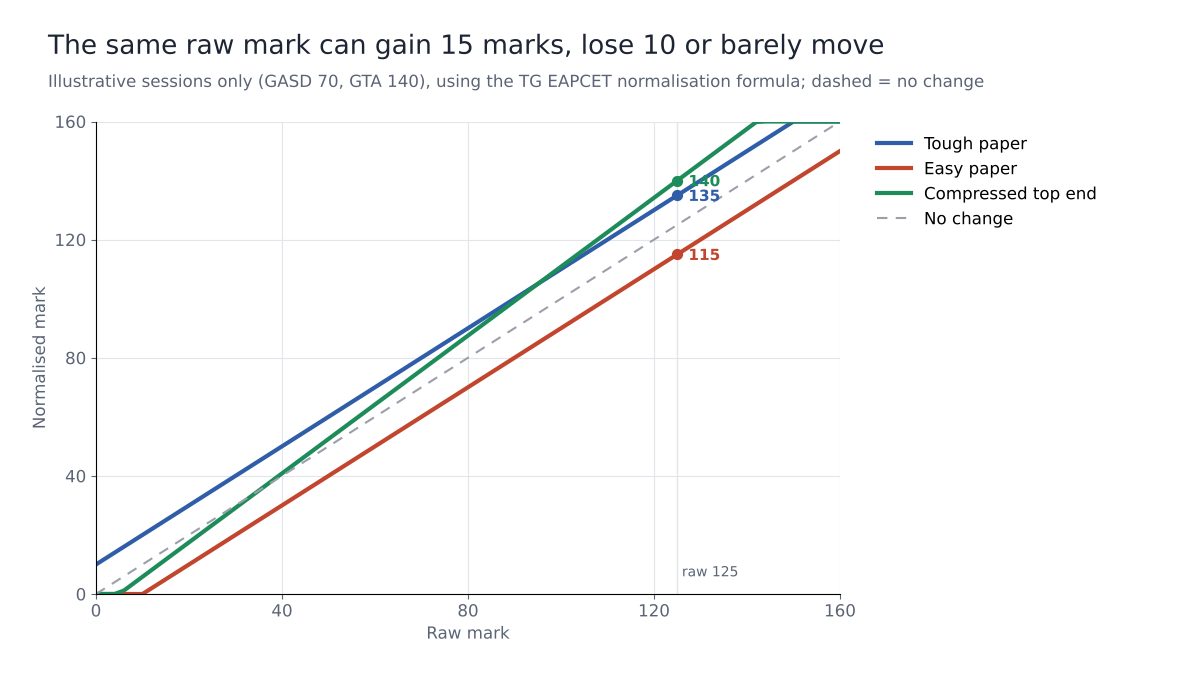
Source: Illustrative calculation using the TG EAPCET 2026 normalisation formula; session figures are hypothetical
An interactive normalisation explorer is available in the web version of this article.
When Normalisation Can Push You Below the 40-Mark Line
To receive a rank, OC, EWS and BC candidates need at least 25% of 160, or 40 marks, after normalisation. SC and ST candidates have no minimum qualifying mark.
Because the 40-mark threshold is checked after normalisation, a raw score just above 40 in an easy session can fall below the line, and one just below 40 in a tough session can rise above it.
Telangana and Andhra Pradesh: Same Formula, Different Rank Recipe
Both states normalise in the same way, but they turn normalised marks into ranks differently.
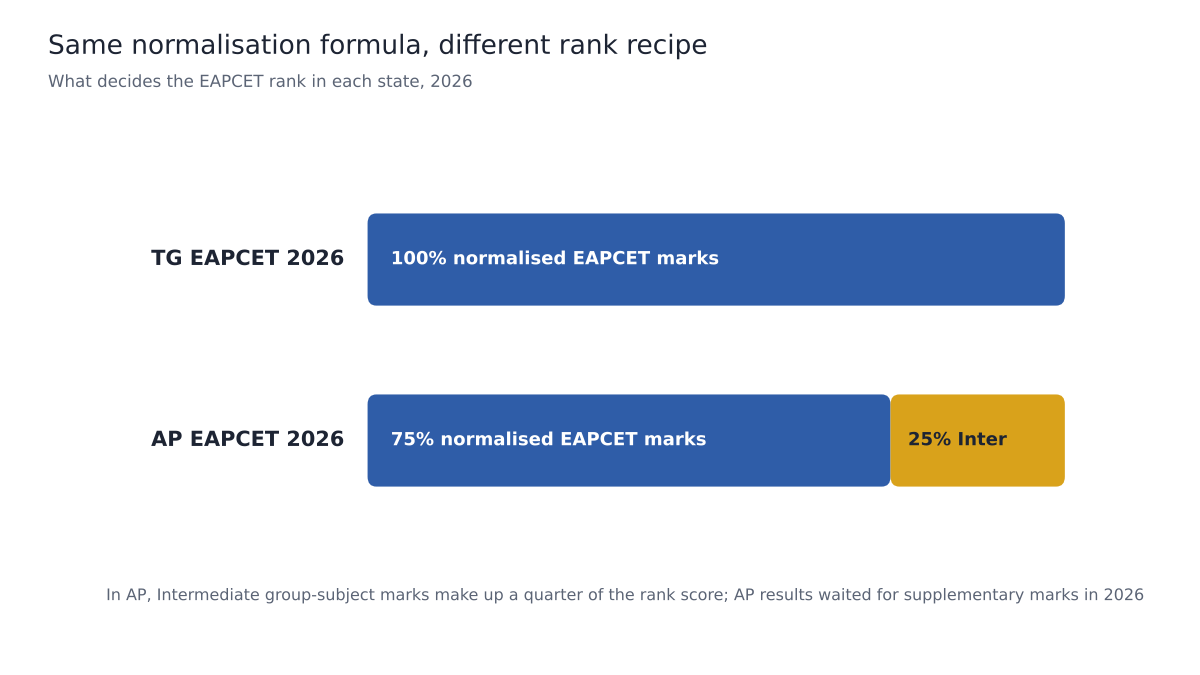
Source: TG EAPCET 2026 information bulletin; AP EAPCET 2026 result notices
In Andhra Pradesh, then, normalisation shifts only three-quarters of the score that decides the rank; the other quarter comes from Intermediate marks in the group subjects.
What Your Response Sheet Can and Cannot Tell You
The preliminary key and response sheet let you calculate your raw mark exactly: one mark per correct answer, no deduction for wrong ones. They cannot tell you your normalised mark, because SASD, STA, GASD and GTA depend on every candidate's performance and are not published with the key. The rank card is the first place the normalised figure appears. Any "normalisation calculator" that asks only for your raw score is assuming session statistics it does not have.
What You May Have Heard vs What the Formula Says
Most confusion about EAMCET normalisation comes from claims that sound specific but have nothing behind them.
EAMCET Normalisation FAQs
How many marks are added in EAMCET normalisation?
There is no fixed number. Marks can rise, stay the same or fall, depending on how a candidate's session compared with all sessions and where the candidate stood within it.
Can normalisation reduce my EAMCET marks?
Yes. In a session whose average and top scores were higher than the overall figures, normalised marks come out lower than raw marks.
Is the qualifying mark checked before or after normalisation?
After. OC, EWS and BC candidates need 40 out of 160 in normalised marks; SC and ST candidates have no qualifying mark.
Does Telangana use Intermediate marks in the EAPCET rank?
Not in 2026. TG EAPCET 2026 ranks were based only on normalised EAPCET marks, while AP EAPCET 2026 used 75% EAPCET and 25% Intermediate group marks.
Can I calculate my normalised marks from the response sheet?
Only your raw marks. The session and overall statistics in the formula are not published with the answer key, so the normalised mark first appears on the rank card.


