
India's engineering landscape extends well beyond the IITs, NITs and IIITs. Private deemed universities, state universities and long-established government colleges together account for a large share of the country's top-ranked engineering institutes, and many of them feature in the top 30 of the NIRF Engineering rankings. Their placement records can be compared directly, because every institute reports its graduate outcomes to NIRF in the same format. For the B.Tech batch that graduated in 2023-24, BITS Pilani reported a median salary of ₹18 lakh, compared with ₹14.35 lakh at NIT Trichy for the same batch.
Across six of the top tier-2 engineering colleges, BITS Pilani, VIT Vellore, Jadavpur University, Thapar Institute, DTU and Manipal Institute of Technology, the 2023-24 medians range from ₹8.5 lakh to ₹18 lakh, and placement rates from 65.0% to 91.0%. Fees vary even more. Jadavpur University's semester fees total about ₹10,110 over four years for most branches. BITS Pilani's tuition for 2026-27 entrants totals ₹25.13 lakh, and Thapar Institute's programme fee for the same intake is ₹19.89–26 lakh, depending on the branch. This guide lists these tier-2 engineering colleges in India with their NIRF rank, placement rate, median salary, BTech fees and admission process, and explains how to compare them.
- What Is a Tier-2 Engineering College?
- List of Top Tier-2 Engineering Colleges in India
- Tier-2 Engineering College Placements and Median Salary
- Median Salary Trends Over Three Batches
- BTech Fees at Tier-2 Engineering Colleges
- Tier-2 Engineering College ROI: Fees vs Median Salary
- Tier-2 Engineering Colleges: College-Wise Details
- Is RVCE a Tier-2 Engineering College?
- How to Choose a Tier-2 Engineering College
- FAQs on Tier-2 Engineering Colleges in India
What Is a Tier-2 Engineering College?
"Tier-2 engineering college" is an informal label rather than an official classification. The Ministry of Education, AICTE and NIRF do not group colleges into tiers, and students, coaching institutes and recruiters use the terms in slightly different ways. In common usage, Tier 1 refers to the IITs, NITs, IIITs and a few other premier institutes. Tier 2 refers to well-regarded engineering colleges outside that group, including private deemed universities such as BITS Pilani and VIT and state institutions such as Jadavpur University and DTU. Many of these colleges also feature in the top 100 of the NIRF Engineering rankings.
Tier 1, Tier 2 and Tier 3 colleges explained
| Label | How the term is commonly used | Examples |
| Tier 1 | IITs, NITs, IIITs and a few other premier institutes | IIT Madras, IIT Delhi, NIT Trichy |
| Tier 2 | Well-regarded colleges outside the national institute system, many ranked in the NIRF Engineering top 100 | BITS Pilani, VIT Vellore, Jadavpur University, Thapar Institute, DTU, MIT Manipal |
| Tier 3 | Used loosely for other engineering colleges; usage varies widely between students and recruiters | No common definition |
Because the labels are informal, a college described as Tier 2 by one source may be described differently by another. NIRF rank also measures something broader than placements: it combines teaching and resources, research, graduate outcomes, outreach and inclusivity, and perception. A college's rank is therefore not a direct measure of its placement record, which is why this guide compares placement data separately.
List of Top Tier-2 Engineering Colleges in India
The six tier-2 engineering colleges below span a wide range of NIRF ranks, from 11 for BITS Pilani to 59 for Manipal Institute of Technology, and include three private deemed universities, two state government institutions and one constituent institute of a deemed university. Each fills its B.Tech seats in a different way. BITS and VIT use their own national exams, BITSAT and VITEEE. Jadavpur admits through the West Bengal entrance exam, WBJEE, and DTU through JEE Main ranks in JAC Delhi counselling. Thapar uses JEE Main ranks and also accepts Class 12 marks in nine of its eighteen branches for 2026-27.
| College | NIRF Engineering rank (2025) | Location | Type | Admission |
| BITS Pilani | 11 | Pilani, Rajasthan | Private (deemed university) | BITSAT |
| VIT Vellore | 16 | Vellore, Tamil Nadu | Private (deemed university) | VITEEE |
| Jadavpur University | 18 | Kolkata, West Bengal | State government | WBJEE |
| Thapar Institute (TIET) | 29 | Patiala, Punjab | Private (deemed university) | JEE Main rank; Class 12 merit in nine branches (2026-27) |
| Delhi Technological University (DTU) | 30 | New Delhi | State government | JEE Main, through JAC Delhi counselling |
| Manipal Institute of Technology (MIT) | 59 | Manipal, Karnataka | Private (constituent of MAHE, a deemed university) | MET (Manipal Entrance Test) |
Tier-2 Engineering College Placements and Median Salary
Placement figures in this guide come from the data each institute submits to NIRF, which uses the same definitions for every institution and so allows a like-for-like comparison. All figures relate to students of four-year B.Tech programmes who graduated in 2023-24. For that batch, Jadavpur University placed 91.0% of its graduates and BITS Pilani 89.1%, while VIT placed 67.6% and Manipal Institute of Technology 65.0%. Median salaries ranged from ₹18 lakh at BITS Pilani to ₹8.5 lakh at MIT Manipal. Batch sizes differ considerably, from 868 graduates at Jadavpur to 5,964 at VIT, which is worth keeping in mind when comparing percentages.
| College | Graduating on time | Placed | Placement rate | Higher studies | Higher-studies share | Median salary |
| BITS Pilani | 2,759 | 2,458 | 89.1% | 283 | 10.3% | ₹18.00 lakh |
| DTU | 2,412 | 1,759 | 72.9% | 653 | 27.1% | ₹13.25 lakh |
| Jadavpur University | 868 | 790 | 91.0% | 75 | 8.6% | ₹10.50 lakh |
| Thapar Institute (TIET) | 2,082 | 1,708 | 82.0% | 152 | 7.3% | ₹10.00 lakh |
| VIT Vellore | 5,964 | 4,031 | 67.6% | 1,255 | 21.0% | ₹8.99 lakh |
| MIT Manipal | 1,755 | 1,140 | 65.0% | 288 | 16.4% | ₹8.50 lakh |
B.Tech (4-year) graduates of 2023-24. Figures for VIT are from its NIRF 2026 data submission, which reports the 2023-24 batch alongside later years; figures for the other five institutes are from their NIRF 2025 submissions. Placement rate = students placed ÷ students graduating in the minimum stipulated time; higher-studies share uses the same base.
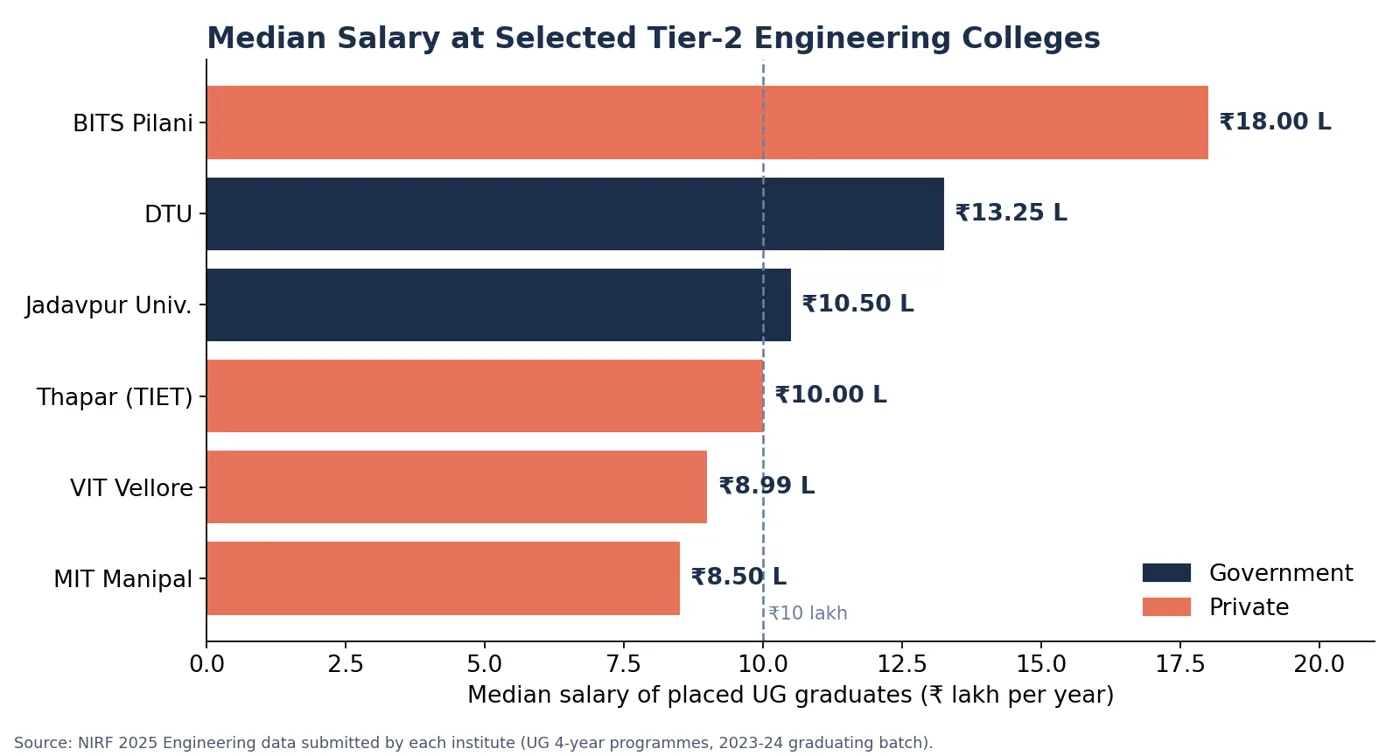
Median salary of placed B.Tech graduates, 2023-24 batch.
How the placement rate is calculated
NIRF divides the number of students placed by the number of students who graduated in the minimum stipulated time. That base includes students who went on to higher studies and students who did not take part in campus placements, so the placement rate and the higher-studies share are separate measures and are shown separately here. At DTU, for example, 72.9% of the 2023-24 batch were placed and 27.1% were selected for higher studies.
College placement reports often calculate a placement rate on a different base, such as the number of students who registered for placements. Because the base is smaller, those figures are usually higher than the NIRF rate for the same batch, and the two should not be compared directly.
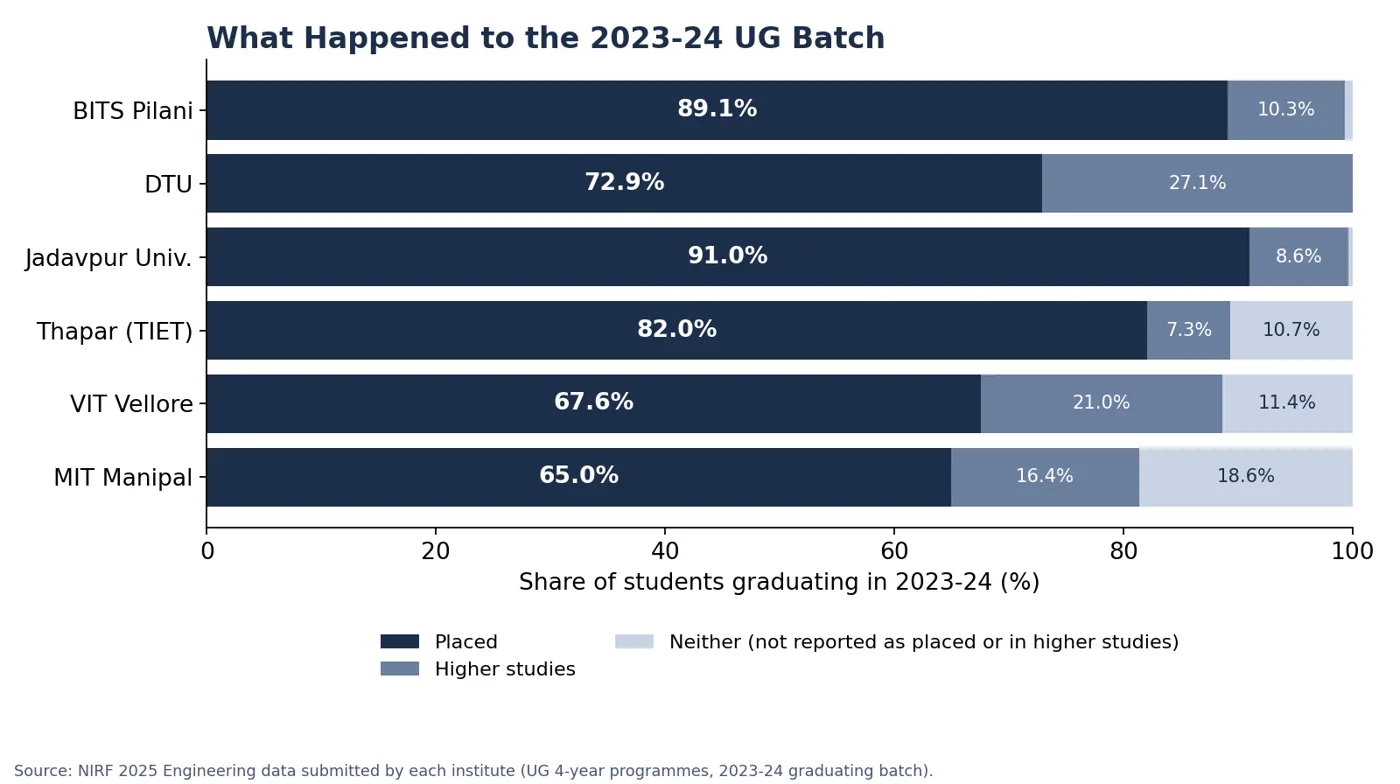
Outcomes of the 2023-24 graduating batch by share of graduates.
Median salary, average salary and highest package
The median salary is the salary of the graduate at the exact middle of the placed batch: half of placed students earned more and half earned less. It is less affected by a small number of very high or very low offers than the average salary, and it is quite different from the highest package, which reflects a single offer. NIRF records only the median. Averages and highest packages that colleges publish elsewhere are calculated on their own bases and are not used in this guide. On the median, four of the six institutes reported ₹10 lakh or more for 2023-24: BITS Pilani, DTU, Jadavpur University and Thapar Institute.
Median Salary Trends Over Three Batches
A single graduating batch can be unusually strong or weak, so medians across consecutive batches give a steadier picture. Each NIRF submission reports three graduating batches. For BITS Pilani, Thapar Institute and MIT Manipal, the 2021-22, 2022-23 and 2023-24 medians from their NIRF 2025 submissions have been checked, and all three recorded their highest median of the period for the 2022-23 batch: ₹19 lakh, ₹11.89 lakh and ₹8.88 lakh respectively. For VIT, the 2022-23 and 2023-24 figures come from its NIRF 2026 submission, which also reports a median of ₹6 lakh for the batch that graduated in 2024-25.
| College | 2021-22 batch | 2022-23 batch | 2023-24 batch | NIRF edition |
| BITS Pilani | ₹18.20 lakh | ₹19.00 lakh | ₹18.00 lakh | 2025 |
| Thapar Institute (TIET) | ₹10.00 lakh | ₹11.89 lakh | ₹10.00 lakh | 2025 |
| MIT Manipal | ₹8.00 lakh | ₹8.88 lakh | ₹8.50 lakh | 2025 |
| VIT Vellore | Not verified | ₹9.00 lakh | ₹8.99 lakh | 2026 |
| DTU | Not verified | Not verified | ₹13.25 lakh | 2025 |
| Jadavpur University | Not verified | Not verified | ₹10.50 lakh | 2025 |
Median salary of placed B.Tech (4-year) graduates. "Not verified" marks batches for which the figure was not checked against the institute's NIRF submission.
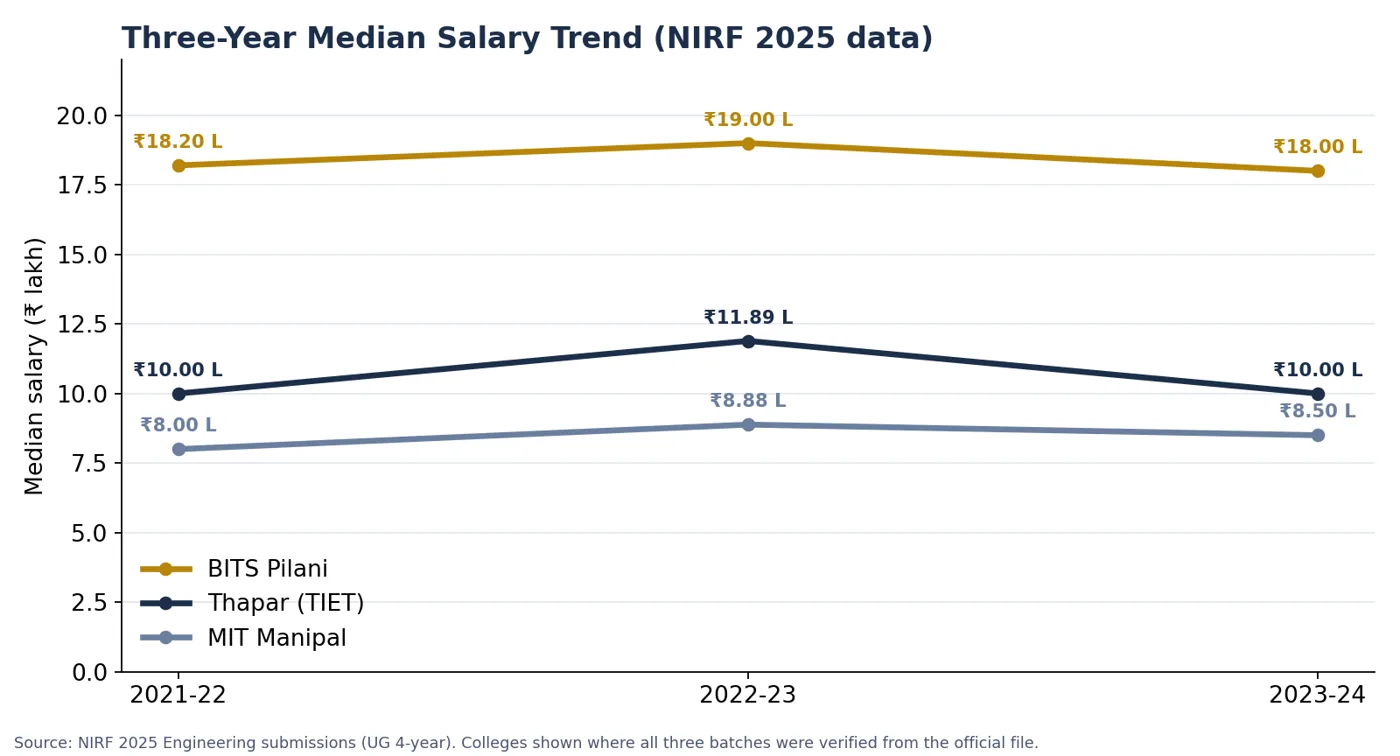
Three-batch median trend for the institutes with a complete checked series.
The trend covers only the batches available in comparable form, so it is a complete three-year series for three of the six institutes. Medians reflect the batch in question and the hiring conditions of that year; a rise or fall in one batch does not indicate what a future batch will earn.
BTech Fees at Tier-2 Engineering Colleges
Fees differ more widely than salaries among these institutes, and they are published in different forms, so each figure below carries its unit and academic year. BITS Pilani publishes semester tuition for 2026-27 entrants, rising each year, which totals ₹25,13,000 over eight semesters. Thapar Institute publishes a total programme fee for 2026-27 entrants, from ₹19,88,800 to ₹26,00,000 depending on the branch group, covering tuition, development and other charges. MAHE lists a single batch total for each MIT Manipal programme in 2026-27. VIT publishes annual tuition for 2025-26 by fee category, and Jadavpur's semester fees, which include tuition, are listed without a session year.
BTech tuition and programme fees
| College | Session or batch | Branch or category | Fee | What the figure covers |
| BITS Pilani | 2026-27 entrants | All first-degree programmes | ₹2,91,500 per semester in year 1, ₹3,06,000 in year 2, ₹3,21,500 in year 3 and ₹3,37,500 in year 4; ₹25,13,000 in total | Tuition, eight semesters |
| Thapar Institute | 2026-27 entrants | DSAI, COE, CSE, CSBS, ENC | ₹3,25,000 per semester; ₹26,00,000 in total | Programme fee: tuition ₹2,57,000, development ₹57,000 and other charges ₹11,000 per semester |
| Thapar Institute | 2026-27 entrants | BT, ECE, EEC, EVD, RAI | ₹2,94,800 per semester; ₹23,58,400 in total | Programme fee: tuition ₹2,26,800, development ₹57,000 and other charges ₹11,000 per semester |
| Thapar Institute | 2026-27 entrants | Other branches | ₹2,48,600 per semester; ₹19,88,800 in total | Programme fee: tuition ₹1,82,600, development ₹55,000 and other charges ₹11,000 per semester |
| MIT Manipal (MAHE) | 2026-27 batch | CSE programmes, Mathematics & Computing, ECE | ₹24,42,000 | Batch total (components not itemised) |
| MIT Manipal (MAHE) | 2026-27 batch | Aeronautical, Mechatronics | ₹19,66,000 | Batch total (components not itemised) |
| MIT Manipal (MAHE) | 2026-27 batch | Biotechnology, Chemical, Civil, EEE, Mechanical, Electronics | ₹18,02,000 | Batch total (components not itemised) |
| VIT Vellore | 2025-26 | Group A programmes, Category 1 | ₹1,73,000 a year | Annual tuition for the lowest fee category |
| VIT Vellore | 2025-26 | Group B programmes, Category 1 | ₹1,95,000 a year | Annual tuition for the lowest fee category |
| Jadavpur University | Session not specified | Most branches | ₹10,110 | Sum of the eight semester fees, including tuition |
| Jadavpur University | Session not specified | Information Technology | ₹1,15,510 | Sum of the eight semester fees, including tuition |
DTU's fee schedule is not included in this comparison.
Admission fee, deposits, hostel and mess charges
| College | Admission and one-time charges | Refundable deposits | Hostel | Mess | Other recurring charges |
| BITS Pilani (2026-27) | Admission fee ₹64,100 | Caution deposit ₹3,000 | ₹36,000 per semester in year 1 | Mess and electricity advance ₹10,000 per semester, adjusted against actual charges | Other advances ₹12,000 per semester; annual union and aid fees |
| Thapar Institute (programme fee 2026-27; hostel 2025-26) | Admission fee ₹30,000 | — | ₹34,600–78,500 per semester at Patiala, by room type (2025-26 rates) | ₹26,900 per semester (2025-26, based on consumption) | Included in the programme fee |
| VIT Vellore (2025-26) | Hostel admission fee ₹15,000 | Caution deposit ₹3,000; hostel caution deposit ₹15,000 | ₹1,12,400 a year for the lowest-cost first-year room, including veg mess | Included in the hostel fee | — |
The fee a student pays depends on more than the institute. At VIT, the fee category is decided by VITEEE rank, and Category 1, shown here, is the lowest; students in other categories pay more. Jadavpur charges considerably more for Information Technology than for its other branches. At Thapar, students with at least 80% in Physics, Chemistry and Mathematics receive a 30% tuition waiver, and those with 75–79.99% a 20% waiver, in eight core branches: Biomedical, Chemical, Civil with Computer Applications, Civil, Electrical, Electronics (Instrumentation & Control), Mechanical and Mechatronics. The waiver continues while the student maintains an AGPA of 8.5. Hostel charges also add substantially: at VIT, the lowest-cost first-year room with mess (₹1,12,400) is about two-thirds of a year's Category 1 Group A tuition.
Tier-2 Engineering College ROI: Fees vs Median Salary
Setting the cost of a programme against what its graduates earn gives a first sense of value for money. The fee-to-median-salary ratio below divides the full published programme fee by one year's median salary for the 2023-24 graduating batch. The fee is BITS Pilani's four-year tuition for 2026-27 entrants, Thapar Institute's programme fee for the same intake, MIT Manipal's 2026-27 batch total and the sum of Jadavpur's eight semester fees. A ratio of 1.40 at BITS Pilani means four years of tuition equal 1.4 times a typical graduate's first-year gross salary. VIT is not included because its fee is published as annual tuition, and DTU because its fee schedule is not part of this comparison.
| College and fee group | Programme fee | Median salary (2023-24 batch) | Fee ÷ median salary |
| Jadavpur University (most branches) | ₹0.10 lakh | ₹10.50 lakh | 0.01 |
| Jadavpur University (IT) | ₹1.16 lakh | ₹10.50 lakh | 0.11 |
| BITS Pilani | ₹25.13 lakh | ₹18.00 lakh | 1.40 |
| Thapar Institute (other branches) | ₹19.89 lakh | ₹10.00 lakh | 1.99 |
| Thapar Institute (BT, ECE, EEC, EVD, RAI) | ₹23.58 lakh | ₹10.00 lakh | 2.36 |
| Thapar Institute (DSAI, COE, CSE, CSBS, ENC) | ₹26.00 lakh | ₹10.00 lakh | 2.60 |
| MIT Manipal (core branches) | ₹18.02 lakh | ₹8.50 lakh | 2.12 |
| MIT Manipal (Aeronautical, Mechatronics) | ₹19.66 lakh | ₹8.50 lakh | 2.31 |
| MIT Manipal (CSE, Mathematics & Computing, ECE) | ₹24.42 lakh | ₹8.50 lakh | 2.87 |
Fees: BITS Pilani tuition and Thapar programme fee, 2026-27 entrants; MIT Manipal batch total, 2026-27; Jadavpur semester fees, session not specified. Median salary: B.Tech graduates of 2023-24.
What the fee-to-salary ratio does not cover
The ratio is an indicator, not a return-on-investment calculation, and it does not show how long it takes to recover the cost of a degree. It compares fees for students joining in 2026-27 with the salaries of a batch that graduated in 2023-24. It uses one median for the whole batch, although fees at Thapar and MIT Manipal vary by branch and salaries vary by branch too. The salary figure is gross pay for placed graduates only. Hostel, mess and living costs, scholarships and fee waivers, education-loan interest and income tax are all left out, and each can change the real cost considerably.
Tier-2 Engineering Colleges: College-Wise Details
The six profiles below bring each institute's admission process, placement record and fees together in one place, using the same 2023-24 placement data and the latest fee figures shown earlier. Each follows the same structure: location and type, NIRF rank, admission, placements, salary trend where available, fees, and the points that distinguish the institute in this comparison. Taken together, they show how differently these institutes are organised. Admission ranges from national exams to state counselling, fees from about ₹10,110 over four years to ₹26 lakh, and graduating batches from 868 to 5,964 students.
BITS Pilani
| Location and type | Pilani, Rajasthan, with campuses at Goa and Hyderabad; private deemed university |
| NIRF Engineering rank | 11 (2025) |
| Admission | BITSAT; the first-rank student of every central and state board is admitted directly |
| Placement (2023-24 batch) | 89.1% placed; 10.3% in higher studies; median ₹18.00 lakh |
| Median trend | ₹18.20 lakh (2021-22), ₹19.00 lakh (2022-23), ₹18.00 lakh (2023-24) |
| Fees (2026-27 entrants) | Tuition ₹25,13,000 over eight semesters; admission fee ₹64,100; hostel ₹36,000 per semester in year 1 |
Points to note:
- BITS reported the highest 2023-24 median in this comparison, ₹18 lakh, and its median stayed between ₹18 lakh and ₹19 lakh across the three batches.
- Tuition rises each year under a published four-year schedule, from ₹2,91,500 a semester in the first year to ₹3,37,500 in the fourth.
Delhi Technological University (DTU)
| Location and type | New Delhi; state government university |
| NIRF Engineering rank | 30 (2025) |
| Admission | JEE Main, through JAC Delhi counselling |
| Placement (2023-24 batch) | 72.9% placed; 27.1% selected for higher studies; median ₹13.25 lakh |
| Median trend | 2023-24 figure only in this comparison |
| Fees | Not included in this comparison |
Points to note:
- DTU's median of ₹13.25 lakh was the second-highest among the six institutes for 2023-24.
- Of its 2,412 graduates, 1,759 were placed and 653 were selected for higher studies, the largest higher-studies share in this group. Students who choose further study are counted separately from those placed.
Jadavpur University
| Location and type | Kolkata, West Bengal; state government university |
| NIRF Engineering rank | 18 (2025) |
| Admission | WBJEE |
| Branches | Include Chemical, Civil, Computer Science, Electrical, Electronics and Telecommunication, IT, Mechanical, Metallurgical, Power, Printing and Production Engineering |
| Placement (2023-24 batch) | 91.0% placed; 8.6% in higher studies; median ₹10.50 lakh |
| Median trend | 2023-24 figure only in this comparison |
| Fees (session not specified) | Semester fees totalling about ₹10,110 over four years for most branches, and ₹1,15,510 for IT |
Points to note:
- Jadavpur placed 91.0% of its 868 graduates in 2023-24, the highest placement rate in this comparison.
- Fees differ by branch: the IT programme's four-year total is more than ten times that of most other branches.
Thapar Institute of Engineering and Technology (TIET)
| Location and type | Patiala, Punjab; private deemed university |
| NIRF Engineering rank | 29 (2025) |
| Admission (2026-27) | JEE Main rank for computer, electronics and related branches; JEE Main rank or Class 12 merit in Mechanical, Mechatronics, Chemical, Civil, Civil with Computer Applications, Electrical and Electronics (Instrumentation & Control); NEET rank or Class 12 merit also accepted for Biomedical Engineering and Biotechnology |
| Placement (2023-24 batch) | 82.0% placed; 7.3% in higher studies; median ₹10.00 lakh |
| Median trend | ₹10.00 lakh (2021-22), ₹11.89 lakh (2022-23), ₹10.00 lakh (2023-24) |
| Fees (2026-27 entrants) | Programme fee ₹19,88,800 to ₹26,00,000 by branch group; admission fee ₹30,000 |
Points to note:
- Thapar's median stayed at ₹10 lakh or above in each of the three batches.
- Fees are set by branch group, from ₹2,48,600 a semester for core branches to ₹3,25,000 for the computer group, and PCM-based tuition waivers of 20% and 30% apply in eight core branches.
VIT Vellore
| Location and type | Vellore, Tamil Nadu; private deemed university |
| NIRF Engineering rank | 16 (2025) |
| Admission | VITEEE; the rank also determines the fee category |
| Placement (2023-24 batch) | 67.6% placed; 21.0% in higher studies; median ₹8.99 lakh |
| Median trend | ₹9.00 lakh (2022-23), ₹8.99 lakh (2023-24), ₹6.00 lakh (2024-25) |
| Fees (2025-26) | Annual tuition ₹1,73,000 (Group A) or ₹1,95,000 (Group B) in Category 1, the lowest fee category; first-year hostel from ₹1,12,400 a year |
Points to note:
- VIT had the largest graduating batch in this comparison, 5,964 students in 2023-24, of whom 1,255 were selected for higher studies.
- Its median was about ₹9 lakh for the 2022-23 and 2023-24 batches and ₹6 lakh for the 2024-25 batch.
- Tuition depends on the VITEEE fee category, so the Category 1 figures are the lower end of the range.
Manipal Institute of Technology (MIT Manipal)
| Location and type | Manipal, Karnataka; constituent institute of the Manipal Academy of Higher Education, a deemed university |
| NIRF Engineering rank | 59 (2025) |
| Admission | Manipal Entrance Test (MET) |
| Placement (2023-24 batch) | 65.0% placed; 16.4% in higher studies; median ₹8.50 lakh |
| Median trend | ₹8.00 lakh (2021-22), ₹8.88 lakh (2022-23), ₹8.50 lakh (2023-24) |
| Fees (2026-27 batch) | Batch total ₹18,02,000 to ₹24,42,000 by programme |
Points to note:
- MIT Manipal's median stayed between ₹8 lakh and ₹8.9 lakh over the three batches.
- Of its 1,755 graduates in 2023-24, 1,140 were placed and 288 were selected for higher studies.
- Fees vary by programme group, from ₹18,02,000 for core branches such as Civil and Mechanical to ₹24,42,000 for CSE programmes and ECE.
Is RVCE a Tier-2 Engineering College?
R.V. College of Engineering (RVCE), Bengaluru, is often discussed alongside tier-2 engineering colleges. As the tier labels are informal, RVCE has no official tier. It was not in the NIRF 2025 Engineering top 100 and is not one of the six institutes profiled above, but it reports its graduate outcomes to NIRF in the same format, so its figures can be read alongside theirs. For the B.Tech batch that graduated in 2023-24, 786 of RVCE's 1,087 graduates were placed (72.3%), 124 were selected for higher studies (11.4%) and the median salary was ₹9 lakh. On placement rate and median salary, these figures sit close to VIT's and MIT Manipal's for the same batch, although the institutes differ in size, fees and admission process.
How to Choose a Tier-2 Engineering College
Choosing between institutes means weighing several factors at the same time. An NIRF rank describes the institution as a whole; a student's experience depends just as much on the branch chosen, the four-year cost and the opportunities around the campus. The data in this guide shows how far these factors can differ even within a small group. Jadavpur combines a 91.0% placement rate with semester fees of about ₹10,110 over four years for most branches, while BITS Pilani pairs an ₹18 lakh median with ₹25.13 lakh in tuition. The criteria below set out what to compare and why each one matters.
| Criterion | What to compare | Why it matters |
| Branch and academic interest | Whether the institute offers the branch, and its curriculum and faculty in that area | The branch shapes coursework, internships and career options more directly than the institute's overall rank |
| Branch-wise placements | The institute's branch-wise placement reports | NIRF figures cover the whole batch, and outcomes differ between branches |
| Median salary trend | NIRF medians over two or three batches | One batch can be unusually high or low |
| Four-year expenditure | Tuition or programme fee, admission charges and deposits for the same admission year | Fees are published in different units and for different years |
| Hostel and living costs | Hostel and mess charges by room type | At VIT, the lowest-cost first-year room with mess is about two-thirds of a year's Category 1 Group A tuition |
| Admission eligibility | Entrance exam, minimum marks, state quotas and counselling rules | Each institute uses a different exam: BITSAT, VITEEE, WBJEE, MET or JEE Main |
| Location and internships | Access to industry, internships and recruiters | Proximity affects internship and project opportunities during the course |
| Higher-studies outcomes | The share of graduates selected for higher studies | Shares ranged from 7.3% at Thapar to 27.1% at DTU in 2023-24 |
| Scholarships and fee waivers | Merit, need-based and category-based waivers | Thapar's PCM-based waivers reduce tuition by 20% or 30% in eight core branches |
FAQs on Tier-2 Engineering Colleges in India
What are the top Tier-2 engineering colleges in India?
There is no official list. Well-known tier-2 engineering colleges include BITS Pilani (NIRF 2025 Engineering rank 11), VIT Vellore (16), Jadavpur University (18), Thapar Institute (29), DTU (30) and Manipal Institute of Technology (59). Their median salaries for the 2023-24 B.Tech batch ranged from ₹8.5 lakh to ₹18 lakh.
What are Tier 1, Tier 2 and Tier 3 colleges?
They are informal labels, not official categories. Tier 1 usually means the IITs, NITs, IIITs and a few premier institutes; Tier 2 well-regarded colleges outside that group, such as BITS Pilani, VIT and Jadavpur University; and Tier 3 is used loosely for other colleges, with no common definition.
Is IIT Tier 1 or Tier 2?
The IITs are generally described as Tier 1, together with the NITs, IIITs and a few other premier institutes. Nine of the top ten institutes in the NIRF 2025 Engineering rankings are IITs.
Are Tier-2 engineering colleges good for placements?
Placement outcomes vary by college. For the 2023-24 B.Tech batch, placement rates at BITS Pilani, VIT, Jadavpur University, Thapar Institute, DTU and MIT Manipal ranged from 65.0% to 91.0%, and median salaries from ₹8.5 lakh to ₹18 lakh.
Which are the top Tier-2 private engineering colleges in India?
Private tier-2 engineering colleges with NIRF 2025 Engineering ranks in the top 60 include BITS Pilani (11), VIT Vellore (16), Thapar Institute (29) and Manipal Institute of Technology (59). Their 2023-24 B.Tech medians were ₹18 lakh, ₹8.99 lakh, ₹10 lakh and ₹8.5 lakh respectively.
Which are the Tier-2 government engineering colleges in India?
Government institutions commonly described as tier 2 include Jadavpur University in Kolkata and Delhi Technological University (DTU) in New Delhi, ranked 18 and 30 in NIRF 2025 Engineering. Their 2023-24 B.Tech medians were ₹10.5 lakh and ₹13.25 lakh.
Are government or private Tier-2 colleges better?
Neither category is consistently ahead; the main differences are in fees and admission. In 2023-24, DTU and Jadavpur reported medians of ₹13.25 lakh and ₹10.5 lakh, and the four private institutes medians from ₹8.5 lakh to ₹18 lakh. Jadavpur's semester fees total about ₹10,110 for most branches, while Thapar's 2026-27 programme fee is ₹19.89–26 lakh.
What are the BTech fees at Tier-2 engineering colleges?
BTech fees range from about ₹10,110 to ₹26 lakh over four years. For 2026-27 entrants, BITS Pilani's tuition totals ₹25.13 lakh, Thapar's programme fee is ₹19.89–26 lakh and MIT Manipal's batch total is ₹18.02–24.42 lakh. VIT's annual tuition starts at ₹1.73 lakh in its lowest fee category (2025-26).
Is VIT a Tier-2 college?
VIT Vellore is commonly grouped with tier-2 engineering colleges. It is not an IIT, NIT or IIIT, and it was ranked 16th in NIRF 2025 Engineering. Its B.Tech median was ₹8.99 lakh for the 2023-24 batch and ₹6 lakh for the 2024-25 batch.
Is RVCE Tier 2 or Tier 3?
RVCE has no official tier, because the tier system is informal. It was not in the NIRF 2025 Engineering top 100, and its 2023-24 B.Tech batch recorded a 72.3% placement rate and a median salary of ₹9 lakh.
Can you get a 10 LPA salary from a Tier-2 engineering college?
Yes, at several colleges, although salaries depend on the college and branch. BITS Pilani, DTU, Jadavpur University and Thapar Institute reported 2023-24 B.Tech medians of ₹10 lakh or more. A median of ₹10 lakh means half of placed graduates earned more and half earned less.
How do you calculate the ROI of an engineering college?
A simple starting point is to divide the full programme fee by the median salary. On 2026-27 fees and 2023-24 medians, the fee-to-median-salary ratio is 1.40 at BITS Pilani and 1.99–2.60 at Thapar, by branch group. A complete assessment also adds hostel and living costs, fee waivers, loan interest and tax.
Is college ranking more important than branch?
Neither should be judged alone. NIRF rank reflects the institution as a whole, while placements, salaries and, at Thapar and MIT Manipal, fees differ between branches within the same college.


