
The CAT 2026 Difficulty Level is expected to range from moderate to difficulty depending upon the variations in questions in VARC, DILR and Quantitative Aptitude.
To estimate the expected difficulty of CAT 2026, KollegeApply has analysed the last five years of CAT question papers to identify trends in section-wise difficulty, question patterns, and overall exam complexity.
- The CAT 2026 VARC section is expected to be moderate to difficult, with Reading Comprehension (RC) likely to remain a major component. Candidates may face questions requiring strong comprehension, inference, and critical reasoning skills, along with Verbal Ability questions on para jumbles and paragraph summaries.
- The CAT 2026 DILR section is expected to be moderate to difficult. Data Interpretation and Logical Reasoning sets may test analytical thinking, calculations, and decision-making under time pressure. Selecting the right sets and managing time effectively will be important for maximising scores.
- The CAT 2026 QA section is expected to be moderate to difficult, with Arithmetic and Algebra likely to remain important preparation areas. Questions from Geometry, Number Systems, and Modern Mathematics may also require conceptual clarity and efficient problem-solving.
Note : This analysis provides candidates with an overview of what to expect from CAT 2026, which sections may be more challenging, and how the paper could compare with previous years. However, the actual difficulty level will be confirmed only after the examination on November 29, 2026.
Table of Contents
CAT Exam Difficulty Level: 5 Year Trend Analysis (2021–2025)
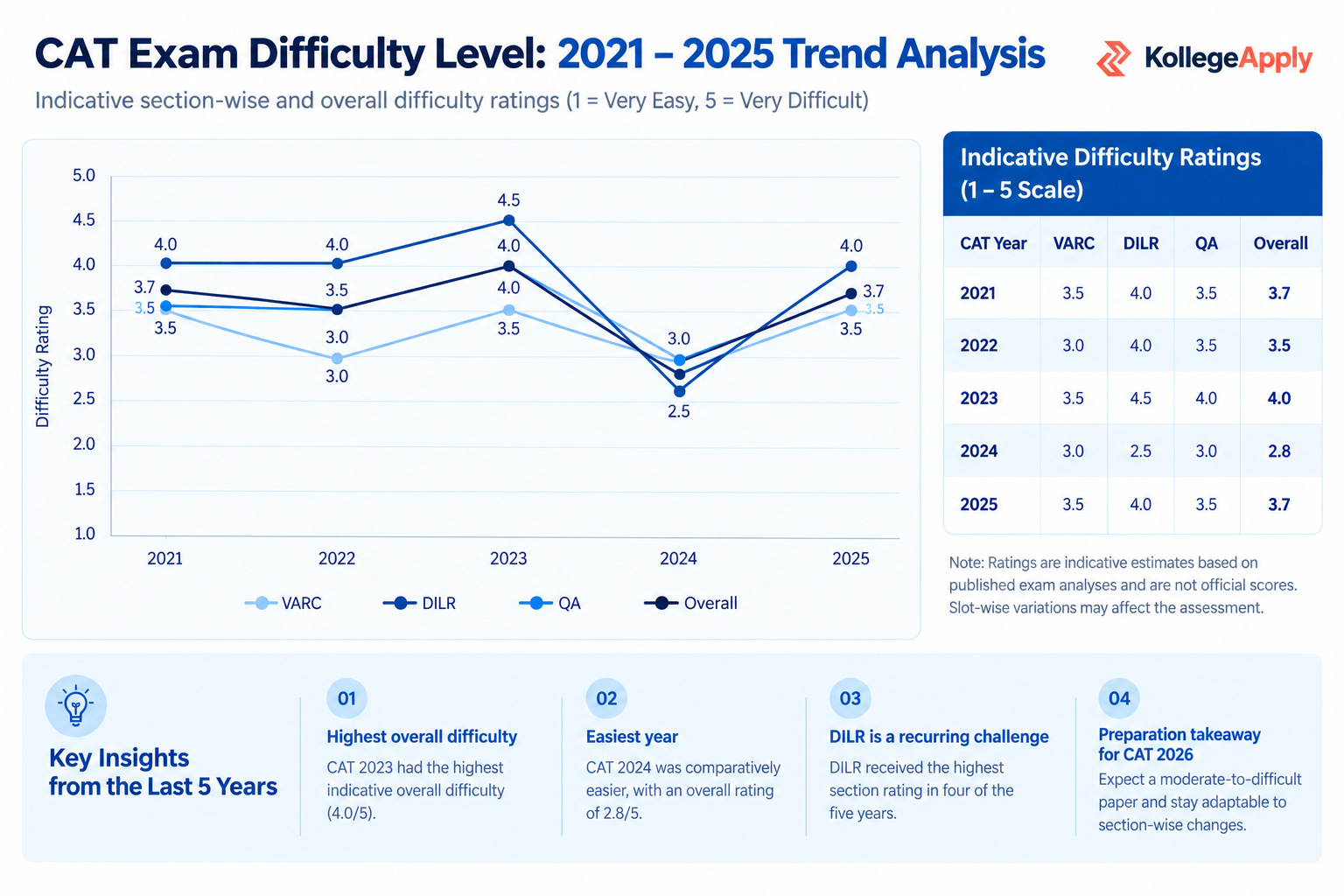
As per analysis done by Kollegeapply CAT 2023 remained one of the toughest paper in the last 5 years while CAT 2024 was comparatively easier. In 2025 difficulty increased again in DILR section.
- CAT difficulty changes every year: The exam was moderately difficult in 2021 and 2022, became tougher in 2023, was comparatively easier in 2024, and became challenging again in 2025.
- DILR is often a challenging section: Candidates have frequently found Data Interpretation and Logical Reasoning difficult. Practising different types of sets and managing time well can help improve performance.
- QA can also make the paper difficult: CAT 2023 showed that Quantitative Aptitude can be challenging too. Candidates should prepare all three sections instead of focusing only on DILR.
- CAT 2026 may have a different difficulty level: Previous years can help candidates understand exam trends, but the difficulty of CAT 2026 cannot be predicted with certainty. It is best to prepare for both easy and difficult questions.
Which Slot was Easy in CAT 2025?
Based on slot wise paper analysis and score vs percentile trends, CAT 2025 Slot 2 was relatively more balanced overall . Slot 2 had a comparatively easier VARC section but a Challenging DILR Section. Slot 3 had easier DILR Questions while Quantitative Aptitude (QA ) was considered more challenging.Therefore, the overall difficulty depended on candidates' strengths across the three sections.
As per CAT Marks vs Percentile 2025 the marks required for the 99th percentile were lowest for Slot 2, at approximately 82–83 marks, compared with 88–91 marks for Slot 1 and 85–87 marks for Slot 3. This suggests that Slot 2 may have been comparatively challenging overall, despite its more manageable VARC section.
However, CAT uses a normalisation process to account for differences in difficulty across slots. Therefore, the final percentile depends on candidates' relative performance, and the easiest slot should not be determined from section-wise ratings alone.
CAT 2025 Slot-Wise Difficulty Comparison
CAT Normalisation Formula
The official CAT Scaled score calculation uses a statistical formula based on candidate’s raw score, the mean and standard deviation of scores in their slot, the corresponding statistics across all slots and the average score of the top 0.1% of candidates. The calculation is performed section wise.
Before normalization, CAT Calculates a raw score for each section based on the candidate’s correct and incorrect responses. This raw score serves as a basis for calculating the scaled score.
CAT Raw Score Formula (Section-Wise)
Raw Score = (Correct MCQ Answers × 3) − (Incorrect MCQ Answers × 1) + (Correct TITA Answers × 3)
Where:
- Correct MCQ answers: Each correct answer carries 3 marks.
- Incorrect MCQ answers: Each incorrect answer attracts a penalty of 1 mark.
- Correct TITA answers: Each correct answer carries 3 marks, with no negative marking for incorrect TITA responses.
- Unattempted questions: No marks are awarded or deducted for questions left unanswered, regardless of question type.
Now coming to the CAT Normalisation process
The process involves the following steps:
- Calculate session-wise statistics: The mean and standard deviation of raw scores are calculated separately for each section in each exam session.
- Calculate overall statistics: The mean and standard deviation are also calculated using the scores across all sessions combined. These values provide the overall reference point.
- Calculate scaled scores: A statistical transformation adjusts each candidate's section-wise raw score in relation to their session's score distribution and the overall reference distribution.
- Calculate the total scaled score: The scaled scores for VARC, DILR and QA are added to obtain the overall scaled score.
Scaled Score Formula:
Scaled Section Score = Mg + (SDg ÷ SDi) × (Ri − Mi)
Where:
- (S): Scaled score for the section.
- (M_g): Mean raw score for that section across all sessions.
- (SD_g): Standard deviation of raw scores for that section across all sessions.
- (R_i): Candidate's raw score in the section in their exam session.
- (M_i): Mean raw score for that section in the candidate's exam session.
- (SD_i): Standard deviation of raw scores for that section in the candidate's exam session.
Example of CAT Normalisation
Suppose a candidate scores 40 marks in VARC in a particular session. For this illustrative example, assume the following statistics:
Using the formula: The answer is 44
In this example, the candidate's raw score of 40 is adjusted to a scaled score of 44 to account for differences in difficulty between exam slots. This does not mean the candidate gets 4 extra marks or scores in the 44th percentile. The scaled score is used to compare performance across slots.
Note: The formula requires actual score-distribution data from the examination. Therefore, candidates cannot calculate their exact normalised score using their raw marks alone.
FAQs
What is the expected difficulty level of CAT 2026?
CAT 2026 is expected to be moderate to difficult overall. However, the actual difficulty will depend on the questions asked in VARC, DILR and Quantitative Aptitude (QA), and may vary across exam slots.
Which section is expected to be the toughest in CAT 2026?
DILR may be challenging because it requires logical reasoning, data interpretation, careful set selection and time management. However, the toughest section cannot be predicted accurately before the exam, as difficulty may vary each year.
Will CAT 2026 be tougher than CAT 2025?
It is not possible to confirm whether CAT 2026 will be tougher than CAT 2025 before the examination. Previous-year papers can help identify trends, but the difficulty level and question patterns may change from year to year.
How does the CAT normalisation process affect scores?
CAT normalisation accounts for differences in score distributions across exam slots. It helps make candidates' performance comparable by converting raw scores into scaled scores. The final percentile reflects a candidate's relative performance among test-takers.
How can I prepare for a difficult CAT 2026 paper?
Candidates should practise mock tests under timed conditions, strengthen concepts in all three sections and analyse their mistakes after each test. For DILR, practise selecting manageable sets; for VARC, focus on reading comprehension and inference; and for QA, improve conceptual clarity and calculation accuracy.


