Bachelor of Accounting and Finance (BAF) is a 3-year undergraduate level program that combines fundamental concepts of accounting with core aspects of financial management, taxation and audit practices. Students learn about bookkeeping and cost accounting, as well as corporate finance and financial markets while also participating in practical workshops and case studies.
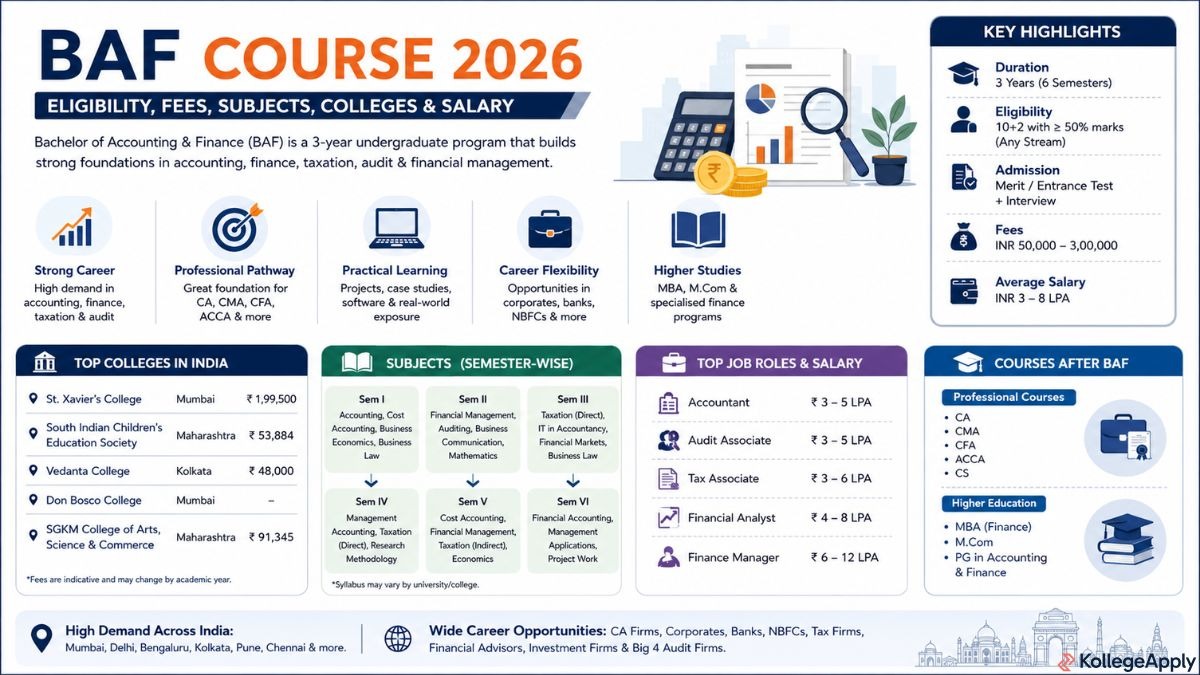
Admission is based on your 10+2 aggregate marks or college entrance test marks to ascertain your number, aptitude and communication skills. Reputable institutions, such as St. Xavier's College, South Indian Children's Education Society, Vedanta College, Don Bosco College, SGKM College of Arts, and Science and Commerce, have developed curriculums that meet industry needs, along with seasoned faculty and full placement assistance. The average course fee is INR 50,000 - 3,00,000.
With the essential skills learned above, BAF graduates pursue employment as junior accountants, tax associates or trainee financial analysts. The sound operation of India's corporate sector and financial services industry means that there continues to be a steady demand for skilled finance professionals. They can earn an average salary of INR 3 - 8 LPA.
- BAF Course Details Highlight
- What is BAF Course?
- Is BAF a 1-Year Course?
- Why Study BAF in 2026?
- Is BAF worth it in 2026?
- What are the Types of BAF Courses?
- BAF Eligibility Criteria
- BAF Entrance Exams 2026
- BAF Colleges in India
- BAF Course Fees 2026
- BAF Admission Process 2026
- BAF Syllabus
- BAF Job Opportunities in India
- Courses After BAF
- Skill-Based Courses After BAF
- Can I Do CA After BAF?
- Are There Job Opportunities Abroad After BAF?
- BAF vs B.Com vs BBA: Which Course is Better?
- BAF FAQs
BAF Course Details Highlight
The BAF course provides focused undergraduate-level education in accounting and finance, with coverage of areas such as financial management, taxation, auditing and financial analysis. The table below summarises the BAF course duration, eligibility, fees, admission process, career options and expected salary to help students quickly understand the programme.
What is BAF Course?
BAF is a specialised undergraduate degree in accounting and finance that combines accounting principles with financial management, taxation, auditing, economics, business law and related areas. The course is particularly suitable for students who want to build a career in accounting, corporate finance, taxation, audit, banking or financial services.
The BAF full form in commerce is Bachelor of Accounting and Finance. Unlike a general B.Com programme, BAF places comparatively greater emphasis on accounting and finance-oriented subjects. Depending on the college, students may also receive exposure to accounting software, spreadsheets, financial analysis, taxation applications and practical projects.
Is BAF a 1-Year Course?
No. BAF is generally not a 1-year course. It is normally a 3-year undergraduate degree, usually structured across six semesters. Students searching for “BAF 1 year” should check whether they are referring to a certificate, diploma or another finance-related programme rather than the Bachelor of Accounting and Finance degree.
Why Study BAF in 2026?
BAF can be a suitable choice for students who want to develop specialised knowledge of accounting and finance at the undergraduate level. Its curriculum can provide a foundation for both entry-level employment and professional qualifications such as CA, CMA, CFA and ACCA.
The relevance of BAF in 2026 is also linked to the growing use of digital accounting, data-driven financial decision-making, compliance technology and financial services. Students can improve their employability further by developing practical skills in Excel, accounting software, financial modelling, taxation and data analysis. Some of the key reasons to pursue BAF include:
- Specialised finance education: Focuses on accounting, taxation, auditing and financial management.
- Professional qualification pathway: Can be pursued alongside or followed by CA, CMA, CFA, ACCA or other qualifications.
- Career flexibility: Opens opportunities in accounting, audit, taxation, banking, finance and corporate roles.
- Practical skill development: Depending on the college, students may work on projects, case studies, spreadsheets and accounting applications.
- Higher-study opportunities: Graduates can pursue MBA, M.Com and specialised finance programmes.
- Industry-oriented skill building: Finance graduates can strengthen their profile with Excel, financial analytics, ERP/accounting tools and digital finance skills.
Is BAF worth it in 2026?
BAF can be worth pursuing in 2026 for students who are specifically interested in accounting, finance, taxation, audit or financial services. The degree provides a focused foundation, but career growth generally depends on additional skills, internships, professional certifications, academic performance and practical experience.
Students who want only a general business and management education may find BBA more suitable, while students who prefer accounting and finance may benefit more from BAF. BAF can be particularly suitable for:
- Commerce students interested in accounting and finance.
- Students are comfortable with numbers, analysis and financial concepts.
- Aspirants planning to pursue CA, CMA, CFA, ACCA or MBA after graduation.
- Students interested in banking, taxation, audit or corporate finance.
- Learners who want a finance-focused undergraduate degree before entering the workforce.
What are the Types of BAF Courses?
BAF programmes may be available in different modes depending on the institution and recognition status of the programme. Students can generally explore the following options:
- Full-Time BAF: A regular classroom-based programme with lectures, practical activities, projects and other academic activities.
- Online BAF: Delivered through online learning platforms and suitable for students seeking greater flexibility.
- Distance BAF: Designed for learners who prefer flexible or self-paced study, subject to the recognition and approval of the concerned institution.
- Part-Time BAF: May be offered by selected institutions for students who need flexible class schedules.
BAF Eligibility Criteria
The BAF eligibility criteria are decided by the university or college offering the programme. While Class 12 is the basic requirement, the minimum percentage, preferred stream, required subjects and admission method may differ across institutions.
Students should therefore check the 2026 admission notification of their shortlisted college rather than assuming that one eligibility rule applies to all BAF programmes. The general BAF eligibility requirements include:
- Candidates should have passed Class 12 or an equivalent examination from a recognised board.
- Many colleges require a minimum aggregate percentage, commonly around 45–50% or above, depending on institutional rules.
- Commerce students may receive preference or may be specifically required by some institutions.
- Some colleges accept students from Arts or Science streams if they satisfy the prescribed subject and percentage requirements.
- Certain institutions may require subjects such as Accountancy, Mathematics, Economics or related subjects.
- Candidates must satisfy the age, reservation and other conditions specified by the respective institution, wherever applicable.
BAF Entrance Exams 2026
BAF admission does not have one common entrance examination applicable to all colleges in India. Depending on the institution, admission may be based on Class 12 merit, an institution-specific entrance test, or another university-prescribed process. Students should check the admission notification of the college they wish to join before applying.
For example, CUET-UG may be relevant where a participating university or college uses it for its BAF or equivalent undergraduate programme. For Delhi University, UG admissions for the 2026–27 academic year are being conducted through CUET-UG followed by the Common Seat Allocation System (CSAS-UG). The common admission ways for BAF are:
- Merit-Based Admission: Selection based on Class 12 marks as per the college's admission criteria.
- CUET-UG: Applicable where the concerned university or college accepts CUET scores for the programme.
- University/College Entrance Test: Some institutions may conduct their own entrance examination.
- Institution-Specific Selection: Certain colleges may follow additional selection or document-verification procedures.
Note: Students should verify the applicable entrance requirement directly from the official admission notification before filling out the application form.
BAF Colleges in India
Students pursuing a Bachelor of Accounting and Finance (BAF) can choose from different types of institutions across India, including government, private, and affiliated colleges. These institutions offer BAF programmes with varying curricula, fee structures, admission processes, faculty expertise, and industry exposure. Comparing these factors can help students select a college that aligns with their academic and career goals.
Note: Fees are indicative and may change by academic year. Students should confirm the latest fee structure from the respective college before applying.
Also read about B.Com Hons in Accounting and Finance
BAF Course Fees 2026
BAF course fees vary by college, university, location, study mode and academic facilities. Students searching for Bachelor of Finance and Accounting fees should note that the programme may be listed as Bachelor of Accounting and Finance or B.Com. (Accounting and Finance) by different institutions.
Indicative tuition fees can range from around INR 50,000 to INR 3 lakh, but the actual amount should be confirmed from the college's latest 2026 fee structure.
Note: Fees are indicative and may vary by institution, academic year, university charges, examination fees and other expenses.
BAF Admission Process 2026
The BAF admission process varies from college to college, so students should always follow the official notification of the institution they are applying to. In general, the process involves registration, document submission, merit or entrance-based selection and fee payment. The general BAF admission process includes:
- Step 1: Check Eligibility - Verify the Class 12 percentage, stream, subject requirements and other eligibility conditions of the preferred college.
- Step 2: Register Online - Visit the official college or university portal and register for the BAF course by entering the required details.
- Step 3: Submit Application - Complete the application form and upload the required academic and personal documents before the deadline.
- Step 4: Appear for Entrance Exam, If Applicable - If the college conducts an entrance test, appear for it and meet the required cutoff or selection criteria.
- Step 5: Check Merit List - Check the official portal for the merit list, shortlist or seat-allotment result based on the college's admission criteria.
- Step 6: Pay Course Fees - After selection, complete document verification and pay the prescribed BAF course fees within the given deadline.
- Step 7: Confirm Admission - Complete the remaining college formalities and attend the orientation or induction programme as instructed.
Required Documents:
The documents required for BAF admission can differ by institution and category. Students should keep scanned and original copies ready because colleges may require document verification during admission. The commonly required documents include:
BAF Syllabus
The BAF syllabus at Prahladrai Dalmia Lions College covers key areas of accounting, finance, taxation, economics, and business management. The curriculum is structured semester-wise to help students build foundational concepts and develop practical knowledge relevant to careers in finance and accounting.
Students can also pursue BBA Finance and Accounts
BAF Job Opportunities in India
BAF graduates can explore entry-level opportunities across accounting, audit, taxation, banking, financial services and corporate finance. Career progression depends on factors such as experience, professional qualifications, technical skills, employer and location.
Note: Salary figures are indicative and may vary according to experience, employer, location, qualifications and skills.
Click to read more about BBA Accounting
Courses After BAF
After completing a BAF degree, students can choose from professional certifications, postgraduate programmes, or employment-oriented courses based on their career goals. Those interested in accounting and taxation can pursue professional qualifications, while students aiming for managerial or specialised finance roles can opt for an MBA, M.Com, or finance-related postgraduate programme. The right choice depends on factors such as career interests, eligibility, course duration, professional recognition, and long-term growth opportunities.
Professional Courses After BAF
Professional qualifications can help BAF graduates develop specialised expertise in accounting, taxation, financial analysis, corporate compliance, and investment management. These programmes are particularly useful for students who want to build careers in finance, auditing, consulting, corporate accounting, or investment-related fields. The course include:
- Chartered Accountancy (CA)
- Cost and Management Accountancy (CMA)
- Chartered Financial Analyst (CFA)
- ACCA
- Company Secretary (CS)
Higher Education After BAF
Students who want to continue their academic education after BAF can pursue postgraduate programmes in finance, accounting, banking, management, or related specialisations. A postgraduate degree can help graduates develop advanced subject knowledge and may improve their eligibility for specialised and managerial positions. The higher studies option are:
- MBA in Finance
- MBA in Banking and Finance
- M.Com
- Master's programmes in Accounting and Finance
- Finance and Financial Analytics-related postgraduate programmes
Skill-Based Courses After BAF
Students can also pursue short-term, job-oriented certification courses after BAF to strengthen their practical knowledge and improve their readiness for accounting, finance, taxation, analytics, and banking roles. These courses can be selected based on the student’s preferred career path and the skills required for specific job profiles.
Can I Do CA After BAF?
Yes. BAF graduates can pursue Chartered Accountancy (CA) through the route for which they meet ICAI's eligibility requirements. Commerce graduates/postgraduates with at least 55% marks may be eligible for the Direct Entry Route, while graduates/postgraduates from other streams generally require at least 60%, subject to ICAI rules.
Students who do not qualify for Direct Entry can pursue the applicable Foundation Route. BAF provides a useful academic foundation in accounting, taxation, auditing and finance, but completing BAF alone does not make a student a Chartered Accountant.
Are There Job Opportunities Abroad After BAF?
BAF graduates may explore accounting and finance opportunities abroad, but a BAF degree alone does not guarantee employment in another country. Eligibility depends on the destination country's employment regulations, employer requirements, accounting standards and professional credentials.
Students planning an international career can consider additional qualifications such as ACCA, CPA or other country-specific accounting certifications, depending on their target country and career role.
BAF vs B.Com vs BBA: Which Course is Better?
BAF, B.Com and BBA are undergraduate programmes with different academic focuses. BAF is more specialised towards accounting and finance, B.Com provides broader exposure to commerce, while BBA focuses more on management and business operations.
BAF FAQs
What is the full form of BAF in commerce?
BAF stands for Bachelor of Accounting and Finance. It is an undergraduate course focused on accounting, finance, taxation, auditing and financial management.
What is a BAF degree?
A BAF degree is a 3-year undergraduate programme covering accounting, finance, taxation, auditing, economics and financial management for finance-focused careers.
What are the BAF course subjects?
BAF course subjects commonly include financial accounting, cost accounting, taxation, auditing, financial management, economics, business law and related areas.
What is the BAF salary in India?
BAF salary in India may range from around INR 3–8 LPA in entry-level and early-career roles, depending on skills, experience, employer and location.
What are the BAF course fees?
BAF course fees vary by college and location. Indicative tuition fees may range from around INR 50,000 to INR 3 lakh for the programme.
What is the eligibility for BAF?
BAF eligibility generally requires Class 12 or equivalent from a recognised board. Minimum marks, stream and subject requirements vary by college or university.
Is BAF admission based on merit or entrance exam?
BAF admission may be based on Class 12 merit, CUET-UG where applicable, or an institution-specific entrance and selection process, depending on the college.
Is BAF better than B.Com?
BAF provides more specialised learning in accounting and finance, whereas B.Com generally offers broader exposure to commerce, business, accounting and related subjects.
Which courses can I pursue after BAF?
Courses after BAF include MBA Finance, M.Com, CA, CMA, CFA, ACCA, Financial Modelling, Advanced Excel, Power BI, Data Analytics and GST-related courses.
Can I get a job after BAF?
Yes. BAF graduates can pursue jobs such as Accountant, Audit Associate, Tax Associate, Financial Analyst and Finance Executive across accounting and finance sectors.
What are the career options after BAF?
Career options after BAF include accounting, auditing, taxation, banking, financial analysis, corporate finance, investment operations and financial services.
Is BAF good for a career in banking?
Yes. BAF builds accounting and finance knowledge that can support banking careers in financial operations, credit, customer services, analysis and related functions.
Which professional courses are best after BAF?
CA, CMA, CFA, ACCA and CS are popular professional courses after BAF. The best choice depends on whether the student prefers accounting, finance or corporate careers.
Can I do MBA after BAF?
Yes. BAF graduates can pursue an MBA in Finance, Banking and Finance, Financial Management or other specialisations based on their career goals and eligibility.
Can non-commerce students pursue BAF?
Non-commerce students may pursue BAF at some institutions, but eligibility varies. Certain colleges may require commerce subjects, specific marks or particular Class 12 subjects.
Is BAF difficult?
BAF can be challenging because its syllabus includes accounting, taxation, finance and numerical subjects. Regular practice and strong fundamentals can make the course manageable.