B Pharma Jobs offer career opportunities across pharmaceutical manufacturing, quality control, quality assurance, regulatory affairs, pharmacovigilance, clinical research, sales and marketing, hospital pharmacy and community pharmacy. A B.Pharm graduate can therefore choose between patient-facing pharmacy roles and industry-oriented careers involving medicines, drug safety, production, compliance and research.
The B.Pharm is a four-year undergraduate pharmacy degree, and its curriculum develops knowledge in areas such as pharmaceutics, pharmaceutical chemistry, pharmacology, pharmacognosy, pharmaceutical analysis and pharmacy practice. Career progression depends on the graduate's skills, registration requirements for practice-based roles, experience and choice of specialisation. Higher studies such as M.Pharm can further support specialised careers in areas including pharmaceutical research, regulatory affairs and drug development.
- B Pharma Jobs: Quick Overview
- What Are the Career Options After B Pharma?
- Why Choose B Pharma as a Career?
- B Pharma Jobs by Specialisation
- B Pharma Jobs for Freshers
- B Pharma Jobs and Salary
- What Is the Salary After B Pharma?
- B Pharma Government Jobs
- B Pharma Pharmacist Jobs
- B Pharma Jobs in Pharmaceutical Companies
- B Pharma Pharmacovigilance Jobs
- B Pharma Regulatory Affairs Jobs
- B Pharma Jobs in Clinical Research
- B Pharma Jobs in Sales and Marketing
- Skills Required for B Pharma Jobs
- How to Get a Job After B Pharma?
- Top Recruiters for B Pharma Graduates
- B Pharma Jobs: Private vs Government Sector
- B Pharma Jobs FAQs
B Pharma Jobs: Quick Overview
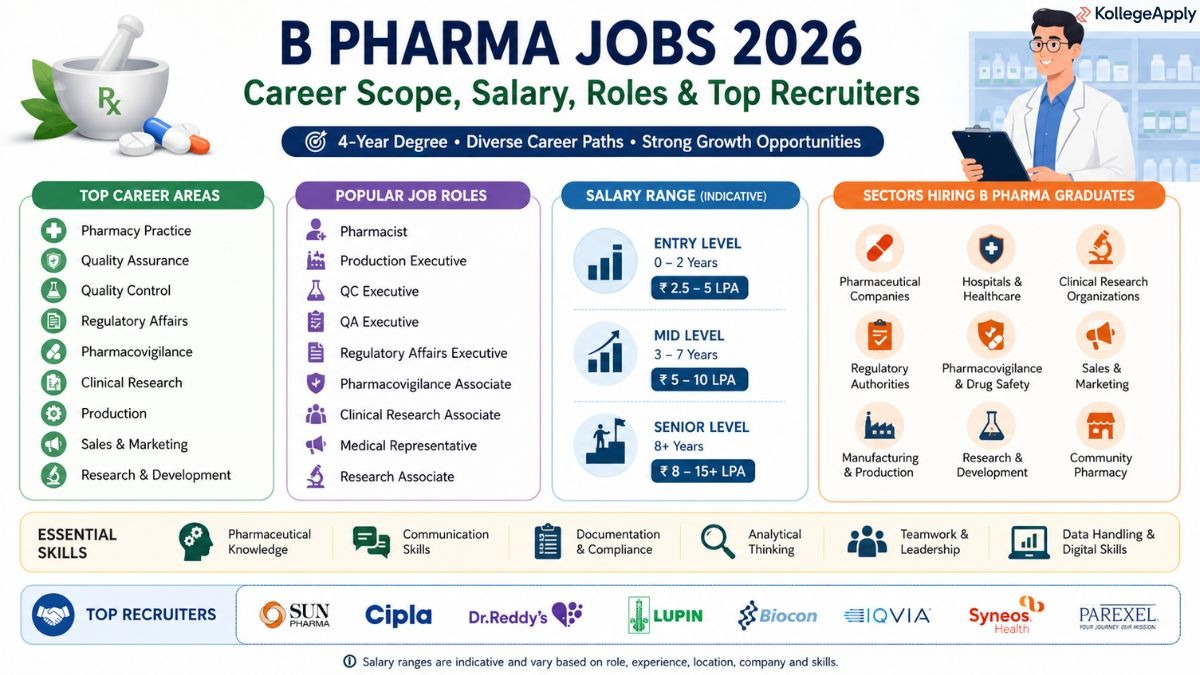
B Pharma career options are spread across several sectors rather than being limited to working as a pharmacist. Graduates can enter pharmaceutical companies, hospitals, contract research organisations, clinical research, drug safety, regulatory functions and sales. The table below provides a quick overview of the career landscape before exploring individual roles, salaries and progression opportunities.
Note: Salary ranges are indicative and vary according to role, employer, location, experience and skills.
What Are the Career Options After B Pharma?
B Pharma career options extend across patient care, pharmaceutical industry, research, drug safety, regulatory compliance and commercial functions. The degree is designed to prepare graduates for different parts of the medicine lifecycle, from formulation and manufacturing to quality testing, distribution and safe use.
The career path can be broadly divided into pharmacy practice and pharmaceutical-industry careers. A graduate interested in patient interaction may consider hospital or community pharmacy, subject to applicable pharmacist registration requirements. Those interested in laboratory work can explore quality control, quality assurance, production or analytical functions.
B Pharma graduates can also move into pharmacovigilance, clinical research and regulatory affairs, where work involves medicine safety, clinical-study documentation, regulatory submissions and compliance. These roles may be particularly suitable for graduates who prefer documentation, data analysis and corporate environments.
The degree also provides a foundation for higher studies and specialisation. M.Pharm can support deeper study in pharmaceutical disciplines, while management-oriented postgraduate education may be relevant to candidates targeting pharmaceutical marketing, administration or business roles. MCOPS, for example, describes B.Pharm career areas spanning industrial, hospital/community pharmacy and sales/distribution, with higher qualifications opening specialised industry areas.
Why Choose B Pharma as a Career?
B Pharma can be a suitable career choice for students interested in medicines and healthcare but who want options beyond conventional clinical practice. The degree combines pharmaceutical science with practical learning and can lead to careers across manufacturing, pharmacy, drug safety and regulatory functions.
- Diverse career options: Graduates can work in pharmacy, production, quality, regulatory affairs, pharmacovigilance and clinical research.
- Pharmaceutical industry exposure: The degree can lead to roles across the medicine manufacturing and quality lifecycle.
- Scope for specialisation: Graduates can develop expertise in areas such as regulatory affairs, drug safety, quality assurance or clinical research.
- Higher-study opportunities: M.Pharm and other postgraduate programmes can support specialised or managerial career paths.
- Entrepreneurship opportunities: Eligible graduates can explore pharmacy-related business opportunities subject to applicable registration and licensing requirements.
- International career pathways: Graduates interested in working abroad can explore country-specific qualification assessment and pharmacist licensing requirements.
Also checkout detailed article on: B Pharma Course
B Pharma Jobs by Specialisation
B Pharma jobs can be grouped according to the graduate's preferred work environment and skill set. Some roles are laboratory-oriented, while others involve documentation, patients, regulatory compliance or commercial activities. Understanding these career clusters helps students choose internships and additional skills more strategically.
B Pharma Jobs for Freshers
Freshers generally begin in junior or executive-level positions where they receive practical exposure to pharmaceutical processes, documentation, quality systems or customer-facing responsibilities. The first role can influence later specialisation, so students should consider the learning potential of a job along with the starting salary.
Note: Mentioned aboveIndicative ranges, actual salaries vary by employer, city, job description and candidate profile.
B Pharma Jobs and Salary
B Pharma salary depends on the job function, experience, organisation, location and additional qualifications. Fresh graduates typically enter executive or associate positions, while experienced professionals can move towards specialist and managerial responsibilities.
What Is the Salary After B Pharma?
There is no single fixed B Pharma salary because graduates enter different sectors and job functions. Salary progression is usually influenced by experience, technical expertise, location, company size, specialisation and postgraduate qualifications.
Which B Pharma Jobs Have Higher Salary Potential?
Higher salary potential is generally associated with specialised and senior positions rather than simply the B.Pharm qualification itself. Career paths such as regulatory affairs, clinical research, pharmacovigilance, quality management, pharmaceutical management and specialised research can offer progression into higher-responsibility positions.
An M.Pharm or relevant postgraduate qualification may also help graduates develop specialised expertise. MCOPS currently offers M.Pharm specialisations including Pharmaceutical Regulatory Affairs and Pharmacology, illustrating how postgraduate study can support deeper specialisation.
B Pharma Government Jobs
B Pharma government jobs can be available in government hospitals, public healthcare organisations, government pharmacies and other departments when recruitment notifications prescribe B.Pharm or a related pharmacy qualification.
The most recognisable pathway is the Pharmacist role, although eligibility, registration requirements, age limits, examinations and experience criteria vary by recruiting authority. Graduates should not assume that every government pharmacist vacancy accepts B.Pharm automatically; the official recruitment notification is the final authority. Possible recruitment channels include:
- State government health departments
- Government hospitals
- Central government healthcare organisations
- Public sector healthcare institutions
- Government medical colleges
- Public health programmes
- Drug-control and regulatory organisations, where the specific qualification and experience requirements are met
Important: Job eligibility for Drug Inspector, Government Analyst and similar regulatory posts should always be checked against the exact recruitment notification. A B.Pharm degree alone should not be presented as an automatic qualification for every such post.
B Pharma Pharmacist Jobs
Pharmacist is one of the most direct career options after B Pharma, but candidates must distinguish between holding the degree and being legally registered to practise as a pharmacist. PCI lists B.Pharm as a four-year approved pharmacy qualification and directs candidates to the relevant regulations for qualification and registration requirements. Registration is handled through the applicable State Pharmacy Council rather than simply being conferred by completing the degree. Pharmacist opportunities can exist in:
- Hospitals
- Community pharmacies
- Retail pharmacies
- Institutional pharmacies
- Healthcare organisations
- Pharmaceutical establishments where the role is applicable
B Pharma Jobs in Pharmaceutical Companies
The pharmaceutical industry offers some of the broadest B Pharma career options because graduates can participate in different stages of medicine development and commercialisation. MCOPS specifically describes industrial B.Pharm career opportunities in manufacturing, packaging, quality control and quality assurance. Common areas include:
- Manufacturing: Production executives support pharmaceutical manufacturing, packaging and process activities.
- Quality Control: QC professionals conduct or coordinate testing of raw materials, intermediates and finished products.
- Quality Assurance: QA professionals work with documentation, quality systems, compliance and process standards.
- Regulatory Affairs: Regulatory professionals support submissions, regulatory documentation and compliance requirements.
- Research and Development: Graduates with relevant skills or higher qualifications can explore formulation, analytical and research-oriented roles.
B Pharma Pharmacovigilance Jobs
Pharmacovigilance is a growing career area for pharmacy graduates interested in medicine safety and scientific documentation. Professionals may work on adverse-event case processing, safety databases, medical review support, safety reporting and related activities. Typical entry-level roles include:
- Pharmacovigilance Associate
- Drug Safety Associate
- Safety Data Associate
- Case Processing Associate
Graduates can improve their prospects by developing knowledge of adverse-event terminology, medical concepts, documentation standards and relevant safety processes.
B Pharma Regulatory Affairs Jobs
Regulatory affairs is suitable for graduates who enjoy pharmaceutical regulations, technical documentation and compliance. Regulatory professionals help pharmaceutical organisations prepare and maintain documents required for regulatory submissions and approvals. Experience in regulatory documentation, pharmaceutical legislation and submission processes can help graduates progress towards specialist and managerial positions. Common roles include:
- Regulatory Affairs Associate
- Regulatory Affairs Executive
- Regulatory Documentation Executive
- Regulatory Affairs Specialist
B Pharma Jobs in Clinical Research
Clinical research provides opportunities for B Pharma graduates interested in clinical studies, research documentation and healthcare data. Depending on the organisation and role, graduates may work with clinical trial documentation, study coordination, data management or site-level activities. Relevant experience, research skills and postgraduate qualifications can strengthen progression in this area. Possible job titles include:
- Clinical Research Associate
- Clinical Research Coordinator
- Clinical Trial Associate
- Clinical Data Associate
B Pharma Jobs in Sales and Marketing
Pharmaceutical sales and marketing is another career path for graduates with strong communication, persuasion and relationship-management skills. This pathway can be attractive for candidates who prefer client interaction and commercial responsibilities over laboratory work. The work may involve communicating product information to healthcare professionals, supporting distribution and achieving business targets. Typical roles include:
- Medical Representative
- Business Development Executive
- Product Executive
- Pharmaceutical Sales Executive
- Product Manager, with experience and relevant qualifications
Skills Required for B Pharma Jobs
Employers look beyond the B.Pharm degree when hiring for many pharmaceutical roles. Candidates who combine pharmaceutical knowledge with communication, analytical ability, documentation skills and digital proficiency can be better prepared for competitive entry-level positions.
How to Get a Job After B Pharma?
B Pharma graduates can improve their chances of getting hired by aligning their skills and internships with a specific career cluster. Rather than applying randomly to every pharmaceutical vacancy, candidates should identify whether they prefer pharmacy practice, laboratory work, documentation, research, sales or regulatory careers. A practical approach is:
- Choose a career area such as QA, QC, pharmacovigilance, regulatory affairs or clinical research.
- Build relevant technical knowledge through academic projects and practical learning.
- Complete internships in pharmaceutical companies, hospitals, laboratories or relevant organisations.
- Develop communication and documentation skills alongside technical knowledge.
- Prepare a role-specific CV highlighting projects, internships and relevant skills.
- Apply through company career pages and credible job portals.
- Prepare for technical and HR interviews based on the target job role.
- Continue skill development after joining the organisation.
Top Recruiters for B Pharma Graduates
B Pharma graduates can find employment across pharmaceutical, biotechnology, healthcare, clinical research and related industries. Recruiter availability differs by city, college, job profile and hiring cycle, so students should not interpret the names below as guaranteed campus recruiters.
B Pharma Jobs: Private vs Government Sector
Both sectors can offer career opportunities after B Pharma, but their recruitment processes and career structures differ. Private-sector roles often provide opportunities to specialise early in areas such as pharmacovigilance, regulatory affairs or quality, while government recruitment follows vacancy-specific eligibility and selection rules.
B Pharma Jobs FAQs
What are the best jobs after B Pharma?
B Pharma graduates can explore QA, QC, pharmacovigilance, regulatory affairs, clinical research, production, pharmacy and sales roles.
What is the salary after B Pharma?
B Pharma salary can start around INR 2.5–5 LPA and increase with experience, specialisation, employer and role.
Is B Pharma a good career in 2026?
Yes. B Pharma offers career opportunities in pharmacy, pharma manufacturing, quality, regulatory affairs, drug safety and research.
Can B Pharma graduates get government jobs?
Yes. B Pharma graduates can apply for eligible government posts, including pharmacist roles where the notification accepts their qualification.
Which B Pharma job has the highest salary?
Senior specialised and managerial roles can offer higher salaries, especially in regulatory, quality, research and pharmaceutical management.
Can I get a job after B Pharma without M Pharma?
Yes. B Pharma graduates can enter industry, pharmacy, sales, quality, regulatory and pharmacovigilance roles without an M.Pharm.
Can B Pharma graduates work in pharmacovigilance?
Yes. B Pharma graduates can enter pharmacovigilance as associates or drug-safety professionals after developing relevant skills.
Can B Pharma graduates work in regulatory affairs?
Yes. Regulatory affairs is a career option after B Pharma, particularly for graduates interested in documentation and compliance.
What can I do after B Pharma?
You can pursue B Pharma jobs, government recruitment, higher studies, pharmacy practice or relevant entrepreneurial opportunities.
Is B Pharma better than D Pharma for jobs?
B Pharma is a four-year degree with broader academic and career progression options than the two-year D Pharma diploma.