Bachelor of Pharmacy (B Pharm) is a four-year undergraduate degree programme focused on pharmaceutical sciences, medicines, drug formulation, pharmacology, pharmaceutics, pharmaceutical chemistry and pharmacy practice. The B Pharma course generally extends across eight semesters and combines classroom learning with laboratory work, practical training, projects and, depending on the institute, industrial or clinical exposure. The Pharmacy Council of India (PCI) regulations prescribe an eight-semester, four-academic-year structure for the B.Pharm programme.
For admission to a B Pharmacy course, candidates generally need to complete 10+2 with English, Physics, Chemistry and Mathematics and/or Biology, subject to the eligibility rules of the university or state admission authority. PCI's B.Pharm regulations specify PCM and/or PCB subjects at the 10+2 level. Minimum marks, entrance requirements and admission routes can differ across institutions. Some colleges use state-level entrance tests, some conduct their own entrance examinations, while others offer admission based on Class 12 merit.
After completing the B Pharm degree, graduates can explore opportunities in pharmaceutical manufacturing, quality assurance, quality control, pharmacovigilance, regulatory affairs, clinical research, hospital and community pharmacy, pharmaceutical sales, medical writing and related healthcare sectors. The average starting salaries often fall around INR 2.5–5 LPA, while specialised roles and experience can lead to higher compensation. Actual salary depends on role, employer, location, skills and experience.
- B Pharma Key Highlights
- What is a B Pharm course?
- Why Study B Pharm?
- Is B Pharma Worth It in 2026?
- B Pharma Eligibility Criteria
- B Pharma Entrance Exams 2026
- B Pharm Course Colleges in India
- B Pharma Admission Process 2026
- B Pharm Course Syllabus
- What Skills Are Required for B Pharma?
- B Pharm Job Opportunities in India
- What is the Salary After B Pharma?
- Top Recruiters for B Pharma
- Career Scope After B Pharma
- Can B Pharm Graduates Open a Pharmacy?
- B Pharma vs D Pharma
- B Pharma vs MBBS
- B Pharm FAQs
B Pharma Key Highlights
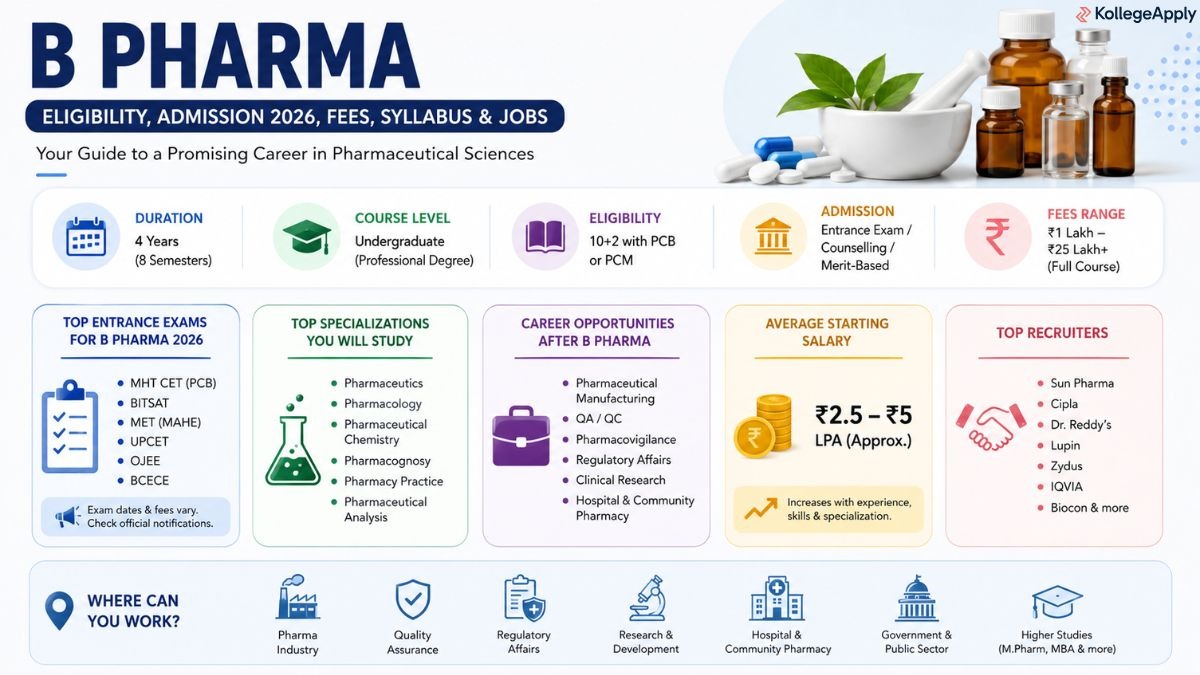
The B Pharma course is a professional undergraduate programme that combines pharmaceutical theory with laboratory and practical learning. The following table provides a quick overview of the B Pharm degree, including its duration, eligibility, admission routes, fees, career opportunities and salary expectations.
What is a B Pharm course?
Bachelor of Pharmacy (B Pharm/B.Pharm) is a four-year undergraduate degree that focuses on the science, development, manufacture, quality testing and safe use of medicines. The course is generally divided into eight semesters and combines theoretical learning with laboratory work, practicals and other industry-oriented training. Students study areas such as pharmaceutics, pharmacology, pharmaceutical chemistry, pharmacognosy, pharmaceutical analysis, medicinal chemistry and pharmacy practice.
The B Pharm course also introduces students to the practical and professional aspects of pharmacy through laboratory experiments, formulation analysis, quality-control procedures and, depending on the institute, internships or industrial exposure. The degree can lead to career opportunities in pharmaceutical manufacturing, quality assurance and control, pharmacovigilance, regulatory affairs, clinical research, hospital pharmacy and pharmaceutical sales, making it suitable for students interested in medicines and the pharmaceutical industry.
Why Study B Pharm?
B Pharma offers career options beyond traditional pharmacy practice. The degree combines pharmaceutical science with laboratory, manufacturing, healthcare and regulatory knowledge, allowing graduates to select career paths based on their interests and skills.
- Multiple Career Options: Graduates can work in pharmaceutical manufacturing, QA/QC, pharmacovigilance, regulatory affairs, clinical research, pharmacy practice, sales and medical writing.
- Growing Pharmaceutical Sector: The course provides a pathway into one of India's major healthcare and manufacturing sectors.
- Practical Skill Development: Laboratory work helps students develop formulation, analysis, documentation and quality-control skills.
- Specialised Career Paths: Graduates can move towards pharmacovigilance, regulatory affairs, clinical research, formulation development and other specialised areas.
- Higher Studies: Students can pursue M.Pharm, MBA in Pharmaceutical/Healthcare Management, Pharm.D pathways where eligible, or other relevant postgraduate programmes.
- Entrepreneurship: With appropriate registration and compliance, graduates can explore pharmacy and pharmaceutical business opportunities.
Is B Pharma Worth It in 2026?
B Pharma can be a worthwhile choice in 2026 for students who are genuinely interested in pharmaceutical sciences, medicines, drug development, healthcare and the pharma industry. The degree does not lead to only one job profile; graduates can move into manufacturing, quality, regulatory, drug safety, clinical research, pharmacy practice and other areas.
However, the value of a B Pharm degree depends significantly on the college, practical exposure, internships, technical skills, communication ability and career specialisation. A graduate entering a basic entry-level role may have a different salary trajectory from someone who develops expertise in regulatory affairs, pharmacovigilance, clinical research or specialised pharmaceutical operations.
The pharmaceutical sector is also becoming increasingly technology-driven. Digital documentation, data analysis, automation, advanced analytical instruments, AI-supported drug discovery, pharmacovigilance databases and technology-enabled clinical research are creating demand for professionals who combine pharmaceutical knowledge with digital and analytical skills. Therefore, B Pharma can offer good long-term scope when supported by relevant skills and, where required, higher education.
B Pharma Eligibility Criteria
The eligibility criteria for B Pharmacy vary slightly among universities, states and admission authorities. The PCI framework provides the academic foundation, while individual institutions may specify minimum marks, entrance requirements, reservation benefits and other conditions. Candidates generally need to meet the following requirements:
- Minimum Qualification: Passed 10+2 or an equivalent examination recognised by the relevant authority.
- Required Subjects: English, Physics, Chemistry and Mathematics and/or Biology.
- Required Marks: Minimum aggregate requirements vary by institution. Some colleges may require around 50%, while others may prescribe different thresholds.
- Entrance Examination: Candidates may need to qualify for a state-level CET, university entrance examination or institution-specific test.
- Merit-Based Admission: Some institutions may offer B.Pharm admission based on Class 12 marks.
- Reserved Categories: Eligible candidates may receive relaxation in minimum marks or other criteria according to applicable government and institutional rules.
- Age Limit: There is no single universal age criterion applicable to every B.Pharm admission route; candidates should check the relevant admission notification.
- Lateral Entry: PCI regulations recognise B.Pharm lateral entry to the third semester for candidates who have completed D.Pharm from a PCI-approved institution, subject to applicable rules.
B Pharma Entrance Exams 2026
There is no single national entrance examination mandatory for all B.Pharm colleges in India. Admission routes vary by institution and state. The following are examples of important 2026 routes and should be checked against the relevant official notification before applying. Some of the entrance exams are:
Does B Pharma Need NEET?
No, NEET-UG is not universally required for B.Pharm admission in India. Admission may be through a state CET, university entrance examination or Class 12 merit, depending on the college and state.
However, students should not assume that NEET is never accepted. Admission rules can be institution-specific. For example, DPSRU's previous programme information listed JEE Main/NEET/DPSRU Entrance for B.Pharm, while its 2026-27 notification states that diploma/UG admissions are on merit of the qualifying examination. Therefore, students should always check the current admission notification of their chosen institution.
B Pharm Course Colleges in India
The choice of a B Pharm college should be based on more than ranking alone. Students should compare PCI approval, curriculum, laboratories, faculty, practical training, internship opportunities, placement support, fees, location and admission route.
The following institutions are established pharmacy institutions that offer B.Pharm and appear in the NIRF 2025 Pharmacy ranking where applicable. NIRF ranking is shown specifically under the Pharmacy category to avoid mixing it with university, engineering or overall rankings.
B Pharma Fees in India
B Pharm fees vary significantly depending on whether the institution is government, aided, private or a premium private/deemed university. A broad estimate is INR 20,000 to INR 25 lakh or more for the full four-year programme, excluding hostel and personal expenses.
For example, Jamia Hamdard's 2026-27 prospectus lists INR 80,000 for the first and INR 8,00,000 for subsequent semesters for its B.Pharm programme. BITS Pilani lists INR 2,91,500 per semester for B.Pharm under its 2026-27 first-degree fee structure. Students should always check:
- Tuition fee
- Admission fee
- Examination fee
- Laboratory fee
- Hostel fee
- Mess charges
- Security deposit
- Internship/industrial training charges, if applicable
- Other university or student-service charges
B Pharma Admission Process 2026
B Pharmacy admission follows different routes depending on the institution. Some universities use entrance examinations, some use state-level counselling, and some offer merit-based admission. The step-wise process below represents the common pattern rather than a universal national procedure.
Step 1: Check B Pharma Eligibility - Check the Class 12 subjects, minimum marks, category relaxation and any additional conditions prescribed by the college or state admission authority.
Step 2: Select the Admission Route - Determine whether the college accepts:
- State-level CET
- University-level entrance examination
- BITSAT or another institutional test
- Class 12 merit
- Counselling-based admission
- A combination of entrance score and qualifying-exam marks
Step 3: Register for the Entrance Exam, If Applicable - Candidates applying through an entrance route should complete the relevant exam registration before the deadline. For example, MHT CET is used for B.Pharm admissions in Maharashtra, while BITSAT is used for B.Pharm admission at BITS.
Step 4: Fill the College Application Form - Some institutions require a separate application even after candidates have appeared for a state or national-level examination. Candidates should enter academic and personal details carefully.
Step 5: Appear for the Entrance Examination - If an entrance test is required, candidates must appear for the exam and obtain the required score or rank.
Step 6: Check Merit List or Rank - Institutions may prepare a merit list based on entrance scores, Class 12 marks or a combination of criteria.
Step 7: Participate in Counselling or Seat Allotment - Candidates may need to register for counselling and select their preferred colleges/courses. Seat allotment depends on merit, category, preferences and availability.
Step 8: Complete Document Verification - Candidates must submit or verify the required academic, identity and category documents.
Step 9: Pay Admission Fees - After receiving a confirmed seat, candidates must pay the prescribed admission or tuition fee within the specified deadline.
Step 10: Confirm Admission and Report to College - The final step is to complete admission formalities and report to the college as instructed.
Document Required
Note: Exact document requirements vary by institution and admission authority.
B Pharm Course Syllabus
The B Pharm syllabus covers pharmaceutical sciences from foundational subjects to advanced areas such as pharmacology, medicinal chemistry, pharmacovigilance, quality assurance, regulatory affairs and industrial pharmacy. The PCI curriculum provides the academic framework, while universities may vary in sequencing, electives and institutional components. For reference, Given below is the 4-year syllabus for B Pharm at DPSRU:
B Pharma 1st Year Syllabus
B Pharma 2nd Year Syllabus
B Pharma 3rd Year Syllabus
B Pharma 4th Year Syllabus
Note: The exact semester-wise subject names and sequencing can differ by university. Candidates should refer to the latest syllabus issued by their institution.
What Skills Are Required for B Pharma?
B Pharma requires a combination of scientific knowledge, laboratory ability, communication skills and professional discipline. Students who build both technical and transferable skills can improve their employability across pharmaceutical and healthcare sectors.
- Pharmaceutical Knowledge: Understanding drug formulation, pharmacology, pharmaceutical chemistry and pharmacy practice.
- Laboratory Skills: Ability to perform experiments, handle instruments and follow laboratory protocols.
- Analytical Thinking: Interpreting laboratory results, drug data, research findings and quality parameters.
- Attention to Detail: Important for quality control, documentation, formulation and regulatory work.
- Communication Skills: Useful for patient interaction, medical writing, sales, regulatory documentation and teamwork.
- Problem-Solving: Helps professionals identify formulation, quality, production and compliance issues.
- Digital Skills: Knowledge of spreadsheets, databases, documentation systems and digital research tools can support pharma careers.
- Regulatory Awareness: Understanding pharmaceutical regulations and compliance requirements is valuable for regulatory and quality roles.
- Teamwork: Pharmaceutical manufacturing, clinical research and drug development require collaboration across multiple functions.
- Time Management: Important for handling laboratory assignments, documentation, projects and industry deadlines.
B Pharm Job Opportunities in India
B Pharma graduates can explore both pharmacy-practice and pharmaceutical-industry roles. Career opportunities are available in pharmaceutical companies, hospitals, contract research organisations, healthcare companies, regulatory functions and related sectors.
Salary varies considerably according to the job profile, city, employer, experience and specialisation. The ranges below are indicative rather than guaranteed salaries.
Note: Salary ranges are indicative market estimates and should not be treated as guaranteed compensation.
What is the Salary After B Pharma?
The salary after B Pharma generally increases with experience, specialisation, employer and job responsibility. Fresh graduates may start in entry-level pharmaceutical, pharmacy, quality, sales or research-support positions, while experienced professionals can progress into specialist and managerial roles.
These figures are indicative. Professionals in specialised regulatory, quality, research, pharmacovigilance, medical affairs or management positions may earn more, while entry-level pharmacy and manufacturing roles can fall toward the lower end of the range.
Top Recruiters for B Pharma
B Pharma graduates can find employment across pharmaceutical manufacturing, healthcare, CROs, hospitals, regulatory services and life-sciences organisations. The recruiter lists should be treated as examples rather than placement guarantees. Individual colleges may have different campus recruiters and placement outcomes. Recruitment depends on the job role, location, academic background and current vacancies. Some of the recruiter examples along with their industry is given below:
Career Scope After B Pharma
A B Pharma degree offers career opportunities across the pharmaceutical, healthcare, research and regulatory sectors. Graduates can work in areas such as drug manufacturing, quality control, pharmacovigilance, regulatory affairs, clinical research and pharmacy practice. The choice of career path depends on a candidate’s interests, technical skills, registration requirements and the role-specific eligibility criteria set by employers or regulatory authorities.
B Pharm graduates can also strengthen their career prospects through higher education and specialised certifications. Popular options include M.Pharm, MBA in Pharmaceutical Management or Healthcare Management, postgraduate programmes in clinical research, regulatory affairs and pharmacovigilance, and relevant international postgraduate programmes. The major career options after B Pharma are given below:
- Pharmaceutical Manufacturing: Graduates can work in drug production, formulation, manufacturing operations, process management and related pharmaceutical functions.
- Quality Assurance and Quality Control: QA/QC professionals are involved in maintaining quality standards, conducting testing, reviewing documentation and ensuring compliance with pharmaceutical manufacturing requirements.
- Pharmacovigilance: This field focuses on drug safety, adverse-event reporting, safety data assessment and pharmacovigilance documentation. Graduates can work with pharmaceutical companies, CROs and healthcare organisations.
- Regulatory Affairs: Regulatory professionals handle documentation, submissions and compliance activities associated with the approval, registration and continued regulation of pharmaceutical products.
- Clinical Research: B Pharm graduates can pursue roles supporting clinical trials, clinical data, research documentation and trial operations. Additional training or postgraduate qualifications can be useful for specialised positions.
- Hospital and Community Pharmacy: Graduates can work in pharmacy practice involving dispensing, medication management, patient counselling and other professional pharmacy responsibilities. Registration requirements should be checked with the relevant State Pharmacy Council. B.Pharm is a recognised qualification for pharmacist registration subject to applicable statutory requirements.
- Government Jobs: B Pharm graduates may apply for government pharmacist, drug-control, public-sector pharmaceutical and other healthcare-related positions, provided they meet the eligibility, registration and recruitment requirements specified in individual notifications.
- Higher Studies: Graduates can pursue M.Pharm, MBA in Pharmaceutical Management or Healthcare Management, postgraduate programmes in clinical research, pharmacovigilance or regulatory affairs, and relevant master's programmes abroad. These options can help candidates specialise in a particular area and expand their career opportunities
Can B Pharm Graduates Open a Pharmacy?
A B.Pharm degree can provide the educational qualification required for pharmacist registration, but the degree alone should not be treated as an automatic pharmacy licence. Pharmacist registration is handled by the relevant State Pharmacy Council, and the pharmacy business must also comply with applicable drug-licensing and state requirements.
PCI states that B.Pharm is a recognised four-year pharmacy qualification and provides information on pharmacist registration through State Pharmacy Councils. Students planning to start a retail pharmacy should therefore verify the current requirements with the relevant State Pharmacy Council and drug-control authority.
B Pharma vs D Pharma
B.Pharm and D.Pharm are two different pathways to a career in pharmacy, with key differences in course duration, qualification level, curriculum depth, career opportunities and higher-study options. B.Pharm is a four-year undergraduate degree that provides broader exposure to pharmaceutical sciences, industry and research, while D.Pharm is a shorter diploma programme focused more on foundational pharmacy knowledge and practice. The choice between the two depends on whether a student prioritises broader career progression and higher education or an earlier entry into pharmacy practice.
Which is better, B.Pharma or D.Pharma? For students who want a broader degree-level qualification and more options for higher education and pharmaceutical-industry careers, B.Pharm is generally the stronger long-term academic route. D.Pharm may suit students looking for a shorter pharmacy qualification.
B Pharma vs MBBS
B.Pharm and MBBS are distinct healthcare qualifications with different academic curricula, professional responsibilities and career pathways. B.Pharm focuses on medicines, pharmaceutical sciences, drug development, manufacturing and pharmacy practice, whereas MBBS prepares students for medical diagnosis, treatment and direct patient care. The right choice depends on a student’s career goals, interest in medicines or clinical practice, preferred work environment and willingness to pursue further specialisation.
B Pharm FAQs
What is B Pharma?
B Pharma is a four-year undergraduate degree covering medicines, pharmaceutical sciences, drug formulation, pharmacology and pharmacy practice.
What is B Pharma duration?
B Pharma duration is four academic years, generally divided into eight semesters under the PCI framework.
Is BPharm a doctor?
No. A BPharm graduate is a pharmacist, not an MBBS medical doctor. B Pharma focuses on pharmaceutical sciences.
Is B Pharma better than MBBS?
Neither is universally better. B Pharma suits pharma careers, while MBBS is for students who want to become medical doctors.
Can PCB students do B Pharma?
Yes. PCB students can be eligible for B Pharma because Physics, Chemistry and Biology are accepted subjects under the PCI framework.
Can PCM students do B Pharma?
Yes. PCM students can also be eligible for B Pharma, subject to the admission rules of the chosen institution.
What is the salary after B Pharma?
B Pharma graduates may start around INR 2.5–5 LPA. Salary increases with experience, role, skills and specialisation.
Can B Pharm graduates open a pharmacy?
B Pharm can support pharmacist registration, but pharmacy operation also requires applicable State Pharmacy Council and drug-licensing compliance.
Can I open a pharmacy after B Pharm without D.Pharm?
Yes. B.Pharm is a recognised pharmacy qualification. A separate D.Pharm is not required, subject to State Pharmacy Council registration and drug-licensing rules.
Is B Pharm recognised globally?
B.Pharm can support higher studies abroad. Pharmacy practice requires country-specific qualification assessment, registration and licensing, which may include exams or additional training.
Can B Pharm graduates enter pharma IPR?
Yes. B.Pharm graduates can pursue pharmaceutical patent analysis and IPR roles. Additional training in patents, intellectual property or regulatory affairs can improve opportunities.
Can B Pharm graduates become Drug Inspectors or Government Analysts?
Yes, subject to the eligibility criteria of the relevant recruitment notification. Some posts require specific subjects, qualifications or work experience.