BBA in Finance and Accounting is a specialised undergraduate management program, focusing on financial management, accounting principles, taxation, auditing, banking, investment analysis, and business operations. The course is designed for the students who wish to build their careers in the finance, banking, accounting, insurance, taxation, and corporate sectors.
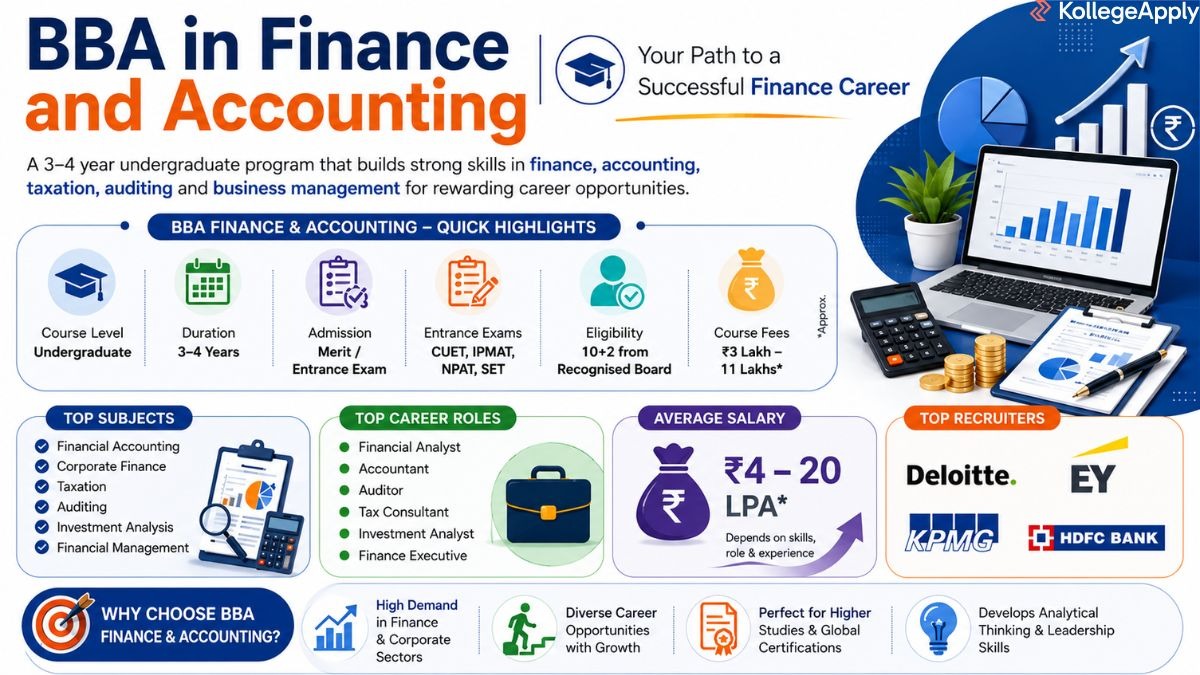
To pursue BBA Finance and Accounting, candidates must complete Class 12 from a recognised board with the required minimum marks. Admission is offered through merit-based selection or entrance exams such as CUET, IPMAT, NPAT, SET, and other university-level tests. The admission process generally includes application submission, entrance exam performance, counselling, and document verification.
After completing the course, graduates can explore various BBA Finance and Accounting Jobs in banking, corporate finance, auditing firms, fintech companies, and investment firms. The average BBA Finance and Accounting Salary packages range between INR 4 – 20 LPA, depending on the job roles, experience, sectors, and skills, etc.
- BBA Finance and Accounting Course Highlights
- What is BBA Finance and Accounting?
- Why Pursue BBA Finance and Accounting?
- Is BBA Finance and Accounting Worth It in 2026?
- BBA Finance and Accounting Eligibility Criteria
- BBA Finance and Accounting Entrance Exams
- BBA Finance and Accounting Colleges in India
- BBA Finance and Accounting Admission Process
- BBA Finance and Accounting Syllabus
- What Skills are required for BBA Finance and Accounting?
- BBA Finance and Accounting Jobs & Salary
- Top Recruiters for BBA Finance and Accounting
- BBA Finance and Accounting vs BCom Accounting and Finance
- BBA Finance and Accounting FAQs
BBA Finance and Accounting Course Highlights
BBA Finance and Accounting is among the most popular management specialisations for students interested in finance and business operations. The course combines management studies with specialised financial and accounting knowledge. Some of the important course details is mentioned in the highlights below:
What is BBA Finance and Accounting?
BBA Finance and Accounting is a 3-4 year undergraduate course that focuses on business management, accounting systems, financial planning, taxation, auditing, and investment management. The course is structured to provide students with strong business and financial knowledge that is essential in the corporate sector.
The curriculum covers several important BBA in accounting and finance subjects such as Financial Accounting, Corporate Finance, Business Economics, Cost Accounting, Taxation, Financial Management, Auditing, Investment Analysis, and Business Law. Students gain both theoretical and practical knowledge through projects, internships, case studies, presentations, and industrial exposure.
Students pursuing BBA Accounting and Finance develop analytical thinking, communication skills, leadership abilities, and decision-making capabilities. The course is suitable for students interested in careers in banking, financial consulting, taxation, auditing, investment management, and entrepreneurship.
Why Pursue BBA Finance and Accounting?
BBA Finance and Accounting offers strong career opportunities in the growing financial and corporate sectors. Students gain industry-relevant skills that help them build stable and rewarding careers. With increasing demand for skilled finance professionals, graduates enjoy strong career prospects, excellent salary growth, and opportunities for specialization in various domains. Some of the reasons to pursue this course are:
- High industry demand for finance and accounting professionals across sectors such as banking, taxation, auditing, insurance, consulting, fintech, and corporate organizations, ensuring stable and rewarding career opportunities.
- Diverse career opportunities in roles like Financial Analyst, Accountant, Tax Consultant, Auditor, Investment Analyst, Credit Analyst, and Finance Executive, with strong career growth and competitive starting salaries.
- A specialised and industry-oriented program that enhances employability compared to a general management degree by providing in-depth knowledge of financial management, accounting principles, taxation, auditing, and business analytics.
- Helps students develop analytical thinking, problem-solving abilities, managerial expertise, communication skills, and leadership qualities required for corporate and business environments.
- Excellent scope for higher education and professional certifications such as MBA, CA, CFA, CMA, ACCA, or CPA, which can further improve career opportunities, salary potential, and access to senior management roles.
Is BBA Finance and Accounting Worth It in 2026?
BBA in Finance and Accounting remains highly relevant in 2026 due to the increasing demand for finance professionals in banking, fintech, insurance, consulting and multinational companies. Businesses today require skilled professionals who can manage financial operations, taxation, budgeting, and investment planning efficiently.
Technological advancements such as digital banking, AI-driven financial systems, and fintech innovations have further increased the importance of finance education. Students with knowledge of accounting software, financial analysis, and business management are expected to have strong career prospects in the coming years.
The course also provides flexibility for higher studies and professional certifications. Graduates also pursue MBA finance, chartered accountancy, ACCA, CFA, CMA and other globally recognized finance qualifications for better career growth and salary opportunities.
BBA Finance and Accounting Eligibility Criteria
Candidates interested in BBA Finance and Accounting must fulfil the basic admission requirements set by universities and colleges. Eligibility conditions may differ slightly depending on the institution. The common eligibility requirement to fulfilled by the candidates are given below:
- Minimum Qualification: Candidates must pass Class 10+2 from a recognised board.
- Minimum Marks: Most colleges require minimum 50% aggregate marks.
- Reserved Category Relaxation: Relaxation may be provided to candidates belonging to the reserved category as per government norms.
- Stream: Any student (Science, Commerce, or Arts) can apply, there is normally no stream limitation.
- Entrance Exams: Some universities accept CUET, SET, NPAT, or IPMAT scores.
- Age Limit: Generally, there is no specific age limit for admission.
BBA Finance and Accounting Entrance Exams
Several national-level, state-level, and university-specific entrance exams are accepted for admission into BBA accounting and finance programs across India. Some universities offer direct admission based on class 12th merit, many reputed institutions conduct their own entrance tests or accept scores from popular management entrance examinations to shortlist eligible candidates for admission. Some of the major entrance exams are listed below along with their important details such as registration date, admission date and fees:
BBA Finance and Accounting Colleges in India
India has several reputed private and government institutions offering quality education in finance and accounting management. These colleges provide excellent academic exposure and placement opportunities. Some of the top BBA accounting and finance colleges along with their location and approximate total tuition fees are listed below:
BBA Finance and Accounting Admission Process
The admission process for BBA Finance and Accounting generally includes entrance exams, merit evaluation, counselling, and fee submission. Students should regularly check official college notifications for updates. For reference, the generic step-by-step admission process is given below:
- Step 1: Register online for entrance exams such as CUET, SET, NPAT, IPMAT, or other university-level exams accepted for BBA Finance and Accounting admission.
- Step 2: Fill out the application forms of your preferred colleges and universities with the required academic and personal details.
- Step 3: Upload necessary documents such as marksheets, photographs, signatures, identity proof, and entrance exam scorecards.
- Step 4: Colleges shortlist candidates based on entrance exam scores, Class 12 merit, and eligibility criteria.
- Step 5: Some institutes may conduct Group Discussions (GD) and Personal Interviews (PI) for final selection.
- Step 6: Universities release the final merit list of selected candidates for admission.
- Step 7: Selected students must complete document verification by submitting original academic and identification documents.
- Step 8: Candidates can confirm admission by paying the required course fees within the specified deadline.
Documents Required
BBA Finance and Accounting Syllabus
The BBA Finance and Accounting syllabus covers management fundamentals, accounting principles, financial analysis, taxation, auditing, and business operations. The curriculum is divided into six or eight semesters to ensure structured and progressive learning. Jain University follows a six semester-wise syllabus structure for the BBA Finance and Accounting program, as outlined below:
Note: Candidates are advised to visit the official websites of their respective colleges or universities to check the complete and updated syllabus for the MBA in Finance and Accounting program.
What Skills are required for BBA Finance and Accounting?
Students pursuing BBA Finance and Accounting need a combination of technical, analytical, and managerial skills to succeed in the corporate and finance industry. Some of the important skills are:
- Communication Skills: Important for presentations, client interaction, and teamwork
- Leadership Skills: Helps manage teams and business operations effectively
- Analytical Thinking: Essential for financial analysis and decision-making
- Problem-Solving Ability: Helps resolve financial and operational challenges
- Team Management: Important in corporate and project-based environments
- Technical Skills: Knowledge of accounting software and financial tools
- Strategic Thinking: Useful for business planning and financial management
- Time Management: Helps handle deadlines and multiple projects efficiently
- Decision-Making Skills: Important for finance and investment-related roles
- Attention to Detail: Necessary for accounting accuracy and auditing work
BBA Finance and Accounting Jobs & Salary
BBA Finance and Accounting graduates can explore opportunities in banking, accounting firms, insurance companies, investment firms, and multinational corporations. The top job title for the graduates along with the average salary range are given below:
Top Recruiters for BBA Finance and Accounting
Top recruiters actively hire BBA Finance and Accounting graduates for roles in finance, banking, auditing, taxation, investment analysis, consulting, and corporate accounting across diverse industries. Graduates are recruited by multinational companies, financial institutions, consulting firms, and leading banking organizations for entry-level and managerial positions. Some of the top recruiters along with their industry are listed in the table below:
BBA Finance and Accounting vs BCom Accounting and Finance
Both courses offer finance and accounting knowledge, but they differ in management focus, curriculum structure, and career pathways. For a clear understanding, the comparison between the BBA and BCom Accounting and Finance is highlighted below:
BBA Finance and Accounting FAQs
What is BBA Accounting and Finance?
BBA Finance and Accounting is an undergraduate management program that teaches finance, accounting, taxation, auditing, and business operations for careers in banking and corporate sectors.
What is the scope of BBA finance?
BBA Finance and Accounting offers strong career opportunities in banking, taxation, auditing, investment management, consulting, insurance, and fintech sectors with good salary growth.
Is BBA of 3 years or 4 years?
Most BBA Finance and Accounting programs in India are 3 years long, while some universities also offer 4-year honours or research-based degree programs.
Is BBA better or ACCA?
BBA Finance and Accounting focuses on management and finance fundamentals, whereas ACCA is a professional qualification specialised in global accounting and auditing.
What are the major in BBA accounting and finance subjects?
Major BBA in accounting and finance subjects include Financial Accounting, Taxation, Auditing, Financial Management, Investment Analysis, Economics, and Business Law.
Can I get banking jobs after BBA Finance and Accounting?
Yes, BBA Finance and Accounting graduates can work in banking operations, customer relationship management, financial analysis, credit management, and loan processing roles.
What is the average BBA Finance and Accounting Salary?
The average BBA Finance and Accounting Salary for freshers ranges between INR 3–6 LPA, while experienced professionals can earn significantly higher packages.
Which entrance exams are accepted for BBA Finance and Accounting?
Popular entrance exams accepted for BBA Finance and Accounting admission include CUET, SET, NPAT, IPMAT, and several university-level management entrance tests.
Can I pursue MBA after BBA Finance and Accounting?
Yes, students often pursue MBA Finance, PGDM, CFA, ACCA, CA, or CMA after completing BBA Finance and Accounting for better career opportunities.
Is mathematics compulsory for BBA Finance and Accounting?
Mathematics is preferred by many colleges for BBA Finance and Accounting admission, but several universities also accept students from all academic streams.