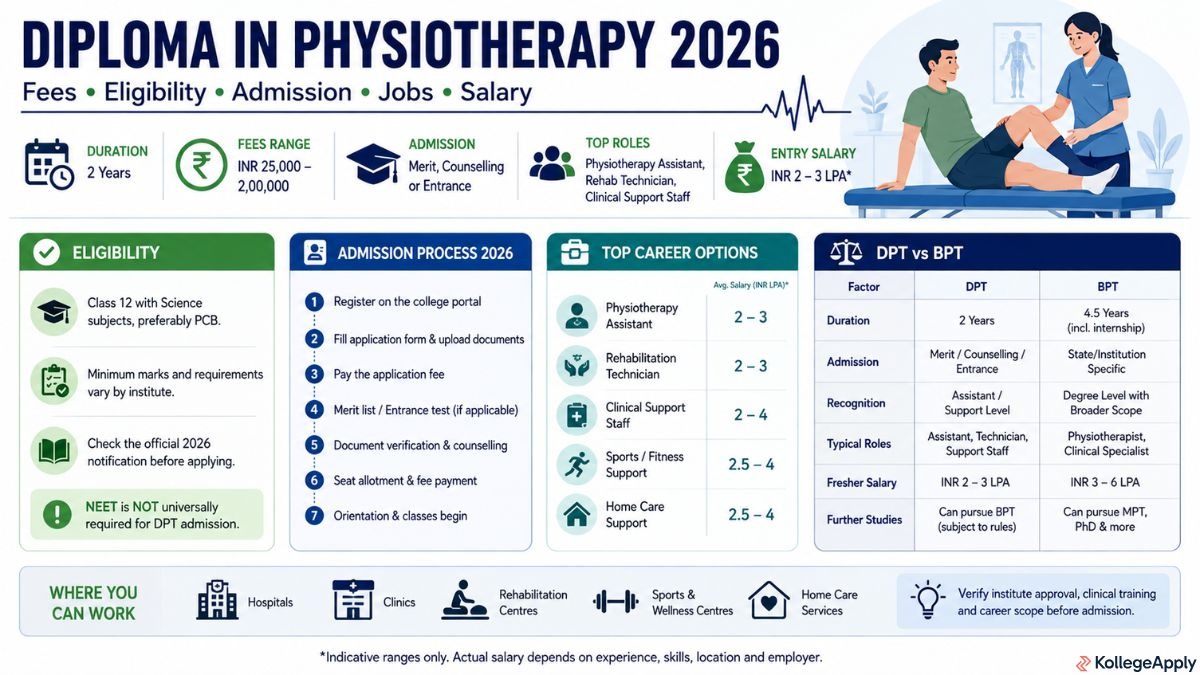
Diploma in Physiotherapy is a diploma-level healthcare programme that introduces students to human anatomy, physiology, exercise therapy, electrotherapy, rehabilitation and patient mobility. The course is generally completed in 2 years, although practical training or internship requirements may extend the total training period at some institutes.
Admission requirements are not uniform across India. Depending on the institute or state, students may be selected through merit, counselling or an entrance process. A science background is commonly preferred or required, but the exact subjects and minimum marks vary. NEET is not a universal requirement for Diploma in Physiotherapy admission.
Diploma in Physiotherapy fees typically range from INR 25,000 to INR 2,00,000 for the full course, depending on the institute. Freshers can expect a starting salary of roughly INR 2 LPA to 3 LPA, rising to INR 4–6 LPA with a few years of experience and specialisation. Graduates work as physiotherapy assistants, rehabilitation technicians, and clinical support staff in hospitals, clinics, and sports and fitness facilities. Some graduates may pursue further study, including BPT where they meet the eligibility requirements, or relevant skill-based certifications.
- DPT Course Highlights
- What is DPT?
- Is DPT Worth It in 2026?
- Why Study a DPT?
- DPT Eligibility Criteria
- Is NEET Required for DPT?
- DPT Colleges in India
- DPT Fees
- DPT Admission Process 2026
- DPT Syllabus
- What Can You Do After a DPT?
- DPT Job Opportunities in India
- DPT Salary in India
- DPT vs BPT: Which Should You Choose?
- DPT FAQs
DPT Course Highlights
The following table summarises the key details students usually check before applying for a Diploma in Physiotherapy. Since this course is offered under different institutional and state frameworks, details such as eligibility, admission method, internship and certification can vary. Candidates should therefore use the table as a general overview rather than a substitute for the admission notification of the college they intend to join:
What is DPT?
DPT stands for Diploma in Physiotherapy, is a healthcare diploma that provides foundational training in movement, rehabilitation, therapeutic exercises and physical recovery. Students learn how the human body functions and how physiotherapy techniques are used to support mobility and rehabilitation in different clinical settings.
The course commonly covers anatomy, physiology, kinesiology or biomechanics, exercise therapy, electrotherapy and rehabilitation. Practical training is an important part of the programme because physiotherapy-related work requires patient interaction and supervised application of therapeutic techniques.
The exact title can differ between institutions. Some colleges use Diploma in Physiotherapy, while others use terms such as Diploma in Physiotherapy Technique or Diploma in Physiotherapy Technician. Students should check the exact qualification name and awarding body before admission.
Is DPT Worth It in 2026?
Diploma in Physiotherapy can be worth considering in 2026 for students who want a shorter entry route into the rehabilitation and allied-health sector and are comfortable beginning with support-oriented or entry-level roles. Its main advantage is the shorter duration compared with BPT, while its limitation is that the academic and professional scope can be narrower.
Students should choose the diploma after checking three things: the institute's affiliation/approval, the clinical training offered and the professional scope of the qualification in the relevant state or employer setting. A recognised programme with meaningful hospital exposure is generally more valuable than a course selected only because it has a low fee.
For students aiming for a broader long-term physiotherapy career, BPT may be the stronger option because it provides degree-level education and more extensive professional training.
Why Study a DPT?
A diploma in Physiotherapy after 12th opens up a wide range of job prospects in the healthcare industry. It can be useful for students interested in rehabilitation, orthopaedic care, sports support, elderly care and wellness services. It may also provide a pathway toward further education, depending on the eligibility rules of the next programme. Students should assess the course based on clinical exposure, certification, affordability and future study opportunities rather than salary claims alone. Here are the main reasons why pursuing this diploma can be beneficial:
- Shorter Course Duration: Offers a shorter route into the physiotherapy and rehabilitation field compared with a BPT degree.
- Early Clinical Exposure: Introduces students to basic physiotherapy, rehabilitation practices and patient-care concepts at an early stage.
- Practical Skill Development: Provides hands-on learning in exercise therapy, therapeutic techniques and basic rehabilitation procedures.
- Diverse Career Opportunities: Opens opportunities in hospitals, physiotherapy clinics, rehabilitation centres and other healthcare settings.
- Scope for Further Education: Provides a foundation for pursuing relevant higher education, advanced training or specialised courses.
- Relevant for Allied Healthcare Aspirants: Suitable for students interested in physiotherapy, rehabilitation, patient care and allied healthcare careers.
DPT Eligibility Criteria
Diploma in Physiotherapy eligibility is not identical across all colleges. Many institutes ask candidates to complete Class 12 or an equivalent qualification, while Science subjects and minimum marks may be specified by individual institutions.
Before applying for Diploma in Physiotherapy admission 2026, candidates should check the official notification for their selected college. Important factors include the required Class 12 subjects, minimum marks, age requirement, domicile conditions, entrance examination and counselling process. Common requirements may include:
- Many colleges require Class 12 with Science subjects, particularly PCB, while minimum marks may range according to the institution. Understanding physiological concepts in physiotherapy requires a scientific background.
- In the 12th grade, a minimum aggregate of 50% is usually required. However, the exact percentage may vary by institute.
- The required subject combination for eligibility is Biology, Physics, and Chemistry. Some universities may also require candidates to have a rudimentary understanding of mathematics before pursuing the course.
Is NEET Required for DPT?
No, NEET is not universally required for Diploma in Physiotherapy admission. Admission depends on the college and state. Some institutions use merit or direct counselling, while others may use an institutional or state-level entrance process.
For example, NIMT's current DPT information refers to the UP Combined Paramedical Admission Test (UPCPAT), while other institutes have their own admission procedures. Therefore, students looking for physiotherapy without NEET should check the admission notification of each college rather than assuming that all DPT courses follow one examination system.
DPT Colleges in India
Diploma in Physiotherapy seats are more limited than BPT seats, and the diploma is offered by a smaller, more specific set of institutes, mostly government medical universities and their affiliated paramedical colleges, alongside a handful of private paramedical institutes. The table below lists colleges that are documented as offering Physiotherapy diplomas specifically, so verify current fees and seat availability directly with each institute before applying, as these change every admission cycle.
Note: Course availability, intake, fees and admission status can change. Always verify the current 2026 admission notification and awarding/affiliating body before applying.
DPT Fees
Diploma in Physiotherapy fees vary substantially because the programme is offered by government universities, private institutions and different allied-health training institutes. The total cost can include tuition, examination, registration, practical training, internship and other institutional charges.
For example, KGMU's current paramedical fee page lists a Diploma in Physiotherapy fee of INR 48,000 under its published fee structure, while private institutes can charge considerably more. Therefore, the article should not present INR 20,000–1.5 lakh as a universal national fee range. Students should compare the total payable fee, not just tuition. Hostel, examination, registration, clinical training and other charges may be billed separately.
DPT Admission Process 2026
Diploma in Physiotherapy admission 2026 varies by institute and state. Colleges may use Class 12 merit, counselling, an entrance examination or an institute-level selection process. Candidates should follow the admission notification of their preferred institute. Below is a general step-by-step outline that applies to most government and private colleges offering the diploma in physiotherapy admission 2026 cycle; always cross-check the specific steps and dates on your target university's website, since some private institutes add a short interview or aptitude round.
- Register online on the university/college admission portal with your basic personal and academic details.
- Fill out the application form, including educational history and any category certificates, and upload required documents.
- Submit the application along with the prescribed fee before the deadline.
- Merit list/shortlisting: most colleges rank candidates by Class 12 PCB percentage; a few private institutes may hold a short entrance test or interview.
- Document verification and counselling, where shortlisted candidates confirm eligibility and seat category.
- Seat allotment and fee payment to confirm admission.
- Orientation, where the college shares the semester schedule, hostel details (if applicable), and fee structure.
Required Documents:
DPT Syllabus
DPT Course is intended to provide a solid foundation in physiotherapy, covering both theoretical concepts and practical application in clinical settings. Given below is the Diploma in Physiotherapy syllabus followed at Jyoti College of Management Science and Technology.
What Can You Do After a DPT?
After completing a Diploma in Physiotherapy, graduates can explore entry-level opportunities in hospitals, physiotherapy clinics, rehabilitation centres and other healthcare settings, depending on the course and employer requirements. They may work in patient-support and rehabilitation roles or pursue further education to expand their career options. Additional skill-based certifications in rehabilitation, fitness or wellness can also help build relevant practical skills.
DPT Job Opportunities in India
Graduates with DPT can work in a variety of healthcare settings. These positions provide several job opportunities in the healthcare, sports, and rehabilitation sectors. The table below lists some of the most prevalent Physiotherapy career opportunities for students, along with job descriptions and compensation packages.
The following are the top job possibilities in India for Diploma in Physiotherapy graduates, according to job portals statistics.
DPT Salary in India
Diploma in Physiotherapy salary depends on qualification, job title, experience, location, employer and clinical skills. It is better to avoid quoting a high “average DPT salary” as a guaranteed figure because salary databases generally combine different physiotherapy qualifications and job titles.
Current salary data for physiotherapists in India provides a useful broader market benchmark, but it should not be presented as the guaranteed salary of every Diploma in Physiotherapy graduate. Job portal's May 2026 data reports an average physiotherapist salary of about INR 19,644 per month in India, while salary estimates vary by location and experience. For DPT graduates entering assistant or support roles, a more conservative expectation is appropriate.
Note: These are indicative ranges, not guaranteed salaries for all DPT graduates. Location, employer, qualification, experience and professional eligibility can significantly affect earnings.
DPT vs BPT: Which Should You Choose?
Since many students weigh the diploma against a full Bachelor of Physiotherapy before deciding, it helps to see the two side by side. The comparison below focuses on the factors that actually affect your career, duration, recognition, and independence of practice, rather than just fees.
DPT FAQs
What is the DPT physiotherapy full form?
DPT commonly means Diploma in Physiotherapy in India, though some institutes use it for Diploma in Physiotherapy Technique.
How many years is DPT?
Diploma in Physiotherapy is a 2-year, full-time paramedical diploma at most institutes in India, combining classroom study with clinical training.
Is NEET required for Diploma in Physiotherapy?
No. NEET is not universally required; admission in DPT depends on the college and state.
Can I do physiotherapy without NEET?
Yes. Several diploma programmes admit students without NEET through merit, counselling or institute-level processes.
Is Diploma in Physiotherapy a doctor?
No. A DPT holder is not an MBBS doctor. Physiotherapy is a separate allied healthcare field.
Can I do Diploma in Physiotherapy after 12th?
Yes, Many colleges admit Class 12 students, with Science subjects, particularly PCB, while minimum marks may range according to the institution. Candidates should check the official admission notification before applying.
What is Diploma in Physiotherapy salary in India?
Entry-level DPT-related roles may pay about INR 2–3 LPA, depending on location, employer and role.
What are Diploma in Physiotherapy fees?
DPT fees vary widely by institute. Roughly INR 25,000 to INR 2,00,000 for the full 2-year course, depending on whether the institute is government or private.
Is Diploma in Physiotherapy better than BPT?
BPT is generally better for a long-term physiotherapy career, while the diploma offers a shorter entry route.
Does a Diploma in Physiotherapy certificate have value?
DPT Certificate value depends on the awarding body, affiliation, current approval and applicable professional requirements.
Can I pursue BPT after a Diploma in Physiotherapy?
Some universities allow lateral entry into BPT after a diploma, but policies vary — check directly with your target university.