MD Radiology, also known as MD Radiodiagnosis, is a 3-year postgraduate medical degree after MBBS that focuses on diagnostic imaging and image-guided procedures. The curriculum covers conventional radiography, ultrasound, CT, MRI and other imaging modalities, along with radiological anatomy, pathology, radiation safety, research, clinical decision-making and interventional radiology. The National Medical Commission (NMC) recognises MD Radiodiagnosis as a postgraduate broad-speciality programme.
Admission to MD Radiology in India is primarily through NEET PG for participating medical colleges and through INI-CET for Institutes of National Importance such as AIIMS and PGIMER. Candidates generally need an MBBS degree, medical registration and completion of the required one-year internship by the applicable cut-off date. NEET PG is the single eligibility-cum-ranking examination for MD/MS/PG Diploma admissions, while INI-CET is used for PG admissions at participating INIs.
The cost of MD Radiology varies substantially by institution. Government medical colleges and central institutes generally have much lower tuition fees, whereas deemed and private medical universities can charge several tens of lakhs or more for the full programme. Candidates should verify the latest official fee and seat matrix for the specific counselling year rather than relying on a single nationwide fee figure.
- MD in Radiology Course Highlights
- What is MD Radiology?
- What is the MD Radiology Course Duration?
- Why Study MD in Radiology/Radio-Diagnosis?
- MD in Radiology Eligibility Criteria
- MD in Radiology Entrance Exams
- Top Colleges for MD Radiology in India
- NEET-PG Cutoff for MD Radiology 2026: Is Your Rank Good Enough?
- MD in Radiology Syllabus
- MD Radiology Admission Process 2026
- Documents Required for MD Radiology Admission 2026
- MD Radiology Jobs and Salary
- MD Radiology Duration: Quick Comparison
- MD vs DNB Radiology: Which Is Better?
- MD in Radiology FAQs
MD in Radiology Course Highlights
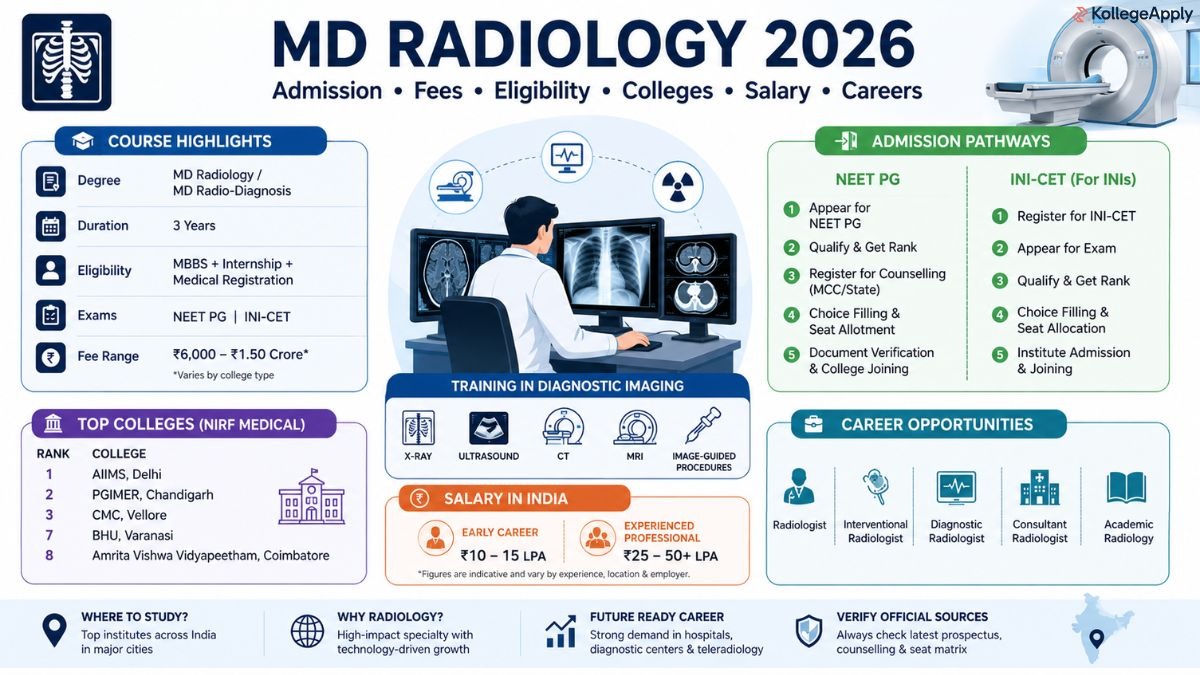
Before applying for MD Radiology, candidates should understand the course structure, admission route, duration, fees, training areas and career opportunities. The programme is a three-year postgraduate medical degree after MBBS, with admission primarily based on NEET-PG for participating institutions and INI-CET for eligible Institutes of National Importance. The key course details are summarised below for quick reference.
These details provide a starting point for comparing Radiodiagnosis course with other postgraduate medical specialisations. However, fees, seat availability, admission rules and salary can differ considerably across institutions and admission years.
What is MD Radiology?
What is radiology? Radiology is a branch of medicine that uses medical imaging techniques to diagnose, monitor and sometimes guide the treatment of diseases and injuries.
MD Radiology is a three-year postgraduate clinical specialisation in which doctors are trained to interpret medical images and use imaging techniques to identify, characterise and monitor various diseases and injuries.
The programme may be listed under different names by medical institutions, including MD Radiodiagnosis, MD Radio-Diagnosis, MD Radio Diagnosis or MD Radiology. While “MD Radiology” is commonly used as a broader search term, MD Radiodiagnosis is the more institutionally specific terminology used by many medical colleges in India.
During the three-year residency, students receive supervised clinical training in various imaging modalities and radiological interpretation. The curriculum covers areas such as chest radiology, neuroradiology, gastrointestinal radiology, urology, cardiovascular imaging, musculoskeletal imaging, interventional radiology, emergency radiology, paediatric radiology and women's imaging.
What is the MD Radiology Course Duration?
The MD Radiology course duration is 3 years after MBBS. The NMC postgraduate regulations prescribe three years for broad-speciality postgraduate degree courses after MBBS. The programme is residency-based and combines:
- Classroom and theoretical teaching
- Clinical postings
- Image interpretation
- Case discussions
- Seminars and journal clubs
- Practical and procedural training
- Research and thesis work
- Internal assessments
- Final postgraduate examinations
Why Study MD in Radiology/Radio-Diagnosis?
MD Radiology can be a suitable postgraduate option for MBBS graduates who enjoy diagnostic reasoning, anatomy, medical imaging and technology-driven clinical practice. Unlike some specialisations where patient interaction is the primary focus, radiology combines image interpretation with clinical decision-making and collaboration with multiple medical and surgical departments.
The field also offers several directions for further professional development. After MD Radiology, doctors can build careers in diagnostic imaging, pursue focused training in areas such as neuroradiology or breast imaging, enter interventional radiology pathways where eligible, or work in academic and research settings. Key reasons students consider MD Radiology include:
- MD Radiology can offer key positions within interdisciplinary medical teams.
- It equips students with the ongoing developments in imaging methods and the integration of AI.
- There is an increasing demand for radiologists globally in the healthcare sector, which opens doors for several career opportunities with attractive salary packages.
- Offers a chance to focus on various specialities such as interventional radiology or neuroradiology.
- Increased opportunities to work at higher positions in government/private hospitals, diagnostic facilities, or research organizations.
MD in Radiology Eligibility Criteria
Eligibility for MD Radiology depends on the admission route and the rules prescribed for the relevant examination and counselling authority. For most colleges covered under the NEET-PG system, candidates must have an MBBS qualification, meet the internship requirement and hold the required medical registration. Candidates targeting participating Institutes of National Importance generally need to follow the separate INI-CET eligibility and admission requirements.
Before applying, students should check the latest examination information bulletin because internship cut-off dates, registration requirements and other eligibility conditions are tied to the specific admission session. The basic eligibility requirements generally include:
- Completed MBBS from an institution recognised by the National Medical Commission (NMC).
- Completed a 1-year compulsory rotatory internship, or on track to complete it by the cut-off date specified in that year's NEET-PG/INI-CET bulletin.
- Qualified NEET-PG or INI-CET, as applicable to the target institute.
- Holds a valid (permanent or provisional) NMC/State Medical Council registration.
NBEMS states that candidates appearing for NEET PG must possess a recognised MBBS qualification, appropriate registration and have completed or be due to complete the one-year internship by the prescribed cut-off date, subject to the information bulletin for that admission session.
Is NEET PG Required for MD Radiology?
Yes, NEET PG is the primary entrance examination for MD Radiology admissions in medical colleges covered by the NEET PG system. Candidates seeking MD/MS/PG Diploma seats through this route must qualify NEET PG and participate in the applicable counselling process. For AIIMS and other participating Institutes of National Importance, candidates generally enter the MD Radiology programme through INI-CET, not through NEET PG.
MD in Radiology Entrance Exams
The entrance examination for MD Radiology depends primarily on the type of institution a candidate is targeting. NEET-PG is the main national-level route for MD/MS and PG Diploma admissions across participating government, private, deemed and other eligible medical institutions. On the other hand, INI-CET is used for postgraduate admissions at participating Institutes of National Importance.
Therefore, candidates should identify their preferred colleges before deciding which admission route to follow. A student targeting AIIMS and other participating INIs needs to pay attention to the INI-CET schedule, while candidates applying to colleges under the NEET-PG counselling framework need to track NEET-PG and the relevant counselling authority.
Top Colleges for MD Radiology in India
There are several well-regarded institutions in India offering MD Radio-Diagnosis (MD Radiology), ranging from highly subsidised government institutions to private and deemed universities with significantly higher programme costs. For example, the total tuition fee for the course can range from a few thousand rupees at institutions such as AIIMS to over INR 1 crore at some private medical colleges. Therefore, while NIRF ranking can help candidates assess an institution's overall standing in the Medical category, course fees, seat availability, admission route, stipend and clinical exposure should also be considered before making a choice.
The table below lists selected institutions offering MD Radiology/Radio-Diagnosis, along with their NIRF Medical Ranking 2025 and indicative total tuition fees. Fees may vary depending on the admission category, quota and academic year, so candidates should verify the latest fee structure with the respective institution before applying.
Note: Fees are indicative and may include tuition or institution-specific charges depending on the source. Candidates should verify the latest official fee structure before admission.
For students comparing the cost of this postgraduate programme, our detailed MD Radiology Fees in India guide covers government and private college fees, fee ranges, additional charges.
NEET-PG Cutoff for MD Radiology 2026: Is Your Rank Good Enough?
MD Radiology is among the most competitive postgraduate medical specialisations, so the closing rank can vary substantially by college, category, quota and counselling round. Government institutions and highly preferred colleges generally close at much stronger ranks than many private institutions.
Want college-wise closing ranks, category-wise trends and expected 2026 cutoff? See our detailed MD Radiology NEET PG Cutoff 2026 guide.
MD Radiology Fees
The MD Radiology fees can vary significantly across colleges in India depending on the type of institution, admission quota, seat category and applicable university charges. Government medical colleges and central institutes generally have lower tuition fees, while private and deemed universities may charge substantially higher amounts for the same Radiodiagnosis course.
For students planning to pursue the radiology doctor degree after MBBS, the total cost should not be assessed from tuition fees alone. Hostel, examination, university, security and other institutional charges can also contribute to the overall expenditure. In addition, the stipend offered during residency can differ from one college to another. Before selecting an MD Radiology college, candidates should compare:
- Tuition fee and total course fee
- Government, private or deemed university status
- Admission quota and seat category
- Hostel and accommodation charges
- University, examination and other institutional fees
- Monthly stipend during the MD Radiology residency
- Clinical workload and patient volume
- Availability of CT, MRI, ultrasound and other imaging facilities
- Exposure to interventional radiology and image-guided procedures
Note: Since fees can change between admission cycles, candidates should check the latest official fee notification or counselling documents of the concerned college before making a decision.
MD in Radiology Syllabus
The MD Radiology syllabus combines academic teaching with residency-based clinical training in diagnostic imaging. Students learn the principles behind different imaging modalities and gradually develop the ability to interpret images in relation to clinical presentations.
The exact sequence and subject names may differ between institutions, but the broad areas remain similar. Training generally progresses from foundational concepts such as radiological anatomy, radiation physics and imaging techniques to system-wise imaging, emergency radiology, paediatric imaging, breast imaging, neuroimaging and interventional radiology. For reference, the syllabus for the MD Radiology/Radio-Diagnosis course of Kasturba Medical College is mentioned below:
MD Radiology Admission Process 2026
Admission to MD Radiology/MD Radio-Diagnosis primarily takes place through two routes: NEET PG for eligible medical colleges covered under the NEET PG counselling framework and INI-CET for participating Institutes of National Importance. Here is the process can be broadly understood in five stages:
Admission Through NEET PG
- Register and Appear for NEET PG - Complete the NEET PG application on the official NBEMS portal and appear for the examination.
- Obtain a Qualifying Rank - Check the result and qualifying status. Your NEET PG rank will determine your eligibility and competitiveness during counselling.
- Register for Counselling - Apply for the appropriate counselling process, such as MCC counselling for eligible seats under its jurisdiction or counselling conducted by the relevant state authority.
- Fill Choices and Participate in Seat Allotment - Select and prioritise your preferred colleges and MD Radio-Diagnosis/MD Radiology seats. Allotment is based on factors such as rank, eligibility, category, preferences and seat availability.
- Report to the Allotted College - After receiving a seat, complete the required fee payment, document verification and institutional admission formalities within the specified deadline before joining the residency programme.
Admission Through INI-CET
- Register and Apply for INI-CET - Complete the registration and application process according to the schedule and eligibility requirements mentioned in the session-specific prospectus.
- Appear for the Examination - Download the admit card and appear for INI-CET on the scheduled examination date.
- Obtain a Qualifying Rank - Check the result and rank after the declaration of INI-CET results. Eligible candidates can then participate in the seat allocation process.
- Fill Preferences and Participate in Seat Allocation - Select your preferred participating institutes and available MD Radio-Diagnosis seats. Allocation depends on rank, eligibility, category, preferences and seat availability.
- Accept the Seat and Complete Admission - Candidates allotted a seat must complete the required acceptance, document verification, fee payment and institute-level admission formalities within the prescribed timeline.
Important: MD Radiology seat availability can vary by institution and admission session. Candidates should always check the latest NEET PG counselling seat matrix or session-specific INI-CET prospectus before filling their choices.
Documents Required for MD Radiology Admission 2026
Candidates allotted an MD Radiology/MD Radio-Diagnosis seat through NEET PG or INI-CET are generally required to submit documents for counselling verification and institute-level admission. The exact requirements may vary depending on the counselling authority and medical college. The Commonly Required Documents are:
- NEET PG or INI-CET admit card, as applicable
- NEET PG or INI-CET result/rank card
- MBBS degree certificate or provisional degree certificate
- MBBS marksheets or academic records, if required by the institute
- Internship completion certificate, as applicable
- Permanent or provisional medical registration certificate
- Valid government-issued photo ID proof
- Date of birth proof
- Recent passport-size photographs
- Allotment letter issued during the counselling or seat allocation process
- Category or reservation certificate, if applicable
- PwD certificate, if applicable
- NOC or sponsorship certificate, where applicable
- Any additional documents specified by the counselling authority or allotted medical college
Important: Candidates should check the latest counselling information bulletin and institute-specific admission instructions before reporting. Document requirements, formats and verification procedures may differ for NEET PG, MCC counselling, state counselling and INI-CET admissions.
MD Radiology Jobs and Salary
An MD Radiology qualification can lead to careers across hospitals, diagnostic centres, medical colleges, imaging facilities, teleradiology services and private practice. The nature of work can differ significantly depending on whether a radiologist works in a teaching hospital, diagnostic centre, corporate hospital or independent practice.
Early-career doctors may begin in diagnostic or hospital-based roles, while experience can open opportunities for consultant positions, academic careers, subspecialty-focused work and private practice. The earning potential also changes with experience, location, workload, employer and the type of imaging services handled.
MD Radiology Salary in India 2026
The salary of an MD Radiologist in India does not follow a single fixed pay scale. Fresh graduates entering salaried roles may earn around INR 10–15 LPA, while compensation can increase substantially with clinical experience, subspecialty expertise and higher reporting volumes.
Experienced radiologists, consultant radiologists and doctors with established private or teleradiology practice may earn INR 20–50 LPA or more. However, these figures should be treated as indicative ranges rather than guaranteed salaries, as earnings can differ widely across cities, hospitals and employment models.
Factors Affecting MD Radiology Salary
The earning potential of an MD Radiology graduate may depend on:
- Years of clinical experience
- City and geographic location
- Government or private-sector employment
- Hospital or diagnostic centre
- Subspecialty expertise, such as neuroradiology or interventional radiology
- Number and complexity of imaging studies reported
- Full-time, part-time or teleradiology work
- Private practice and professional reputation
For a detailed breakdown of MD Radiology salary in India, including salary ranges by experience, job profile and employment sector, candidates can refer to our MD Radiology Salary in India guide.
MD Radiology Duration: Quick Comparison
The MD Radiology course duration is 3 years after MBBS, with training combining academic learning, clinical residency and practical exposure to diagnostic imaging. However, candidates may also consider related qualifications such as DNB Radiology, fellowships and super-speciality programmes depending on their career goals. Comparing these pathways can help medical graduates understand the difference in training duration, level of specialisation and career focus. The table below provides a quick overview of these options.
A fellowship or super-speciality should not be presented as part of the standard MD Radiology course. MD Radiology provides broad postgraduate training, after which doctors may pursue further focused training.
MD vs DNB Radiology: Which Is Better?
This is one of the most common questions aspirants search, and the honest answer is: they are officially equivalent, and the better choice depends on your rank, budget, and career goals — not on one degree being objectively superior.
MD in Radiology FAQs
What is MD in Radiology?
MD Radiology is a 3-year postgraduate degree after MBBS that trains doctors in diagnostic imaging and image-guided procedures.
Is MD Radiology the same as MD Radiodiagnosis?
Yes. MD Radiology, MD Radiodiagnosis and MD Radio-Diagnosis may refer to the same postgraduate speciality, depending on the institution.
Is MD Radiology hard?
Yes. The course requires strong knowledge of anatomy, pathology and imaging, along with regular image interpretation and clinical training.
What is the salary of an MD Radiologist in India?
MD Radiology salary can vary by experience, location and employer. Early-career roles may offer around INR 10–15 LPA.
What is the MD Radiology course duration?
The MD Radiology course duration is 3 years after MBBS, combining academic teaching, clinical residency, practical training and research.
Is NEET PG compulsory for MD Radiology?
NEET PG is the main admission route for participating colleges. AIIMS and other eligible INIs generally use INI-CET for MD Radiology admission.
How many MD Radiology seats are there in AIIMS Delhi?
AIIMS Delhi MD Radiology seats can vary by admission session. Check the latest INI-CET prospectus and seat matrix for the current number.
Which is better, DNB or MD Radiology?
Both qualifications are recognised as equivalent. Compare the institute, clinical exposure, fees, workload and career goals before choosing between them.
Can MD Radiologists work in interventional radiology?
MD Radiology provides exposure to interventional radiology. Advanced interventional practice may require additional specialised training, depending on the pathway.
Is MD Radiology worth it in 2026?
MD Radiology can be a strong option for doctors interested in imaging and technology. Compare fees, training quality, exposure and career goals before deciding.