
IIT Delhi is expected to conduct JEE Advanced 2027 under the Joint Admission Board (JAB) rotation. The Joint Admission Board has not officially announced the organising institute as of 23 October 2026, so the choice rests on the rotation that has held without a break since 2014: IIT Delhi last organised the exam in 2020, and every one of the seven zonal IITs has organised it once since then, ending with IIT Roorkee in 2026.
IIT Roorkee's 2026 cycle had 1,87,389 registered candidates, 1,79,694 who appeared in both papers and 56,880 who qualified (31.65%), the highest qualifying rate in eight years.
JEE Advanced 2027: Overview
| Detail | JEE Advanced 2027 |
| Expected organising IIT | IIT Delhi (by rotation; official announcement pending) |
| Supervising body | Joint Admission Board (JAB) |
| Previous organiser | IIT Roorkee (JEE Advanced 2026) |
| IIT Delhi's last cycle | JEE Advanced 2020 |
| Eligible pool | Top 2,50,000 candidates of JEE Main 2027, across categories |
| Participating institutes | 23 IITs, IISc Bengaluru, 5 IISERs, IIST, RGIPT and IIPE |
| Official website | jeeadv.ac.in |
| 2026 exam date (reference) | 17 May 2026 |
- JEE Advanced Organising Institute: The Seven-IIT Rotation
- Which IIT Will Conduct JEE Advanced 2027?
- JEE Advanced Organising IIT Year-wise: Candidates and Qualifiers (2019–2026)
- Does the Organising IIT Affect JEE Advanced Difficulty or Cutoff?
- Organising IIT vs JAB: Who Decides What in JEE Advanced
- JEE Advanced 2027 Exam Date: Expected Timeline
- JEE Advanced 2026 Schedule (Reference for 2027)
- JEE Advanced 2027 Eligibility Criteria
- JEE Advanced Exam Pattern: What to Expect in 2027
- JEE Advanced 2026 Result Highlights
- From Qualifying to an IIT Seat: JoSAA Numbers
- Which IIT Will Conduct JEE Advanced 2027 FAQs
JEE Advanced Organising Institute: The Seven-IIT Rotation
Only the seven zonal IITs organise JEE Advanced, each taking a turn once every seven years. The sequence since 2014 has been Kharagpur, Bombay, Guwahati, Madras, Kanpur, Roorkee and Delhi, repeating in the same order.
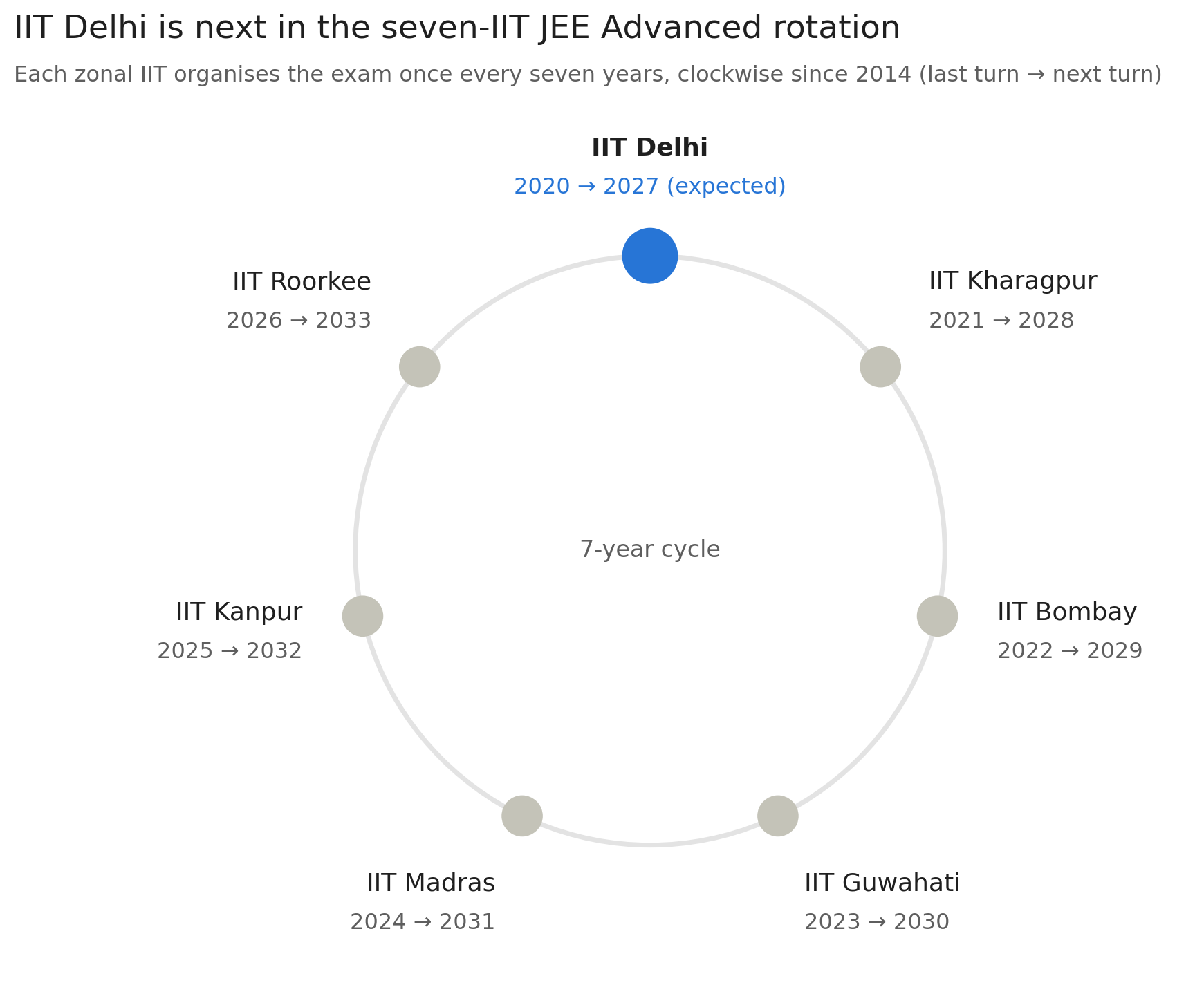
| Zonal IIT | Years organised (JEE Advanced) | Next turn by rotation |
| IIT Delhi | 2013, 2020 | 2027 |
| IIT Kharagpur | 2014, 2021 | 2028 |
| IIT Bombay | 2015, 2022 | 2029 |
| IIT Guwahati | 2016, 2023 | 2030 |
| IIT Madras | 2017, 2024 | 2031 |
| IIT Kanpur | 2018, 2025 | 2032 |
| IIT Roorkee | 2019, 2026 | 2033 |
The organising IIT runs registration, the admit card, the exam, the answer keys and the result, and publishes a Joint Implementation Committee (JIC) report on the cycle at jeeadv.ac.in.
Which IIT Will Conduct JEE Advanced 2027?
By the rotation, IIT Delhi is next: it follows IIT Roorkee in the sequence, exactly as it did in 2020 after Roorkee organised the 2019 exam. IIT Delhi has organised JEE Advanced twice, in 2013 and 2020, and also conducted IIT-JEE 2012.
| Cycle | Organiser | Gap since previous turn |
| JEE Advanced 2013 | IIT Delhi | — |
| JEE Advanced 2020 | IIT Delhi | 7 years |
| JEE Advanced 2027 (expected) | IIT Delhi | 7 years |
IIT Delhi's 2020 cycle was held on 27 September 2020, later than usual because of the COVID-19 pandemic. In that cycle, 1,50,838 candidates appeared in both papers and 43,204 qualified (28.64%). Admission and course details are on our IIT Delhi college page.
JEE Advanced Organising IIT Year-wise: Candidates and Qualifiers (2019–2026)
The table lists every organising IIT of the current rotation with the official candidate numbers from each cycle's JIC report and result release.
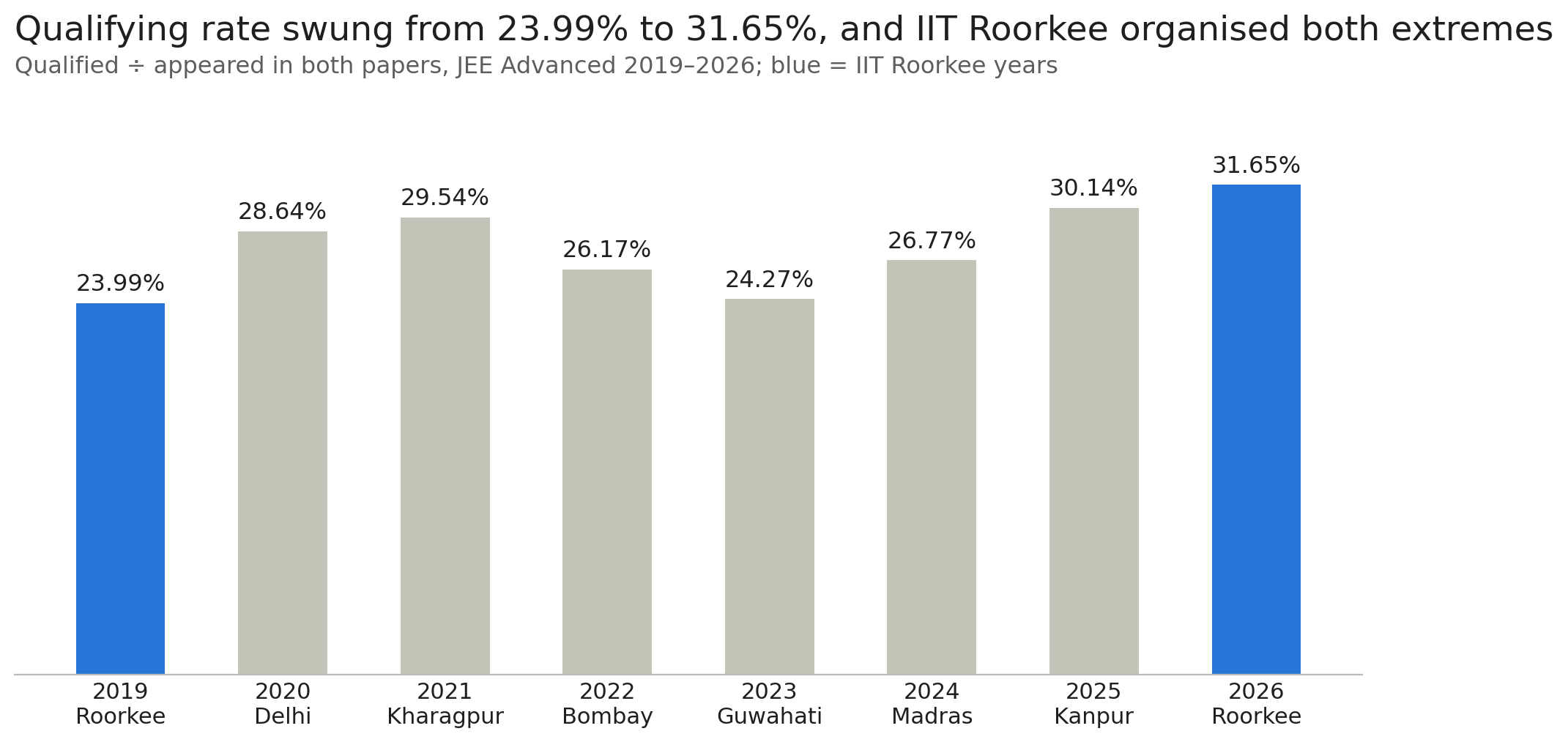
| Year | Organising IIT | Appeared (both papers) | Qualified | Qualifying rate |
| 2026 | IIT Roorkee | 1,79,694 | 56,880 | 31.65% |
| 2025 | IIT Kanpur | 1,80,422 | 54,378 | 30.14% |
| 2024 | IIT Madras | 1,80,200 | 48,248 | 26.77% |
| 2023 | IIT Guwahati | 1,80,372 | 43,769 | 24.27% |
| 2022 | IIT Bombay | 1,55,538 | 40,712 | 26.17% |
| 2021 | IIT Kharagpur | 1,41,699 | 41,862 | 29.54% |
| 2020 | IIT Delhi | 1,50,838 | 43,204 | 28.64% |
| 2019 | IIT Roorkee | 1,61,319 | 38,705 | 23.99% |
The 2023 qualified figure appears as 43,773 in some reports. Qualifying rate = qualified ÷ appeared.
The number of qualifiers grew 47.0% from 2019 to 2026 (38,705 to 56,880), while the number who appeared grew 11.4% (1,61,319 to 1,79,694). In 2026, 10,107 of the 56,880 qualifiers (17.8%) were women.
Does the Organising IIT Affect JEE Advanced Difficulty or Cutoff?
The organising IIT does not decide the difficulty on its own, and the data shows no pattern by host. IIT Roorkee organised both the cycle with the lowest qualifying rate in this period (23.99% in 2019) and the one with the highest (31.65% in 2026).
| Measure | Lowest | Highest |
| Qualifying rate, 2019–2026 | 23.99% (2019, IIT Roorkee) | 31.65% (2026, IIT Roorkee) |
| Candidates appeared, 2019–2026 | 1,41,699 (2021, IIT Kharagpur) | 1,80,422 (2025, IIT Kanpur) |
| Candidates qualified, 2019–2026 | 38,705 (2019, IIT Roorkee) | 56,880 (2026, IIT Roorkee) |
Qualifying cut-offs follow JAB rules, not the host's choice. The JIC report for 2025 states that the qualifying criteria were relaxed so that at least twice as many candidates qualified as there were seats in each category; the aggregate cut-off for the common rank list that year was 20.56%. Category-wise closing ranks are on our JEE Advanced cutoff 2025 page.
Organising IIT vs JAB: Who Decides What in JEE Advanced
The organising IIT runs the exam, while the rules on eligibility, qualifying and seat allocation are set above it. This split is why the host shows no measurable effect on the qualifying rate across the 2019–2026 cycles.
| Decision | Who decides | Example from the 2025–2026 cycles |
| Exam date and schedule | Organising IIT, through the information brochure | IIT Roorkee held the exam on 17 May 2026 |
| Registration, admit card, answer keys and result | Organising IIT | IIT Roorkee declared the result on 1 June 2026 |
| Eligibility rules (age, attempts, Class 12 year) | Joint Admission Board | Two attempts in consecutive years, retained for 2026 |
| Qualifying cut-offs | Joint Admission Board criteria | 2025: relaxed so at least twice the seats qualified; CRL aggregate cut-off 20.56% |
| Seat allocation to IITs | JoSAA | Counselling began on 2 June 2026, a day after the result |
JEE Advanced 2027 Exam Date: Expected Timeline
The organising IIT announces the schedule in the information brochure. The two most recent cycles were held on the third Sunday of May, 15 days before the result.
| Event | JEE Advanced 2025 (IIT Kanpur) | JEE Advanced 2026 (IIT Roorkee) | JEE Advanced 2027 |
| Exam date | 18 May 2025 | 17 May 2026 | Not announced |
| Result date | 2 June 2025 | 1 June 2026 | Not announced |
| Exam to result | 15 days | 15 days | — |
JEE Advanced 2026 Schedule (Reference for 2027)
The complete 2026 schedule shows how the cycle runs from registration to JoSAA, a span of 39 days from the opening of registration for JEE Main qualified candidates to the result.
| Event | Date |
| Registration (foreign nationals) | 6 April to 2 May 2026 |
| Registration (JEE Main qualified candidates) | 23 April to 2 May 2026 |
| Admit card | 11 May 2026 |
| Exam (Paper 1 and Paper 2) | 17 May 2026 |
| Candidate response sheets | 21 May 2026 |
| Provisional answer key | 25 May 2026 |
| Objection window | 25 to 26 May 2026 |
| Final answer key and result | 1 June 2026 |
| JoSAA counselling begins | 2 June 2026 |
Registration for 2027 is expected after the JEE Main 2027 results; the process is explained on our JEE Advanced 2027 registration page.
JEE Advanced 2027 Eligibility Criteria
The 2027 information brochure has not been released. The official 2026 criteria moved every date one year forward from 2025, when the age cut-off was 1 October 2000; the right-hand column applies the same one-year shift to 2027.
| Criterion | JEE Advanced 2026 (official) | JEE Advanced 2027 (if the pattern holds) |
| JEE Main rank | Top 2,50,000 in JEE Main 2026 Paper 1, across categories | Top 2,50,000 in JEE Main 2027 Paper 1 |
| Age, General, OBC-NCL and EWS | Born on or after 1 October 2001 | Born on or after 1 October 2002 |
| Age, SC, ST and PwD | Born on or after 1 October 1996 | Born on or after 1 October 1997 |
| Attempts | Maximum 2, in consecutive years | Maximum 2, in consecutive years |
| First appearance in Class 12 | 2025 or 2026, with Physics, Chemistry and Mathematics | 2026 or 2027, with Physics, Chemistry and Mathematics |
Under the 2026 rules, candidates who first appeared in Class 12 in 2024 or earlier were not eligible, whatever their JEE Main rank.
How the Top 2,50,000 JEE Main Candidates Split by Category
NTA fills the 2,50,000 JEE Advanced places category by category, setting a separate JEE Main cut-off for each. In 2026, the five main categories took 2,45,791 places and the remainder went to PwD candidates.
| Category | JEE Main 2026 cut-off (percentile) | Candidates made eligible |
| General (UR) | 93.4123549 | 96,873 |
| OBC-NCL | 80.9232583 | 67,597 |
| SC | 63.9172792 | 37,522 |
| Gen-EWS | 82.4164528 | 25,009 |
| ST | 52.0174712 | 18,790 |
Not every eligible candidate registers. In 2026, 1,87,389 registered, about 75% of the 2,50,000 places; in 2025, 1,87,223 of 2,50,236 eligible candidates registered (74.8%). The JEE Main stage is covered on our JEE Main exam page, and category quotas on our JEE Main reservation criteria page.
JEE Advanced Exam Pattern: What to Expect in 2027
JEE Advanced has two compulsory papers on the same day, each covering all three subjects. The number of questions, question types and marking scheme are not announced in advance and have changed from year to year, so only the fixed elements are listed.
| Element | JEE Advanced 2026 |
| Mode | Computer-based test |
| Papers | Paper 1 and Paper 2, both compulsory |
| Duration | 3 hours per paper |
| Subjects in each paper | Physics, Chemistry and Mathematics |
| Medium | English and Hindi |
| Maximum marks (both papers) | 360 |
Top scores show how demanding the paper is. AIR 1 scored 330 out of 360 (91.7%) in 2026 and 332 out of 360 (92.2%) in 2025, while the top female candidate in 2026 scored 280 (77.8%).
JEE Advanced 2026 Result Highlights
IIT Roorkee declared the 2026 result on 1 June 2026, 15 days after the exam. The top three ranks all came from the IIT Delhi zone.
| Measure | JEE Advanced 2026 |
| Registered | 1,87,389 |
| Appeared in both papers | 1,79,694 (95.9% of registered) |
| Qualified | 56,880 |
| Women qualified | 10,107 |
| AIR 1 | Shubham Kumar, IIT Delhi zone, 330 out of 360 |
| AIR 2 | Kabeer Chhillar, IIT Delhi zone, 329 out of 360 |
| AIR 3 | Jatin Chahar, IIT Delhi zone, 319 out of 360 |
| Top female candidate | Arohi Deshpande, IIT Delhi zone, CRL 77, 280 out of 360 |
Compared with 2025 (54,378 qualified out of 1,80,422), 2,502 more candidates qualified in 2026 even though 728 fewer appeared. Full exam details are on our JEE Advanced exam page.
From Qualifying to an IIT Seat: JoSAA Numbers
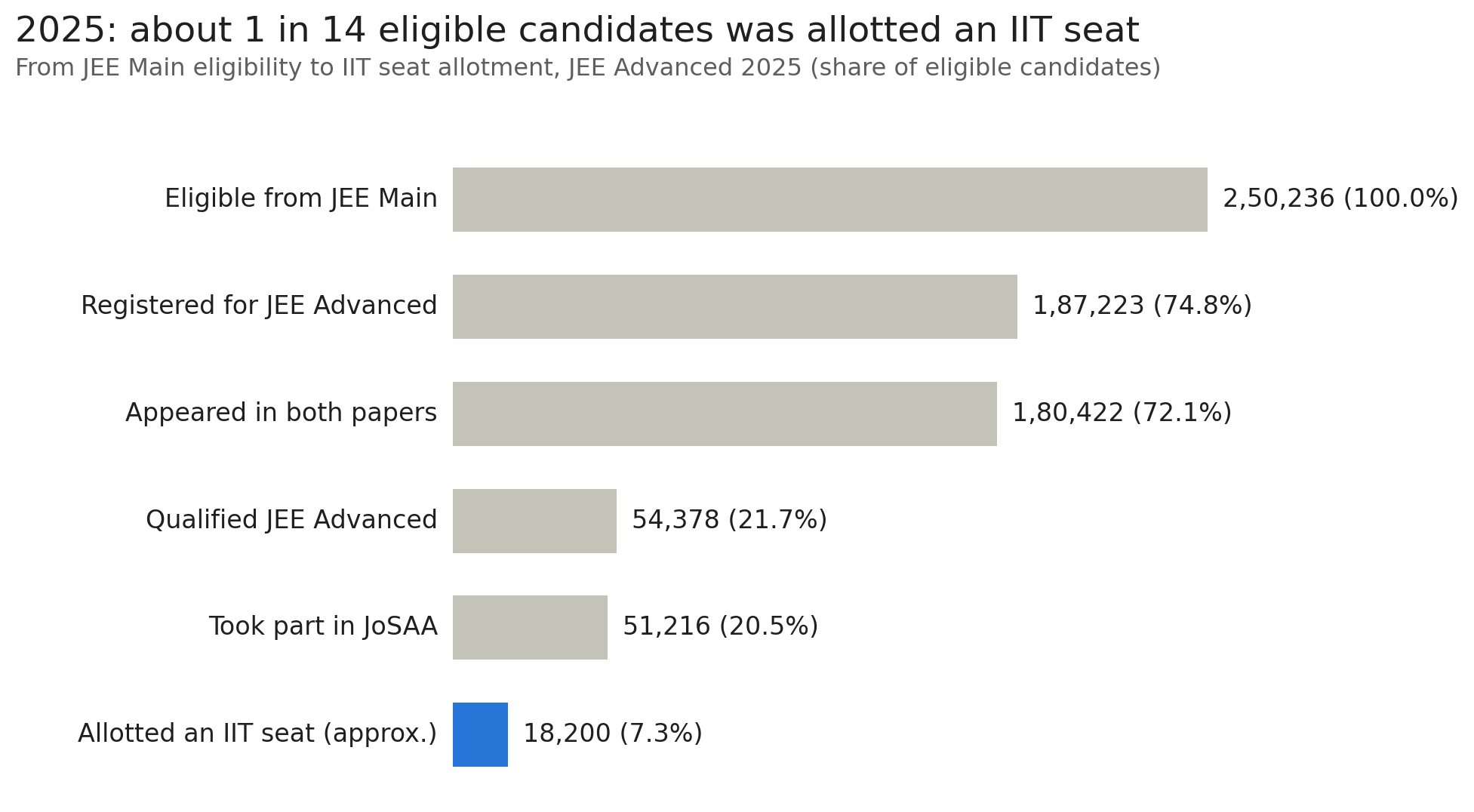
Qualifying JEE Advanced makes a candidate eligible for IIT seats through JoSAA counselling, but about one in three qualifiers was allotted an IIT seat in 2025. The JIC report for 2025 gives the participation figures.
| Measure | 2025 cycle |
| Candidates who qualified JEE Advanced | 54,378 |
| Qualified candidates who took part in JoSAA | 51,216 (94.2%) |
| Choices filled by those candidates | 73,28,847 (143 per candidate on average) |
| Choices filled by all JoSAA candidates | 3,33,98,917 |
| IIT seats allotted | About 18,200 (reported figures range from 18,160 to 18,188) |
| Share of qualifiers allotted an IIT seat | About 33% |
IIT Delhi B.Tech Closing Ranks (General Category)
Organising the exam has no bearing on admission to IIT Delhi itself: its seats are filled through JoSAA by JEE Advanced rank, like every other IIT. General-category closing ranks for four core branches:
| Branch | 2022 | 2023 | 2024 |
| Computer Science and Engineering | 102 | 118 | 116 |
| Electrical Engineering | 574 | 582 | 625 |
| Mechanical Engineering | 1,882 | 1,791 | 1,782 |
| Civil Engineering | 4,316 | 4,472 | 4,169 |
Computer Science closed at 125 in 2025, 23 ranks later than its 2022 closing rank of 102. Branch-wise seats and fees are on our IIT Delhi Btech page.
Which IIT Will Conduct JEE Advanced 2027 FAQs
These answers cover the most-searched questions on the 2027 organising IIT and exam date, using official figures from the 2019–2026 cycles.
Which IIT will conduct JEE Advanced 2027?
IIT Delhi is expected to conduct JEE Advanced 2027, as it follows IIT Roorkee (2026) in the seven-IIT rotation. JAB has not officially announced the organising institute as of 23 October 2026.
What is the JEE Advanced 2027 exam date?
It has not been announced. The 2025 and 2026 exams were held on 18 May 2025 and 17 May 2026, with results 15 days later on 2 June 2025 and 1 June 2026.
When did IIT Delhi last conduct JEE Advanced?
In 2020, when the exam was held on 27 September 2020. Of the 1,50,838 candidates who appeared in both papers, 43,204 qualified (28.64%). IIT Delhi also organised JEE Advanced 2013.
Does the organising IIT make JEE Advanced tougher?
The data shows no link. IIT Roorkee organised both the 2019 cycle, with the lowest qualifying rate of 2019–2026 (23.99%), and the 2026 cycle, with the highest (31.65%). Qualifying cut-offs follow JAB rules.
Which IIT will conduct JEE Advanced 2028?
By the rotation, IIT Kharagpur, which organised the exam in 2014 and 2021 after IIT Delhi's turns in 2013 and 2020.
How many candidates qualify for JEE Advanced?
In 2026, 56,880 of 1,79,694 candidates who appeared in both papers qualified (31.65%). Only the top 2,50,000 candidates of JEE Main are eligible to register.
Who is eligible for JEE Advanced 2027?
The 2027 criteria are not yet published. If the 2026 rules move forward one year, as they did from 2025 to 2026, candidates must rank in the top 2,50,000 of JEE Main 2027, have first appeared in Class 12 in 2026 or 2027 with Physics, Chemistry and Mathematics, and be born on or after 1 October 2002 (1 October 1997 for SC, ST and PwD candidates).
How many attempts are allowed in JEE Advanced?
Two, and they must be in consecutive years. The rule was retained for JEE Advanced 2026.
What percentage of JEE Advanced qualifiers get an IIT seat?
About 33% in 2025. Of 54,378 qualifiers, 51,216 took part in JoSAA counselling, and about 18,200 IIT seats were allotted.


