BTech in AI and ML is a 4-year undergraduate engineering programme that combines computer science with artificial intelligence, machine learning, data analysis and intelligent computing. The course covers areas such as programming, data structures, probability and statistics, machine learning, deep learning, natural language processing and computer vision, depending on the university.
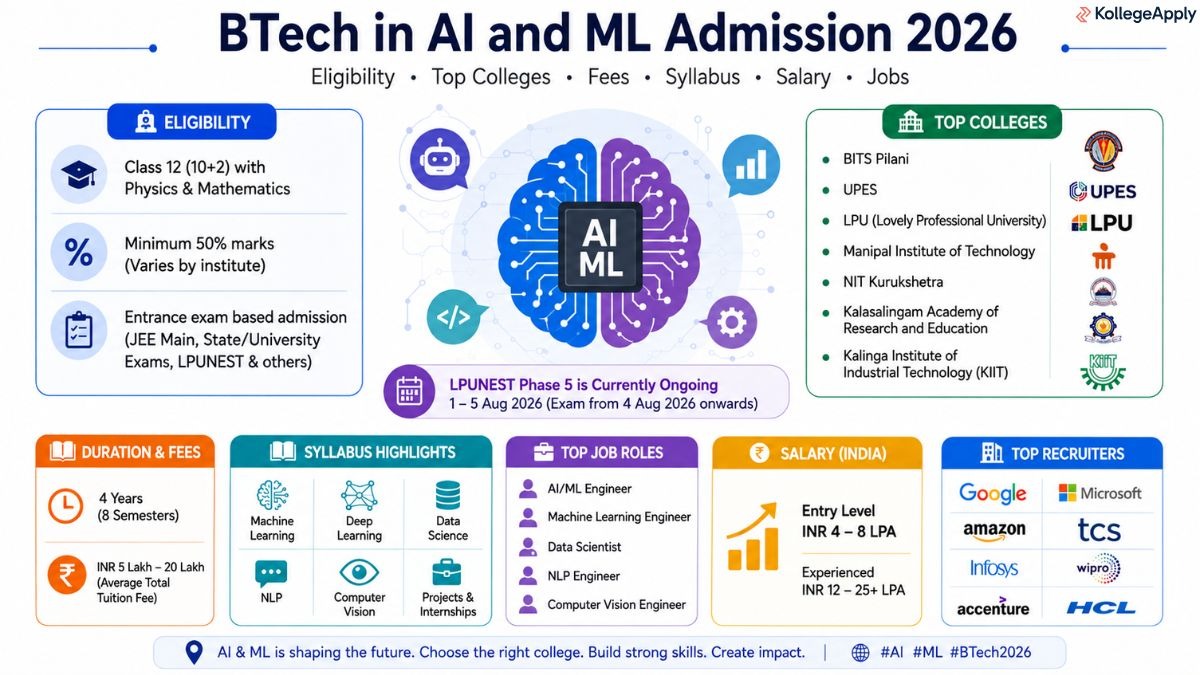
For BTech in AI and ML Admission 2026, candidates generally need to complete Class 12 with Physics and Mathematics along with other subjects specified by the institute. Admission may be based on JEE Main, state-level engineering entrance exams, university-level tests or institute-specific selection processes. Eligibility, entrance requirements and admission routes vary across colleges.
The BTech in AI and ML fees in India vary significantly by institute, with private universities generally charging more than government or publicly funded institutions. After graduation, students can explore roles such as AI/ML Engineer, Machine Learning Engineer, Data Scientist, NLP Engineer and Computer Vision Engineer. Starting salaries depend on factors such as technical skills, college, role, location, internships and recruiter.
- BTech in AI and ML Key Highlights
- What is BTech in AI and ML?
- Why Study BTech in AI and ML?
- Is BTech in AI and ML Worth It in 2026?
- Eligibility Criteria for BTech in AI and ML
- BTech in AI and ML Entrance Exams 2026
- BTech in AI and ML Colleges in India
- BTech AI and ML Fees in India
- BTech in AI and ML Admission Process
- Syllabus of BTech in AI and ML
- BTech AI and ML Skills Required
- BTech in AI and ML Job Opportunities in India
- BTech AI and ML Salary in India
- Career Scope of BTech AI and ML
- BTech AI and ML vs BTech CSE
- BTech in AI and ML FAQs
BTech in AI and ML Key Highlights
Before exploring the detailed admission process, syllabus and career options, students can refer to the key course details below for a quick comparison of the programme’s duration, eligibility, admission routes, fees, colleges, job profiles and salary range.
What is BTech in AI and ML?
BTech in AI and ML, or Bachelor of Technology in Artificial Intelligence and Machine Learning, is an undergraduate engineering programme focused on developing intelligent software and computational systems. Students learn how machines can process data, identify patterns, make predictions and support automated decision-making. The programme combines computer science, mathematics, statistics and specialised AI/ML concepts rather than treating artificial intelligence as an isolated subject.
The exact programme structure differs by university. Some institutions offer BTech AI & ML as a dedicated programme, while others offer BTech CSE with Artificial Intelligence and Machine Learning as a specialisation. For example, UPES offers BTech Computer Science and Engineering – Artificial Intelligence and Machine Learning, while LPU offers BTech CSE – Artificial Intelligence and Machine Learning.
Why Study BTech in AI and ML?
BTech AI and ML can be considered by students who want to build a career around software development, intelligent systems, data-driven applications and emerging technologies. However, choosing the course only because AI is currently popular can be risky. Students should also evaluate their interest in mathematics, programming, problem-solving and continuous technical learning before selecting the programme.
- Specialised technical skills: Students study AI, ML, deep learning and related computational methods.
- Strong computer science foundation: Most programmes include programming, algorithms, databases, operating systems and software engineering.
- Industry applications: AI and ML are used across finance, healthcare, manufacturing, retail, automotive, cybersecurity and other sectors.
- Project-based learning: Several programmes include projects, internships, laboratories and industry exposure.
- Research opportunities: Students interested in advanced AI can move towards research and postgraduate study.
- Flexible career paths: Graduates can pursue software, data, AI, ML and research-oriented roles.
Is BTech in AI and ML Worth It in 2026?
BTech in AI and ML can be worth pursuing in 2026 if the student chooses a credible programme and develops strong fundamentals beyond the degree title. The growth of AI applications has increased the relevance of skills such as machine learning, deep learning, data analysis, software engineering and generative AI. However, simply completing a BTech AI & ML degree does not guarantee a high-paying AI job.
The more important factors are the quality of the institute, curriculum, coding ability, mathematics and statistics knowledge, internships, projects, problem-solving skills, GitHub/portfolio work and placement opportunities. Students should also compare an AI/ML specialisation with a broader BTech CSE programme before making a decision.
Eligibility Criteria for BTech in AI and ML
The eligibility criteria for BTech AI and ML vary by university, so students should always check the admission notification of the institute they plan to join. A common requirement is completion of Class 12 or equivalent with Physics and Mathematics, along with other subjects specified by the institution. Minimum marks, subject combinations and admission routes can differ considerably between universities.
BTech in AI and ML Entrance Exams 2026
Different universities and engineering colleges use different admission routes in India to offer admission in the BTech in AI and ML course such as, depending on marks scored in entrance exams or merit-based. Some of the top entrance examinations for admission in B Tech AI and ML course among different colleges or universities in India are given in the table below:
Latest Update (August 2026): As of August 2026, LPU has listed Phase 5 of LPUNEST for eligible applicants. Candidates should verify the latest schedule on the official LPU admission portal before applying.
BTech in AI and ML Colleges in India
The programme naming is important when comparing colleges. Not every institution that teaches AI and ML offers a standalone BTech in AI and ML. Some offer BTech CSE with an AI & ML specialisation, while others offer AI/ML through electives within CSE. The following list focuses on institutions for which an official university source currently confirms an AI/ML-focused undergraduate programme or specialisation rather than simply mentioning AI/ML as a subject.
Note: BTech AI and ML fees vary significantly by institute, programme structure and admission category. Private universities generally have higher tuition fees than government institutions.
BTech AI and ML Fees in India
The cost of BTech AI and ML varies substantially according to the type of institution, campus, programme structure and additional charges. Government and publicly funded engineering institutions generally have a different fee structure from private universities. Private AI/ML programmes may also charge separately for hostel, examination, registration, laboratory, development and other services.
BTech in AI and ML Admission Process
The admission procedure for taking admission in BTech AI and ML varies across the universities. It depends on whether the institution uses JEE Main, a state entrance examination, a university entrance test or merit-based selection. Students should first identify colleges offering the programme, check their eligibility requirements and then apply through the appropriate admission portal. After the entrance result or merit assessment, candidates may need to participate in counselling, choice filling or direct university-level admission. For reference, below is the admission process followed at MS Ramaiah University:
- Step 1: The aspirants must enroll themselves in any one of these JEE Main/COMEDK/KCET entrance exams and sit for the test.
- Step 2: The candidates who pass the entrance test may apply by filling up the application form given online on the official college website.
- Step 3: The college will release a merit list based on the JEE Main/COMEDK/KCET marks/rank and availability of seats in the college.
- Step 4: Shortlisted candidates will need to go through document verification. Disqualification will follow if done otherwise.
- Step 5: The candidates who clear document verification may have to appear before an interview.
- Step 6: The final selection will be done on the basis of JEE Main/Entrance exam score, past academic record, and seats availability.
- Step 7: Finally, the selected candidates will have to pay the fee of admission or tuition as instructed by the admission committee.
- Step 8: After payment of the required fee, the candidate will be invited for the orientation program on the college campus.
Documents Required:
Students should keep their academic and identity documents ready before beginning the admission process. The exact list can differ between colleges and counselling authorities, particularly for candidates applying through state-level counselling or reserved-category admission. Original documents may also be required for physical verification after online submission. The list of documents required at the time of counseling and during admission is as follows:
Syllabus of BTech in AI and ML
The BTech AI and ML syllabus normally combines foundational engineering and computer science subjects with specialised AI and machine learning courses. The exact subjects vary by university, so the following structure should be treated as a representative curriculum rather than the official syllabus of one institution. Common areas include programming, data structures, databases, mathematics, probability, machine learning, deep learning, NLP, computer vision and project work. For reference, the syllabus for BTech in AI and ML at BITS Pilani is given in the tables below:
Note: The BTech AI and ML syllabus varies by university. The following is a representative syllabus covering subjects commonly included in AI/ML-focused undergraduate engineering programmes. It should not be treated as the official syllabus of any single university.
Elective Courses
There are different electives offered by various colleges, such as Data Science, Cloud Computing, Cyber Security, Internet of Things (IoT), and Machine Learning. The electives offered by BITS Pilani in the B Tech program in Artificial Intelligence and Machine Learning are mentioned below:
BTech AI and ML Tools and Technologies
Practical exposure is an important part of AI/ML education because employers generally look for the ability to implement concepts rather than only theoretical knowledge. Students may encounter different tools depending on the institution's curriculum, projects and laboratory facilities. Python is particularly important, while libraries and frameworks can vary as the field continues to evolve.
BTech AI and ML Skills Required
A BTech AI and ML degree provides the academic foundation, but employability depends heavily on the skills students build during the four years. Programming, mathematics and data-handling ability are particularly important. Students should also develop communication and project skills because AI/ML professionals frequently work with software, product, business and domain teams.
- Programming and problem-solving
- Mathematics and statistics
- Data structures and algorithms
- Machine learning
- Deep learning
- Data analysis
- Model evaluation
- SQL and database management
- Cloud and deployment fundamentals
- Version control
- Communication and teamwork
- Research and technical documentation
BTech in AI and ML Job Opportunities in India
After completing a BTech degree in AI & ML, graduates have enormous scope as one can opt for various job roles in multiple sectors such as IT, Healthcare, E-commerce, Manufacturing, and others. Below mentioned are the BTech in AI and ML job roles along with average salary in India and abroad:
BTech AI and ML Salary in India
There is no single fixed salary for BTech AI and ML graduates. Entry-level compensation depends on the candidate's technical skills, college, location, role, internship experience, hiring company and recruitment cycle. A realistic approach is to treat INR 4–8 LPA as an indicative entry-level range for many graduates, while stronger candidates and specialised roles can command higher packages. Salary claims should not be presented as guaranteed outcomes.
Career Scope of BTech AI and ML
The scope of BTech AI and ML extends beyond traditional software companies. AI technologies are increasingly being applied to areas such as financial services, healthcare, manufacturing, retail, logistics, cybersecurity, automotive technology and enterprise software. This creates opportunities for graduates with strong foundations in programming, mathematics, machine learning and software engineering. The strongest career outcomes generally require continuous upskilling because AI technologies and tools change rapidly. The Major areas of employment include:
- Artificial intelligence
- Machine learning
- Data science
- Software development
- Natural language processing
- Computer vision
- Robotics
- FinTech
- Healthcare technology
- E-commerce
- Cybersecurity
- Cloud and MLOps
- Research and academia
BTech AI and ML vs BTech CSE
Students often have to choose between BTech AI & ML and BTech CSE. A CSE programme generally provides broader exposure to computer science, while AI & ML programmes place greater emphasis on artificial intelligence, machine learning and related mathematical and computational concepts. The better option depends on the student's career goals, curriculum and the quality of the particular college rather than the programme title alone.
BTech in AI and ML FAQs
Is BTech in AI and ML good?
Yes, BTech in AI and ML is a great choice as it offers high-demand skills in emerging technologies. It provides strong career opportunities in IT, data science, and research fields.
What is the salary of BTech in AI?
The freshers in AI and ML can earn around INR 4–8 LPA on average in India. With experience, salaries can go significantly higher depending on skills and job role.
Is AI a high paid job?
AI and ML can offer strong earning potential, but salaries vary by role, skills, experience, employer, location and industry. A BTech AI and ML degree alone does not guarantee a high-paying job .
What is the scope of BTech AI and ML?
The scope is vast, covering industries like healthcare, finance, robotics, and e-commerce. Graduates can work as AI engineers, data scientists, and ML specialists.
What is the language of programming and tools for BTech AI and ML courses?
Python is the most widely used programming language in AI and ML courses. Other tools include TensorFlow, PyTorch, R, and MATLAB.
Can higher studies or research be done after BTech in AI and ML?
Yes, students can pursue MTech, MS, or PhD in AI, ML, Data Science or any related field for the specialization. Many also enter research roles in top institutes and companies.
Why is Mathematics important in BTech AI and ML courses?
Mathematics forms the foundation of AI and ML algorithms, especially statistics and linear algebra. It helps in building accurate models and improving predictions.
Which are the best colleges for BTech in AI and ML in India?
Some of the top colleges include BITS Pilani, NITs, KIIT, LPU, Manipal Institute of Technology, and UPES. These institutes offer strong placements and industry exposure.
What is the eligibility for BTech in AI and ML?
To be eligible candidates must pass 10+2 with Physics, Chemistry, and Mathematics. Most colleges require at least 50% marks along with entrance exam qualification.