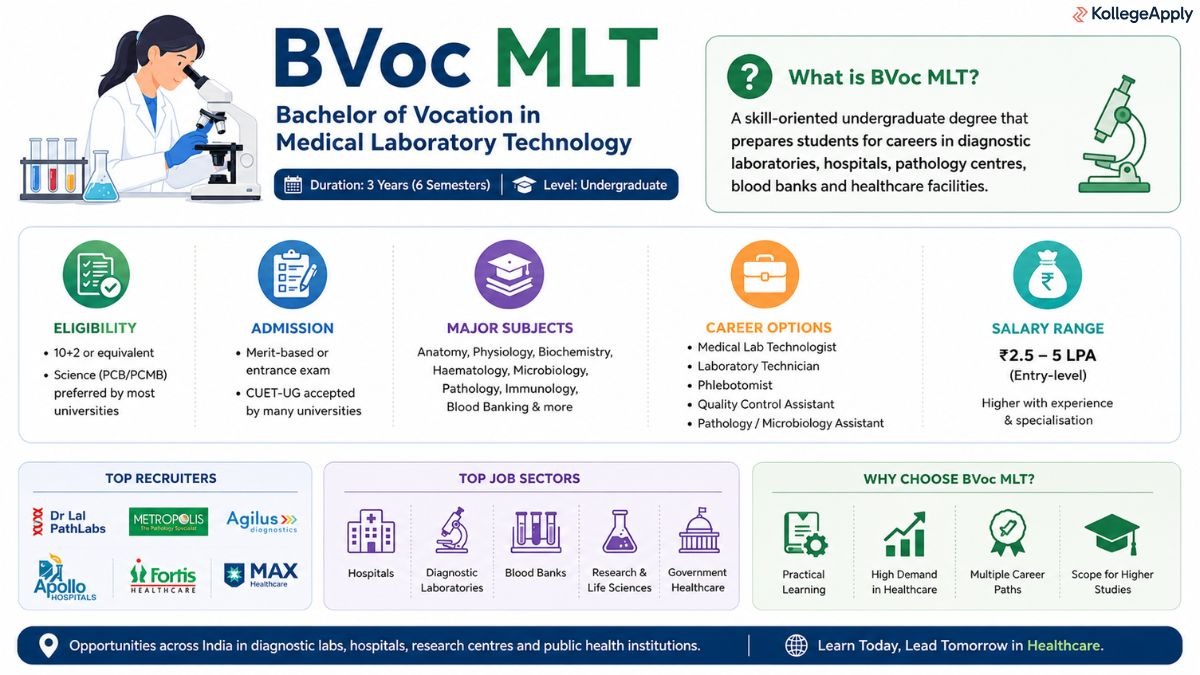
BVoc MLT (Bachelor of Vocation in Medical Laboratory Technology) is a 3-year undergraduate programme designed to develop practical and technical skills for careers in medical laboratories and diagnostic services. The course combines theoretical learning with hands-on training in subjects such as anatomy, physiology, biochemistry, haematology, microbiology, clinical pathology, immunology, blood banking and laboratory technology. While 3 years or 6 semesters is the common structure, the duration and curriculum may vary by institution.
For admission to BVoc MLT, candidates generally need to pass Class 12 or an equivalent examination. Science subjects, particularly PCB or PCMB, are commonly preferred or required, although eligibility varies across universities. Minimum marks may range from passing marks to around 50%, depending on the institution. Admission can be based on Class 12 merit, university-level entrance exams or other institution-specific admission criteria. Some universities may also consider CUET-UG scores where applicable.
After completing BVoc MLT, graduates can explore careers in hospitals, diagnostic laboratories, pathology centres, blood banks, research facilities and healthcare organisations. Common job roles include Medical Lab Technologist, Laboratory Technician, Phlebotomist, Pathology Laboratory Assistant and Microbiology Laboratory Assistant, subject to employer and applicable regulatory requirements. Entry-level BVoc MLT salaries generally range from around INR 2–5 LPA, with earning potential increasing with experience, skills, specialisation and location.
Table of Contents
- BVoc MLT Course Highlights
- What is BVoc MLT? — BVoc MLT Full Form
- Why Pursue BVoc MLT?
- Is BVoc MLT Worth It in 2026?
- BVoc MLT Eligibility Criteria
- BVoc MLT Entrance Exams
- BVoc MLT Colleges in India
- BVoc MLT Admission Process
- BVoc MLT Syllabus
- What Skills Are Required for BVoc MLT?
- BVoc MLT Jobs & Salary
- What is the Salary After BVoc MLT?
- Top Recruiters for BVoc MLT
- BVoc MLT vs BSc MLT
- FAQs on BVoc MLT
BVoc MLT Course Highlights
The following table summarises the major features of the BVoc MLT course. Duration, eligibility, admission mode and fees can vary considerably between universities, so students should check the latest prospectus of their preferred institution before applying.
What is BVoc MLT? — BVoc MLT Full Form
BVoc MLT stands for Bachelor of Vocation in Medical Laboratory Technology. It is an undergraduate programme focused on developing theoretical knowledge and practical skills required for laboratory-based healthcare and diagnostic services. The course covers areas such as anatomy, physiology, biochemistry, haematology, microbiology, clinical pathology, immunology and blood banking.
Typically completed in 3 years or 6 semesters, BVoc MLT combines classroom learning with practical laboratory training and vocational exposure. Graduates can pursue entry-level opportunities in hospitals, diagnostic laboratories, pathology centres, blood banks and other healthcare facilities, depending on the eligibility requirements of the employer.
Why Pursue BVoc MLT?
Students who are interested in laboratory-based healthcare careers can consider BVoc MLT for its combination of academic knowledge, practical training and exposure to diagnostic procedures. The course can be particularly suitable for students who prefer working with laboratory technology and patient samples rather than direct clinical care. Key reasons to pursue the programme include:
- Growing diagnostic sector: Hospitals, diagnostic centres and pathology laboratories require trained laboratory professionals for routine and specialised testing.
- Practical learning: The vocational structure gives students exposure to laboratory procedures and equipment alongside theoretical knowledge.
- Multiple career options: Graduates can explore pathology, microbiology, haematology, biochemistry, blood banking and diagnostic laboratory roles.
- Scope for specialisation: Experience or further education can help professionals move towards molecular diagnostics, quality control, microbiology and other specialised areas.
- Healthcare industry exposure: Internships, OJT and laboratory training can provide practical experience before graduation.
- Further education opportunities: Depending on university eligibility and applicable regulations, graduates can pursue postgraduate or advanced vocational programmes in related fields.
Is BVoc MLT Worth It in 2026?
BVoc MLT can be a worthwhile option in 2026 for students who want to enter the healthcare sector through diagnostic and laboratory services. Medical testing is an essential part of disease detection, monitoring and treatment, creating continuing demand for trained laboratory personnel. The NCAHP framework also places Medical Laboratory Technology within the regulated allied and healthcare professional ecosystem.
The course is particularly useful for students who prefer practical healthcare work rather than a doctor- or nursing-oriented career. With experience, professionals can progress from technician-level positions to senior technologist, quality-control, laboratory coordination and supervisory roles. Salaries vary by location, laboratory type, experience, specialisation and employer.
Technology is also changing medical diagnostics. Automation, molecular diagnostics, digital laboratory information systems, quality-control software and advanced analytical instruments are increasing the technical requirements of laboratory jobs. Students who develop computer literacy, quality-assurance knowledge and specialised diagnostic skills can improve their long-term career prospects.
BVoc MLT Eligibility Criteria
The eligibility criteria for BVoc MLT are not identical across all universities. While Class 12 completion is the common entry requirement, institutions may differ in their preferred subjects, minimum marks, admission route and age conditions. Students should check the latest programme-specific notification before applying. Some of the common eligibility criteria that need to be considered are:
- Educational qualification: Candidates generally need to pass Class 12 or an equivalent examination from a recognised board. Some universities may accept students from specific academic or vocational backgrounds.
- Subject requirements: Since BVoc MLT involves subjects related to laboratory science and healthcare, many institutions prefer or require Science subjects, particularly Physics, Chemistry and Biology (PCB) at the Class 12 level.
- Minimum marks: The required aggregate may vary by institution. Many universities keep the minimum eligibility around 45–50% in Class 12, although some may prescribe a higher or lower percentage.
- Relaxation for reserved categories: Candidates belonging to eligible reserved categories may receive relaxation in minimum marks or other admission conditions according to the university's rules and applicable government regulations.
- Admission criteria: Depending on the institution, admission may be offered through Class 12 merit, an entrance examination, counselling or a combination of these methods. There is no single admission process followed by every university.
- CUET-UG requirement: Some participating universities may consider CUET-UG scores for BVoc or related programmes. However, CUET-UG is not a mandatory entrance exam for every BVoc MLT course, so applicants should check whether their preferred university includes the programme under its CUET admission process.
BVoc MLT Entrance Exams
There is no single national entrance examination exclusively conducted for BVoc MLT across India. Admission depends on the university. Some colleges use Class 12 merit, while others conduct their own entrance examinations. MANUU, for example, listed B.Voc Medical Laboratory Technology among its vocational programmes and conducted entrance-test-based admissions in 2026. MANUU's 2026-27 admission schedule stated that applications for entrance-test-based vocational programmes opened on April 6 and closed on April 27, with entrance tests held from May 19–21. Its application fee was INR 550 for General/EWS candidates and INR 350 for SC/ST/PwD/OBC-NCL/women candidates.
BVoc MLT Colleges in India
BVoc MLT is offered by selected government, private and affiliated colleges across India. However, the availability of the programme, course structure, laboratory facilities, clinical training opportunities and fee levels can vary significantly from one institution to another. Students should therefore compare factors such as university recognition, curriculum, practical training, internship or industry exposure, location and total course cost before finalising a college.
The following table provides an overview of some colleges and institutions offering BVoc MLT. The fee figures are approximate and may change depending on the academic year, scholarship availability and other institutional charges.
Note: College fees, programme availability and admission requirements can change from year to year. Students should verify the latest BVoc MLT course details and fee structure through the official admission notification before applying.
BVoc MLT Admission Process
The admission process for BVoc MLT depends on whether the college follows merit-based or entrance-based admission. Students should carefully check the admission notification because eligibility, entrance requirements, counselling and fee structures differ between universities.
- Entrance exam registration (if applicable): Candidates register for CUET UG, a university-level test, or the relevant state exam through the official portal.
- Application form filling: Applicants fill in personal, academic, and category details on the university's admission portal and upload scanned documents.
- Shortlisting: Candidates may be shortlisted based on Class 12 marks, entrance-test performance or the institution's admission criteria.
- Merit list: A merit list is published, ranking candidates by academic score or entrance exam performance.
- Document verification: Shortlisted candidates attend in-person or online document verification before seat confirmation.
- Fee submission: Candidates pay the admission fee within the specified deadline to lock in their seat.
Documents Required
BVoc MLT Syllabus
The BVoc MLT syllabus generally combines foundational medical sciences with medical laboratory subjects, practical laboratory training and industry-oriented learning. Students may study areas such as anatomy and physiology, clinical biochemistry, haematology, microbiology, pathology, immunology, blood banking and laboratory quality management.
The semester-wise curriculum is not uniform across all universities. Subjects, practical components, vocational training and internship requirements can differ depending on the institution and its academic framework. For reference, the curriculum followed at the MANUU is given below:
What Skills Are Required for BVoc MLT?
A career in Medical Laboratory Technology requires more than knowledge of laboratory tests. BVoc MLT graduates need to combine scientific understanding with practical laboratory skills, accuracy, safety awareness and professional discipline. These skills help them handle patient samples correctly, operate laboratory equipment, maintain reliable test results and work effectively within healthcare teams.
- Communication: Ability to communicate clearly with laboratory staff, healthcare professionals and patients.
- Analytical Thinking: Helps interpret test observations and identify irregularities.
- Attention to Detail: Essential because small errors can affect laboratory results.
- Technical Skills: Knowledge of laboratory equipment, sample processing and testing procedures.
- Problem Solving: Helps identify procedural errors, equipment issues and inconsistent results.
- Teamwork: Laboratory services involve coordination with technicians, doctors, nurses and other healthcare workers.
- Time Management: Important for handling multiple samples while maintaining accuracy.
- Quality-Control Skills: Knowledge of laboratory quality assurance and safety protocols is increasingly valuable.
- Computer Skills: Laboratory information systems and digital reporting require basic computer proficiency.
- Ethical Responsibility: Professionals must maintain patient confidentiality, sample integrity and laboratory safety.
BVoc MLT Jobs & Salary
Graduates can pursue laboratory and diagnostic roles in hospitals, pathology laboratories, diagnostic centres, blood banks, research facilities and healthcare organisations. Salary depends heavily on location, employer, laboratory specialisation and practical experience.
Note: These salary ranges are indicative market ranges rather than guaranteed salaries. Government pay scales, large diagnostic chains, specialised laboratories and senior supervisory positions may offer different compensation.
What is the Salary After BVoc MLT?
The salary after BVoc MLT generally increases with professional experience, technical specialisation and responsibility. Fresh graduates usually enter technician or laboratory assistant positions before progressing towards senior technical or supervisory roles.
Top Recruiters for BVoc MLT
BVoc MLT graduates can explore employment opportunities across diagnostic laboratories, hospitals, blood banks, research institutions and specialised testing facilities. Recruitment is not limited to large diagnostic chains; graduates can also find opportunities in hospital laboratories, blood banks, research facilities and smaller pathology centres. The actual job opportunities available to a graduate depend on factors such as qualification, practical experience, location, employer requirements and any applicable registration or regulatory conditions. Some common organisations and employment settings include:
Note: The organisations listed above are examples of potential employers or employment settings, not a guarantee of recruitment. Eligibility, vacancies and job roles can vary by organisation and recruitment cycle. Graduates should check the specific qualification and experience requirements before applying.
BVoc MLT vs BSc MLT
Both BVoc MLT and BSc MLT can lead to careers in medical laboratory services, but their academic emphasis can differ. BVoc programmes generally place stronger emphasis on vocational skills, practical training and workplace exposure, while BSc MLT programmes may have a more conventional science and allied-health academic structure.
FAQs on BVoc MLT
Which is best, BVoc MLT or BSc MLT?
Both are valid options; BVoc MLT suits students wanting quicker, practical entry into diagnostic jobs, while BSc MLT offers a stronger theoretical base for those planning further studies.
Can I do MSc MLT after BVoc MLT?
Yes, many universities allow BVoc MLT graduates to pursue an MSc in Medical Lab Technology, though some institutes may require a bridge course first.
Is BVoc a valid degree?
Yes, BVoc is a UGC-recognized undergraduate degree under the National Skills Qualifications Framework, valid for employment and further academic study.
What are the eligibility criteria for BVoc MLT?
Candidates generally need Class 12, with Science/PCB preferred or required by many universities.
What is the b voc mlt full form?
The b voc mlt full form is Bachelor of Vocation in Medical Laboratory Technology, a skill-based undergraduate degree focused on diagnostic lab training.
What is the duration of BVoc MLT?
BVoc MLT is typically a three-year programme divided into six semesters, though some universities offer a four-year format with an integrated internship year.
What is the average salary after BVoc MLT?
Entry-level graduates typically earn between INR 2 and INR 5 LPA, with salaries rising significantly as professionals gain experience and specialization.
Do I need NEET for BVoc MLT admission?
Not usually, Most BVoc in medical lab technology programmes admit students through 10+2 merit or CUET UG, though a few institutes optionally consider NEET scores.
What jobs can I get after BVoc MLT?
Graduates can work as lab technicians, technologists, phlebotomists, blood bank technicians, or quality control analysts in hospitals and diagnostic centres.
Is BVoc MLT recognized by UGC?
BVoc programmes are offered by eligible higher-education institutions. Check the university's recognition and programme status before admission.