Diploma in Cooperative Management (DCM) in Tamil Nadu is a state-focused professional diploma designed for students who want to build careers in the cooperative sector. Unlike a general management diploma, the Tamil Nadu DCM is closely connected with the state's network of cooperative societies, Cooperative Management Institutes and the Tamil Nadu Cooperative Union.
The DCM course in Tamil Nadu is offered through Institutes of Cooperative Management (ICMs) and other recognised cooperative training centres. The Tamil Nadu Cooperative Union states that its regular DCM is designed for students who have completed Class 12 and is structured as a one-year, two-semester course covering 10 subjects.
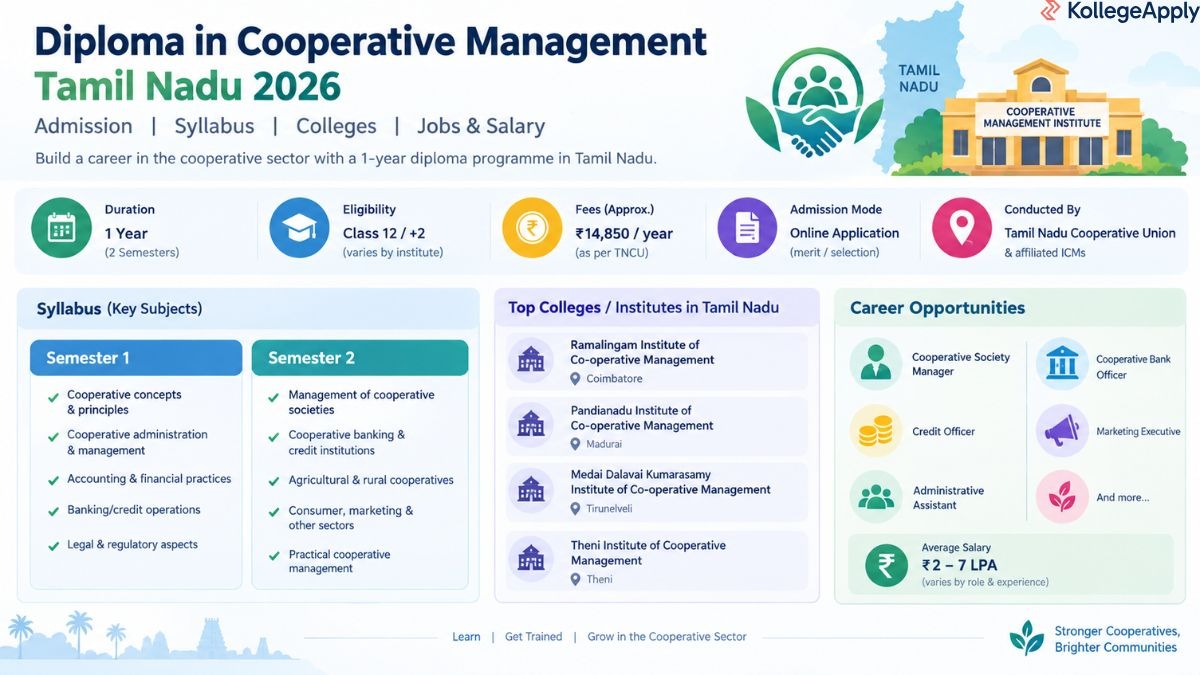
Table of Contents
- Diploma in Cooperative Management in Tamil Nadu: Key Highlights
- Diploma in Cooperative Management in Tamil Nadu: Eligibility
- DCM in Tamil Nadu: Admission 2026
- Diploma in Cooperative Management in Tamil Nadu: Syllabus
- DCM in Tamil Nadu: Colleges and Institutes
- Diploma in Cooperative Management in Tamil Nadu: Fees
- Diploma in Cooperative Management in Tirunelveli
- DCM Course in Tamil Nadu: Regular vs Correspondence
- Career Scope After Diploma in Cooperative Management in Tamil Nadu
- Is Online DCM Admission Available in Tamil Nadu?
- Why Study DCM in Tamil Nadu?
- FAQs on Diploma in Cooperative Management in Tamil Nadu
Diploma in Cooperative Management in Tamil Nadu: Key Highlights
The Tamil Nadu DCM is different from a conventional private diploma in business management because its curriculum and training are oriented towards cooperative institutions. The course can be particularly relevant for students interested in cooperative banks, credit societies, agricultural cooperatives, consumer cooperatives and other organisations operating within Tamil Nadu's cooperative framework.
The Tamil Nadu Cooperative Union operates the Institutes of Cooperative Management through which cooperative education and training are provided. Its official information currently lists 26 ICMs functioning as units of the Tamil Nadu Cooperative Union, along with associated cooperative training institutions.
The TNCU's current citizen charter also describes the regular DCM as a 9-month/36-week programme, while its main education page describes the course as one year/two semesters. Students should therefore follow the duration and schedule specified in the latest admission notification for their batch
Diploma in Cooperative Management in Tamil Nadu: Eligibility
For the regular Diploma in Cooperative Management in Tamil Nadu, candidates generally need to have passed Class 12 or an equivalent examination. The Tamil Nadu Cooperative Union's recent prospectus also accepts certain candidates with higher qualifications, including graduates following the prescribed educational pathways. The 2024-25 DCM prospectus specified a minimum age of 17 years as on the stated cutoff date and no maximum age limit. Since age conditions can be tied to a particular admission year, applicants should verify the requirement in the 2026 notification before applying.
DCM in Tamil Nadu: Admission Process 2026
DCM admission 2026 in Tamil Nadu is conducted through the cooperative management training network rather than through a single nationwide entrance examination. The Tamil Nadu Cooperative Union's recent admission prospectus required candidates to submit applications online, after which applications were placed before a selection committee. The admission process can be broadly understood as follows:
- Check the latest DCM admission notification issued by the Tamil Nadu Cooperative Union or concerned institute.
- Confirm educational eligibility and other conditions.
- Complete the online application within the notified period.
- Upload the required educational and category documents.
- Pay the applicable application/training fee through the prescribed method.
- Applications are scrutinised and considered by the selection process.
- Selected candidates complete admission formalities at the allotted institute.
Important: Admission dates, selection rules, application fees and institute-wise availability can change from one academic year to another. Candidates should not rely on dates from the 2024-25 prospectus when applying for the 2026 batch.
Is there an entrance exam for DCM in Tamil Nadu?
The recent Tamil Nadu DCM prospectus describes application scrutiny and selection by a selection committee rather than a common state-level entrance examination. Therefore, candidates should check the 2026 notification for the exact selection procedure applicable to that year's admission.
Diploma in Cooperative Management in Tamil Nadu: Syllabus
The Diploma in Cooperative Management Tamil Nadu syllabus is designed around the functioning and administration of cooperative institutions. The Tamil Nadu Cooperative Union describes the regular programme as a one-year course divided into two semesters with five subjects in each semester.
The syllabus is intended to give students an understanding of cooperative principles as well as the practical management of cooperative organisations. Depending on the applicable syllabus for the batch, students may study areas related to cooperative management, cooperative law, accounts, banking, administration and the functioning of different types of societies.
Note: The table gives the broad academic areas rather than presenting them as the official 2026 subject titles. Students should use the syllabus issued with the relevant admission batch for the final paper-wise list.
DCM in Tamil Nadu: Colleges and Institutes
Tamil Nadu has a network of Cooperative Management Institutes under the Tamil Nadu Cooperative Union that conduct the Diploma in Cooperative Management. The official TNCU directory lists institutes including Ramalingam Institute of Co-operative Management, Pandianadu Institute of Co-operative Management and Medai Dalavai Kumarasamy Institute of Co-operative Management.
Diploma in Cooperative Management in Tamil Nadu: Fees
Fees for the DCM can vary according to the programme and admission notification. The Tamil Nadu Cooperative Union's citizen charter currently lists INR 14,850 per trainee per year for the regular DCM and INR 12,550 for the correspondence programme for eligible cooperative society employees.
The below fee figures should be treated as the latest publicly available TNCU fee information rather than a guaranteed 2026 fee, until the 2026 admission notification confirms the amount.
Note: The correspondence programme is stated to be for cooperative society employees.
Diploma in Cooperative Management in Tirunelveli
Candidates looking for a Diploma in Cooperative Management in Tirunelveli can explore the Medai Dalavai Kumarasamy Institute of Co-op. Management, located in Udaya Nagar, Government Staff New Quarters, N.G.O. ‘B’ Colony, Tirunelveli. The Tamil Nadu Cooperative Union's institute directory lists this institute as one of its Cooperative Management Institutes.
The Tirunelveli district administration also lists an Institute of Cooperative Management among the cooperative institutions functioning in the district. The district has a substantial cooperative network, including a District Central Cooperative Bank, District Cooperative Union, agricultural credit societies, urban cooperative banks and other cooperative organisations.
Important: Current 2026 fees, seat intake and admission dates for the Tirunelveli institute should be confirmed from the latest institute/Tamil Nadu Cooperative Union notification rather than inferred from older prospectuses.
DCM Course in Tamil Nadu: Regular vs Correspondence
Tamil Nadu provides different DCM pathways depending on the candidate's background. The regular course is aimed at students who have completed +2, while the correspondence route is intended specifically for eligible employees of cooperative societies.
Career Scope After Diploma in Cooperative Management in Tamil Nadu
The DCM is particularly relevant to candidates who want to work in Tamil Nadu's cooperative ecosystem. The Tamil Nadu Cooperative Union states that its cooperative management institutes are intended to provide training connected with employment opportunities in cooperative institutions. Depending on recruitment rules and the vacancy, DCM-qualified candidates may explore opportunities associated with:
- Cooperative banks and credit institutions
- Primary Agricultural Cooperative Credit Societies
- Consumer cooperative societies
- Cooperative marketing organisations
- Cooperative stores
- Housing cooperatives
- District Cooperative Unions
- Other cooperative institutions and societies
However, completing the DCM does not by itself guarantee a government or cooperative-sector job. Recruitment depends on the eligibility conditions, vacancies, selection process and rules prescribed for a particular post.
Is Online DCM Admission Available in Tamil Nadu?
Yes, the Tamil Nadu Cooperative Union has used online applications for DCM admissions. This refers to the application process and should not automatically be interpreted as an entirely online DCM course. The recent regular DCM prospectus specifically stated that applications were received online.
Students searching for an online Diploma in Cooperative Management course should therefore distinguish between online application and online study mode. The regular Tamil Nadu DCM is conducted through Cooperative Management Institutes, while a separate correspondence route is available for eligible cooperative society employees.
Why Study DCM in Tamil Nadu?
Tamil Nadu is particularly relevant for cooperative management education because the state has an established institutional network for cooperative training. The Tamil Nadu Cooperative Union reports that its ICMs have been established to impart cooperative education and training and that the state has multiple institutes functioning under its cooperative education system.
For a student who specifically wants to understand cooperative institutions in Tamil Nadu, studying through this state-level network can provide a more relevant pathway than choosing a generic management diploma with little exposure to cooperative administration.
FAQs on Diploma in Cooperative Management in Tamil Nadu
What is a Diploma in Cooperative Management in Tamil Nadu?
It is a professional diploma focused on cooperative administration and management, offered through Tamil Nadu's cooperative training network.
What is the eligibility for DCM admission in Tamil Nadu?
Regular DCM admission generally requires Class 12 or equivalent. Exact eligibility should be checked in the latest Tamil Nadu admission notification.
What is the duration of DCM in Tamil Nadu?
The Tamil Nadu Cooperative Union describes the regular DCM as a one-year, two-semester course with 10 subjects.
How can I apply for DCM admission 2026 in Tamil Nadu?
Applications have been invited online in recent admission cycles. For DCM admission 2026, follow the latest TNCU notification.
What is the DCM syllabus in Tamil Nadu?
The syllabus covers cooperative management, administration, accounting, banking, cooperative law and sector-specific cooperative operations.
Which institutes offer DCM courses in Tamil Nadu?
Tamil Nadu has multiple Cooperative Management Institutes, including centres in Tirunelveli, Madurai, Coimbatore, Chennai, Erode and other districts.
Is there a DCM course in Tirunelveli?
Yes. The Medai Dalavai Kumarasamy Institute of Co-op. Management is listed by TNCU in Tirunelveli.
Can I apply for a TN cooperative course online?
Yes, recent DCM admission cycles have used online applications. Check the 2026 notification for the active application procedure.
Is an online Diploma in Cooperative Management available?
Tamil Nadu offers online application facilities, while the regular DCM is institute-based. A separate correspondence route serves eligible cooperative employees.
What can I do after DCM in Tamil Nadu?
Graduates can explore cooperative banks, credit societies, consumer cooperatives and other cooperative institutions, subject to recruitment rules and vacancies.