Diploma in Cooperative Management Salary in India generally ranges from INR 2–7 LPA, depending on experience, job role, location, employer and recruitment conditions. Freshers may earn around INR 2–4 LPA, while experienced professionals in cooperative banking, credit, accounts, administration and society management can earn higher salaries.
The salary after Diploma in Cooperative Management is not fixed because DCM-qualified candidates work across different cooperative institutions and roles. Cooperative banks, PACS, credit societies, consumer cooperatives and other organisations may follow different salary structures. Candidates can improve their earning potential through practical experience, accounting and digital skills, graduation and relevant higher qualifications.
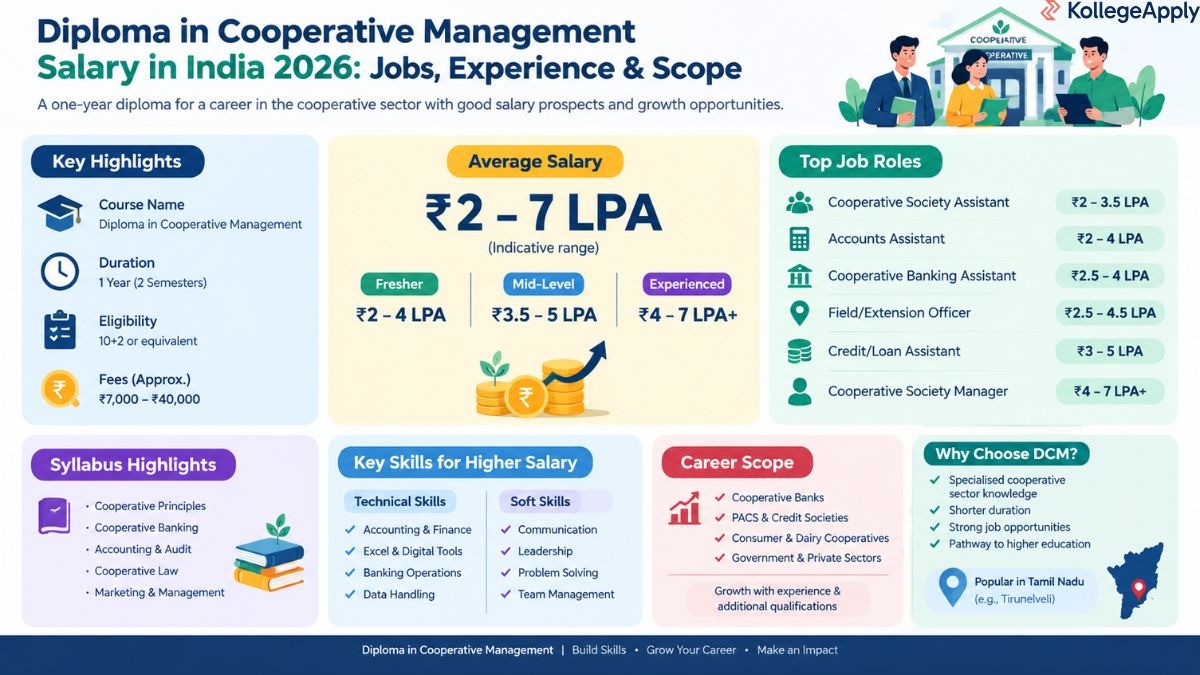
Table of Contents
- Diploma in Cooperative Management Salary: Key Highlights
- Factors Influencing Diploma in Cooperative Management Salary
- Detailed Breakdown of Diploma in Cooperative Management Salary
- Diploma in Cooperative Management Salary in Government and Cooperative Sector
- Diploma in Cooperative Management Salary in Private Sector
- Skills Required for High Diploma in Cooperative Management Salary
- How to Increase Salary After Diploma in Cooperative Management?
- Career Scope After Diploma in Cooperative Management
- What Are the Benefits of a Diploma in Cooperative Management?
- Diploma in Cooperative Management Salary FAQs
Diploma in Cooperative Management Salary: Key Highlights
The salary after a Diploma in Cooperative Management varies significantly because DCM-qualified candidates can enter different types of cooperative-sector roles. A fresher working in an administrative or accounts position may have a lower starting salary than someone entering credit operations or a role with greater responsibility. The table below provides an indicative 2026 salary benchmark rather than a guaranteed pay scale.
Note: Salary figures are indicative market-oriented ranges compiled for career guidance. Actual compensation can vary considerably by organisation, recruitment notification, location, experience and responsibilities.
Also Read: Diploma in Cooperative Management 2026: Eligibility, Admission, Syllabus, Colleges, Jobs & Salary
Factors Influencing Diploma in Cooperative Management Salary
The Diploma in Cooperative Management Salary in India is not fixed because the qualification can lead to different job profiles across the cooperative sector. A candidate working in accounts may have a different salary from one handling credit operations or managing a cooperative society. Employer type and recruitment rules can also create significant differences in compensation. The following factors have the greatest impact on DCM salary:
- Experience: Salary generally increases as candidates gain experience and take on greater responsibilities.
- Job role: Credit, banking, accounts and managerial roles may offer different salary levels.
- Employer: Cooperative societies, banks, federations and private organisations can follow different salary structures.
- Location: Salaries can vary between metropolitan cities, tier-2 cities and rural areas.
- Skills: Accounting, computer applications, banking operations and communication skills can improve employability.
- Additional qualifications: Graduation, HDCM, PG Diploma or management qualifications can support career progression.
- Recruitment rules: Government and cooperative-sector vacancies may have fixed pay scales and eligibility conditions.
- Responsibilities: Supervisory and managerial positions generally carry greater earning potential than entry-level administrative roles.
Detailed Breakdown of Diploma in Cooperative Management Salary
A DCM salary can be better understood by comparing compensation according to experience, job profile and location. There is no universal salary structure for all DCM graduates because the qualification is used across different cooperative institutions and employment settings. Candidates should therefore treat the following figures as indicative benchmarks for career planning rather than guaranteed salaries.
For government or cooperative-sector recruitment, the actual salary may be determined by the organisation's recruitment notification, pay matrix, allowances and service rules. Private-sector employers may instead offer a consolidated annual package based on experience, responsibilities and market conditions.
Diploma in Cooperative Management Salary Based on Experience
Experience is one of the most important factors affecting DCM salary in India. Fresh diploma holders generally begin with entry-level administrative, accounts, field or credit-related responsibilities. With experience, professionals can take responsibility for member services, financial operations, loan documentation, society administration and team supervision.
Candidates who develop additional skills and move into supervisory positions may have better salary prospects. However, experience alone does not guarantee a particular salary, and progression depends on employer policies, vacancies and individual performance.
Diploma in Cooperative Management Salary Based on Job Roles
Job role is another major determinant of cooperative job salary. A DCM graduate may work in accounts, banking support, credit operations, field services or cooperative society administration. The responsibilities attached to each position can influence the starting package and subsequent salary growth.
Candidates should also distinguish between a job title and an organisation. For example, “cooperative bank” is an employer or sector, while roles within it may include banking assistant, credit assistant, accounts staff or officer-level positions. Actual eligibility for officer and managerial posts must be checked against the relevant recruitment notification.
Note: These figures are indicative. A specific post may require graduation, experience, a particular cooperative qualification or other conditions in addition to DCM. Government recruitment should always be checked against the official notification.
Diploma in Cooperative Management Salary Based on Location
Location can influence Diploma in Cooperative Management Salary in India because employers, operating costs, organisational structures and available opportunities differ across regions. Metropolitan and larger urban markets may provide more opportunities in banking, finance and cooperative administration, while district-level and rural areas have stronger links with agricultural and primary cooperative institutions.
For DCM graduates, location should not be considered only in terms of salary. The number of cooperative institutions, availability of vacancies, career progression and cost of living can also affect the overall value of a job.
Note: These location categories indicate relative salary potential, not fixed city-wise salaries. A specific employer in a smaller city may offer more than an entry-level position in a metropolitan area.
Diploma in Cooperative Management Salary in Government and Cooperative Sector
Government and cooperative-sector employment should be evaluated separately from private-sector salary estimates because compensation may be governed by prescribed recruitment rules. A DCM qualification may be relevant for certain cooperative-sector positions, but eligibility is always determined by the individual vacancy notification.
In Tamil Nadu and other states with established cooperative networks, opportunities may arise in cooperative banks, credit societies, PACS, consumer cooperatives, marketing organisations and cooperative departments. Candidates should verify whether the vacancy accepts DCM qualification, requires graduation or specifies another cooperative-management qualification.
Diploma in Cooperative Management Salary in Private Sector
Private-sector opportunities for DCM graduates are generally concentrated around administrative, accounting, credit, customer support and field operations. Smaller cooperative organisations may offer entry-level salaries, while candidates with experience and stronger financial or managerial skills may qualify for more responsible positions.
The private-sector DCM course salary can therefore vary substantially between employers. Candidates should compare the annual package, fixed salary, incentives, responsibilities, working location and opportunities for progression rather than selecting a job solely on the starting CTC.
Skills Required for High Diploma in Cooperative Management Salary
A DCM qualification provides sector-specific knowledge, but salary growth also depends on the candidate's practical skills. Professionals working with cooperative societies and financial institutions may need to handle member records, accounts, credit documentation, reports, communication and digital systems.
Building a combination of cooperative management knowledge and finance, accounting and technology skills can improve career flexibility. Candidates who want higher earning potential should focus on skills that are directly relevant to the job role rather than collecting qualifications without practical application.
How to Increase Salary After Diploma in Cooperative Management?
Salary growth after DCM generally depends on a combination of experience, job performance, skills and additional qualifications. Candidates should focus on building expertise in areas that are frequently used in cooperative banking, credit, accounts and administration rather than relying only on the diploma. The following steps can improve long-term career prospects:
- Gain practical experience in cooperative societies, banking, accounts or credit operations.
- Improve accounting skills through practical exposure to bookkeeping, financial records and auditing.
- Learn Excel and digital tools used for reporting and data management.
- Develop communication skills for dealing with members, customers and officials.
- Consider graduation if you currently hold only a Class 12 qualification and want access to graduate-level vacancies.
- Explore HDCM or PG-level programmes when you meet the required eligibility.
- Track cooperative recruitment notifications for posts where DCM is an accepted qualification.
- Build specialised expertise in credit, banking, accounts or cooperative administration.
Career Scope After Diploma in Cooperative Management
The career scope after Diploma in Cooperative Management is strongest for candidates who want to work within the cooperative ecosystem. The course provides foundational knowledge of cooperative principles, administration, accounting, banking, credit and related operations.
Graduates can explore entry-level opportunities in cooperative banks, PACS, consumer cooperatives, dairy cooperatives, credit societies, cooperative marketing organisations and other member-based institutions. However, DCM does not guarantee employment, and some higher-level posts may require graduation or another prescribed qualification.
What Are the Benefits of a Diploma in Cooperative Management?
The benefits of getting a Diploma in Cooperative Management are mainly linked to its specialised focus. Unlike a broad management diploma, DCM introduces students to the functioning of cooperative societies, credit institutions and member-owned organisations. Key benefits include:
- Specialised knowledge of cooperative management
- Understanding of cooperative banking and credit
- Exposure to cooperative accounting and administration
- Relevant preparation for selected cooperative-sector jobs
- Shorter study duration than a conventional bachelor's programme
- Foundation for further education and professional development
- Better understanding of rural and community-based institutions
However, candidates should remember that a diploma is not equivalent to a bachelor's degree where a recruitment notification specifically requires graduation.
Candidates interested in state-specific opportunities can also check Diploma in Cooperative Management Admission 2026 in Tamil Nadu.
Diploma in Cooperative Management Salary FAQs
What is the average Diploma in Cooperative Management Salary in India?
DCM salary generally ranges from INR 2–7 LPA, depending on role, experience, employer, location and recruitment rules.
What is the starting salary after DCM?
Freshers may earn around INR 2–4 LPA in entry-level cooperative, accounts, credit or administrative roles.
What is the salary after 5 years of DCM?
Professionals with 5+ years may earn around INR 4–7 LPA or more, depending on role and employer.
What is a cooperative job salary?
Cooperative job salary varies by post and employer. Entry-level roles may start around INR 2–4 LPA.
What is DCM qualification?
DCM means Diploma in Cooperative Management, a diploma-level qualification focused on cooperative administration and management.
What are the benefits of getting a Diploma in Cooperative Management?
DCM provides specialised knowledge of cooperative banking, accounting, credit, administration and cooperative-sector operations.
Which Diploma has a high salary?
Salary depends more on skills, role and experience than the diploma alone. DCM is specialised for cooperative-sector careers.
Can DCM graduates work in cooperative banks?
Yes, DCM graduates can explore cooperative banking roles where the recruitment notification accepts their qualification.
Does DCM guarantee a government job?
No, DCM does not guarantee a government job. Candidates must meet the qualification and selection requirements of each recruitment notification.
How can DCM graduates increase their salary?
Experience, accounting and digital skills, graduation, higher qualifications and specialised expertise can support better salary growth.