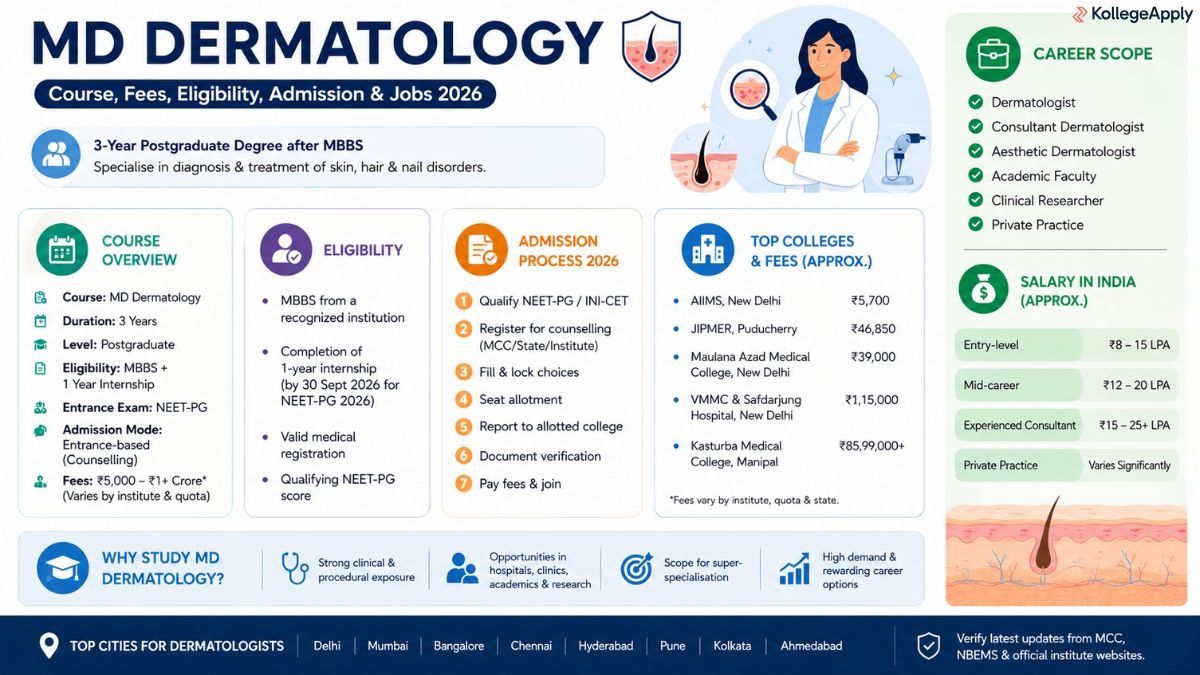
MD Dermatology is a 3-year postgraduate medical course for MBBS graduates who want to specialise in the diagnosis and treatment of diseases affecting the skin, hair and nails. The programme combines theoretical learning with supervised clinical training, patient evaluation, diagnostic procedures, treatment planning, dermatological procedures and research. Depending on the institution, students may also receive exposure to areas such as dermoscopy, phototherapy, dermatopathology and procedural or aesthetic dermatology.
Admission to MD Dermatology is generally through NEET-PG, followed by the relevant counselling and seat-allotment process. However, Institutes of National Importance such as AIIMS, JIPMER and PGIMER use INI-CET for applicable postgraduate admissions. Candidates must hold a recognised MBBS qualification, complete the required internship and satisfy the applicable medical registration and entrance-examination requirements.
MD Dermatology offers career opportunities in government and private hospitals, dermatology clinics, medical colleges, research organisations and private practice. Graduates can also develop focused expertise in areas such as dermatosurgery, pediatric dermatology, dermatopathology, trichology and aesthetic dermatology. The NMC's postgraduate curriculum describes three years of training in Dermatology, Venereology & Leprosy, which is why the terms MD Dermatology and MD DVL are both encountered in Indian medical education.
- MD Dermatology Course Highlights
- Is MD Dermatology Worth It in 2026?
- Why Study MD Dermatology?
- MD Dermatology Eligibility Criteria
- MD Dermatology Entrance Exams 2026
- MD Dermatology Colleges in India
- MD Dermatology Fees: Government vs Private vs Deemed
- MD Dermatology Syllabus
- Career Scope in MD Dermatology
- Dermatologist Salary in India
- How to Become a Dermatologist After MBBS?
- Higher Studies and Specialised Training After MD Dermatology
- MD Dermatology FAQs
MD Dermatology Course Highlights
The following highlights provide a quick overview of MD Dermatology before exploring eligibility, admission, syllabus, colleges and career opportunities. The programme is a postgraduate medical degree rather than an undergraduate or diploma course, and its training is primarily residency-based. Course titles may vary slightly between institutions, with “MD Dermatology” and “MD Dermatology, Venereology & Leprosy” both appearing in official records. Candidates should verify the exact nomenclature used by their preferred college.
Note: fees vary sharply by state, quota (government/management/NRI), and whether the seat is All India Quota, state quota, or deemed-university. Always verify against the current-year MCC/state counselling brochure before assuming any figure.
Is MD Dermatology Worth It in 2026?
MD Dermatology remains a highly sought-after postgraduate medical specialty in India, particularly among MBBS graduates interested in clinical diagnosis, outpatient care and procedural dermatology. The course offers career opportunities across hospitals, clinics, academics, research and private practice. However, whether MD Dermatology is worth pursuing depends on your NEET-PG/INI-CET performance, preferred college, financial situation and long-term career goals. MD Dermatology may be a good choice if you:
- Prefer outpatient and clinic-based patient care.
- Enjoy visual diagnosis and detailed clinical examination.
- Are interested in both medical and procedural dermatology.
- Want opportunities in hospitals, academics, research or private practice.
- Plan to develop expertise in areas such as dermatosurgery or pediatric dermatology.
- Are comfortable with the competitive nature of postgraduate dermatology admissions.
Before choosing the course, candidates should also consider the fee difference between government and private/deemed seats, the clinical exposure available at the institution and the cost of any additional specialised training.
What is MD Dermatology?
MD Dermatology is a three-year postgraduate medical degree after MBBS that trains doctors in the diagnosis and management of disorders affecting the skin, hair and nails. The recognised postgraduate curriculum also includes venereology and leprosy. NMC's curriculum aims to develop knowledge of basic sciences as applied to dermatology, clinical diagnosis, investigations, therapeutics and practical and procedural skills.
The programme is primarily based on clinical and patient-centred training. Residents learn to take detailed histories, perform dermatological examinations, develop differential diagnoses, interpret investigations and manage patients under specialist supervision. Depending on the institution, clinical exposure may include skin biopsies, dermoscopy, phototherapy, cryotherapy, dermatopathology and dermatological procedures.
MD DVL Full Form and Meaning
MD DVL stands for Doctor of Medicine in Dermatology, Venereology & Leprology. In India, MD DVL and MD Dermatology commonly refer to the same postgraduate dermatology specialty, although the exact title used by a university or medical college may differ.
The NMC lists both MD - Dermatology and MD - Dermatology, Venereology & Leprosy among recognised PG degree course nomenclatures. Therefore, candidates should not treat MD Dermatology and MD DVL as two completely separate postgraduate degrees.
Why Study MD Dermatology?
MD Dermatology can be an attractive postgraduate option for MBBS graduates who enjoy clinical diagnosis, patient interaction and procedural medicine. Dermatology involves much more than cosmetic treatment; residents encounter infectious, inflammatory, autoimmune, pigmentary, neoplastic and systemic diseases with skin manifestations. The speciality can also provide flexibility in career settings, from hospitals and academics to specialised clinics and private practice.
- Focused clinical specialisation: The course provides advanced training in diagnosing and treating dermatological disorders.
- Strong procedural component: Depending on the institution, residents may receive exposure to dermatosurgery and other dermatological procedures.
- Multiple career settings: Graduates can work in hospitals, clinics, medical colleges, research institutions and private practice.
- Scope for focused expertise: Additional training can be pursued in areas such as pediatric dermatology, dermatopathology, dermatosurgery, trichology and aesthetic dermatology.
- Private-practice opportunities: Dermatology can offer opportunities for independent practice after completing the required specialist training and professional requirements.
- Academic and research scope: MD Dermatology graduates can pursue teaching, clinical research, publications and institutional research roles.
MD Dermatology Eligibility Criteria
Eligibility for MD Dermatology is linked to the postgraduate medical admission framework and NEET-PG requirements. The internship completion deadline is particularly important because candidates who do not meet it may become ineligible for the relevant admission cycle. For NEET-PG 2026, the internship completion cut-off is September 30, 2026. Candidates should always refer to the latest NBEMS information bulletin before applying. The general requirements include:
- Candidates must hold a recognised MBBS qualification and satisfy the eligibility requirements specified in the current NEET-PG information bulletin.
- Completion of the mandatory one-year rotating internship.
- A valid, current medical registration with the NMC or a State Medical Council.
- A qualifying score in NEET PG, the national entrance exam for MD/MS/PG Diploma admissions, conducted by the NBEMS (National Board of Examinations in Medical Sciences).
- No upper age limit for NEET PG as of the current cycle; SC/ST/OBC-NCL and PwD candidates get relaxed qualifying percentiles versus the general category.
MD Dermatology Entrance Exams 2026
NEET-PG is the national postgraduate medical entrance examination used for admission to MD, MS and other eligible postgraduate medical programmes. As of August 2026, the NEET-PG 2026 examination is scheduled for August 30, 2026. The Ministry of Health & Family Welfare has also confirmed the August 30 examination date. The 2026 examination has also introduced changes to the examination format, including 180 questions to be answered in 210 minutes, according to the Ministry of Health's August 2026 update. NEET-PG is the primary national entrance examination for MD/MS admissions in participating medical colleges. However, Institutes of National Importance such as AIIMS and JIPMER use INI-CET for their postgraduate MD/MS admissions. Candidates should rely on the latest NBEMS communication for final notification instructions.
NEET-PG vs INI-CET for MD Dermatology
Looking for short-term courses after MBBS? Know aboutDiploma in Dermatology, Venereology and Leprosy
MD Dermatology Colleges in India
India has several reputed medical colleges and institutes offering MD Dermatology, Venereology & Leprosy. Admission to most MD Dermatology seats is based on NEET-PG, followed by the respective counselling process, while institutes such as AIIMS and JIPMER admit students through INI-CET. The choice of college depends on factors such as admission route, course fees, clinical exposure, patient load, infrastructure and reputation. Some of the prominent MD Dermatology colleges in India and their approximate course fees are listed below.
Note: Course availability and seat numbers can change by academic year. Candidates should verify the latest NMC seat matrix and individual college admission information before applying.
MD Dermatology Fees: Government vs Private vs Deemed
The MD Dermatology fees in India vary significantly based on the type of institution and the quota through which admission is secured. Government medical colleges generally have the lowest fees, while private and deemed universities may charge substantially higher tuition fees, particularly under management and NRI quotas. Candidates should verify the current fee structure with the counselling authority and individual college before making a financial decision.
Note: Actual fees can vary by college, state, quota and admission year. Students should check the respective college/university fee structure and counselling authority notifications before making admission decisions.
MD Dermatology Admission Process 2026
Admission to MD Dermatology involves more than simply qualifying NEET-PG. Candidates must obtain a competitive rank, participate in the relevant counselling process and secure a seat based on merit, preferences, category, seat availability and applicable reservation rules. The counselling route can differ according to the type of seat and institution, so candidates should follow the applicable MCC or state counselling authority rather than assuming that every college follows the same process.
Step 1: Complete MBBS and the mandatory internship within the applicable eligibility period.
Step 2: Ensure that the required medical registration is valid.
Step 3: Appear for NEET-PG and obtain a qualifying rank.
Step 4: Register for the relevant PG medical counselling process.
Step 5: Check available MD Dermatology seats and participating colleges.
Step 6: Fill and lock preferred colleges and courses.
Step 7: Check the seat allotment result.
Step 8: Report to the allotted institution within the specified deadline.
Step 9: Complete document verification and pay the prescribed fees.
Step 10: Join the three-year MD Dermatology residency according to the college's academic schedule.
Documents Required for MD Dermatology Admission
Candidates should prepare their documents well before counselling because missing or invalid documentation can affect admission. Exact requirements vary by counselling authority and institution, but medical PG admissions generally require academic certificates, internship and registration documents, NEET-PG records and category-related documents wherever applicable.
MD Dermatology Syllabus
The MD Dermatology syllabus is based on postgraduate training in Dermatology, Venereology & Leprosy. NMC's curriculum specifies three years of postgraduate training and focuses on knowledge of basic sciences, clinical diagnosis, investigations, treatment, recent advances and practical and procedural skills.
Unlike a conventional undergraduate programme, MD Dermatology should not be presented as a nationally identical six-semester classroom course. The exact rotation schedule, teaching methods and departmental postings may differ between institutions.
Important MD Dermatology Subjects
The exact subject distribution and clinical postings should be checked against the curriculum followed by the respective institution. Major areas of study may include:
- Basic dermatology
- Skin anatomy and physiology
- Dermatological pharmacology
- Clinical dermatology
- Dermatopathology
- Pediatric dermatology
- Infectious dermatological diseases
- Autoimmune and inflammatory skin diseases
- Pigmentary disorders
- Leprosy
- Venereology
- Dermatosurgery
- Diagnostic procedures
- Dermatological therapeutics
- Research methodology
- Recent advances in dermatology
Career Scope in MD Dermatology
An MD Dermatology degree opens up career opportunities across clinical practice, aesthetic dermatology, medical education, research and hospital-based roles. The job profile, experience required and earning potential vary depending on the work setting and area of specialisation. The table below highlights some of the common MD Dermatology job profiles in India, along with their typical employers and indicative salary ranges.
Note: Salary figures are indicative rather than guaranteed. Private-practice earnings can vary substantially according to city, patient volume, consultation fees, procedures, operating costs and professional reputation.
Dermatologist Salary in India
The dermatologist salary in India depends on experience, location, type of employer, clinical expertise and practice model. A newly qualified dermatologist working in a hospital or private clinic may receive a fixed annual salary, while experienced consultants and private practitioners may have substantially different earning structures.
Doctors working in metropolitan cities may have different salary and practice opportunities compared with those working in Tier-2 and Tier-3 cities. Private practice income should not be treated as a fixed salary because it depends on patient volume, procedures, consultation charges and operating expenses.
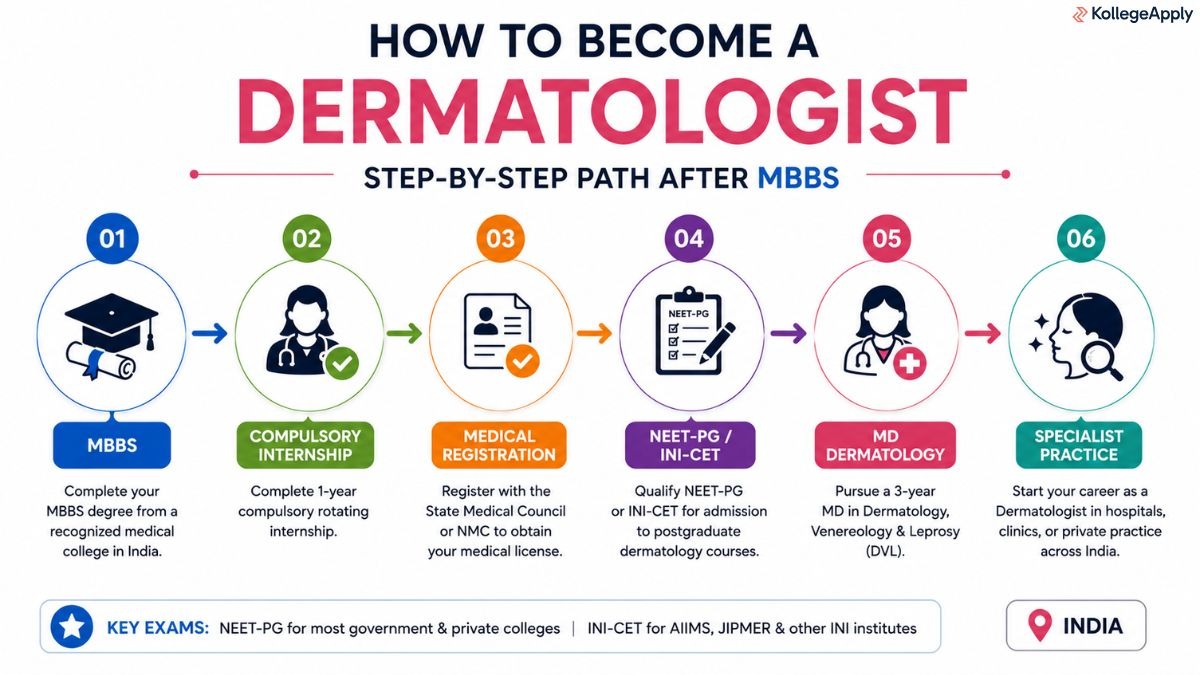
How to Become a Dermatologist After MBBS?
Becoming a dermatologist in India generally involves completing MBBS followed by postgraduate specialist training in dermatology. The typical pathway is that candidates should take is:
- Complete an MBBS degree from a recognised medical institution.
- Complete the mandatory internship within the applicable deadline.
- Fulfil the required medical registration requirements.
- Appear for NEET-PG or INI-CET, depending on the institute and admission route.
- Secure an MD Dermatology seat through the relevant counselling process.
- Complete the three-year postgraduate training.
- Meet applicable professional and registration requirements before independent practice.
Higher Studies and Specialised Training After MD Dermatology
After MD Dermatology, doctors may pursue additional training based on their career interests. Options can include recognised fellowships, institutional training programmes, observerships, research programmes and focused clinical training in areas such as dermatosurgery, pediatric dermatology, dermatopathology, trichology, aesthetic dermatology and immunodermatology. Candidates should verify the recognition, duration, curriculum and hands-on clinical exposure of any fellowship before enrolling.
MD Dermatology FAQs
What is MD in Dermatology?
MD Dermatology is a 3-year postgraduate degree after MBBS that trains doctors to diagnose and treat diseases of the skin, hair and nails.
Is a dermatologist an MBBS doctor?
Yes. A dermatologist is an MBBS-qualified doctor who completes postgraduate specialist training in Dermatology, Venereology & Leprology (DVL).
How many years is MD Dermatology in India?
MD Dermatology is a 3-year postgraduate degree pursued after MBBS and the mandatory one-year internship.
Is MD Dermatology the same as MD DVL?
In India, MD Dermatology and MD DVL generally refer to the same postgraduate specialty, although the official course title may vary by institution.
What is the eligibility for MD Dermatology?
Candidates generally need an MBBS degree, completed internship, valid medical registration and a qualifying NEET-PG score as per current admission rules.
How can I get admission to MD Dermatology?
Admission is primarily through NEET-PG, followed by MCC or state counselling, depending on the institution and seat category.
Which college is best for MD Dermatology?
AIIMS, PGIMER, JIPMER, MAMC and VMMC & Safdarjung are among the preferred institutes. The best choice depends on rank, fees, location and clinical exposure.
What is the dermatologist salary in India after MD?
Fresh MD Dermatology graduates may earn around INR 8–12 LPA, while experienced consultants and private practitioners can earn significantly more.
Can I open a clinic after MD Dermatology?
Yes. After completing MD Dermatology and meeting medical registration and applicable local regulatory requirements, graduates can establish a dermatology clinic or private practice.
Can I practise abroad after MD Dermatology from India?
Yes, but an Indian MD does not automatically permit overseas practice. Doctors must fulfil the destination country's licensing, registration and specialist-recognition requirements.