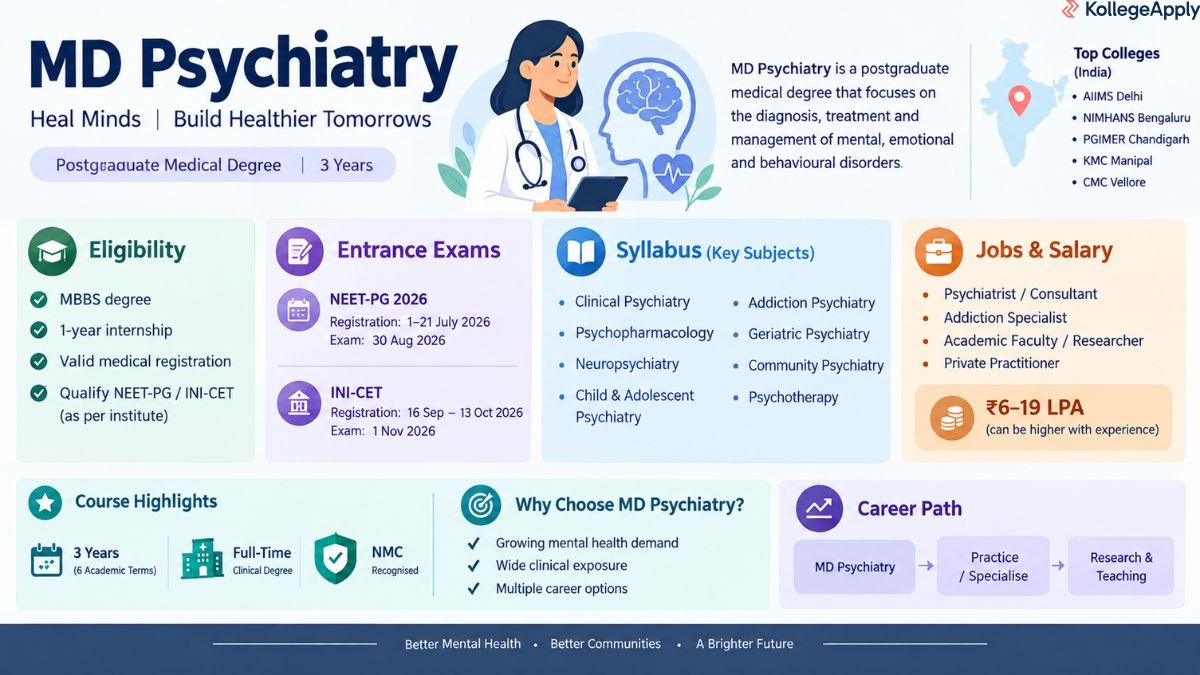
MD Psychiatry is a three-year postgraduate medical degree that focuses on the diagnosis, treatment, prevention, and management of mental, emotional, and behavioural disorders. The programme provides advanced training in clinical psychiatry, psychopharmacology, psychotherapy, neuropsychiatry, child and adolescent psychiatry, addiction psychiatry, geriatric psychiatry, and community mental health.
To pursue MD Psychiatry, candidates generally need an MBBS degree from a recognised medical institution, completion of the required one-year compulsory internship, and valid medical registration. Admission to most MD Psychiatry seats is based on NEET-PG, while institutes of national importance such as NIMHANS admit candidates through INI-CET. The admission process typically involves qualifying the relevant entrance examination, participating in counselling or seat allocation, completing document verification, and reporting to the allotted medical college.
After completing the course, graduates can work as psychiatrists, consultant psychiatrists, academic faculty, researchers, addiction specialists, or private practitioners. The MD Psychiatry salary depends on experience, location, employer, clinical responsibilities, and practice setting, with opportunities for higher earnings as professionals gain experience or establish specialised clinical practice. Current market data indicates that employed psychiatrists may earn around INR 6–19 LPA or more, while experienced professionals and private practitioners may earn more.
Table of Contents
- MD in Psychiatry Course Highlights
- What is MD Psychiatry?
- Why Study MD in Psychiatry?
- Is MD Psychiatry Worth It in 2026?
- MD in Psychiatry Eligibility
- MD in Psychiatry Entrance Exam
- MD in Psychiatry Colleges in India
- MD in Psychiatry Admission Process
- MD in Psychiatry Syllabus
- MD Psychiatry Jobs & Salary
- MD Psychiatry vs DPM
- MD in Psychiatry FAQs
MD in Psychiatry Course Highlights
The course follows competency-based postgraduate medical training and includes clinical postings, case discussions, seminars, research and dissertation work. Below are the basic highlights for the course MD Psychiatry:
What is MD Psychiatry?
MD Psychiatry is a postgraduate medical degree focused on the diagnosis, treatment, prevention and rehabilitation of mental, emotional and behavioural disorders. It is a clinical specialty in which postgraduate trainees learn to evaluate patients, formulate psychiatric diagnoses and provide appropriate medical and psychological management.
The MD Psychiatry syllabus covers general psychiatry along with areas such as child and adolescent psychiatry, addiction psychiatry, consultation-liaison psychiatry, community psychiatry, geriatric psychiatry, neuropsychiatry, psychopharmacology and psychotherapy. The NMC competency-based curriculum also includes research methodology, ethics, teaching skills and community-oriented mental healthcare.
Practical training is an important component of MD Psychiatry. Students participate in outpatient and inpatient services, clinical case presentations, psychiatric assessments, seminars, journal clubs and supervised clinical work. The exact posting structure varies between institutions.
Why Study MD in Psychiatry?
There are numerous reasons why one could opt for the course on MD Psychiatry.
- Growing need for mental-health specialists: Psychiatrists work across hospitals, mental-health institutes, de-addiction centres, community programmes and private practice.
- Wide clinical exposure: Training covers adult psychiatry as well as child and adolescent, addiction, community, geriatric and consultation-liaison psychiatry.
- Combination of medicine and behavioural sciences: The specialty involves pharmacology, neuroscience, psychology, social factors and clinical medicine.
- Multiple career pathways: Graduates can work in hospitals, medical colleges, research organisations, government services, rehabilitation centres and private practice.
- Scope for subspecialisation: After MD Psychiatry, doctors can pursue further training in areas such as addiction psychiatry, child and adolescent psychiatry, geriatric psychiatry and other focused areas.
- Research and academic opportunities: MD Psychiatry training includes research methodology, dissertation work and academic activities, allowing graduates to enter teaching and research careers.
Is MD Psychiatry Worth It in 2026?
MD Psychiatry remains a specialised clinical medical qualification with applications across hospitals, mental-health institutes, medical colleges, community programmes and private practice. NMC's current postgraduate curriculum recognises MD Psychiatry as a dedicated postgraduate specialty, with a revised competency-based curriculum available for the programme.
The financial outcome varies considerably by employer, experience, location, clinical workload and whether a psychiatrist is employed or operates an independent practice. Current salary data from Glassdoor places psychiatrist total pay in India broadly around INR 6–19 LPA, with an average base pay of about INR 87,000 per month in its available dataset. These figures are market indicators rather than guaranteed MD Psychiatry salaries.
Technology is also expanding the way psychiatric services are delivered through teleconsultation, digital mental-health services, electronic records and technology-assisted research. However, clinical assessment, diagnosis, treatment planning and patient follow-up continue to require qualified medical professionals.
MD in Psychiatry Eligibility
Candidates seeking admission to MD Psychiatry generally need to satisfy the postgraduate medical admission requirements applicable to the institute and counselling authority.
NMC postgraduate regulations require candidates entering recognised postgraduate medical courses to possess a recognised MBBS qualification and appropriate medical registration. The general eligibility criteria includes:
- Must have an MBBS degree or recognised equivalent qualification.
- Must complete the required one-year compulsory rotating internship within the prescribed cut-off date.
- Must have valid medical registration with the appropriate medical registration authority.
- For NEET-PG seats, candidates must qualify NEET-PG according to the applicable qualifying criteria.
- For institutes admitted through INI-CET, candidates must satisfy the eligibility requirements specified in the relevant INI-CET prospectus.
- Category-wise qualifying criteria, reservations and relaxation provisions are governed by the applicable regulations and admission bulletin.
- There is generally no separate upper age limit for MD Psychiatry, subject to the rules of the examination and institution.
MD in Psychiatry Entrance Exam
MD Psychiatry admission is primarily through national postgraduate medical entrance systems. NEET-PG is used for MD Psychiatry seats participating in the NEET-PG counselling system, while institutions of national importance such as NIMHANS admit MD Psychiatry candidates through INI-CET.
NBEMS had officially notified 30 August 2026 NEET-PG 2026 examination date, with 30 September 2026 as the internship completion cut-off in its January 2026 notice. NBEMS subsequently issued notices concerning the examination and a re-examination for affected candidates at specific centres. INI-CET is Conducted for January and July admission sessions; January 2027 registration is currently being opened by AIIMS. Below are details for 2026:
Note: NEET-PG conducted on 30 August 2026; re-examination was subsequently conducted for affected candidates at specified Jaipur centres on 5th of September 2026.
MD in Psychiatry Colleges in India
MD Psychiatry is offered by government medical institutions, institutes of national importance, deemed universities and private medical colleges. The admission route differs by institute. For example, NIMHANS states that admission to MD Psychiatry is through INI-CET, while NEET-PG is used for many other participating institutions.
The table below combines some of the known colleges with available published fee information. NIRF ranking is an institutional medical ranking and should not be interpreted as a course-specific Psychiatry ranking. Here are some of the institutes offering MD Psychiatry in India as per real-time 2026 data:
MD in Psychiatry Admission Process
The MD Psychiatry admission process depends on the entrance examination and institution. For NEET-PG seats, candidates generally participate in the relevant counselling process after qualifying the examination. MCC conducts counselling for 50% All India Quota PG seats and specified central/deemed university and other participating seats. The common Step-by-Step Admission Process for MD in Psychiatry is given below:
Check Eligibility: - Complete MBBS, internship and registration requirements applicable to the admission year.
Appear for the Entrance Exam: - Take NEET-PG for participating MD Psychiatry seats or INI-CET for institutes such as NIMHANS, AIIMS and PGIMER.
Register for Counselling: - NEET-PG candidates register with MCC or the relevant state counselling authority, depending on the seat category. INI-CET candidates follow the AIIMS examination and seat-allocation process.
Fill Course and College Choices: - Select MD Psychiatry and preferred participating institutes according to the applicable counselling rules.
Seat Allotment: - Seats are allotted according to merit, eligibility, category, available seats and candidate choices.
Document Verification: - The candidate reports to the allotted institution and submits the required original documents.
Fee Payment: - Pay the prescribed admission/course fees and complete joining formalities.
Documents Required
- MBBS degree/provisional degree certificate
- MBBS marksheets
- Internship completion certificate
- Permanent/provisional medical registration certificate
- NEET-PG or INI-CET scorecard
- NEET-PG/INI-CET admit card, where applicable
- Counselling allotment letter
- Valid identity proof
- Category certificate, if applicable
- PwD certificate, if applicable
- Passport-size photographs
- Migration/transfer documents, if required
- Medical fitness certificate, where required
Candidates can check the detailed MD Psychiatry admission process for counselling, seat allotment, documents and fee payment requirements.
MD in Psychiatry Syllabus
The MD Psychiatry syllabus is competency-based and includes clinical psychiatry, psychotherapy, psychopharmacology, neuropsychiatry, community psychiatry, addiction psychiatry, research and academic activities. NMC's revised curriculum specifically lists competencies related to diagnosis, treatment, prevention, rehabilitation, community psychiatry, ethics and research.
Because MD Psychiatry is a three-year programme, the training is organised across six academic terms rather than four conventional semesters. NMC regulations describe MD/MS training as three completed years and six academic terms.
Listed below are some subjects taken from the curriculum of AIIMS Rishikesh, to give students a simple syllabus from AIIMS, which is widely followed by top medical institutions offering MD Psychiatry:
Note: For detailed syllabus check out the MD Psychiatry Syllabus.
MD Psychiatry Jobs & Salary
MD Psychiatry graduates can work in government hospitals, private hospitals, mental-health institutes, medical colleges, de-addiction services, rehabilitation centres, research projects and private practice. Private-practice earnings vary substantially with consultation volume, location, professional experience, practice model and operating costs.
Note: Current market data should be treated as indicative rather than guaranteed. The job portal's current India psychiatrist salary data shows total pay around INR 6–19 LPA, with an average base pay of approximately INR 87,000 per month in its dataset.
MD Psychiatry vs DPM
DPM generally refers to a Diploma in Psychiatry/Psychological Medicine. NMC has a competency-based curriculum for the postgraduate Diploma in Psychiatry (Psychological Medicine), but historical DPM seats at several institutions were converted to degree seats, with many institutions no longer admitting fresh candidates to those diploma programmes.
MD in Psychiatry FAQs
What is a psychiatric MD?
MD Psychiatry is a 3-year postgraduate medical degree covering clinical psychiatry, psychopharmacology, psychotherapy, neuropsychiatry and mental-health care.
Is there MD in Psychiatry?
Yes, MD Psychiatry is a recognised 3-year postgraduate medical degree for MBBS graduates, with clinical training, research and psychiatric case management.
What is the duration of MD Psychiatry?
MD Psychiatry is a 3-year postgraduate degree organised across six academic terms, with clinical postings, academic work and dissertation training.
What is MD Psychiatry eligibility?
MD Psychiatry eligibility generally includes an MBBS degree, completion of the required one-year internship and valid medical registration.
Which exam is required for MD Psychiatry?
NEET-PG is used for many MD Psychiatry seats, while institutes such as NIMHANS, AIIMS and PGIMER admit through INI-CET.
What is the MD Psychiatry salary in India?
MD Psychiatry salary varies by experience, employer and location. Current market data indicates about INR 6–19 LPA or more for employed roles.
What does the MD Psychiatry syllabus include?
The MD Psychiatry syllabus covers general psychiatry, child psychiatry, addiction, neuropsychiatry, psychotherapy, community psychiatry and research.
Can MD Psychiatry graduates work in hospitals?
Yes, MD Psychiatry graduates can work in government and private hospitals, mental-health institutes, medical colleges, de-addiction services and private practice.
Which is better, MD or DPM in Psychiatry?
MD Psychiatry is a 3-year degree, while DPM is a diploma. DPM availability is limited, so recognition and current seats should be checked.
What are the jobs after MD Psychiatry?
After MD Psychiatry, graduates can work as psychiatrists, consultants, academic faculty, researchers, addiction specialists or private practitioners.