BPT course, which stands for Bachelor of Physiotherapy, is an undergraduate programme designed for students who want to build a career as professional physiotherapists. The course typically includes 4 years of academic study followed by a 6-month to 1-year internship, combining theoretical learning with practical and clinical training. Students study subjects such as Anatomy, Physiology, Clinical Biochemistry, Biomechanics, and Kinesiology, along with other areas related to physiotherapy and rehabilitation.
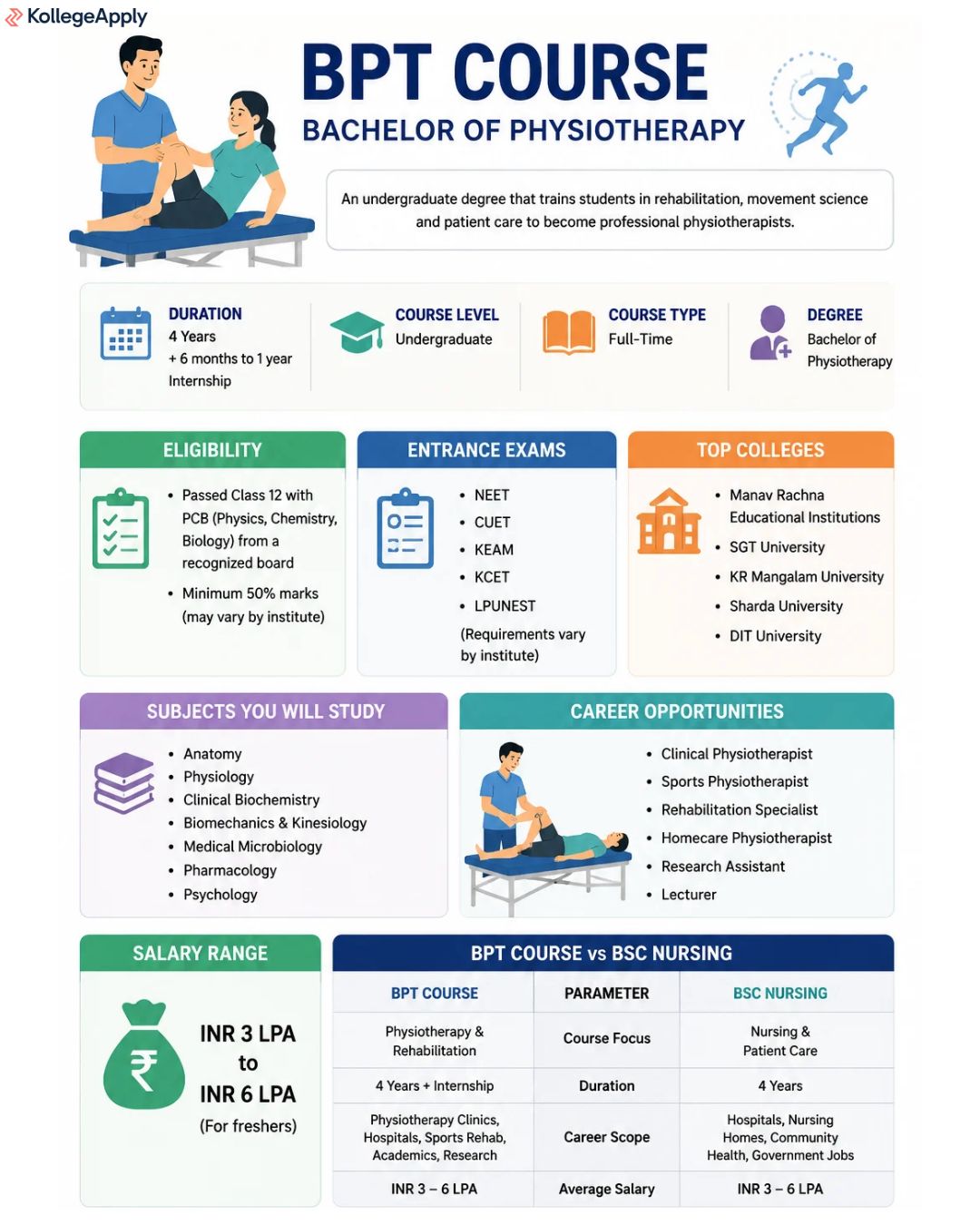
To be eligible for BPT admission, students generally need to have passed Class 12 with Physics, Chemistry, and Biology (PCB) from a recognised board. Many institutions require a minimum of 50% marks, although the eligibility criteria may vary by college or university. Admission may be based on entrance exams such as NEET UG, CUET UG, LPUNEST, KEAM, and KCET, as well as institution-specific admission processes. Reserved category students may also receive relaxation in the minimum marks requirement, depending on the applicable rules.
After completing the 4-year academic programme and internship, graduates can explore various career opportunities in the healthcare and rehabilitation sector. They can work in hospitals, clinics, rehabilitation centres, sports facilities, fitness centres, and other healthcare settings. Graduates can also pursue higher education, research, teaching, or specialised areas of physiotherapy. The average BPT salary generally ranges from INR 3 LPA to INR 6 LPA, depending on factors such as experience, specialisation, employer, and location. Popular job roles include Physiotherapist, Clinical Physiotherapist, Sports Physiotherapist, Rehabilitation Specialist, Lecturer, and Research Assistant.
Table of Contents
- BPT Course Highlights
- What is a BPT Course?
- Why Pursue a BPT Course?
- Is the BPT Course Worth It in 2026?
- Is NEET Required for BPT?
- What is the Eligibility Criteria for BPT Course?
- Which Entrance Exams Are Required for BPT Admission?
- What Is the BPT Course Admission Process 2026?
- What is the BPT Course Syllabus?
- Career Opportunities After BPT Course
- BPT Course vs BSc Nursing
- BPT Course FAQs
BPT Course Highlights
It is crucial for aspirants to take into account several components of the BPT course before taking admission into their desired college. Elements such as BPT course fees, eligibility, and various other BPT course details are essential for students to understand. These details help students make better educational decisions and gain a clearer understanding of the program. To provide better clarity regarding BPT course details, a table highlighting the key aspects of the program is provided below:
What is a BPT Course?
The full form of BPT is Bachelor of Physiotherapy. It is an undergraduate programme designed for students interested in human movement, physical rehabilitation, and patient care. The course equips students with the knowledge and practical skills required to help improve and restore patients' movement, physical function, and quality of life. Students develop a strong understanding of human anatomy, including bones, muscles, joints, and nerves.
The BPT course generally includes 4 years of academic study followed by a 6 month to 1-year internship, combining theoretical learning with practical and clinical training. The curriculum covers subjects such as Biomechanics and Kinesiology, Medical Microbiology, Pharmacology, General Medicine, Pediatrics, Psychiatry, and other areas related to physiotherapy and rehabilitation. Students gain hands-on clinical exposure during their training, helping them develop the skills required for a career in physiotherapy.
Why Pursue a BPT Course?
A BPT course can be a suitable choice for students interested in healthcare, physical rehabilitation, and patient care. Some of the key reasons to pursue a Bachelor of Physiotherapy include:
- Growing career opportunities: Physiotherapists can work across hospitals, rehabilitation centres, sports clinics, fitness centres, and other healthcare settings.
- Practical learning: The programme combines classroom education with clinical training and internship experience.
- Multiple specialisations: Graduates can develop expertise in areas such as neurological, geriatric, paediatric, sports, and cardiopulmonary physiotherapy.
- Private practice opportunities: After gaining the required experience and meeting applicable professional requirements, graduates can explore opportunities in private physiotherapy practice.
- Meaningful healthcare career: Physiotherapists help patients improve mobility, manage physical limitations, and enhance their quality of life.
- Higher education opportunities: Graduates can pursue advanced programmes such as a Master of Physiotherapy (MPT) and specialise in specific areas of physiotherapy.
- Research and teaching: BPT graduates can also explore opportunities in research, academics, and healthcare education.
Is the BPT Course Worth It in 2026?
Yes, a BPT course can be a good career option in 2026 for students interested in physiotherapy, rehabilitation, and allied healthcare. The programme combines academic learning with clinical training and internship experience, helping students develop practical skills for working with patients.
The demand for physiotherapy services is supported by factors such as an ageing population, lifestyle-related health concerns, sports injuries, and the growing need for rehabilitation services. Graduates can explore career opportunities in hospitals, rehabilitation centres, sports clinics, fitness centres, community healthcare settings, and private practice.
Physiotherapy bachelor degree graduates can also pursue higher education, including MPT programmes, to specialise in areas such as sports, neurological, orthopaedic, paediatric, or cardiopulmonary physiotherapy. However, career growth and salary after BPT depend on factors such as specialisation, experience, location, employer, and work setting.
Is NEET Required for BPT?
NEET is not uniformly required for BPT colleges and universities. Admission requirements vary by institution and state. Some institutions may accept NEET scores, while others may conduct their own entrance examinations, accept other entrance tests, or offer admission based on merit. Students should check the latest eligibility and admission requirements of the college or university they wish to join.
What is the Eligibility Criteria for BPT Course?
The BPT course eligibility criteria consist of factors such as the successful completion of the Class 12 examination, entrance exam scores, and other admission requirements prescribed by colleges and universities. Students aiming for admission into a BPT program must ensure that they fulfil the required eligibility conditions, as institutions use these criteria to assess the suitability of applicants for the course. Students can refer to the table given below to learn more about the BPT course eligibility:
Which Entrance Exams Are Required for BPT Admission?
BPT admission requirements vary by college, university, and state. While some institutions consider scores from entrance examinations, others may offer admission based on merit or conduct their own selection process. Some of the entrance exams accepted by institutions for Bachelor of Physiotherapy (BPT) admission include NEET UG, CUET UG, KEAM, and KCET. Students should check the latest admission requirements of their preferred college before applying.
Which Colleges Offer a BPT Course in India?
Several colleges and universities in India offer Bachelor of Physiotherapy (BPT) programmes. The course fees vary depending on the institution and location. For instance, Manav Rachna Educational Institutions in Faridabad charges around INR 2.95 lakh per year, while KR Mangalam University in Gurgaon has an annual fee of around INR 1.58 lakh. Nirwan University in Jaipur has a comparatively lower annual fee of INR 70,000. Students can check out the table given below to learn more:
What Is the BPT Course Admission Process 2026?
Students who wish to take part in the BPT Admission 2026 process must fulfil the required eligibility criteria and complete all admission-related formalities within the prescribed timeline. The admission process generally includes stages such as meeting the eligibility requirements, submitting the application form, presenting valid entrance exam scores, participating in counselling, and completing document verification. To help students better understand the procedure, a step-by-step overview of the BPT admission process followed at The Apollo University is provided below:
Step 1: Candidates must have passed Class 12 or an equivalent examination from a recognized board with at least 45% marks. They must have studied Botany, Zoology, Physics, and Chemistry, or an equivalent vocational stream with a bridge course in Biological and Physical Sciences.
Step 2: Students may be required to present valid entrance exam scores for admission. Some commonly accepted examinations include NEET UG, CUET UG, and other relevant national, state, or university-level entrance exams as specified by the university.
Step 3: Eligible candidates must apply online through the official admission portal of The Apollo University. Applicants are required to fill in the necessary details and upload documents such as Class 10 and 12 mark sheets, identity proof, and other relevant certificates.
Step 4: After the completion of the admission process, candidates should check the official website for results and merit list announcements. Merit lists are generally prepared based on entrance exam scores and academic performance.
Step 5: Shortlisted candidates must attend the counselling process and select their preferred course. Seats are allotted based on merit rank, category, seat availability, and applicable reservation policies.
Step 6: Candidates are required to submit their original documents for verification at the allotted institution. After successful document verification, candidates must pay the prescribed admission fee to confirm their seat.
Documents Required
What is the BPT Course Syllabus?
BPT subjects are structured across 4 years of academic study, followed by 6 months to 1 year of internship, depending on the institute. The syllabus consists of core physiotherapy subjects that focus on building a strong foundation in human anatomy, physiology, and rehabilitation sciences before progressing to more specialized areas of the physiotherapy field. This balanced approach helps students develop both theoretical knowledge and practical clinical skills. Students interested in learning more about the BPT Course syllabus can refer to the table below, which highlights the curriculum structure followed at Atal Bihari Vajpayee Medical University:
Career Opportunities After BPT Course
Students can explore a variety of career opportunities after completing a BPT course in hospitals, rehabilitation centres, sports clinics, fitness centres, community healthcare organisations, and educational institutions. The BPT salary generally ranges from INR 3 LPA to INR 6 LPA, depending on factors such as experience, specialisation, location, and employer. Popular job roles after BPT include Clinical Physiotherapist, Geriatric Care Expert, Pediatric Physiotherapist, Neurological Physiotherapist, and Research Assistant. The table below highlights some of the common career opportunities after BPT, along with their employers and salary ranges:
BPT Course vs BSc Nursing
Students must analyze the available course options after completing the Class 12 examination and select the program that best aligns with their career aspirations. BPT Course and BSc Nursing are two popular healthcare programs that offer promising career opportunities and professional growth. However, the two courses differ in terms of curriculum, career scope, job roles, and practical training. Students can refer to the table below to understand the key differences between BPT Course vs BSc Nursing.
BPT Course FAQs
What is a BPT Course?
A BPT Course is a Bachelor of Physiotherapy degree that trains students in rehabilitation, movement science, and patient care. The programme typically includes 4 years of academic study followed by internship training.
What is the BPT course duration?
The BPT course duration is generally 4 years of academic study followed by 6 months to 1 year of compulsory internship, depending on the institute.
What is the eligibility criteria for BPT Course?
The BPT course eligibility criteria require candidates to pass Class 12 with PCB subjects and a minimum of 50% marks from a recognised board.
Is NEET required for BPT admission?
No, BPT admission does not always require NEET. Many colleges accept scores from CUET, KCET, KEAM, and LPUNEST, while some institutions conduct their own admission process.
What is the BPT course fee in private colleges?
The BPT course fee in private colleges usually ranges from INR 70,000 to INR 2.95 lakh per year, depending on factors such as facilities, location, and reputation.
What are the Bachelor of Physiotherapy salary packages offered to graduates?
The average Bachelor of Physiotherapy salary ranges from INR 3 LPA to INR 6 LPA for freshers and can increase significantly with experience and specialisation.
What are the BPT course jobs offered to freshers?
Popular BPT course jobs for freshers include Clinical Physiotherapist, Sports Rehab Specialist, Homecare Physiotherapist, Research Assistant, and Rehabilitation Coordinator.
Which are some popular Bachelor of Physiotherapy colleges in India?
Some well-known Bachelor of Physiotherapy colleges include Manav Rachna, SGT University, KR Mangalam University, Sharda University, and DIT University.