BBA LLB Syllabus combines business administration and legal education in a five-year integrated undergraduate programme, generally spread across 10 semesters. Students study BBA LLB subjects such as management, accounting, economics, marketing and human resources along with contracts, constitutional law, criminal law, corporate law, taxation, IPR and other legal disciplines. The curriculum is designed to develop both business understanding and professional legal skills.
Along with classroom learning, the BBA LLB syllabus includes clinical courses, moot courts, legal research, drafting, advocacy and internships. The exact subjects differ between universities. For example, the BBA LL.B. (Hons.) curriculum of Maharashtra National Law University, Nagpur includes management and business subjects alongside legal courses, while RIMT University includes subjects such as digital marketing, entrepreneurship, cyber laws, taxation and professional readiness.
BBA LLB Syllabus combines business administration and legal education in a five-year integrated undergraduate programme, generally spread across 10 semesters. Students study BBA LLB subjects such as management, accounting, economics, marketing and human resources along with contracts, constitutional law, criminal law, corporate law, taxation, IPR and other legal disciplines. The curriculum is designed to develop both business understanding and professional legal skills.
Along with classroom learning, the BBA LLB syllabus includes clinical courses, moot courts, legal research, drafting, advocacy and internships. The exact subjects differ between universities. For example, the BBA LL.B. (Hons.) curriculum of Maharashtra National Law University, Nagpur includes management and business subjects alongside legal courses, while RIMT University includes subjects such as digital marketing, entrepreneurship, cyber laws, taxation and professional readiness.
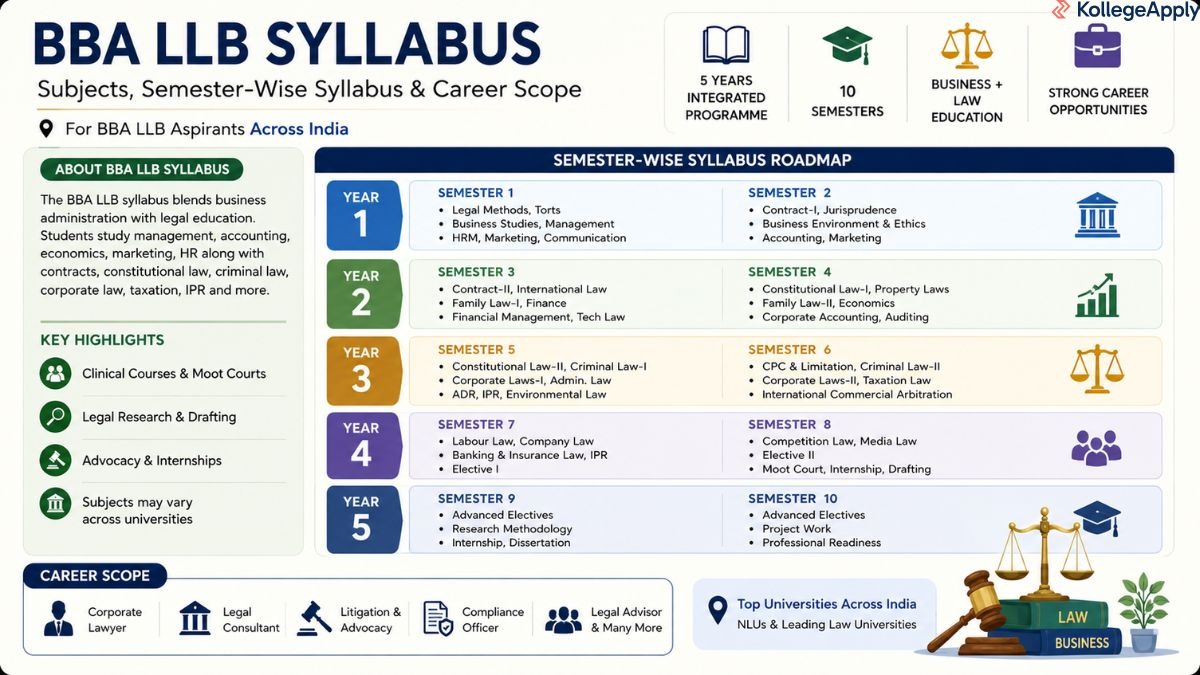
Table of Contents
BBA LLB Syllabus Semester-Wise
The BBA LLB syllabus at Maharashtra National Law University, Nagpur follows a five-year, 10-semester structure. It combines foundational business subjects with progressively advanced legal courses, clinical training and optional papers. The curriculum also includes areas such as corporate law, taxation, banking, IPR and international trade.
BBA LLB Subjects 1st Year
The BBA LLB subjects 1st year establish the foundation of both disciplines. Students are introduced to legal methods, torts and contracts while simultaneously studying business studies, management, accounting, marketing and communication.
Second Year: Semester 3 and 4
The second year moves from introductory subjects to more specialised areas. Students study constitutional, family, property and international law while strengthening their understanding of finance, economics, accounting, auditing and technology.
Third Year: Semester 5 and 6
The third year introduces major areas of professional legal education, including criminal law, corporate law, administrative law and environmental law. Clinical courses also begin to provide practical exposure through alternative dispute resolution and international commercial arbitration.
Fourth Year: Semester 7 and 8
The fourth-year BBA LLB syllabus focuses more strongly on professional and commercial legal areas. Students study taxation, labour law, evidence, IPR and environmental law, alongside research and company-secretaryship-oriented clinical courses.
Fifth Year: Semester 9 and 10
The final year of the BBA LLB syllabus focuses on advanced commercial and professional law. Students study banking, financial laws, CSR, drafting, international trade, professional ethics and optional specialisations while developing practical readiness for legal careers.
BBA LLB Syllabus in Private University
Private universities may structure the BBA LLB syllabus differently while retaining the integrated combination of business and law. RIMT University's curriculum, for example, includes business economics, accounting, marketing, management and entrepreneurship along with BNS, BNSS, constitutional law, corporate law, cyber law, taxation and clinical legal courses.
Electives in BBA LLB Syllabus
Electives allow students to move beyond the compulsory BBA LLB subjects and explore areas aligned with their intended career. MNLU Nagpur's optional-course list includes commercial, financial, technology, international, criminal justice, infrastructure and emerging legal specialisations.
Practical Training / Internship in BBA LLB
Practical training is an important part of the BBA LLB curriculum because legal education involves applying classroom concepts to real legal and business situations. Clinical courses, moot courts, drafting, research, advocacy and internships help students develop professional skills before graduation. Key practical components include:
- Moot Court: Students practise legal arguments, case presentation and courtroom advocacy.
- Legal Research: Students learn to identify legal issues, analyse authorities and prepare research-based work.
- Drafting and Pleading: Training develops skills in preparing legal documents and pleadings.
- Alternative Dispute Resolution: Students learn approaches such as mediation, negotiation and arbitration.
- Business Analysis and Research: The MNLU Nagpur curriculum includes a clinical course focused on business analysis and research.
- Internship: Internships provide exposure to law firms, courts, companies, legal departments, NGOs and other legal workplaces.
- Professional Ethics: Students develop an understanding of professional conduct and responsibilities.
Skills Developed Through BBA LLB Syllabus
The combination of business education and legal training makes the BBA LLB syllabus broader than a purely law-focused curriculum. Students develop communication, research, analytical and advocacy abilities while also gaining an understanding of management, finance, business operations and commercial decision-making.
Books for BBA LLB Syllabus
The right books depend on the university's prescribed reading list and the subjects studied in each semester. Students should prioritise books recommended by their faculty and use the latest editions, particularly for subjects affected by changes in Indian legislation.
Note: Students should verify the latest edition and their university's prescribed reading list before purchasing books. For criminal-law subjects in particular, students should use materials aligned with the Bharatiya Nyaya Sanhita, Bharatiya Nagarik Suraksha Sanhita and Bharatiya Sakshya Adhiniyam, where applicable. RIMT's current curriculum explicitly incorporates BNS, BNSS and BSA.
BBA LLB Syllabus FAQs
What is the BBA LLB syllabus?
The BBA LLB syllabus combines management, accounting and economics with contracts, constitutional, corporate, criminal and other legal subjects.
What subjects are there in BBA LLB?
BBA LLB subjects include management, accounting, marketing, contracts, constitutional law, corporate law, taxation, IPR and international law.
What are the BBA LLB subjects 1st year?
BBA LLB subjects 1st year include Legal Methods, Torts, Business Studies, Management, HRM, Contracts, Accounting, Marketing and Business Communication.
How many semesters are in the BBA LLB syllabus?
The BBA LLB syllabus is generally structured over five years and 10 semesters, although subjects vary across universities.
Does BBA LLB include practical training?
Yes. The BBA LLB syllabus includes moot courts, clinical courses, legal research, drafting, advocacy and internships for practical exposure.
Are there electives in the BBA LLB syllabus?
Yes. Electives can include cyber law, IPR, investment law, international trade, competition law, sports law and other specialised areas.
Is BBA LLB hard or easy?
BBA LLB requires regular reading, legal reasoning, research and writing. Its difficulty depends on the student's interest and consistency.
Which is better, LLB or BBA LLB?
BBA LLB suits students seeking business and legal knowledge, while a three-year LLB suits graduates seeking a focused legal programme.
What is the BBA LLB syllabus at private universities?
Private universities may add subjects such as digital marketing, entrepreneurship, cyber forensics, GST, professional readiness and specialised electives.
What can I do after studying the BBA LLB syllabus?
BBA LLB graduates can pursue corporate law, litigation, compliance, banking, taxation, IPR, legal consulting and government-related legal careers.