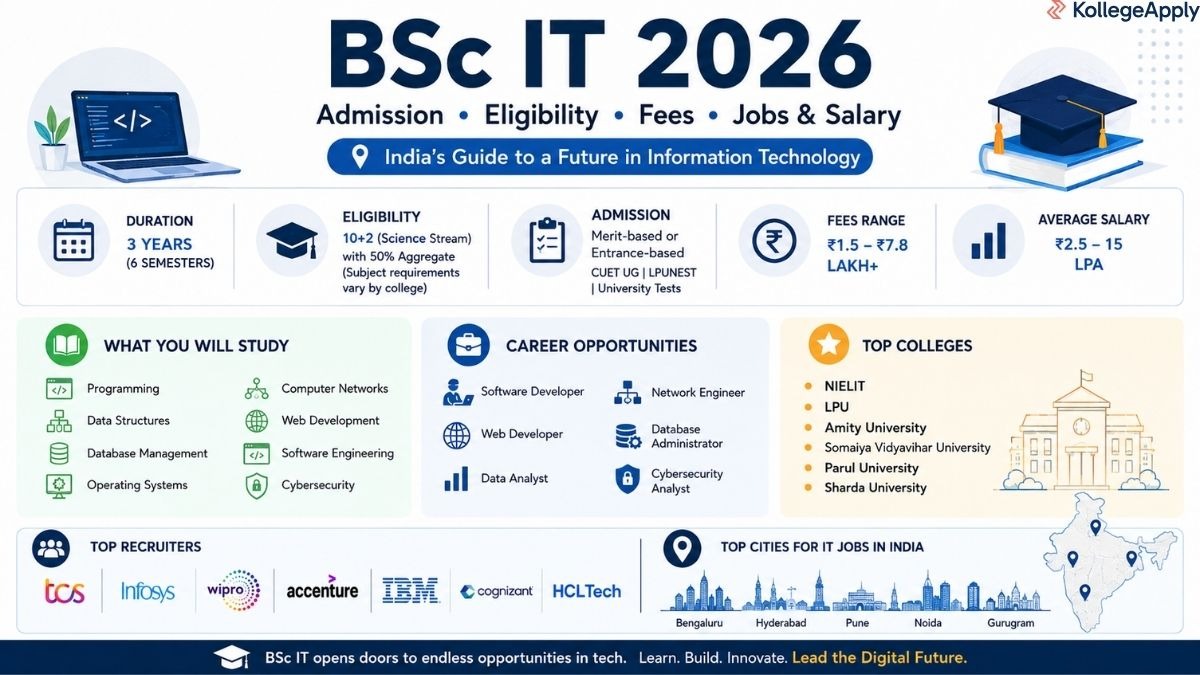
BSc IT, or Bachelor of Science in Information Technology, is a three-year undergraduate degree that focuses on computer systems, programming, databases, networking, web technologies and software development. The BSc IT course is generally divided into six semesters, although some universities may offer four-year Honours or Honours with Research pathways.
Students who have completed Class 12 from a recognised board can apply for BSc IT, but the exact eligibility criteria vary by college. Mathematics, Statistics, Computer Science or a related subject may be required by some institutions, while others accept students from Science, Commerce or Arts backgrounds subject to their programme-specific rules. Admission may be based on Class 12 merit, CUET UG, university-level entrance tests or other institution-specific criteria.
The BSc IT course includes both theoretical and practical learning through programming assignments, laboratory work, projects and technical activities. Students study subjects such as programming, data structures, operating systems, database management, computer networks, web development and cybersecurity. After completing the degree, graduates can explore BSc IT jobs in software development, web development, networking, database administration, technical support, cybersecurity, data analytics and cloud computing.
- BSc IT Course Highlights
- What is BSc IT?
- Why Pursue BSc IT?
- Is BSc IT Worth It in 2026?
- BSc IT Eligibility Criteria
- BSc IT Entrance Exams 2026
- BSc IT Colleges in India
- BSc IT Fees in India
- BSc IT Syllabus
- What Skills are Required for BSc IT?
- BSc IT Jobs and Salary
- What is the Salary After BSc IT?
- Top Recruiters for BSc IT
- BSc IT vs BCA
- BSc IT Jobs and Career Scope
- How to Increase BSc IT Salary?
- BSc IT FAQS
BSc IT Course Highlights
The following table summarises the important BSc IT course details that students should know before applying. The course generally lasts three years and provides a combination of programming, computing and information technology subjects. Fees, admission routes and eligibility can differ considerably between universities, so students should verify institution-specific requirements before applying.
What is BSc IT?
BSc IT is an undergraduate programme designed to provide students with academic and practical knowledge of information technology. The BSc in IT course covers the technologies used to develop, manage and maintain computer-based systems and digital applications.
The core curriculum usually includes programming languages, data structures, database management, operating systems, computer networks and web technologies. Depending on the university, students may also study cloud computing, cybersecurity, artificial intelligence, Internet of Things, software engineering and data analytics.
Practical learning is an important part of the BSc IT course. Students may complete programming assignments, laboratory exercises, software projects, database activities and web-development projects. This practical exposure helps students apply classroom concepts to technology-based problems.
A BSc IT degree can suit students who are interested in computers, programming, software, digital systems and problem-solving. After graduation, students can enter IT jobs or pursue higher studies such as MCA, MSc IT, MSc Computer Science, MBA or specialised professional certifications.
Why Pursue BSc IT?
The BSc IT course can be a useful undergraduate option for students who want to build a career in information technology without pursuing a traditional engineering degree. Its combination of computing fundamentals and practical skills can provide several career pathways.
- Growing IT Opportunities: Software, cloud, cybersecurity, data and digital services continue to create technology-related employment opportunities.
- Practical Skill Development: Students develop programming, database, networking and problem-solving skills through coursework and projects.
- Multiple Career Paths: BSc IT graduates can explore software development, web development, networking, technical support, cybersecurity and data-related roles.
- Scope for Specialisation: Students can build expertise in areas such as cloud computing, artificial intelligence, cybersecurity or data analytics.
- Higher Salary Potential With Experience: Salary generally improves as graduates gain experience, technical expertise and responsibility.
- Higher Studies Options: Graduates can pursue MCA, MSc IT, MSc Computer Science, MBA or relevant professional certifications.
Is BSc IT Worth It in 2026?
BSc IT can be a relevant undergraduate choice in 2026 for students who are interested in technology and are willing to continuously update their technical skills. Employers increasingly value practical abilities in programming, cloud platforms, cybersecurity, databases, data analytics and software development.
However, the value of the degree depends on more than the course name. Students should consider the college's curriculum, laboratory facilities, internships, placement support, faculty, project opportunities and overall fees before taking admission. Building practical projects alongside the BSc IT degree can also improve employability.
The BSc IT scope can expand further when graduates develop specialised skills and gain professional experience. Students may start in entry-level IT roles and progress towards senior technical, consulting, project management or specialised positions.
BSc IT Eligibility Criteria
A BSc in IT is a high-demand course among students who would like to make a career in computers and information technology. The student should see whether they have the minimum qualification as per the rules of the institutes and universities.
- Educational Qualification: Students should have passed 10+2 from a recognised board. Students who have completed their diplomas are also eligible for this course.
- Subject Requirements: Most colleges expect students to have studied Science subjects in Class 12, particularly Mathematics, Physics, and Computer Science or Information Technology.
- Minimum Marks: Students normally require at least 50% marks in Class 12 examinations. Some colleges might have a higher or lower cut-off.
- Age Limit: There is no fixed age limit in most colleges, but students must refer to the individual rules of the college they are applying to.
- Entrance Exams: There are some entrance exams that may be required by some colleges. Some other students on the basis of Class 12 marks.
BSc IT Entrance Exams 2026
BSc IT admission may be based on Class 12 merit or entrance examinations, depending on the college and university. Students can use the table below to identify the relevant entrance exams, check their conducting bodies, compare application and examination timelines, and review the applicable application fees. Since not every exam is accepted by every institution, candidates should first check the admission requirements of their preferred college and then apply for the relevant examination.Here are some of the important exams for the same:
BSc IT Colleges in India
There is no single national ranking that can determine the best BSc IT college for every student. The right choice depends on course curriculum, fees, admission route, location, internships, practical exposure and placement opportunities. The colleges below are among the institutions referenced for BSc IT and related undergraduate IT education in the supplied college list.
NIRF rankings are institution/category rankings and do not represent a specific BSc IT programme. Therefore, students should not use a NIRF rank alone to judge the quality of a BSc IT course.
Note: The fee figures are approximate references based on the college list provided and can change according to academic year, scholarship, category, programme structure, campus and additional charges.
BSc IT Fees in India
BSc IT fees vary considerably between government institutions, private universities and deemed universities. Based on the colleges listed above, the total course fees can range from approximately INR 1.5 lakh to INR 7.8 lakh or more.
Government or publicly supported institutions may have comparatively lower fees, while private universities may charge higher tuition because of programme structure, facilities and additional academic services. Scholarships can also significantly reduce the final amount payable at some universities.
BSc IT Admission Process 2026
Students should know about the admission process of the BSc IT course. This will help them to prepare for the admission process of their interested colleges. This is the process of the University of Mumbai:
Step 1: Students must check if they are eligible for the BSc Information Technology.
Step 2: Students must visit the official admission portal of the University of Mumbai. They should create a new student account through a valid email address and mobile number.
Step 3: Students must complete the pre-enrolment form on the university's website. Personal, academic, and contact details must be entered appropriately.
Step 4: Students will have to select the colleges of the University of Mumbai to which they will be making applications. Students will have to fill individual application forms for every college.
Step 5: The student needs to upload scanned documents.
Step 6: Students need to pay the application fee online.
Step 7: Merit lists will be published by colleges on the basis of Class 12 marks or entrance test marks.
Step 8: Shortlisted candidates need to report to the college for verification of documents. They might be required to attend a counselling session as well.
Step 9: The student needs to pay the admission fee and validate original documents in order to confirm their seat.
Document Required:
BSc IT Syllabus
The BSc IT syllabus introduces students to core concepts in computing and information technology while gradually developing their technical and practical skills. Course subjects and semester-wise structure can vary across universities; therefore, students should review the curriculum of their preferred institution before applying. The table below presents the semester-wise BSc IT syllabus for Amity University, including foundational subjects, major requirements, electives and common curriculum courses.
What Skills are Required for BSc IT?
A BSc IT curriculum develops a strong foundation in information technology, but students also need to apply this knowledge through practical and professional skills. Programming, databases, problem-solving and analytical thinking are important for handling technical tasks, while communication, teamwork and time management support effective project execution. Students can strengthen these skills through academic projects, internships, certifications and hands-on practice, depending on their career goals.
- Programming: Knowledge of languages such as Python, Java, JavaScript or C++.
- Database Management: Understanding SQL, database design and data management.
- Problem Solving: Ability to analyse technical problems and develop logical solutions.
- Analytical Thinking: Useful for debugging, data analysis and system-related tasks.
- Communication: Helps professionals explain technical information clearly.
- Teamwork: IT projects often involve developers, testers, designers and business teams.
- Time Management: Helps students handle projects, assignments and multiple technical tasks.
- Cloud Skills: Familiarity with cloud platforms can support careers in modern IT infrastructure.
- Cybersecurity Awareness: Understanding security principles is valuable across IT roles.
- Continuous Learning: Technology changes quickly, making regular skill development important.
BSc IT Jobs and Salary
For students specifically searching for BSc IT jobs salary per month, monthly earnings can vary significantly between technical roles. Specialised positions in cloud computing, artificial intelligence and project management generally have higher earning potential than entry-level support roles.
Note: These are indicative ranges and are not guaranteed starting salaries. Actual BSc IT salary varies according to employer, skills, experience, location and role.
What is the Salary After BSc IT?
The salary after BSc IT generally increases with professional experience and technical specialisation. Fresh graduates may begin in junior software development, support, testing, web development or networking roles, while experienced professionals can move into specialised or leadership positions.
Students should focus on skills and career progression rather than treating the degree alone as a guarantee of a particular salary package. Certifications, internships, coding projects and experience with industry technologies can support better career opportunities.
Top Recruiters for BSc IT
BSc IT graduates can find opportunities across IT services, software development, consulting, telecommunications, financial technology and digital businesses. Recruitment depends on the student's technical profile, college placement ecosystem, internships and job market conditions.
BSc IT vs BCA
BSc IT and BCA are both undergraduate programmes that can lead to careers in information technology. However, their curriculum and academic orientation can differ between universities. BSc IT generally places stronger emphasis on information technology concepts, computing systems and technical foundations, while BCA focuses more directly on computer applications and software development.
BSc IT Jobs and Career Scope
The BSc IT scope extends beyond traditional software development. Graduates can build careers in technical support, networking, databases, cybersecurity, cloud computing, data analytics and web development. Common BSc IT jobs include:
- Software Developer
- Web Developer
- Mobile Application Developer
- Network Engineer
- Database Administrator
- System Administrator
- IT Support Specialist
- Data Analyst
- Cybersecurity Analyst
- Cloud Computing Specialist
- QA/Test Analyst
- System Analyst
Career progression depends heavily on practical skills and professional experience. A graduate may begin in an entry-level role and later move into specialised technical, consulting, project management or leadership positions.
How to Increase BSc IT Salary?
Students can improve their earning potential by developing skills that are relevant to their target IT role. The degree provides the academic foundation, but practical competence often determines how effectively graduates can compete for jobs.
- Build Programming Skills: Learn at least one programming language well and practise through projects.
- Develop Projects: Create websites, applications, dashboards or other technical projects for your portfolio.
- Complete Internships: Gain exposure to real workplace projects and development processes.
- Choose a Specialisation: Consider cloud computing, cybersecurity, data analytics, AI or software development.
- Learn Industry Tools: Gain familiarity with databases, Git, cloud platforms and development environments.
- Improve Communication: Strong communication supports interviews, teamwork and career progression.
- Earn Relevant Certifications: Industry-recognised certifications can complement the BSc IT degree.
- Consider Higher Studies: MCA, MSc IT and other postgraduate programmes can provide advanced academic and career pathways.
BSc IT FAQS
What is the BSc IT full form?
BSc IT stands for Bachelor of Science in Information Technology, an undergraduate programme focused on computing, programming and information technology.
What is a BSc IT course?
BSc IT is generally a three-year undergraduate programme covering programming, databases, networking, web technologies and other information technology concepts.
What is the eligibility for BSc IT?
BSc IT eligibility generally requires Class 12 completion. Subject and minimum marks requirements vary by college and university.
What is the BSc IT salary for freshers?
Freshers may earn approximately INR 2.5–5 LPA, depending on their job role, technical skills, employer, location and experience.
What are the BSc IT subjects?
Common BSc IT subjects include programming, data structures, DBMS, computer networks, operating systems, web development and software engineering.
Is BSc IT a good career?
BSc IT can offer career opportunities in software development, cybersecurity, cloud computing, data analytics, networking and technical support.
Is BCA better or BSc IT?
Neither course is universally better. BSc IT focuses on IT systems and computing, while BCA generally emphasises computer applications and software development.
What are the BSc IT jobs after graduation?
Graduates can pursue roles such as Software Developer, Web Developer, Data Analyst, Network Engineer and Cybersecurity Analyst.
What is the BSc IT course fee in India?
BSc IT fees vary by institution. Based on the colleges listed, approximate total fees range from INR 1.5 lakh to INR 7.8 lakh or more.
Does BSc IT have scope in the future?
Yes. BSc IT offers career opportunities in software, cloud computing, cybersecurity, data analytics, networking and other technology-related fields.