BSc Chemistry is an undergraduate degree that focuses on the study of matter, its composition, properties, reactions and transformations. The BSc Chemistry course covers major areas such as Organic Chemistry, Inorganic Chemistry, Physical Chemistry and Analytical Chemistry, along with practical laboratory work. It is offered as a regular BSc, Chemistry Honours and research-oriented undergraduate programme. Depending on the university, the course may be structured for three or four years.
For BSc Chemistry admission 2026, candidates generally need to complete Class 12 with the Science stream and meet the subject and marks requirements of the university. Admission may be based on Class 12 merit, CUET UG or a university-specific entrance examination. Students should check the admission criteria of the university before applying.
The BSc Chemistry degree provides career opportunities in pharmaceuticals, chemical industries, laboratories, research organisations, environmental agencies, food industries and education. The salary after BSc Chemistry varies according to the role, organisation, skills, experience and qualifications. Students can also pursue MSc Chemistry, MSc Biochemistry, MBA, BEd or other higher studies after graduation.
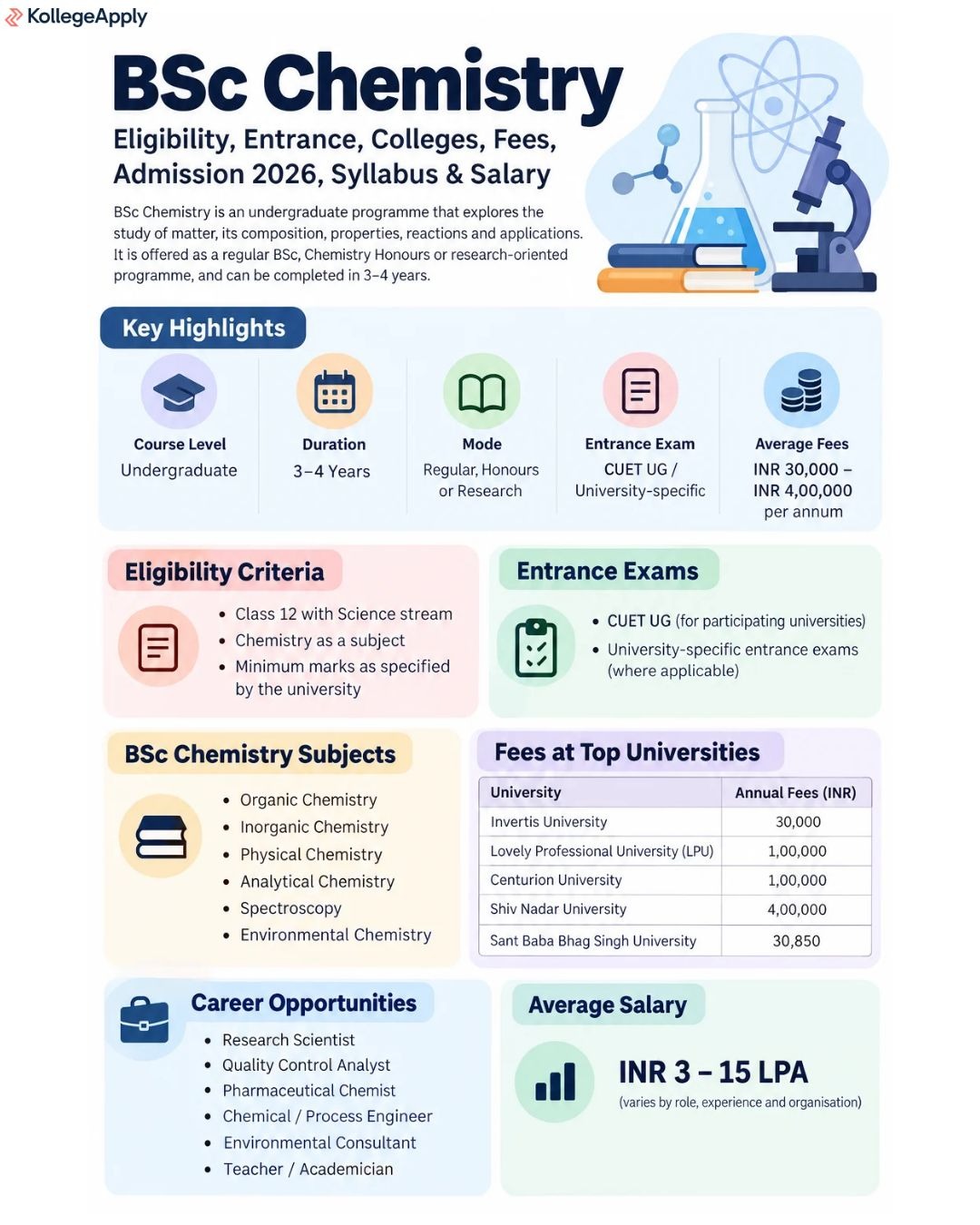
- What are the Key Highlights of BSc Chemistry?
- What is the BSc Chemistry Course?
- What is the Eligibility Criteria for BSc Chemistry?
- What are the Entrance Exams for BSc Chemistry Admission 2026?
- Which Colleges and Universities Offer BSc Chemistry?
- What are the Fees for BSc Chemistry?
- What is the Admission Process for BSc Chemistry?
- What is the Syllabus of BSc Chemistry?
- What are the Career Opportunities After BSc Chemistry?
- What is the Salary After BSc Chemistry?
- Which Industries Hire BSc Chemistry Graduates?
- What are the Higher Study Options After BSc Chemistry?
- What is the Difference Between BSc Chemistry and BSc Agriculture?
- BSc Chemistry FAQs
What are the Key Highlights of BSc Chemistry?
The BSc Chemistry course combines classroom learning with practical laboratory training. Students study different branches of chemistry and may also get opportunities to work on projects, internships and specialised electives. The following table provides the key highlights of the BSc Chemistry degree.
What is the BSc Chemistry Course?
The BSc Chemistry course is an undergraduate programme that provides knowledge of chemical substances, their structures, properties, reactions and applications. The course generally covers Organic Chemistry, Inorganic Chemistry, Physical Chemistry and Analytical Chemistry.
Along with theoretical learning, students perform laboratory experiments such as titration, qualitative analysis, spectroscopy and chromatography. Some programmes may also include research projects, internships, environmental chemistry, industrial chemistry and analytical techniques.
A standard BSc Chemistry programme may be completed in three years or six semesters, while some universities offer four-year research-oriented undergraduate programmes. The exact duration depends on the university and programme structure.
What are the Main Areas Covered in BSc Chemistry?
- Organic Chemistry
- Inorganic Chemistry
- Physical Chemistry
- Analytical Chemistry
- Chemical Bonding
- Thermodynamics
- Chemical Kinetics
- Coordination Chemistry
- Spectroscopy
- Electrochemistry
- Environmental Chemistry
- Industrial Chemistry
What is the Eligibility Criteria for BSc Chemistry?
The eligibility criteria for BSc Chemistry may differ between universities. Generally, candidates must complete Class 12 with Science subjects and meet the required marks and subject combination.
The common eligibility requirements include:
- Candidates should have passed Class 12 or an equivalent examination.
- Students generally need to have studied Science subjects.
- Chemistry is generally required as one of the relevant subjects.
- Some universities may specify minimum marks in Class 12.
- Candidates appearing for their Class 12 examination may also be allowed to apply, subject to university rules.
- Additional eligibility conditions may apply for specific Chemistry Honours or research-oriented programmes.
The supplied BSc Chemistry reference specifies completion of +2 with the Science stream as the basic eligibility requirement.
What are the Entrance Exams for BSc Chemistry Admission 2026?
Admission to BSc Chemistry may be offered through merit-based selection or entrance examinations. CUET UG is one of the national-level examinations accepted by participating universities, while some institutions may conduct their own admission tests.
The entrance examination requirement depends on the university and programme. The supplied Galgotias University admission procedure also states that entrance examinations are applicable only to certain programmes, while other programmes can proceed directly to the selection process.
Which Colleges and Universities Offer BSc Chemistry?
Students can find BSc Chemistry and related Chemistry undergraduate programmes across universities in India. The institutions in the supplied fee data include the following universities:
Students should check the latest programme availability, eligibility and admission requirements directly with the university before applying.
What are the Fees for BSc Chemistry?
The BSc Chemistry fees vary significantly across universities depending on the institution, programme structure, facilities and academic format. Based on the provided fee data, the annual fees range from around INR 30,000 per annum to INR 4,00,000 per annum. Government and private universities may have different fee structures, while research-oriented programmes may have higher fees due to laboratory facilities and additional academic resources.
Students should check whether the BSc Chemistry course fees are charged annually or semester-wise. Hostel, examination, laboratory and other university charges may be applicable separately.
What is the Admission Process for BSc Chemistry?
The BSc Chemistry admission 2026 process may differ from one university to another. Some universities follow merit-based admission, while others may require an entrance examination. A general admission process can include the following steps:
Step 1: Check Eligibility
Candidates should first check the Class 12 subject requirements, minimum marks and other eligibility conditions for their chosen BSc Chemistry programme.
Step 2: Fill the Application Form
Students need to register through the university's official admission portal and provide the required personal, academic and contact details. The supplied Galgotias University procedure mentions online or offline registration and an application fee of INR 1,200.
Step 3: Appear for an Entrance Exam
If the university requires an entrance examination, candidates need to appear for the applicable examination. Universities may also accept national-level examination scores where applicable.
Step 4: Selection and Merit List
Candidates are shortlisted according to the admission criteria of the university. Selection may be based on Class 12 marks, entrance examination performance or other programme-specific criteria.
Step 5: Document Verification and Fee Payment
Selected candidates need to complete document verification and pay the required admission or course fees to confirm their seats.
What Documents are Required for BSc Chemistry Admission?
The supplied Galgotias University admission procedure specifically lists Class 10 and 12 documents, Aadhaar, migration/transfer certificate, character certificate, medical fitness certificate, photographs and the admission offer letter among the mandatory documents.
What is the Syllabus of BSc Chemistry?
The BSc Chemistry syllabus generally covers Organic, Inorganic and Physical Chemistry along with practical subjects. Students may also study analytical techniques, spectroscopy, research methods, green chemistry, electives and project work.
The following semester-wise structure is based on the provided KR Mangalam university syllabus reference.
BSc Chemistry 1st Year Syllabus
BSc Chemistry 2nd Year Syllabus
BSc Chemistry 3rd Year Syllabus
The supplied Chemistry reference also highlights practical learning through titrations, qualitative analysis, spectrophotometers, chromatographs, compound synthesis and research projects.
What are the BSc 1st Year Chemistry Subjects?
The BSc 1st year Chemistry subjects generally introduce students to Organic, Inorganic and Physical Chemistry. Practical subjects accompany the theory papers, helping students develop laboratory and analytical skills.
What are the BSc 2nd Year Chemistry Subjects?
The BSc 2nd year Chemistry subjects build on the core branches of Chemistry through advanced Organic, Inorganic and Physical Chemistry. Students may also study electives, IT tools, communication skills and internship-related subjects.
What are the BSc 3rd Year Chemistry Subjects?
The BSc 3rd year Chemistry subjects may include Quantum Chemistry, Advanced Inorganic Chemistry, Analytical Techniques, Organic Spectroscopy, Green Chemistry, discipline-specific electives and research projects.
What are the Career Opportunities After BSc Chemistry?
The BSc Chemistry scope extends across several industries because chemistry graduates can apply their knowledge to laboratory work, research, manufacturing, quality control and environmental activities.
Chemistry graduates can work in pharmaceuticals, chemical manufacturing, environmental science, food, cosmetics, laboratories and research organisations. Government opportunities mentioned in the supplied source include CSIR, DRDO, ISRO, State Forensic Labs and PSUs.
What is the Salary After BSc Chemistry?
The BSc Chemistry salary depends on the job role, employer, experience, skills, location and additional qualifications. The supplied reference gives an indicative average range of around INR 3–15 LPA. To learn more about the salary offered to the BSc Chemistry graduates, interested candidates can check the table given below:
These figures are indicative and can vary based on the employer, experience, job responsibilities, skills and qualifications.
Which Industries Hire BSc Chemistry Graduates?
BSc Chemistry graduates can explore employment opportunities across several sectors. The major areas include:
- Pharmaceutical Industry
- Chemical Industry
- Research Organisations
- Environmental Agencies
- Laboratories
- Food Industry
- Beverage Industry
- Private Hospitals
- Universities and Educational Institutions
- Cosmetics and Personal Care Industry
- Public Sector Undertakings
The supplied Chemistry source specifically identifies pharmaceuticals, chemical manufacturing, environmental science, food and cosmetics as areas employing Chemistry graduates.
What are the Higher Study Options After BSc Chemistry?
Students who want to build specialised knowledge can pursue higher education after completing a BSc Chemistry degree.
MSc Chemistry
An MSc Chemistry programme allows students to specialise in areas such as Organic Chemistry, Inorganic Chemistry, Physical Chemistry or Analytical Chemistry.
MSc Biochemistry
Students interested in the connection between chemistry and biological systems can explore MSc Biochemistry.
MBA
An MBA can help Chemistry graduates move towards management and business-related roles, particularly in pharmaceutical and chemical industries.
BEd
Students interested in school-level teaching can pursue BEd, subject to the applicable eligibility requirements.
PhD
Students interested in advanced research can pursue a PhD after completing the required postgraduate or other eligibility requirements.
The supplied source identifies MSc Chemistry, MSc Biochemistry, MBA, PhD and professional certifications as possible higher education pathways after Chemistry.
What is the Difference Between BSc Chemistry and BSc Agriculture?
BSc Chemistry and BSc Agriculture are both undergraduate science programmes, but they focus on different areas. BSc Chemistry primarily deals with chemical substances, reactions and laboratory analysis, whereas BSc Agriculture focuses on crops, soil, agricultural production and related areas.
BSc Chemistry FAQs
What is a BSc Chemistry degree?
BSc Chemistry is an undergraduate degree covering Organic, Inorganic, Physical and Analytical Chemistry with theoretical and practical learning.
What is the duration of the BSc Chemistry course?
BSc Chemistry is generally a three-year programme, while some research-oriented undergraduate programmes may have a four-year structure.
What is the eligibility for BSc Chemistry admission 2026?
Candidates generally need to complete Class 12 with the Science stream and meet the university's subject and marks requirements.
What are the main BSc Chemistry subjects?
Major BSc Chemistry subjects include Organic Chemistry, Inorganic Chemistry, Physical Chemistry, Analytical Chemistry, Spectroscopy and Quantum Chemistry.
Is CUET required for BSc Chemistry admission?
CUET UG may be accepted by participating universities, but the entrance requirement depends on the university and programme.
What are the BSc Chemistry fees?
BSc Chemistry fees can range from around INR 30,000 to INR 4,00,000 per annum based on the university and programme structure.
What is the BSc Chemistry syllabus?
The syllabus covers Organic, Inorganic and Physical Chemistry along with practicals, electives, analytical techniques, spectroscopy, green chemistry and projects.
Can I pursue an MSc after BSc Chemistry?
Yes, graduates can pursue MSc Chemistry and related postgraduate programmes to develop specialised knowledge.
What are the career options after BSc Chemistry?
Graduates can explore roles such as Lab Assistant, Research Assistant, Quality Control Analyst, Production Chemist and Analytical Chemist.
What is the salary after BSc Chemistry?
BSc Chemistry salaries vary by role and employer, with the supplied data indicating packages ranging from around INR 3 LPA to INR 15 LPA for selected roles.
Can I pursue an MBA after BSc Chemistry?
Yes, BSc Chemistry graduates can pursue an MBA and explore management-related opportunities in pharmaceutical, chemical and other industries.
Can I get government jobs after BSc Chemistry?
Yes, graduates can explore eligible positions and recruitment opportunities in research organisations, laboratories, forensic services and public sector organisations.