The Diploma in Cloud Computing and Big Data is a technical diploma designed to build foundational skills in cloud infrastructure, networking, programming, databases, data analytics and large-scale data processing. Depending on the institute, students may learn technologies such as Python, Java, SQL, Linux, virtualization, cloud platforms, Hadoop, Spark, data visualisation and web development. Most polytechnic versions are 3-year programmes after Class 10, while some advanced diploma programmes have a 2-year duration.
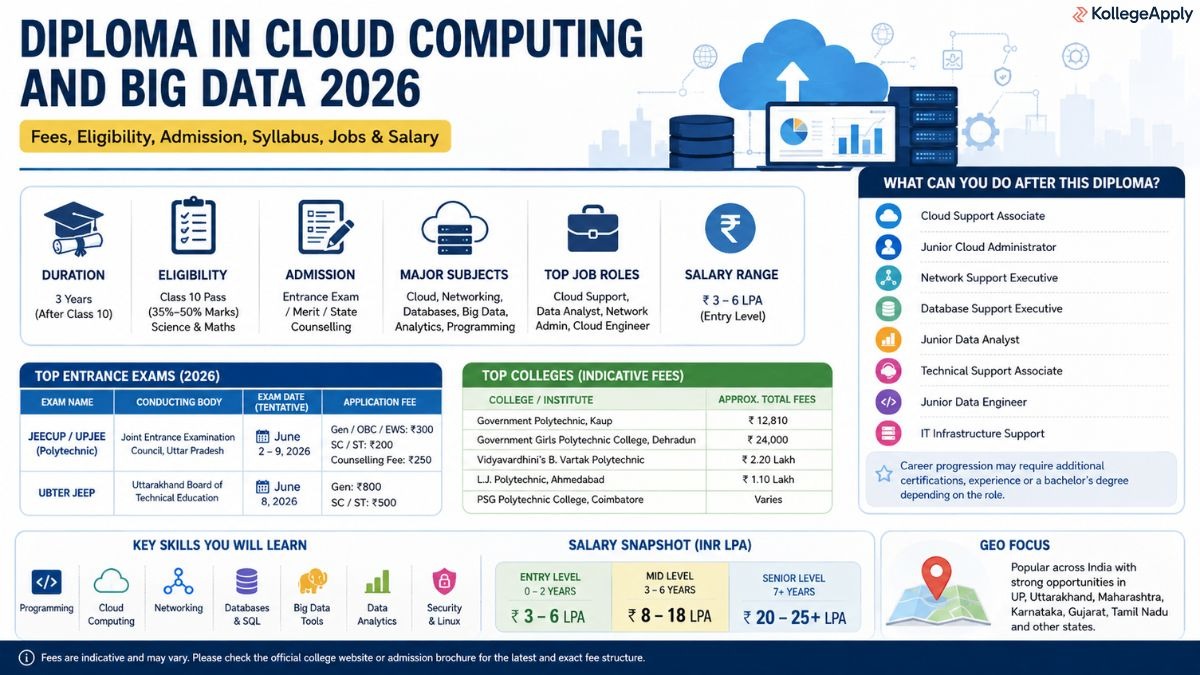
Eligibility generally starts with passing Class 10 from a recognised board, with several institutes requiring around 30-50% marks and specific requirements in Science and Mathematics. Admission is usually conducted through state-level polytechnic counselling or entrance examinations such as JEECUP, UBTER JEEP, or state-specific diploma admission systems. For example, Government Polytechnic and private institutes offering this specialisation in Uttarakhand, Karnataka, Maharashtra, Gujarat and other states follow their respective state technical education admission rules.
Career opportunities after a Diploma in Cloud Computing and Big Data include cloud support engineer, junior cloud administrator, network administrator, data analyst, database support executive, cloud application support associate and junior data engineer. Entry-level salaries after the diploma can vary considerably by role, employer, location and technical skills. Candidates entering support, networking, cloud or junior data roles may typically start around INR 3–6 LPA, while higher salaries generally require relevant experience, certifications and specialised skills.
- Diploma in Cloud Computing and Big Data Course Highlights
- What is Diploma in Cloud Computing and Big Data?
- Why Pursue Diploma in Cloud Computing and Big Data?
- Is Diploma in Cloud Computing and Big Data Worth It in 2026?
- Diploma in Cloud Computing and Big Data Eligibility Criteria
- Diploma in Cloud Computing and Big Data Entrance Exams
- Diploma in Cloud Computing and Big Data Colleges in India
- Diploma in Cloud Computing and Big Data Admission Process
- Diploma in Cloud Computing and Big Data Syllabus
- What Skills are Required for Diploma in Cloud Computing and Big Data?
- Diploma in Cloud Computing and Big Data Jobs & Salary
- What is the Salary After Diploma in Cloud Computing and Big Data?
- Companies and Industries Hiring for Cloud and Data Roles
- What Can You Do After a Diploma in Cloud Computing and Big Data?
- Diploma in Cloud Computing and Big Data vs Diploma in Computer Science
- FAQs on Diploma in Cloud Computing and Big Data
Diploma in Cloud Computing and Big Data Course Highlights
The following table summarises the key details students should know before choosing Diploma in Cloud Computing. Since course duration, admission rules and fees vary by state and institute, candidates should verify the latest prospectus before applying.
What is Diploma in Cloud Computing and Big Data?
Diploma in Cloud Computing and Big Data is a technical programme that combines two closely connected areas of modern computing. Cloud computing focuses on delivering computing resources such as servers, storage, databases and applications over networks, while Big Data focuses on storing, processing and analysing very large and complex datasets.
The curriculum typically begins with computer fundamentals, programming, networking and database management before moving towards cloud infrastructure, virtualization, data analytics and Big Data technologies. For example, the curriculum of Vidyavardhini's programme includes programming, database management, web development, cloud management and networking.
Students also receive practical exposure through computer laboratories, programming exercises, networking activities, cloud configuration and project work. The objective is to help learners understand how applications are developed, deployed and maintained in modern IT environments.
The course is particularly suitable for students who want to enter IT after Class 10 and prefer a practical technical qualification rather than a conventional academic degree. Students can later pursue B.Tech/B.E. through eligible lateral-entry routes or obtain additional certifications in AWS, Azure, Google Cloud, networking, cybersecurity or data engineering.
Why Pursue Diploma in Cloud Computing and Big Data?
A Diploma in Cloud Computing and Big Data can be a practical entry point into IT for students who want to develop computing skills after Class 10. The programme brings together programming, networking, databases, cloud infrastructure and data technologies, allowing students to explore different technical career paths while building a foundation for further education.
- Growing cloud adoption: Businesses increasingly rely on cloud infrastructure for applications, storage, analytics and digital services.
- Multiple career paths: Students can move towards cloud support, networking, data analytics, database administration or software support.
- Practical skill development: The programme combines programming, networking, databases and cloud technologies rather than focusing only on theory.
- Scope for higher salaries: Cloud and Big Data roles can offer strong salary growth as professionals gain experience and certifications.
- Further education opportunities: Diploma holders can explore lateral-entry engineering programmes where permitted by the relevant state and institution.
- Entrepreneurship opportunities: Technical skills can support freelance IT services, cloud support, website deployment, data services and small technology businesses.
Is Diploma in Cloud Computing and Big Data Worth It in 2026?
Yes, the course can be worth considering in 2026, particularly for students who want an early technical career in IT. Cloud infrastructure, networking, data processing and analytics remain important components of modern technology environments. Government skill-training programmes also continue to offer specialised cloud and networking training; for example, NSTI's two-year Advanced Diploma includes networking, web development, business data analytics and cloud application development.
However, the diploma alone does not guarantee a high-paying cloud job. Students should build additional skills in Linux, Python, SQL, networking, Git, Docker and at least one major cloud platform such as AWS, Microsoft Azure or Google Cloud. Certifications and hands-on projects can make a significant difference when competing for entry-level jobs.
The strongest long-term opportunities are likely to come from combining cloud computing with areas such as cybersecurity, DevOps, AI and data engineering. Students who continue learning after the diploma can move from support-level positions towards cloud engineering, DevOps, data engineering and cloud architecture roles.
Diploma in Cloud Computing and Big Data Eligibility Criteria
The eligibility criteria for a Diploma in Cloud Computing and Big Data are not identical across India, as admission rules are determined by the respective state authority and polytechnic. In most cases, students can apply after Class 10, while candidates with relevant Class 12 or ITI qualifications may be eligible for lateral entry. Key requirements include:
- Candidates must have passed Class 10 (SSC) or an equivalent examination from a recognised board.
- Minimum marks required generally range from 35% to 50%, with Science and Mathematics as compulsory subjects in most states.
- Some relaxation in minimum marks is available for reserved categories as per respective state government norms.
- Lateral entry into the second year is open to candidates who have passed Class 12 with Physics, Chemistry, Mathematics (PCM) or Physics, Chemistry, Biology (PCB), or an equivalent ITI qualification in a related trade.
- Entrance exams such as POLYCET, DTE CAP, and KEA counselling are used by many states, though several polytechnics also admit directly on Class 10 merit.
- There is generally no upper age limit for admission to this diploma course.
Diploma in Cloud Computing and Big Data Entrance Exams
Admission to a Diploma in Cloud Computing and Big Data can follow different routes depending on the state and institute. Some states conduct a common polytechnic entrance examination, while others use Class 10 merit, centralised counselling or institute-level admission. UBTER JEEP 2026 registration ran from January 15 to May 15, with the entrance examination held on June 8, 2026. Gujarat's 2026 first-year diploma admission notification specified a INR 250 non-refundable registration fee, while ACPDC regulates admission through merit and candidate preferences.
UPJEE Polytechnic is the state-level examination used for admission to government and private polytechnic colleges in Uttar Pradesh, and the official 2026 portal currently shows additional counselling activity. The following table highlights selected state-level admission routes relevant to diploma applicants in 2026:
Diploma in Cloud Computing and Big Data Colleges in India
Students choosing a Diploma in Cloud Computing and Big Data should consider factors such as course availability, institute type, fees, admission route, location, infrastructure and practical training rather than relying only on overall college rankings.Government Polytechnic, Kaup reports a total tuition fee of approximately INR 12,810, while Government Girls Polytechnic College, Dehradun lists INR 24,000 tuition for the three-year programme. L.J. Polytechnic lists approximately INR 1.10 lakh for the full three-year course.
Since NIRF does not separately rank diploma programmes in Cloud Computing and Big Data, the table below includes institutes that offer or are reported to offer the relevant diploma and provides fee information wherever available.
Note: The fees mentioned are indicative and may vary depending on the college, university, location, category and academic year. Students are advised to check the official college website or admission brochure for the latest and exact fee structure before applying.
Diploma in Cloud Computing and Big Data Admission Process
The admission process differs according to the state. Some colleges use a state-level polytechnic entrance examination followed by counselling, while others admit students on the basis of Class 10 merit.
Step 1: Check Eligibility - Confirm that you meet the Class 10, marks and subject requirements of the institute. Also check whether lateral entry is available if you have completed ITI or 10+2.
Step 2: Register for the Entrance Exam - If the institute participates in a state-level polytechnic examination, register on the relevant official portal before the deadline.
Step 3: Fill the Application Form - Enter personal, academic and category details carefully and upload the required documents and photographs.
Step 4: Appear for the Examination - Candidates applying through an entrance route must appear for the prescribed polytechnic examination and obtain a valid rank or score.
Step 5: Shortlisting and Counselling - Eligible candidates participate in counselling and select their preferred colleges and branches according to their rank and seat availability.
Step 6: Merit List / Seat Allotment - Seats are allotted according to the applicable merit, reservation rules, candidate preferences and availability.
Step 7: Document Verification - Candidates verify their academic, identity, category and other required documents.
Step 8: Fee Submission - After successful verification and seat confirmation, candidates pay the admission fee and complete the joining formalities.
Documents Required
- Class 10 marksheet and certificate
- Transfer Certificate, if applicable
- Migration Certificate, if applicable
- Entrance exam scorecard/rank card
- Passport-size photographs
- Aadhaar card or other valid ID
- Domicile certificate, where required
- Caste certificate, if applicable
- EWS certificate, if applicable
- PwD certificate, if applicable
- ITI/10+2 documents for lateral-entry candidates
- Medical certificate, where required
- Admission fee payment receipt
Diploma in Cloud Computing and Big Data Syllabus
The syllabus for a Diploma in Cloud Computing and Big Data varies across state technical boards and institutes. However, most curricula cover programming, databases, networking, cloud infrastructure, Big Data technologies, analytics and practical project work. Instead of following a fixed semester-wise structure, the key subjects students are likely to encounter include:
Note: The actual subject names, number of semesters and practical components can differ by institute and state board. A conventional three-year after-10th diploma generally distributes these topics across six semesters, along with engineering fundamentals, mathematics, practical labs and project work.
What Skills are Required for Diploma in Cloud Computing and Big Data?
A Diploma in Cloud Computing and Big Data develops a combination of programming, infrastructure, data and problem-solving skills. Students who strengthen these technical abilities through practical projects, labs and certifications can be better prepared for entry-level roles in cloud support, networking, database management, data analytics and IT infrastructure.
- Programming: Python, Java or another programming language helps students automate tasks and develop applications.
- Cloud Skills: Understanding AWS, Azure or Google Cloud is useful for cloud-related roles.
- Networking: Knowledge of IP, DNS, TCP/IP, routing and network security supports cloud administration.
- Database Management: SQL and database concepts are essential for handling structured data.
- Linux: Linux administration is widely used in servers and cloud environments.
- Big Data Tools: Familiarity with Hadoop, Spark and distributed processing can support Big Data careers.
- Analytical Thinking: Data-oriented roles require the ability to interpret information and identify patterns.
- Problem Solving: Cloud and infrastructure professionals must troubleshoot technical issues systematically.
- Communication: Clear communication helps technical professionals work with users, developers and business teams.
- Continuous Learning: Cloud technologies change rapidly, making certification and regular upskilling important.
Diploma in Cloud Computing and Big Data Jobs & Salary
Graduates can start in entry-level technical positions and gradually move towards specialised cloud, DevOps, networking or data roles. Salary varies considerably by employer and skill level, so the figures below should be treated as indicative rather than guaranteed.
What is the Salary After Diploma in Cloud Computing and Big Data?
Salary after a Diploma in Cloud Computing and Big Data depends on the job role, technical certifications, practical projects, location, company and experience. Entry-level graduates generally start in support, networking, administration or junior data roles before moving into higher-paying specialised positions.
Which cloud job has the highest salary?
Among established cloud career paths, Senior Cloud Architects and Principal Cloud Engineers are among the highest-paid cloud roles, although these positions generally require several years of experience and advanced technical skills.
Companies and Industries Hiring for Cloud and Data Roles
Recruitment opportunities vary by qualification, role and employer. Large IT, cloud, telecom and enterprise technology companies hire for cloud, infrastructure, networking and data-related roles, but eligibility for individual positions may require a bachelor's degree or relevant experience. Diploma holders should therefore check the qualification requirements for each vacancy.
What Can You Do After a Diploma in Cloud Computing and Big Data?
After completing a Diploma in Cloud Computing and Big Data, graduates can pursue entry-level roles in cloud support, IT infrastructure, networking, databases and data analytics. The course provides a foundation for working with cloud platforms, databases and data-processing technologies. With practical experience, industry certifications and further education, graduates can progress into specialised cloud, DevOps, data engineering and infrastructure roles. Career Options After Diploma in Cloud Computing and Big Data
- Cloud Support Associate – Assists with cloud applications, infrastructure and troubleshooting.
- Junior Cloud Administrator – Supports cloud resources, user access and basic infrastructure management.
- Network Support Executive – Helps maintain networks, connectivity and related IT systems.
- Database Support Executive – Handles basic database monitoring, SQL queries and troubleshooting.
- Junior Data Analyst – Works with datasets, reporting and basic data visualisation.
- Technical Support Associate – Provides technical assistance for software, systems and applications.
- Junior Data Engineer – Supports data pipelines, databases and data-processing tasks.
- IT Infrastructure Support – Assists with servers, operating systems, networks and IT infrastructure.
Note: Career progression may require additional certifications, relevant work experience or a bachelor's degree, depending on the job role and employer requirements.
Diploma in Cloud Computing and Big Data vs Diploma in Computer Science
Both programmes can lead to IT careers, but their curriculum and specialisation differ. A Computer Science diploma generally provides broader computing fundamentals, while Cloud Computing and Big Data places greater emphasis on cloud infrastructure, networking, data processing and analytics.
FAQs on Diploma in Cloud Computing and Big Data
What is Diploma in Cloud Computing and Big Data?
Diploma in Cloud Computing and Big Data combines cloud infrastructure, networking, programming, databases, data processing and analytics.
Is Diploma in Cloud Computing and Big Data a 2-year course?
Most after-10th versions are 3 years. Some related Advanced Diploma programmes in cloud computing are completed in 2 years.
What is big data in cloud computing?
Big Data refers to very large datasets that can be stored, processed and analysed using scalable cloud infrastructure and distributed technologies.
Is cloud computing in demand in 2026?
Yes. Cloud skills remain relevant across IT infrastructure, software, data, cybersecurity and DevOps, but continuous upskilling is important.
What is the eligibility for this diploma?
Generally, candidates must pass Class 10. Many institutes require at least 35% marks, with specific Science and Mathematics rules varying by state.
What is the salary after this diploma?
Entry-level salaries are commonly around INR 3–6 LPA, while specialised cloud and data professionals can earn significantly more with experience.
Which cloud job has the highest salary?
Senior Cloud Architects, Principal Cloud Engineers and specialised Cloud Security or DevOps professionals can command some of the highest salaries.
Which 3 year Diploma course is best?
A 3-year Advanced Diploma in IT, Networking and Cloud Computing can suit students seeking practical cloud and infrastructure skills.
Can I get a cloud job after a diploma?
Yes. Diploma holders can enter cloud support, networking and junior administration roles, especially with certifications and practical projects.
Can I pursue higher studies after this diploma?
Yes. Eligible diploma holders can explore lateral-entry engineering or other higher-study options according to state and institute rules.