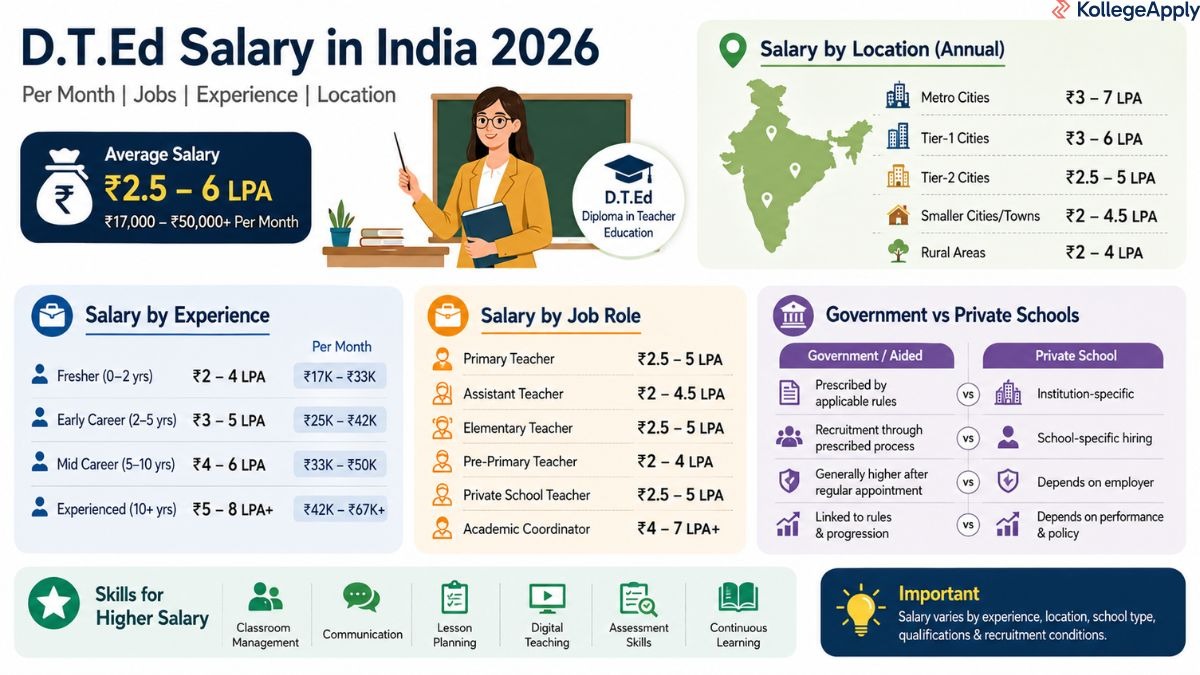
D.T.Ed Salary in India generally ranges from around INR 2.5–6 LPA, depending on experience, school type, location, teaching role and recruitment conditions. Freshers may earn around INR 2–4 LPA, while experienced teachers and candidates working in better-paying private schools or specialised education roles may earn more.
The D.T.Ed Salary per month can therefore vary from approximately INR 17,000–50,000 or more depending on the employer and level of experience. Government or aided-school opportunities may follow prescribed pay scales, while private schools generally determine salaries based on qualifications, skills, experience and institutional policies.
- D.T.Ed Salary: Factors Influencing Salary
- Detailed Breakdown of D.T.Ed Salary
- D.T.Ed Salary in Government vs Private Schools
- Skills Required for High D.T.Ed Salary
- Career Scope After D.T.Ed
- D.T.Ed Salary Growth and Career Progression
- How to Increase D.T.Ed Salary?
- Is D.T.Ed a Good Career Option?
- D.T.Ed Salary FAQs
D.T.Ed Salary: Factors Influencing Salary
D.T.Ed salary is not fixed because employers consider several factors when deciding teacher compensation. The qualification provides entry into teaching-related careers, but actual earnings depend on where and how a candidate works. Experience, teaching skills, school category, location and recruitment method can create significant differences in monthly salary.
- Work experience: Experienced teachers generally earn more than freshers.
- School type: Private, aided and government institutions can have different salary structures.
- Location: Salaries may be higher in metropolitan and major urban areas.
- Job role: Primary teachers, assistant teachers and specialised teaching roles may have different pay.
- Recruitment method: Government recruitment can involve prescribed pay scales and eligibility conditions.
- Teaching skills: Classroom management, digital teaching and communication skills can improve career prospects.
- Additional qualifications: Higher qualifications and relevant certifications can support career progression.
- Performance: Private institutions may consider classroom performance and student outcomes while reviewing salaries.
Detailed Breakdown of D.T.Ed Salary
The detailed D.T.Ed salary breakdown helps candidates understand how earnings can change according to experience, job profile and location. Instead of looking at one average figure, candidates should compare these three factors before evaluating their expected salary. The figures below are indicative ranges, not fixed pay scales, as D.T.Ed recruitment and remuneration differ across employers and states.
D.T.Ed Salary Based on Experience
Experience is one of the most important factors affecting D.T.Ed salary in India. Fresh graduates generally enter as assistant or primary-level teachers, while experienced teachers can take on greater classroom responsibility, academic coordination or senior teaching positions.
Note: Actual salary range may differ because of deductions, allowances, contractual terms and employer policies.
D.T.Ed Salary Based on Job Roles
D.T.Ed graduates can work in different teaching and education-support roles depending on their eligibility and the recruitment requirements of the employer. Primary teaching roles are among the common career options, while additional responsibilities and experience can help candidates move into better-paying positions.
Note: Job eligibility varies by institution, state rules, recruitment notifications and additional qualifications.
D.T.Ed Salary Based on Location
Location can influence D.T.Ed salary because schools in metropolitan and major urban areas may offer different compensation from institutions in smaller cities or rural areas. However, a higher salary in a city can also come with higher living costs, so candidates should compare both salary and expenses.
Note: These ranges are indicative. Government and aided institutions may follow applicable state or institutional pay structures rather than the market ranges shown above.
D.T.Ed Salary in Government vs Private Schools
The salary structure can differ significantly between government and private schools. Government teaching positions generally depend on recruitment rules, applicable pay levels, allowances and service conditions, whereas private schools commonly set salaries according to institutional policies, experience and candidate performance.
Important: A D.T.Ed qualification alone does not guarantee a government teaching job. Candidates must satisfy the applicable eligibility, teacher-qualification and recruitment requirements for the specific post.
Skills Required for High D.T.Ed Salary
A D.T.Ed qualification provides foundational teacher-training knowledge, but strong professional skills can help candidates compete for better teaching opportunities. Schools increasingly value teachers who can manage classrooms effectively, communicate clearly, use digital learning tools and adapt teaching methods to different student needs.
Key skills for better D.T.Ed salary include:
- Classroom management: Maintain discipline while creating a positive learning environment.
- Communication skills: Explain concepts clearly to young learners and communicate with parents.
- Lesson planning: Prepare structured and age-appropriate lessons.
- Child psychology: Understand different learning behaviours and developmental needs.
- Digital teaching: Use smart classrooms, educational software and online resources.
- Assessment skills: Evaluate student learning and identify areas requiring improvement.
- Creativity: Use activities, stories and practical methods to make lessons engaging.
- Time management: Balance teaching, assessment, planning and administrative duties.
- Problem-solving: Handle classroom and student-related challenges effectively.
- Continuous learning: Stay updated with teaching methods, curriculum changes and educational technology.
Career Scope After D.T.Ed
D.T.Ed graduates can pursue entry-level teaching and education-related opportunities, particularly in elementary and primary education settings where their qualification meets the applicable requirements. Career progression generally becomes stronger when candidates combine teaching experience with additional qualifications, certifications or eligibility for relevant recruitment examinations. Common career options include:
The exact posts available after D.T.Ed depend on state-specific eligibility rules, institution requirements and recruitment notifications.
D.T.Ed Salary Growth and Career Progression
D.T.Ed salary growth usually follows a combination of experience, job changes, additional qualifications and increased responsibilities. A fresher may begin in an assistant or primary teaching role and gradually move into senior teaching or coordination positions. A typical progression can look like:
D.T.Ed Fresher → Primary/Assistant Teacher → Experienced Teacher → Senior Teacher → Academic Coordinator
Candidates who pursue higher qualifications relevant to teaching can also broaden their eligibility for future positions. Government recruitment, where applicable, can provide another route to structured career progression, subject to the eligibility criteria of the specific post.
How to Increase D.T.Ed Salary?
Candidates can improve their earning potential by developing skills that schools value and by planning their qualifications around their desired career path. Salary growth is generally stronger when teachers can demonstrate classroom experience, professional competence and readiness for greater responsibilities.
- Gain practical classroom experience.
- Improve English and regional-language communication skills.
- Learn digital classroom and educational technology tools.
- Develop strong lesson-planning and assessment skills.
- Pursue relevant higher qualifications where eligible.
- Explore reputed private schools with structured salary growth.
- Prepare for applicable government teaching recruitment opportunities.
- Take additional responsibilities such as academic coordination.
- Build a strong teaching portfolio and professional record.
Is D.T.Ed a Good Career Option?
D.T.Ed can be a suitable option for candidates interested in elementary-level teaching and classroom-based careers. Its value depends largely on the candidate's location, eligibility for available teaching posts, additional qualifications and willingness to develop professionally.
For candidates who enjoy working with children and want to enter the education sector, D.T.Ed can provide a foundation for teaching careers. However, candidates should check state-specific teacher eligibility and recruitment requirements before choosing the programme.
D.T.Ed Salary FAQs
What is D.T.Ed salary in India?
D.T.Ed salary generally ranges from about INR 2.5–6 LPA, depending on experience, location, school type and job role.
What is D.T.Ed salary per month?
D.T.Ed salary per month may range from around INR 17,000–50,000, depending on experience and employer.
What is the D.T.Ed fresher salary?
D.T.Ed fresher salary is commonly around INR 2–4 LPA, although private-school offers can vary by location and institution.
Does D.T.Ed salary increase with experience?
Yes. D.T.Ed salary can increase with experience, stronger teaching skills, higher responsibilities and better employment opportunities.
What is D.T.Ed teacher salary?
D.T.Ed teacher salary varies by school and location, with indicative earnings of around INR 2.5–5 LPA for many entry-level roles.
Is D.T.Ed enough for a government teacher job?
Not always. Government teaching eligibility depends on the specific post, state rules, recruitment notification and other required qualifications.
Which factors affect D.T.Ed salary?
Experience, location, school type, job role, recruitment conditions, teaching skills and additional qualifications can affect D.T.Ed salary.
Can D.T.Ed graduates earn INR 5 LPA?
Yes. Experienced teachers and candidates in better-paying roles or locations may reach INR 5 LPA or more.
Which jobs offer a higher D.T.Ed salary?
Senior teaching and academic coordination roles can offer higher salaries, especially with relevant experience and additional qualifications.
Is D.T.Ed a good career option?
Yes, D.T.Ed can suit candidates interested in elementary teaching, especially when combined with experience and relevant additional qualifications.