Students with a keen interest in the banking and finance sector and a desire to position themselves in managerial roles can pursue an MBA in Banking and Finance. It is a two-year advanced course offered at the postgraduate level. Individuals study the MBA Banking and Finance syllabus across four equal semesters, where core subjects are covered along with electives, projects, and internships.
It is crucial for students to understand that admission is granted only after meeting the MBA in Banking and Finance eligibility criteria. The eligibility typically includes securing a minimum of 50% in graduation from a recognized university, with a relaxation of around 5% for reserved category students. Appearing for entrance exams such as CAT, MAT, XAT, etc., is also important for selection into MBA in Banking and Finance colleges.
Enrolled students become familiar with topics such as financial markets, risk management, banking operations, account management, investment management, and corporate finance. Some of the career opportunities after graduation include roles like corporate financial analyst, investment banker, and financial analyst. Professionals in this field can earn up to INR 30 LPA or even higher with experience and skill.
Table of Contents
- MBA in Banking and Finance Key Highlights
- What is an MBA in Banking and Finance?
- Why pursue an MBA in Banking and Finance?
- Who Should Study MBA in Banking and Finance?
- MBA in Banking and Finance Eligibility Criteria
- MBA in Banking and Finance Entrance Exams
- MBA in Banking and Finance Colleges
- MBA in Banking and Finance Admission Process 2026
- MBA in Banking and Finance Syllabus
- MBA in Banking and Finance Career
- MBA in Banking and Finance Vs MBA in HRM
- MBA in Banking and Finance FAQs
MBA in Banking and Finance Key Highlights
It is important for students to focus on the MBA in Banking and Finance and all the relevant information associated with it. Students must take into consideration key elements such as course fees, colleges, syllabus coverage, eligibility criteria, and other important aspects. Interested students can refer to the information tabulated below for the key highlights of the MBA in Banking and Finance course:
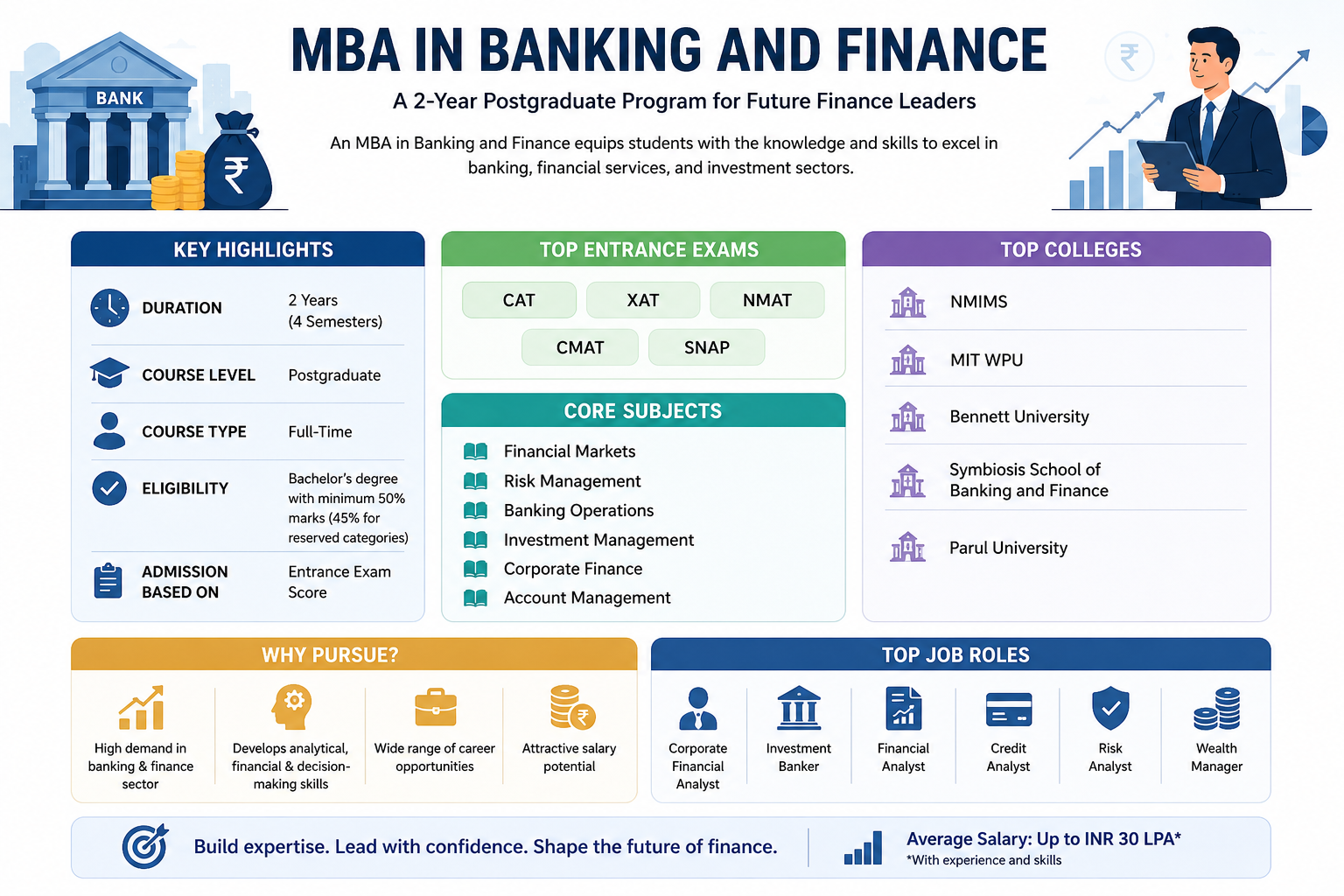
What is an MBA in Banking and Finance?
MBA in Banking and Finance is a postgraduate course offered to students for a period of two years. The course focuses on various aspects of the banking and financial sectors such as financial investment, investment analysis, risk management, and financial markets. MBA in Banking and Finance colleges help students develop skills such as strategic decision-making, accounting skills, and quantitative skills.
The MBA in Banking and Finance syllabus consists of theoretical subjects essential for building a strong career in roles such as bank manager, investment banker, and credit analyst. The course focuses on core theoretical subjects along with specializations such as financial institutions and services, risk management, mergers and acquisitions, and mutual fund management. Students also gain practical knowledge through internships and industry projects.
Why pursue an MBA in Banking and Finance?
It is important for students to understand the significance of the Banking and Finance course before taking admission. The course consists of several advantages that make it a highly sought-after program among graduates. Students can check out the pointers provided below to learn more about the key reasons to pursue an MBA in Banking and Finance.
- The course opens doors to roles in banking, investment firms, and financial institutions, offering strong career growth and stability.
- Students develop key skills like financial analysis, risk management, and strategic decision-making, which are highly valued in the finance sector.
- With experience and expertise, professionals in banking and finance can earn competitive salaries and grow quickly in their careers.
- The course includes internships and industry projects, helping students gain real-world experience alongside theoretical knowledge.
- Graduates can explore diverse career paths such as investment banker, financial analyst, risk manager, and credit analyst.
MBA in Banking and Finance Eligibility Criteria
Students are required to meet the pre-determined criteria set by the university or any other desired college to fulfill the eligibility requirements. Colleges use these entry requirements as an assessment tool to evaluate the academic capability of a student to pursue the program. Students can check out the following pointers for more information related to MBA in Banking and Finance:
- Candidates must make sure to complete their bachelor’s degree from a recognised university.
- Candidates must secure a minimum aggregate of 50% marks or above to be eligible for the MBA in Banking and Finance.
- Students are supposed to appear for entrance exams such as CAT, XAT, MAT, GMAT, SNAP, etc and present a valid scorecard during the time of admission.
- Many universities also require candidates to participate in a group discussion or personal interview as part of the selection process.
MBA in Banking and Finance Entrance Exams
It is crucial for students to prepare for and appear in entrance exams, as they play a vital role in the admission process. There are several national, state, and university-level exams available for students. Exams like CAT, XAT, etc., provide entry into some of the top colleges in India, where a good score is required since the seats are generally limited. Students can check out the table given below to learn more about these entrance exams:
MBA in Banking and Finance Colleges
The Banking and Finance sector is growing consistently, with new job opportunities emerging in areas such as digital banking, investment, risk analysis, and more. Selecting the right MBA in Banking and Finance college is important for long-term career growth. Students need to clear certain entrance exams to be eligible for top universities and colleges. Students can check out the table given below to learn more about colleges:
MBA in Banking and Finance Admission Process 2026
Individuals must focus on thoroughly reading all the steps included in the admission process for MBA in Banking and Finance. Generally, students are required to meet the entry requirement in order to be considered for further admission steps. Candidates need to register, pay the application fee, appear for the entrance exam, score good marks, wait for the merit list, and then pay the course fees. To have a better understanding of the admission process, a reference to Desh Bhagata University is provided below:
Step 1: Students must visit the official admission portal on the college website and complete the online application form.
Step 2: Appearing for the entrance exam such as CAT, XAT, SNAP, CMAT, etc is important as the scorecard will be considered for the next round of admission.
Step 3: Shortlisted candidates on the basis of entrance exam scores will be called for group discussion or personal interview.
Step 4: Final selection is dependent on the overall performance of the candidates which includes exam, GD, and PI.
Step 5: Shortlisted students will be invited for document verification and must pay the required course fee to confirm their seat.
Documents Required
MBA in Banking and Finance Syllabus
MBA in Banking and Finance syllabus is structured into four equal semesters, covering both theoretical concepts and practical sessions. Students study industry-relevant core subjects, which helps in grasping good job opportunities in the future. To learn more, students can check out the MBA in Banking and Finance syllabus followed at MIT WPU:
Electives
MBA in Banking and Finance Career
MBA in Banking and Finance colleges helps in shaping a good career path for the graduates in areas like investment, corporate finance, asset management, risk management, etc. Fresh graduates can find job roles such as Investment banker, credit analyst, financial analyst, and many more. Check out the information tabulated below to learn about MBA in Banking and Finance career:
Is an MBA in Banking and Finance Good?
An MBA in Banking and Finance is a good choice for students who want to build a career in banking, financial services, investment management, insurance, and corporate finance. An MBA for Banking and Finance equips students with analytical, managerial, and financial decision-making skills through subjects such as banking operations, financial markets, risk management, and portfolio management.
MBA Finance Banking specialization also offers strong career opportunities in both the public and private sectors. Graduates can work as Financial Analysts, Investment Bankers, Risk Managers, Credit Analysts, or Banking Managers. With increasing demand for finance professionals, this specialization provides excellent career growth, leadership opportunities, and competitive salary prospects.
MBA in Banking and Finance Vs MBA in HRM
Students interested in taking admission into a master’s program need to first figure out their long-term career goals. There are several courses available that students can opt for after a bachelor’s degree. Human Resource Management is one such course, which is highly sought after and provides plenty of diverse career opportunities to students. Check out the table given below to learn more about the comparison between Banking & Finacne and HRM:
MBA in Banking and Finance FAQs
What is MBA in Banking and Finance?
MBA in Banking and Finance is a 2-year postgraduate course focusing on financial markets, banking operations, and risk management for managerial roles.
What is the eligibility for MBA in Banking and Finance?
Aspirants need a bachelor’s degree with at least 50% marks and a valid entrance exam score like CAT, XAT, or MAT for admission.
What is the MBA in Banking and Finance syllabus?
The MBA Banking and Finance syllabus includes financial markets, investment analysis, risk management, corporate finance, and banking operations.
Which entrance exams are required for MBA in Banking and Finance?
Common exams include CAT, XAT, MAT, CMAT, SNAP, and NMAT, depending on the MBA in Banking and Finance colleges.
What are the top MBA in Banking and Finance colleges?
Top MBA in Banking and Finance colleges include NMIMS, MIT WPU, Bennett University, and Symbiosis School of Banking and Finance.
What is the duration of MBA in Banking and Finance?
The MBA in Banking and Finance course duration is 2 years, divided into 4 semesters with core subjects, electives, and internships.
What is the scope of MBA in Banking and Finance?
MBA in Banking and Finance offers strong career scope in banking, investment, risk analysis, and financial services sectors.
What are the job roles after MBA in Banking and Finance?
Graduates can work as investment banker, financial analyst, risk manager, credit analyst, or corporate banker.
What is the salary after MBA in Banking and Finance?
Salary after MBA in Banking and Finance ranges from INR 3.5 LPA to 30 LPA depending on role, skills, and experience.
Is MBA in Banking and Finance a good career option?
Yes, MBA in Banking and Finance is a good career option due to high demand, strong salary growth, and diverse job opportunities.