Candidates aiming to build expertise in analyzing global economic trends and managing businesses across diverse international environments can pursue an MBA in International Business. This postgraduate program is generally a two-year course, structured across four semesters. It covers a wide range of industry-relevant topics such as international logistics and supply chain management, international trade documentation, trade finance, and more, helping students develop a strong understanding of global business operations.
Admission to the program is granted after successfully meeting the eligibility criteria, which typically requires candidates to secure a minimum of 50% marks in graduation. In addition, applicants must present a valid score from accepted entrance exams such as MAT, CMAT, CAT, XAT, GMAT, among others. Relaxation in eligibility criteria is usually provided to candidates belonging to reserved categories, as per institutional guidelines.
After successfully completing International Business masters from a recognized university or college, students can explore a wide range of career opportunities. Graduates can work in multinational corporations (MNCs), consulting firms, and global organizations. Some of the prominent job roles include International Marketing Manager, Export Manager, Global Supply Chain Manager, and other related positions, allowing students to build a strong and dynamic career in the global business landscape.
Table of Contents
- MBA in International Business Key Highlights
- What is an MBA in International Business?
- Why pursue an MBA in International Business?
- Who Should Study MBA in International Business?
- MBA in International Business Eligibility Criteria
- MBA in International Business Entrance Exams
- MBA in International Business Colleges
- MBA in International Business Admission Process 2026
- MBA in International Business Syllabus
- MBA in International Business Career
- MBA in International Business FAQs
MBA in International Business Key Highlights
The first thing to consider before taking admission into an MBA in International Business is understanding the key components related to the course. Important elements include the duration of the program, syllabus covered, eligibility requirements, career scope after graduation, and several other factors. Interested students can refer to the table given below to learn more about the key highlights of an MBA in International Business:
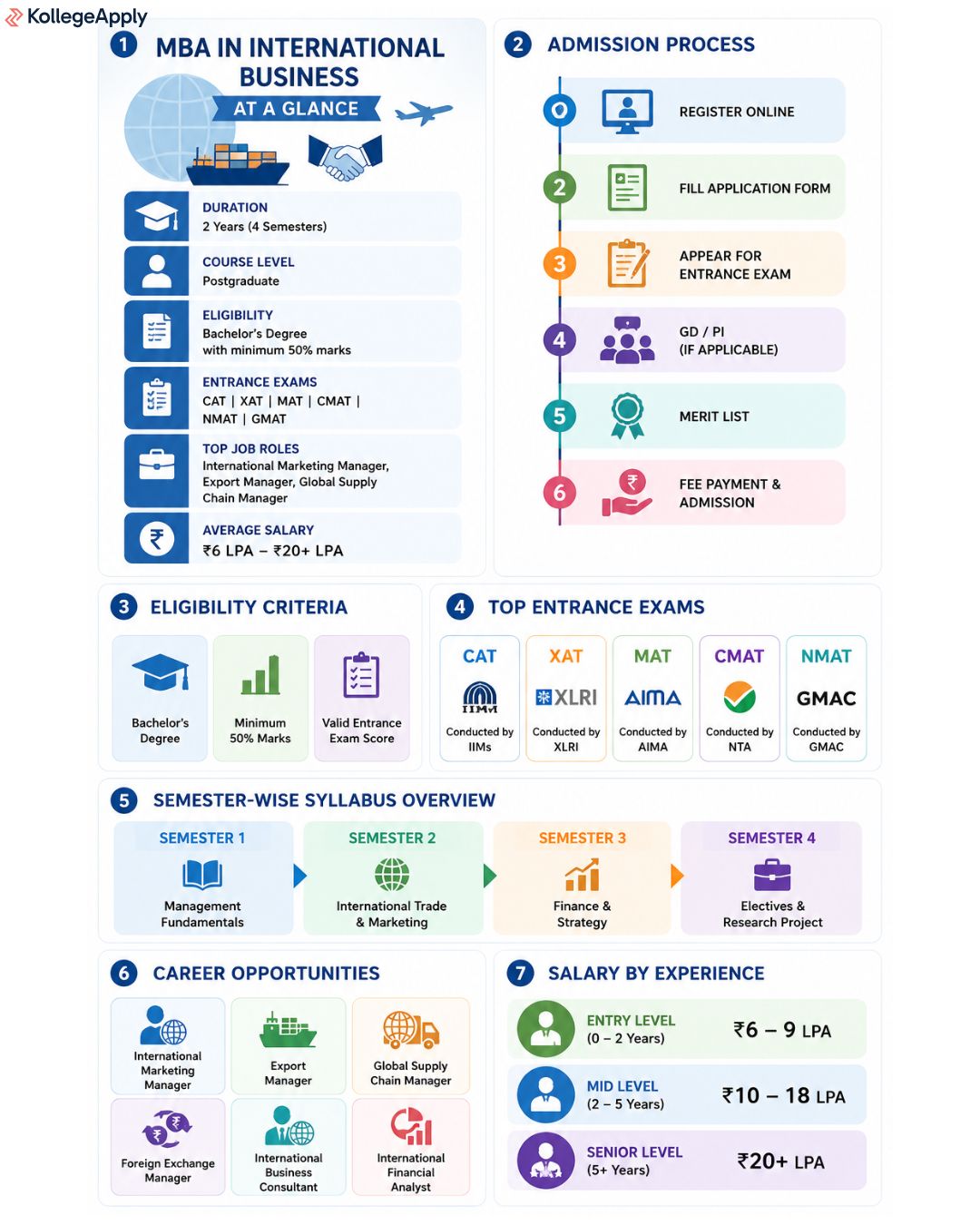
What is an MBA in International Business?
Students looking for a two-year master’s program designed to build a career in business management on a global level can consider an MBA in International Business. This program is typically structured across four semesters and focuses on integrating commercial activities with international business, producing professionals who are well equipped with the skills required to handle global business scenarios.
Colleges offering MBA in International Business provide a curriculum that includes both theoretical and practical knowledge. Students learn industry-relevant topics such as global marketing strategies, global trade policies, export-import procedures and documentation, and more. After successfully completing the MBA in International Business syllabus, students can explore job roles such as Global Supply Chain Manager, Foreign Exchange Manager, International Financial Analyst, and other related positions.
Why pursue an MBA in International Business?
It is important to consider all the reasons why pursuing Master International Business administration can be beneficial for your career. The program helps students pursue opportunities in global business environments and develop the skills required to manage cross-border operations effectively. Check out the following pointers to learn more:
- Students develop a strong understanding of global markets, trade policies, and strategies involved in international business
- MBA in International Business Syllabus helps the students adapt to different economic environments and business practices worldwide.
- The International Business Masters provides exposure to international finance, export-import procedures, and global marketing, which are essential for managing business operations across borders.
- The program also aims at enhancing cross-cultural communication and decision-making skills, allowing professionals to work effectively with international clients.
- Offers wide career opportunities in multinational companies, consulting firms, and global organizations with roles that involve international operations and strategy.
Who Should Study MBA in International Business?
Students who are interested in building a career in the field of International Management can consider pursuing an MBA in International Business. This program is ideal for those aiming for leadership roles in a dynamic industry. There are some pointers given below to learn more about the suitability:
- MBA in IB is designed to meet the growing demand for professionals who can manage global business operations and contribute to international trade and expansion.
- Master in International Business offers specialization in areas like marketing, finance, and supply chain management, helping students tailor their education and build expertise in specific domains of global business.
- Students gain in-depth knowledge of international trade, foreign investments, and global economic trends, making them industry-ready.
- The course opens opportunities for global exposure, including working with international clients and exploring career options in different countries.
- The course builds leadership, analytical, and strategic thinking skills required to handle complex business challenges in an international environment.
MBA in International Business Eligibility Criteria
Aspirants with a keen interest in learning about the inner workings of the global business environment, can consider pursuing an MBA in International Business. Admission is granted based on meeting the eligibility for MBA in International Business, which acts as an assessment tool for colleges. Students can check out the pointers given below to learn more about MBA in International Business and its entry requirements:
- Students are required to focus on completing their bachelor’s degree from a recognised university.
- Students must secure a minimum aggregate of 50% marks or above to be considered for the MBA in International Business admission.
- Appearing for entrance exams such as CAT, MAT, XAT, GMAT, etc and presenting a valid scorecard is also essential.
- Many universities also require candidates to participate in a group discussion or personal interview as part of the selection process.
MBA in International Business Entrance Exams
It is essential for students to appear for entrance exams such as CAT, XAT, MAT, CMAT, and other accepted tests to qualify for admission into an MBA in International Business. Students need to prepare seriously, as the competition for these exams is high and seats in top colleges ranked by NIRF are limited. Students can refer to the table given below for more information related to these entrance exams:
MBA in International Business Colleges
Students aiming to pursue an MBA in International Business should target colleges that are well regarded in the market. The right college helps students gain the appropriate set of skills required for securing good job opportunities. There are several private and public colleges available across India. Students can check out the table given below to learn more about MBA in International Business colleges:
MBA in International Business Admission Process 2026
Students must adhere to the steps involved in MBA International Business admission 2026 offered by various colleges. Generally, the admission process across most colleges is quite similar, starting from registering on the admission portal, paying the application fee, appearing for entrance exams, checking the merit list, and finally completing the course fee payment. A reference of the admission process followed at ITM Business School is provided below for better understanding:
Step 1: Visit the official admission portal of ITM Business School and fill out the MBA in International Business application form.
Step 2: Candidates must pay an application fee of INR 1500/- to complete the registration process.
Step 3: Candidates must carefully fill in all details and submit the application form before the deadline.
Step 4: After successful submission, candidates will receive an Application ID. This ID should be saved for all future communication related to the MBA in International Business admission process.
Step 5: Shortlisted candidates will be invited to participate in the selection process, which may include:
- Group Discussion (GD)
- Personal Interview (PI)
- Evaluation of academic profile and entrance exam scores
Step 6: Candidates who successfully clear the selection rounds will receive an admission offer. To confirm their seat in the MBA in International Business program at ITM Business School, students must complete the fee payment within the given timeline.
Documents Required
MBA in International Business Syllabus
MBA IB subjects are structured into four equal semesters, covering both theoretical concepts and practical sessions. Students study industry-relevant core International Business subjects such as International Business Strategy, Supply Chain Management, and many more. To learn more, students can check out the MBA in International Business syllabus followed at IIFT:
Electives
MBA in International Business Career
A Master’s in International Business helps in building a strong career path in the field of the global business environment. Students gain knowledge in managing and solving complex problems related to international operations while improving outcomes for global clients. The program equips graduates with skills in areas such as international trade, finance, and cross-border management.
After completion, students can explore job roles such as International Marketing Manager, Foreign Exchange Manager, International Business Consultant, and more. Check out the table given below to learn more about MBA in International Business salary on the basis of experience:
MBA in International Business FAQs
What is MBA in International Business?
MBA in International Business is a two-year postgraduate program focusing on global markets, trade, and cross-border business management, helping students build careers in international business environments.
What is the eligibility for MBA in International Business?
Eligibility for MBA in International Business requires a bachelor’s degree with at least 50% marks and a valid entrance exam score such as CAT, MAT, XAT, or GMAT.
Which entrance exams are required for MBA in International Business?
Students must appear for entrance exams like CAT, XAT, MAT, CMAT, or GMAT to qualify for MBA in International Business admission in top colleges.
What is the duration of MBA in International Business?
MBA in International Business is generally a two-year program divided into four semesters, covering both theoretical and practical aspects of global business.
What are the subjects in MBA in International Business syllabus?
MBA in International Business syllabus includes subjects like international marketing, trade documentation, supply chain management, finance, and global business strategies.
What is the career scope after MBA in International Business?
The course offers career opportunities in MNCs, consulting firms, and global organizations with roles in marketing, finance, and supply chain management.
What are the job roles after MBA in International Business?
Graduates can work as International Marketing Manager, Export Manager, Global Supply Chain Manager, or International Financial Analyst in various industries.
What is the salary after MBA in International Business?
Salary after MBA in International Business starts from INR 6 LPA - INR 9 LPA depending on job role, experience, and company type in global business sectors.
Which are the top colleges for MBA in International Business?
Top colleges include IIFT, UPES, Sharda University, LPU, and Amity University offering quality education in international business programs.