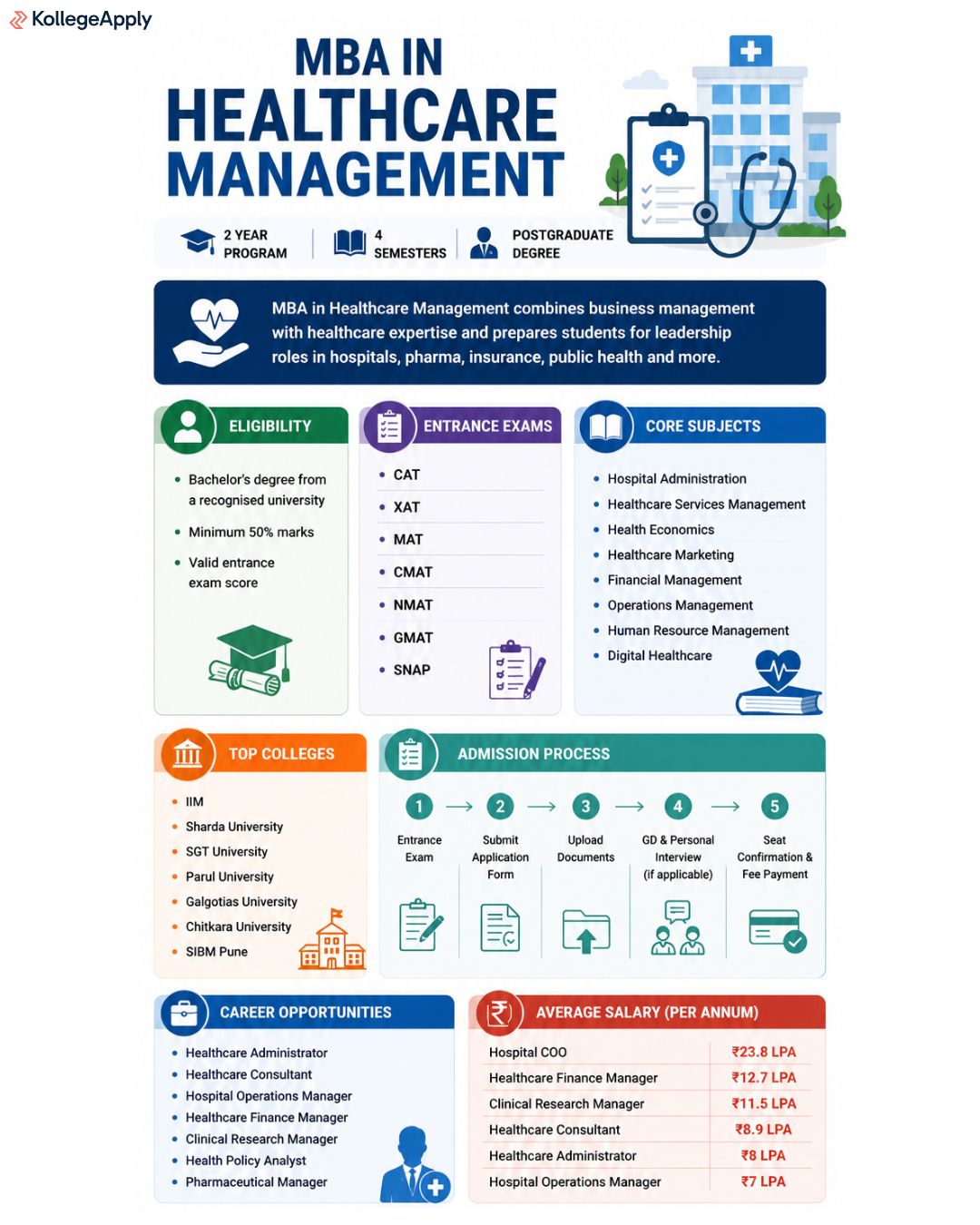
Students who are targeting to pursue an MBA in Healthcare Management must know that it is a postgraduate program of two years. This advanced course is divided into four equal semesters and includes core subjects such as Financial Reporting & Statement Analysis, Marketing Management, and more. Healthcare Management is designed to equip students with a strong understanding of managing healthcare organizations, including hospitals, pharmaceuticals, insurance, and clinical research.
For getting admission into a Healthcare MBA, students are required to meet specific eligibility criteria set by the universities. To fulfil the eligibility requirements , students need to score a minimum of 50% marks or above in their bachelor’s from a recognized university. Eligibility also requires students to submit valid entrance exam scores such as CAT, XAT, NMAT, SNAP, etc.
MBA in Healthcare Management graduates can find work in several in-demand sectors such as pharmaceutical companies, healthcare companies, public health organizations, government health departments and ministries, health startups, and many more. Healthcare MBA students can work in job roles such as healthcare manager, health information manager, pharmaceutical product manager, and many more.
Table of Contents
- MBA in Healthcare Management Key Highlights
- What is an MBA in Healthcare Management?
- Why pursue an MBA in Healthcare Management?
- What is the Eligibility Criteria of MBA in Healthcare Management?
- MBA in Healthcare Management Entrance Exams
- MBA in Healthcare Management Colleges
- How Does the MBA in Healthcare Management Admission Process 2026 work?
- What is the Syllabus of MBA in Healthcare Management?
- What Skills are Acquired During MBA in Healthcare Management?
- What is the scope of MBA in Healthcare Management?
- MBA in Healthcare Management Vs MCA
- MBA in Healthcare Management FAQs
MBA in Healthcare Management Key Highlights
MBA aspirants aiming to study Healthcare Management and build a strong career in this field must gather all the relevant information about the program. There are several important factors to consider, such as the fees of the program, subjects covered, career scope, and more. A table is provided below to help students make an informed decision before taking MBA in Healthcare Management admission:
What is an MBA in Healthcare Management?
MBA in Healthcare Management is a two-year postgraduate course split into four equal semesters. A Masters in Healthcare Management focuses on developing business management skills along with healthcare industry expertise, which leads to various career opportunities. The curriculum consists of core subjects, electives, internships, and a capstone project, helping students become skilled professionals in the healthcare field.
The Healthcare MBA syllabus covers topics such as healthcare economics, healthcare services management, digital marketing in healthcare, design thinking, and entrepreneurship management, among many others. Students also get the opportunity to tailor their education according to their career goals, with areas such as econometrics, generative AI, financial markets, and behavioural economics. After graduating from an MBA in Healthcare Management, students can find work in areas like hospitals, healthcare systems, insurance companies, and more.
Why pursue an MBA in Healthcare Management?
MBA in Healthcare Management is gaining popularity among aspirants looking for a stable and high-growth career path. With increasing demand in the healthcare sector, this specialization offers strong career opportunities and industry relevance. Students interested in learning about the importance of the program, can read the pointers given below:
- High demand in a rapidly growing and dynamic healthcare industry with long-term stability.
- Opportunity to take up leadership roles in hospitals, healthcare organizations, and institutions.
- Candidates get the chance to work in a field of pharma, technology, insurance, and public health.
- Students get exposure to innovation like digital health, telemedicine, and modern healthcare systems.
- Students can get competitive salary packages and strong career growth across public and private sectors.
What is the Eligibility Criteria of MBA in Healthcare Management?
Individuals who are keen to pursue a healthcare management career need to meet the eligibility criteria set by universities and colleges. Admission to Healthcare Management will be provided only when students present their academic performance along with other required documents. Check out the pointers mentioned below to learn about MBA in Healthcare Management eligibility criteria:
- Aspirants must focus on completing their bachelor’s degree from a recognised university.
- Candidates must secure a minimum aggregate of 50% marks or above to be eligible for the MBA in Healthcare Management.
- Students are supposed to appear for entrance exams such as XAT, MAT, GMAT, SNAP, etc and present a valid scorecard during the time of admission.
- Many universities also require candidates to participate in a group discussion or personal interview as part of the selection process.
MBA in Healthcare Management Entrance Exams
Masters degree in Healthcare management requires students to appear for entrance exams to gain admission into their desired colleges. There are several institutions offering a degree in Healthcare Management, and it is important for students to clear exams such as CAT, XAT, GMAT, or other accepted national, state, or university-level tests. Scoring a high rank is crucial for admission, as competition is high, especially for Tier 1 colleges ranked by NIRF. Check out the table given below to learn more about MBA health management:
MBA in Healthcare Management Colleges
Students generally aim to get admission into Tier 1 or popular B-schools for pursuing a degree in Healthcare Management. IIM colleges are among the top-ranked institutions according to the NIRF report. There are several other colleges aligned with IIM-level standards that offer an MBA in Healthcare Management through entrance exams such as CAT, XAT, MAT, and others. The general annual fee ranges from INR 1.5 Lakh to INR 6 Lakh. Check out the college options in the table below to gain a better understanding of MBA in Healthcare management fees and location:
How Does the MBA in Healthcare Management Admission Process 2026 work?
Students must carefully read through the MBA in Healthcare Management admission procedure before taking admission. First and foremost, meeting the eligibility criteria plays an important role before applying to a Healthcare MBA program in any college. The steps usually include factors such as registration, presenting a valid scorecard, and submitting the required documentation. To gain a better understanding, the admission process followed at Apollo University is given below:
Step 1: Candidates must appear in any one of the accepted management entrance tests. A valid scorecard is crucial to move forward in the admission process.
Step 2: Students need to complete the application form and provide the required academic and personal details accurately.
Step 3: Upload all necessary documents and pay the application fee as part of the application process.
Step 4: Shortlisted candidates are invited for Group Discussion (GD) and Personal Interview (PI) to assess their skills and suitability for the programme.
Step 5: Final selection is based on overall performance. Selected candidates receive an admission offer and must confirm their seat within the given timeline by paying the course fees.
Documents Required
What is the Syllabus of MBA in Healthcare Management?
MBA in Healthcare Management syllabus is structured into four equal semesters, covering both theoretical concepts and practical sessions. Students study industry-relevant core Healthcare Management subjects such as Healthcare Services Management, Digital Marketing in Healthcare, and many more. To learn more, students can check out the MBA in Healthcare Management syllabus followed at K.J. Somaiya Institute.
Electives
What Skills are Acquired During MBA in Healthcare Management?
MBA in Healthcare Management helps students develop strong managerial, analytical, and leadership abilities required in the healthcare industry. The program focuses on building practical skills related with hospital administration, healthcare operations, patient care management, and strategic decision-making. MBA in Healthcare Management subjects are designed to prepare candidates for leadership roles in hospitals, pharmaceuticals, insurance firms, and healthcare organizations. Check out the pointers given below to learn about MBA in Healthcare Management:
- Leadership and team management skills for healthcare organizations
- Analytical and decision-making abilities for healthcare operations
- Communication and interpersonal skills for patient and staff coordination
- Knowledge of healthcare finance, budgeting, and hospital administration
- Understanding of digital healthcare systems and healthcare technologies
- Problem-solving and strategic planning skills in healthcare management
- Quality management and patient safety monitoring abilities
- Operations and supply chain management skills in hospitals and healthcare sectors
What is the scope of MBA in Healthcare Management?
Master of business administration healthcare management helps in paving a strong career path in the field of healthcare, hospitals, and more. Students gain knowledge in managing and solving complex problems within healthcare systems while improving outcomes for patients and communities. Graduates can work in job roles such as healthcare consultant, healthcare administrator, hospital operations manager, and more. The starting average annual salary ranges from INR 4- 7 LPA. Check out the table given below to learn more about the scope of MBA in Healthcare Management:
On the basis of Job Roles
On the basis of Experience
MBA in Healthcare Management Vs MCA
Students interested in taking admission into a master’s program need to first figure out their long-term career goals. There are several courses available that students can opt for after a bachelor’s degree. Human Resource Management is one such course, which is highly sought after and provides plenty of diverse career opportunities to students. Aspirants must compare both courses in order to determine which one will be more suitable for their career. Check out the table given below to learn more about the comparison between Healthcare MBA and HRM:
MBA in Healthcare Management FAQs
What is MBA in Healthcare Management?
MBA in Healthcare Management is a two year PG program focusing on healthcare systems, hospital administration, and management skills.
What is MBA in Healthcare Management eligibility?
MBA in Healthcare Management eligibility requires a bachelor’s degree with 50% marks and a valid entrance exam score like CAT, MAT, or XAT.
What is MBA in Healthcare Management duration?
MBA in Healthcare Management duration is 2 years, divided into four semesters with academic and practical learning.
What is MBA in Healthcare Management syllabus?
MBA in Healthcare Management syllabus includes healthcare services, hospital administration, health economics, and marketing.
What are MBA in Healthcare Management entrance exams?
MBA in Healthcare Management entrance exams include CAT, XAT, MAT, NMAT, SNAP, and other accepted tests.
What are MBA in Healthcare Management jobs?
MBA in Healthcare Management jobs include healthcare administrator, consultant, hospital manager, and policy analyst roles.
What is MBA in Healthcare Management salary?
MBA in Healthcare Management salary ranges from INR 4-7 LPA and can go up to INR 20 LPA or above with experience.
What is MBA in Healthcare Management scope?
MBA in Healthcare Management scope is high due to demand in hospitals, pharma, insurance, and public health sectors.
Who should pursue MBA in Healthcare Management?
MBA in Healthcare Management is ideal for students interested in healthcare, management, leadership, and stable careers.
Is MBA in Healthcare Management a good career option?
MBA in Healthcare Management is a good career option due to strong demand, career growth, and industry relevance.