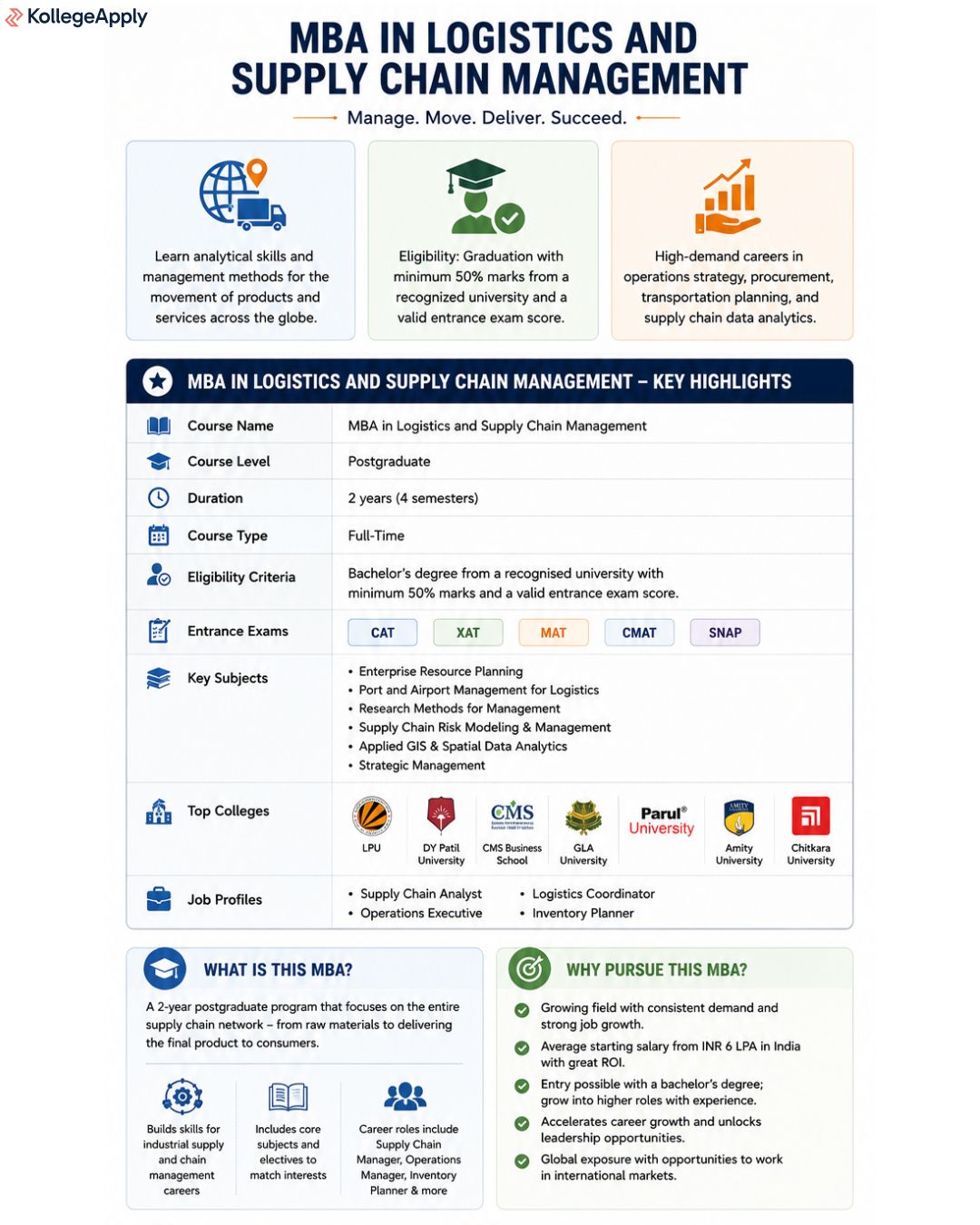
Students interested in learning about the analytical skills and management methods needed for the movement of products and services can consider pursuing an MBA in Logistics and Supply Chain Management. An MBA in SCM and logistics imparts knowledge on the use of inventory, customer service, warehousing, and storage. The program consists of both theoretical and practical sessions to help students become skilled professionals in this field.
Students who want to study an MBA in Logistics and Supply Chain Management need to focus on meeting the eligibility criteria. Generally, the criteria include securing a minimum of 50% marks in graduation from a recognized university. Students are also required to appear for entrance exams such as CAT, XAT, MAT, CMAT, SNAP, etc., to be considered for admission into their desired colleges.
MBA in Logistics and Supply Chain Management graduates can find opportunities in several in-demand areas such as operations strategy, procurement management, transportation planning, and supply chain data analytics. Fresh graduates can build careers in roles such as supply chain analyst, logistics coordinator, operations executive, inventory planner, and many more.
- MBA in Logistics and Supply Chain Management Key Highlights
- What is an MBA in Logistics and Supply Chain Management?
- Why pursue an MBA in Logistics and Supply Chain Management?
- Who Should Study MBA in Logistics and Supply Chain Management?
- MBA in Logistics and Supply Chain Management Eligibility Criteria
- MBA in Logistics and Supply Chain Management Entrance Exams
- MBA in Logistics and Supply Chain Management Colleges
- MBA in Logistics and Supply Chain Management Admission Process 2026
- MBA in Logistics and Supply Chain Management Syllabus
- MBA in Logistics and Supply Chain Management Career
- MBA in Logistics and Supply Chain Management Vs MBA in HRM
- MBA in Logistics and Supply Chain Management FAQs
MBA in Logistics and Supply Chain Management Key Highlights
Aspirants aiming to build a career in the field of MBA in SCM and Logistics must be aware of all the relevant information related to the program. There are several important factors to consider for admission, such as the duration of the course, subjects covered, colleges, career scope, and more. Check out the table given below to learn about the key highlights of MBA in Logistics and Supply Chain Management:
What is an MBA in Logistics and Supply Chain Management?
MBA in Logistics and Supply Chain Management is an advanced program offered at the postgraduate level for a duration of two years. The program focuses on the study of the entire network involved in transporting raw materials to the final product and making it available to consumers. An MBA in SCM and logistics helps graduates develop the skills required to work as future managers in the field of industrial supply and chain management.
The MBA in Logistics and Supply Chain Management syllabus consists of theoretical subjects essential for building a strong career, such as managerial economics, supply operations, enterprise resource planning, and many more. Students also get the opportunity to shape their careers according to their interests with the help of electives. After successfully graduating from an MBA in Logistics and Supply Chain Management, students can work as supply chain managers, purchasing managers, inventory planning specialists, production planners, operations managers, and more.
Why pursue an MBA in Logistics and Supply Chain Management?
Students need to focus on the importance of an MBA in Logistics and Supply Chain Management. The program helps students gain both theoretical and practical knowledge that is essential to secure high-paying opportunities. Check out the pointers given below to learn more about the reasons to pursue an MBA in Logistics and Supply Chain Management:
- Logistics and supply chain is a growing field with consistent demand. The sector has shown resilience, with steady job growth, making it a reliable career choice.
- With average annual salaries starting from INR 6 LPA in India, this MBA offers a solid return on investment compared to many other specializations.
- Many roles in logistics are accessible with a bachelor’s degree, making it easier to enter the field and gradually move into higher positions with experience.
- An MBA helps accelerate career growth, opening doors to managerial and leadership roles that require advanced knowledge and industry expertise.
- Logistics roles often involve global operations and travel, offering valuable exposure to international markets and business practices.
Who Should Study MBA in Logistics and Supply Chain Management?
Students who are interested in building a career in the SCM & Logistics sector while gaining strong business and management skills should consider pursuing an MBA in Logistics and Supply Chain Management. This program is ideal for those aiming for leadership roles in a growing and dynamic industry. There are some pointers given below to learn more about the suitability:
- Individuals who enjoy planning, organizing, and managing processes involved in production, storage, and distribution of goods should consider this program.
- Students who want to move into leadership positions in industries like manufacturing, retail, or e-commerce can benefit from this specialization.
- Working professionals in logistics, operations, or related fields looking to upskill and transition into higher-paying roles should pursue this MBA.
- Those who want exposure to international trade, global supply chains, and cross-border operations will find this program highly relevant.
- Students who enjoy handling real-world challenges like supply delays, cost optimization, and demand planning can build a strong career in this field.
MBA in Logistics and Supply Chain Management Eligibility Criteria
Colleges require students to fulfil certain pre-determined eligibility criteria in order to grant admission to interested candidates. MBA in Logistics and Supply Chain Management usually includes factors such as academic qualifications and marks obtained. Students are assessed on the basis of these components and then considered for further rounds. Interested students can check out the pointers provided below to understand more:
- Aspirants must focus on completing their bachelor’s degree from a recognised university.
- Candidates must secure a minimum aggregate of 50% marks or above to be eligible for the MBA in Logistics and Supply Chain Management.
- Students are supposed to appear for entrance exams such as CAT, XAT, MAT, GMAT, SNAP, etc and present a valid scorecard during the time of admission.
- Many universities also require candidates to participate in a group discussion or personal interview as part of the selection process.
MBA in Logistics and Supply Chain Management Entrance Exams
Students must understand that admission into an MBA in Logistics and Supply Chain Management requires clearing an entrance exam. There are several national-level, state-level, and university-level exams that students can appear for and present a valid scorecard during the admission process. Students interested in learning more about entrance exams can check out the table given below:
MBA in Logistics and Supply Chain Management Colleges
MBA in Logistics and Supply Chain Management is one of the sought-after courses in India, and several colleges offer it to students. Some colleges are government-owned, while others are privately owned. The college fees vary, as private institutions generally cost more than government colleges. Check out the table given below to learn more about popular colleges offering MBA in Logistics and Supply Chain Management:
MBA in Logistics and Supply Chain Management Admission Process 2026
Students must adhere to the steps included in the admission process for MBA Logistics Management. Initially, students are required to meet the eligibility criteria in order to be considered for further admission steps. Candidates need to register, pay the application fee, appear for the exam, score well, wait for the merit list, and then pay the course fees. To have a better understanding of the admission process, a reference to LPU is provided below:
Step 1: First and foremost, students must first register on the LPUADMIT portal through the official university website.
Step 2: MBA aspirants must provide the basic details required for registration, such as name, ID, mobile number, and gender. The student’s email ID will act as the username, and the password will be set during registration.
Step 3: After registration, candidates must log in to the LPUADMIT portal using the credentials and apply for the LPUNEST entrance exam. They need to book a slot and appear for the exam.
Step 4: Students must qualify for the LPUNEST examination, as the scorecard plays a crucial role in progressing further in the admission process.
Step 5: Shortlisted students will be invited for document verification and must pay the required course fee to confirm their seat.
Documents Required
MBA in Logistics and Supply Chain Management Syllabus
MBA in Logistics and Supply Chain Management syllabus is structured into four equal semesters, covering both theoretical concepts and practical sessions. Students study industry-relevant core subjects, which helps in grasping good job opportunities in the future. To learn more, students can check out the MBA Logistics syllabus followed at Pondicherry University:
Electives
MBA in Logistics and Supply Chain Management Career
Masters in SCM and Logistics helps in paving a strong career path in areas like operations strategy, procurement management, transportation planning, and supply chain data analytics. Graduates can work in job roles such as Supply Chain Manager, Logistics Manager, and more. Check out the table given below to learn more about MBA in Logistics and Supply Chain Management career:
MBA in Logistics and Supply Chain Management Vs MBA in HRM
Students interested in taking admission into a master’s program need to first figure out their long-term career goals. There are several courses available that students can opt for after a bachelor’s degree. Human Resource Management is one such course, which is highly sought after and provides plenty of diverse career opportunities to students. Aspirants must compare both courses in order to determine which one will be more suitable for their career. Check out the table given below to learn more about the comparison between Logistics and Supply Chain Management and HRM:
MBA in Logistics and Supply Chain Management FAQs
What is MBA in Logistics and Supply Chain Management?
It is a 2-year postgraduate program that focuses on managing the flow of goods, services, inventory, and supply chain operations efficiently.
What is the eligibility for MBA in Logistics and SCM?
Candidates must have a bachelor’s degree with at least 50% marks and a valid entrance exam score like CAT, MAT, or XAT.
What is the duration of MBA in Logistics and SCM?
The course duration is 2 years, divided into 4 semesters, including both theoretical learning and practical exposure.
What entrance exams are required for MBA in Logistics?
Common exams include CAT, XAT, MAT, CMAT, SNAP, and NMAT, depending on the college requirements.
What subjects are included in this MBA program?
Subjects include supply chain management, logistics, inventory control, procurement, ERP, and transportation management.
What are the job roles after MBA in Logistics and SCM?
Graduates can work as supply chain managers, logistics managers, operations executives, procurement managers, and inventory planners.
What is the salary after MBA in Logistics and SCM?
Freshers can earn INR 6 LPA, and salaries increase with experience and specialization in the field.
What is the scope of MBA in Logistics and SCM?
The field has high demand across industries like e-commerce, manufacturing, retail, and shipping, offering strong career growth.
Who should pursue MBA in Logistics and SCM?
Students interested in operations, management, analytics, and global trade should consider this course.
Is MBA in Logistics and SCM a good career option?
Yes, it offers strong job opportunities, career growth, global exposure, and a stable future in a growing industry.