Students interested in pursuing a program that integrates business principles with the power sector can opt for an MBA in Power Management. It is a two-year postgraduate program designed to equip students with both managerial and industry-specific knowledge. The course covers several industry-relevant subjects that prepare students for careers in government organizations, PSU jobs, and private power companies. Some of the key topics included in the MBA in Power Management syllabus are the regulatory framework in the power sector, solar power development and management, power sector automation and smart grids, and many more.
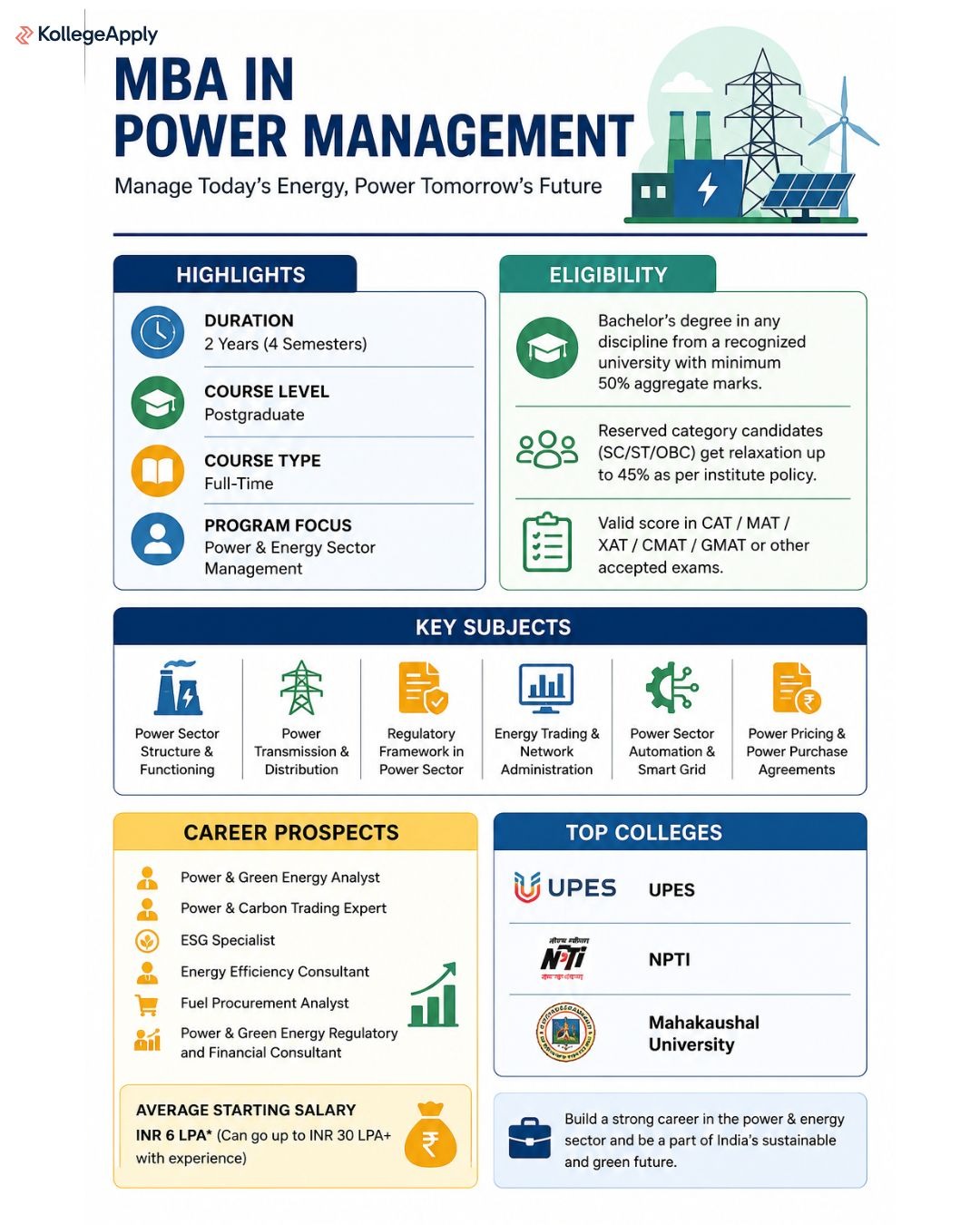
Candidates seeking admission to MBA in Power Management colleges such as UPES, NPTI, and others must meet the eligibility criteria prescribed by the respective universities. Applicants are generally required to hold a bachelor's degree with at least 50% aggregate marks from a recognized university. Students belonging to reserved categories (SC/ST/OBC) are usually provided a relaxation of up to 45% marks, as per the institute's admission policy. Candidates are also required to present a valid entrance exam score, such as CAT, MAT, CMAT, XAT, GMAT, or any other accepted examination.
After completing the MBA in Power Management program, students develop skills in strategic and regulatory management, project finance, data-driven decision-making, leadership, and energy sector operations. These skills open up career opportunities in job roles such as Power and Green Energy Analyst, Carbon Trading Expert, Fuel Procurement Analyst, Procurement Manager, and more. Fresh graduates can expect an average starting salary of around INR 6 LPA, which can increase to INR 30 LPA or more with experience, expertise, and career growth.
- MBA in Power Management Highlights
- What is MBA in Power Management?
- Why Pursue MBA in Power Management?
- Is an MBA in Power Management Worth It?
- What is the Eligibility for MBA in Power Management?
- MBA in Power Management Entrance Exams
- Top MBA in Power Management Colleges in India
- How Does the MBA in Power Management Admission Process Work?
- What is the Syllabus of MBA in Power Management?
- What are the Career Opportunities After MBA in Power Management?
- MBA in Power Management vs MBA in Finance
- MBA in Power Management FAQs
MBA in Power Management Highlights
It is important for the students to gather information related to the MBA in Power Management which will help in making an informed decision. Various components are included in the course details, such as duration, fees, syllabus covered, career scope, and more. There is a table given below that can be referred to for better clarity on the key highlights of an MBA in Power Management:
What is MBA in Power Management?
Aspirants aiming to pursue a two-year postgraduate program focused on developing the skills and knowledge required to excel in the power sector can consider an MBA in Power Management. The program is divided into four equal semesters and imparts both theoretical and practical knowledge. Students develop the skills to analyze the Indian and international power industries, create optimization strategies, and curate project-specific plans while keeping organizational goals at the forefront.
The course helps students become industry-ready professionals through a combination of theoretical subjects, summer internships, and a dissertation. Several industry-focused subjects are included in the program, such as Integrated Power Resources Management, Power Sector Planning, Power Pricing, Power Purchase Agreements, Energy Trading and Network Administration, and more. Many reputed companies provide career opportunities to graduates, including Infosys, Wipro, Deloitte, and several leading organizations in the power and energy sector.
Why Pursue MBA in Power Management?
Pursuing an MBA in Power Management is a suitable program for students who want to build a career in the rapidly evolving power and energy sector. The program mixes management education with industry-specific knowledge, preparing graduates for leadership roles across government organizations, PSUs, and private energy companies. Students can check out the pointers given below to learn more:
- The program offers a specialized curriculum focused on the power and energy sector, helping students develop both managerial and technical expertise.
- The MBA in Power Management syllabus includes industry-relevant subjects such as power sector planning, energy trading, renewable energy, power pricing, regulatory frameworks, and project management.
- Graduates gain practical exposure through internships, live projects, industry visits, dissertations, and interaction with experienced professionals.
- Students develop skills in strategic management, project finance, energy policy, regulatory compliance, leadership, and data-driven decision-making.
- Top MBA in Power Management colleges maintain strong industry collaborations, providing students with placement assistance and networking opportunities.
- The program opens career opportunities in government organizations, PSUs, private power companies, consulting firms, renewable energy companies, and energy startups.
Is an MBA in Power Management Worth It?
An MBA in Power Management is worth pursuing for students who want to build a career in one of the fastest-growing industries. The program combines management education with specialized knowledge of the power and energy sector, preparing graduates for roles in renewable energy, power consulting, energy trading, project management, and business development across government and private organizations.
The growing investment in renewable energy, smart grids, electric mobility, and sustainable infrastructure has significantly increased the demand for skilled professionals. Graduates benefit from strong placement opportunities, competitive salary packages, practical industry exposure through internships and live projects, and long-term career growth, making an MBA in Power Management a valuable investment for aspiring management professionals.
What is the Eligibility for MBA in Power Management?
To secure admission to MBA in Power Management colleges in India, candidates must fulfill the eligibility criteria prescribed by the respective institutes. These basic eligibility requirements help colleges identify suitable candidates for the program. In addition to meeting the academic qualifications, applicants may also be required to qualify for entrance examinations accepted by the institute for the final selection process. The table below provides an overview of the MBA in Power Management eligibility criteria:
MBA in Power Management Entrance Exams
There are several national, state, and university-level entrance exams offered in India for students aiming to secure admission into MBA in Power Management programs. These exams are considered competitive, as there are limited seats available in the best colleges for MBA in Power Management. Entrance tests such as CAT, XAT, MAT, CMAT, and others play an important role in the admission and selection process for the course. Interested candidates can check out the table given below to learn more about the entrance exams accepted for MBA in Power Management:
Top MBA in Power Management Colleges in India
Students have the option to choose from a wide range of public and private colleges in India offering an MBA in Power Management. These colleges focus on imparting industry-specific knowledge and management skills required to excel in the power and energy sector. The curriculum combines theoretical learning with practical exposure through internships, live projects, case studies, and industry interactions, preparing students for leadership roles in government organizations, PSUs, consulting firms, and private energy companies. Check out the table given below to learn more about some of the colleges offering the power management course:
How Does the MBA in Power Management Admission Process Work?
Students seeking admission to MBA in Power Management colleges should understand the complete admission process before applying. Generally, candidates are required to complete the online application, submit the necessary documents, pay the application fee, and appear for the institute's selection process. Applicants can refer to the admission process followed by UPES to better understand the MBA in Power Management admission procedure.
Step 1: Visit the official website of UPES and complete the online registration by filling in the required personal details in the MBA in Power Management application form.
Step 2: Fill in the academic details, upload the required documents, and pay the prescribed application fee to successfully submit the application form.
Step 3: After the application is submitted, UPES reviews the application based on the prescribed eligibility and selection criteria. Candidates are informed about the next stages of the admission process through their registered email ID and mobile number.
Step 4: Eligible candidates are invited to appear for the entrance examination or personal interview, as applicable. Applicants can select their preferred date and time slot whenever required.
Step 5: Based on the overall selection process, shortlisted candidates receive a provisional admission offer. To confirm their admission, candidates must pay the acceptance fee within the specified deadline to reserve their seat in the MBA in Power Management program.
Documents Required
What is the Syllabus of MBA in Power Management?
The MBA in Power Management syllabus is divided into four equal semesters and focuses on providing students with both managerial and practical knowledge of the power and energy sector. Students begin the curriculum with foundational subjects related to management and the power industry and gradually move towards advanced topics such as Power Sector Planning, Power Pricing, Renewable Energy, Energy Trading, and Smart Grid Management. Check out the table given below to learn more about the UPES MBA in Power Management syllabus for a better understanding of the course.
What are the Career Opportunities After MBA in Power Management?
Graduates after completing an MBA in Power Management can explore a wide range of career opportunities in the power, energy, and renewable energy sectors. The program equips students with managerial, analytical, and technical skills required for leadership roles across government organizations, PSUs, consulting firms, utility companies, and private energy organizations. Check out the table given below to learn more about the career opportunities available after an MBA in Power Management:
MBA in Power Management vs MBA in Finance
Several MBA specialisations are available in India that students can pursue to build a successful career in management and business. Human Resource Management, Marketing, Business Analytics, Finance, Operations, and Power Management are some of the popular options. Candidates interested in the energy sector can consider an MBA in Power Management, while those aiming for careers in banking and financial services can opt for an MBA in Finance. Check out the table given below to understand the key differences between MBA in Power Management and MBA in Finance:
MBA in Power Management FAQs
What is MBA in Power Management?
MBA in Power Management is a two-year postgraduate program that combines management studies with power and energy sector knowledge.
Who is eligible for MBA in Power Management?
Candidates with a bachelor's degree and at least 50% aggregate marks are generally eligible for MBA in Power Management.
What is the MBA in Power Management syllabus?
The MBA in Power Management syllabus includes power pricing, renewable energy, smart grids, energy trading, and project management.
What are the top MBA in Power Management colleges?
Popular MBA in Power Management colleges include UPES, NPTI, and Mahakaushal University.
What is the MBA in Power Management fees in India?
MBA in Power Management fees generally range from INR 50,000 to INR 7 lakh, depending on the institute.
What is the salary after MBA in Power Management?
MBA in Power Management graduates can earn around INR 6 LPA initially, with experienced professionals earning INR 30 LPA or more.
Is MBA in Power Management worth it?
Yes, MBA in Power Management offers excellent career opportunities in the power, renewable energy, and consulting sectors.
What jobs are available after MBA in Power Management?
MBA in Power Management graduates can work as Power Analysts, Energy Consultants, Sustainability Managers, and Project Managers.
Which entrance exams are accepted for MBA in Power Management?
MBA in Power Management admissions generally accept CAT, MAT, CMAT, XAT, GMAT, and institute-level entrance exams.
What skills do students gain through MBA in Power Management?
MBA in Power Management develops leadership, analytical, project management, and strategic decision-making skills.