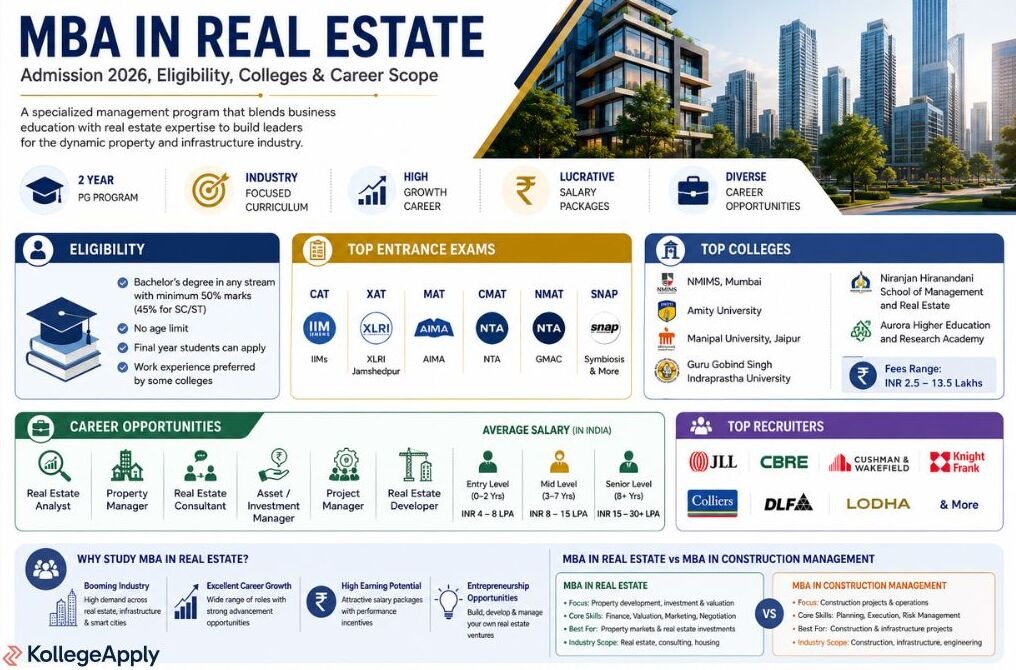
An MBA in Real Estate is a specialized management program that focuses on both business and real estate principles. The course covers areas such as property management, real estate development, investment analysis, urban planning, and construction management. It helps students understand the industry and develop the managerial and leadership skills needed for a successful career in real estate.
To be eligible to pursue this program, candidates must hold a bachelor's degree of at least three years from a recognized university, typically with a minimum of 50% aggregate marks. They may also be required to qualify for management entrance exams such as CAT, XAT, MAT, SNAP, or other institute-specific examinations, depending on the admission criteria of the college.
Some of the MBA in Real Estate colleges include Amity University, NMIMS, Aurora Higher Education and Research Academy, Manipal University, and Guru Gobind Singh Indraprastha University. The total course fee generally ranges from INR 2.5 lakh to INR 13.5 lakh, depending on the institution and program structure.
An MBA in Real Estate opens up career opportunities such as Real Estate Analyst, Property Manager, Real Estate Consultant, Real Estate Appraiser, and Real Estate Developer. Graduates can earn an average salary of INR 6 – 15+ LPA. Top recruiters include JLL, CBRE, Cushman & Wakefield, Knight Frank, Colliers, DLF, and Lodha.
- MBA in Real Estate Course Highlights
- What is an MBA in Real Estate?
- Why Study an MBA in Real Estate?
- Is MBA in Real Estate Worth It in 2026?
- What is the MBA in Real Estate Eligibility Criteria?
- MBA in Real Estate Entrance Exams
- MBA in Real Estate Colleges in India
- MBA in Real Estate Admission Process
- MBA in Real Estate Syllabus
- What Skills are Required for MBA in Real Estate?
- MBA in Real Estate Jobs & Salary
- What is the Salary After MBA in Real Estate?
- Top Recruiters for MBA in Real Estate
- MBA in Real Estate VS MBA in Construction Management
- MBA in Real Estate FAQs
MBA in Real Estate Course Highlights
An MBA Real Estate offers specialized business and management knowledge tailored to the real estate industry. The program focuses on developing expertise in property markets, finance, investment, construction management, and strategic planning. Here are some of the basic highlights for the Master of Business Administration in Real Estate program:
What is an MBA in Real Estate?
An MBA in Real Estate is a two-year full-time postgraduate course offered across different colleges and universities in India. As a specialized postgraduate course, it focuses on the business and legal aspects of the real estate industry. The course combines the principles of finance, marketing, operations, etc, with real estate-focused concepts, thus providing valuable knowledge and industry exposure about real estate law, asset management, and laws governing real estate business.
The course equips the students with a relevant skill set, which includes urban planning, project management, market analysis, negotiation, sustainability in real estate, communication, interpersonal skills, human relations management, etc. The course is a highly chosen one in terms of an MBA program by various graduates who are willing to work and excel in the real estate business.
Industry exposure is a key component of the program. Many institutions offer internships, live projects, industry visits, and interactions with real estate professionals to provide practical insights into the sector. Upon completion, graduates develop strong analytical, managerial, and strategic decision-making skills, making them suitable for careers in property consulting, asset management, real estate investment, and development firms.
Why Study an MBA in Real Estate?
The Master of Business Administration in Real Estate is a highly demanded program by students to pursue their MBA, and hence, it is offered in different colleges and universities in India. The reasons to opt for this course are given below:
- Specialized industry- The real estate business is a specialized industry that focuses on the understanding of consultancy, development firms, urban infrastructure, etc, providing valuable information to the students who want to build a career in real estate.
- Career opportunities- The field of real estate is a lucrative business that is associated with diverse career opportunities, which include brokers, developers, consultants, etc., offering potential for career growth.
- Earning potential- The Real estate business is associated with a high earning potential with attractive salary packages. The students are offered high-paying job roles in finance, development, etc.
- Entrepreneurship opportunities- The course equips the students with the relevant knowledge about the field of real estate, helping them to build, develop, and manage their firms, consultancy agencies, and businesses.
Is MBA in Real Estate Worth It in 2026?
The demand for qualified real estate professionals continues to increase as urbanization, infrastructure development, and smart city initiatives expand across India. Organizations are seeking professionals who possess both business management expertise and industry-specific knowledge.
In 2026, technological advancements such as PropTech, AI-based property analysis, digital transactions, and sustainable construction practices are transforming the real estate industry. An MBA in Real Estate equips students with the skills needed to adapt to these evolving trends.
The program offers excellent career growth opportunities in property management, investment advisory, infrastructure development, and real estate consulting, making it a valuable choice for aspiring professionals.
What is the MBA in Real Estate Eligibility Criteria?
To secure a seat in the top institutes and colleges in India for the MBA in Real Estate course, a student must meet the following eligibility criteria to be selected for further application and the admission process. The detailed eligibility criteria are mentioned below:
- Minimum Qualification: Candidates must possess a valid bachelor's degree in any discipline (such as B.Com, BBA, B.Tech, or B.Arch) from an officially recognized university board.
- Required Minimum Marks: A minimum aggregate score of 50% or equivalent CGPA must be obtained at the undergraduate level.
- Relaxation Criteria: A relaxation of 5% in marks (minimum 45% aggregate requirement) is extended to applicants belonging to reserved classifications, including SC, ST, and PwD categories.
- Accepted Entrance Exams: Applicants must sit for, and clear, national management entrance tests or explicit university design assessment criteria to be considered for next-stage shortlisting.
- Age Limit Parameters: There is no specific upper age limit restriction enforced across major business schools for pursuing a full-time post-graduate management course.
- Professional Experience (Optional): While freshers are fully eligible to apply, certain premium executive programs or specific top-tier colleges prioritize candidates who possess 1–2 years of active work experience in infrastructure, engineering, or real estate fields.
MBA in Real Estate Entrance Exams
To secure admission to top colleges offering an MBA in Real Estate, candidates must qualify for the entrance examinations accepted by their chosen institutions. Some of the major entrance exams for MBA in Real Estate admission are listed in the table below:
MBA in Real Estate Colleges in India
An MBA in Real Estate is a highly chosen course by several students. Hence, it is offered by several colleges and universities across India. Colleges offering this course are listed in the table below:
MBA in Real Estate Admission Process
The admission process for an MBA in Real Estate is similar across most colleges, although there may be variations in the accepted entrance exams and selection criteria. Some institutes offer admission based on entrance exam scores, while others may consider merit-based admission. To secure admission to a top MBA in Real Estate college in India, candidates must first meet the eligibility requirements and then complete the admission process prescribed by the institution. The step-by-step admission procedure is outlined below:
Step 1: Entrance Exam Registration - Candidates must register online and appear for national-level management exams like the CAT, XAT, or NMAT by submitting required test fees.
Step 2: Application Form Filling - Fill out specific institutional admission profiles on individual B-school websites, listing academic records and uploading exam scores.
Step 3: Cutoff Shortlisting - Institutions evaluate incoming scores and release customized merit cutoff lists to screen prospective candidates.
Step 4: Selection Rounds (GD/PI) - Shortlisted applicants must participate in institutional Group Discussions (GD), Written Ability Tests (WAT), and comprehensive Personal Interviews (PI).
Step 5: Final Merit List - Business schools compile a final score based on entrance exam performance, GD/PI marks, academic history, and relevant work experience.
Step 6: Document Verification - Selected students submit their original certificates and test scores to the university verification deck to confirm eligibility.
Step 7: Admission Fee Submission - Pay the first semester or initial academic block fee to secure the allotted seat.
Documents Required
MBA in Real Estate Syllabus
An MBA in Real Estate is a two-year full-time course that draws on different concepts of the real estate industry and combines them with management. The subjects taught during the entire course at Jain University are mentioned below:
What Skills are Required for MBA in Real Estate?
To build a successful career in the real estate industry, professionals need a mix of managerial, analytical, financial, and communication skills. These skills help in managing projects, evaluating investments, understanding market trends, and maintaining strong relationships with clients and stakeholders. Some of the key skills required for an MBA in Real Estate graduate are listed below:
- Communication Skills: Essential for client interactions and negotiations.
- Leadership Skills: Important for managing teams and projects.
- Analytical Thinking: Helps evaluate investments and market trends.
- Problem-Solving Ability: Useful for handling project-related challenges.
- Team Management: Necessary for coordinating multidisciplinary teams.
- Financial Analysis: Important for assessing property investments.
- Strategic Thinking: Helps in long-term business planning.
- Negotiation Skills: Crucial for property transactions.
- Time Management: Ensures efficient project execution.
- Industry Knowledge: Understanding real estate regulations and market dynamics.
MBA in Real Estate Jobs & Salary
An MBA in Real Estate opens up diverse career opportunities across real estate development, property management, consulting, investment, and infrastructure sectors. The program equips graduates with industry-specific knowledge and management skills, enabling them to take on strategic and operational roles in the real estate industry. Some of the popular career options are listed below:
What is the Salary After MBA in Real Estate?
The salary offered after an MBA in Real Estate depends on factors such as work experience, job role, employer, and location. Professionals with specialized skills and industry experience often receive higher compensation and better career growth opportunities. The average salary range as per the experience level is given below:
Top Recruiters for MBA in Real Estate
The real estate industry offers a wide range of employment opportunities across property development, consulting, infrastructure, construction, and investment sectors. MBA in Real Estate graduates are recruited by leading real estate firms, consultancy companies, financial institutions, and infrastructure organizations for various managerial and strategic roles. Some of the top recruiters are listed below:
MBA in Real Estate VS MBA in Construction Management
Both MBA in Real Estate and MBA in Infrastructure Management focus on the development and infrastructure sectors. However, they differ in terms of curriculum, industry focus, and career opportunities. While one emphasizes property development and real estate management, the other focuses on large-scale infrastructure projects and public utilities. The key differences between the two programs are outlined below:
MBA in Real Estate FAQs
What is MBA in Real Estate?
MBA in Real Estate is a management program focused on property development, valuation, finance, and real estate investment. It prepares students for industry leadership roles.
What is the duration of MBA in Real Estate?
MBA in Real Estate is a two-year postgraduate degree divided into four semesters. The program includes classroom learning, projects, case studies, internships, and industry-oriented training.
Who can apply for MBA in Real Estate?
Candidates with a bachelor's degree from a recognized university and at least 50% aggregate marks can apply. Most colleges also require valid scores in accepted MBA entrance examinations.
Which entrance exams are accepted for MBA in Real Estate?
Admission is generally based on entrance exams such as CAT, XAT, MAT, CMAT, NMAT, and SNAP. Some universities may also conduct their own entrance tests and interview rounds.
What are the major MBA in Real Estate subjects?
The curriculum includes Real Estate Finance, Property Valuation, Urban Planning, Construction Management, Real Estate Marketing, Investment Analysis, and Real Estate Laws and Regulations.
Is MBA in Real Estate worth pursuing in 2026?
Yes, the program offers strong career prospects due to increasing urbanization, infrastructure projects, and real estate investments. It also provides specialized industry knowledge and management skills.
What is the average salary after MBA in Real Estate?
Fresh graduates can earn around INR 4–8 LPA, depending on their skills and employer. With experience and specialization, professionals can secure significantly higher salary packages.
What are the career options after MBA in Real Estate?
Graduates can work as Real Estate Analysts, Property Consultants, Asset Managers, Project Managers, and Investment Managers across real estate, infrastructure, and consulting sectors.
Which are the top colleges for MBA in Real Estate?
Some leading institutions include NMIMS, Amity University, Manipal University, Guru Gobind Singh Indraprastha University, and Niranjan Hiranandani School of Management and Real Estate.
Can I pursue MBA in Real Estate after engineering?
Yes, engineering graduates are eligible to pursue MBA in Real Estate. Their technical background can be beneficial for careers in property development, construction, and infrastructure management.