MD Microbiology Colleges offer a three-year postgraduate medical programme focused on microorganisms, infectious diseases, laboratory diagnosis, immunology, antimicrobial resistance and infection control. The course is pursued after MBBS and includes theoretical learning, laboratory training, clinical correlation, research and dissertation work.
Admission to MD Microbiology colleges in India is primarily based on NEET-PG followed by the applicable counselling process. Depending on the institution and seat category, admission may be through MCC counselling or the relevant state counselling authority. Candidates generally need an MBBS degree and completion of the compulsory internship as per applicable NMC requirements.
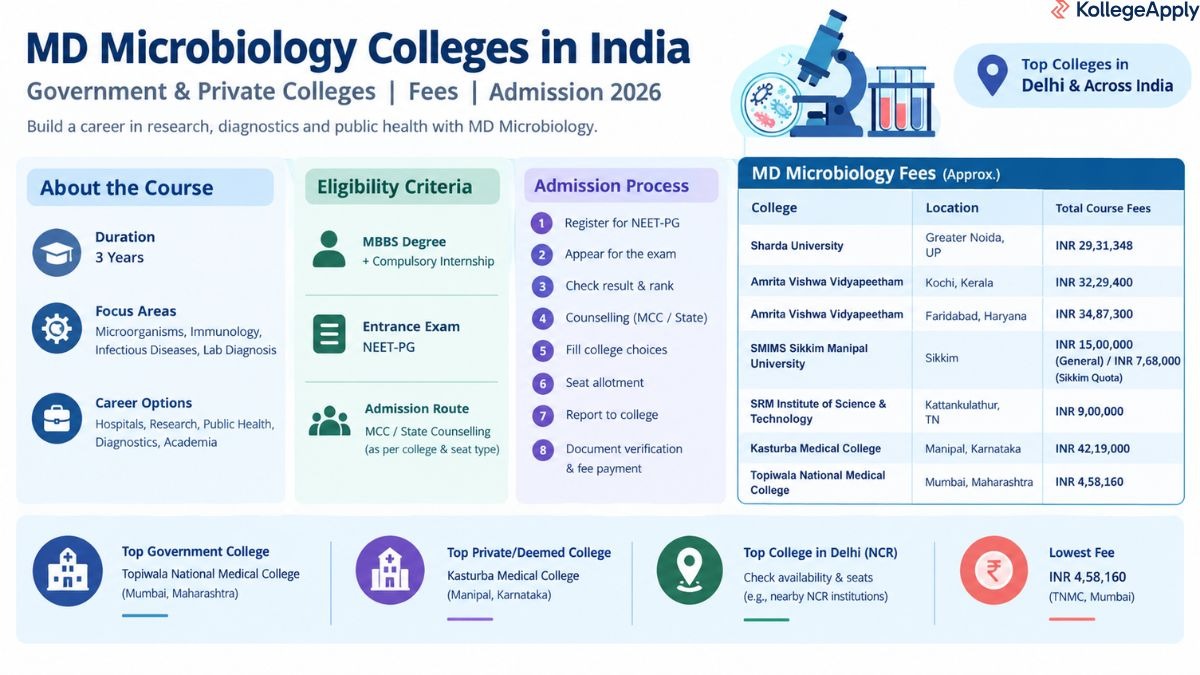
Table of Contents
Top Government and Private MD Microbiology Colleges in India
MD Microbiology is offered by medical colleges and universities across different parts of India. Government institutions generally have regulated fee structures, while private and deemed universities may have substantially different tuition fees. The admission route, seat intake, fee structure and institutional requirements can also vary between colleges. The following list includes institutes for which MD Microbiology is documented through institutional sources or the provided official fee.
Government MD Microbiology Colleges
Government medical colleges generally offer MD Microbiology through NEET-PG counselling, with seats allocated according to the applicable All India Quota, state quota or institutional rules. Fees are usually lower than those charged by private or deemed medical universities. Candidates should also consider the attached teaching hospital, laboratory facilities, postgraduate intake and academic exposure while comparing institutions. Topiwala National Medical College officially lists MD Microbiology as a postgraduate course affiliated with MUHS and reports an intake capacity of eight students per year.
Private and Deemed MD Microbiology Colleges
Private and deemed universities may offer dedicated microbiology departments, clinical laboratories and research facilities. Sharda University states that its three-year MD Microbiology programme requires NEET qualification and allotment through UPDGME. SMIMS also states that admission to its three-year MD Microbiology programme is through the NEET merit list.
SRM Medical College Hospital and Research Centre, Kattankulathur, officially lists MD Microbiology as a three-year postgraduate programme with six general and three NRI seats. However, fee structures can differ considerably, so students should compare the total course fee, additional charges, seat category and counselling route before making their choices.
What is the Eligibility Criteria for MD Microbiology Colleges?
Eligibility for MD Microbiology colleges follows the requirements applicable to postgraduate medical education in India. Candidates must have completed the required undergraduate medical qualification and internship before joining the programme. Individual institutions may also specify counselling, registration and documentation requirements. Therefore, students should distinguish between basic eligibility for NEET-PG and the additional admission requirements of a particular college.
- Candidates should possess an MBBS degree from a recognised medical institution.
- The compulsory rotating internship must be completed within the prescribed timeline.
- Candidates must qualify NEET-PG for MD Microbiology admission.
- Candidates must participate in the counselling process applicable to their chosen college.
- Category-wise eligibility and qualifying requirements are governed by the applicable medical education and counselling rules.
- For institutions such as Sharda University, admission requires NEET qualification and allotment through UPDGME.
- SMIMS requires an MBBS qualification with internship completion according to the date specified by NMC.
MD Microbiology Admission Process
The MD Microbiology admission process generally begins with NEET-PG registration and examination. After the result is declared, eligible candidates participate in the relevant counselling process and fill their preferred colleges and courses. Seats are allotted according to merit, choices, category and applicable counselling rules.
For deemed medical universities such as SRM Institute of Science and Technology, NEET-qualified candidates participate in MCC counselling and select the institution and specialty during the choice-filling process. The admission process generally involves the following steps:
- Register for NEET-PG: Complete the NEET-PG application within the prescribed registration period.
- Appear for NEET-PG: Take the postgraduate medical entrance examination and obtain a qualifying score and rank.
- Check the result: Review the NEET-PG result, rank and qualifying status after the examination.
- Register for counselling: Participate in MCC counselling or the respective state counselling, depending on the college and seat category.
- Fill college choices: Select MD Microbiology and preferred medical colleges during the choice-filling window.
- Participate in seat allotment: Seats are allotted based on merit, choices, category, seat availability and applicable counselling rules.
- Report to the allotted college: Candidates who accept the allotted seat must report to the respective medical college within the specified deadline.
- Complete admission formalities: Submit the required documents, complete verification and pay the prescribed admission fees to confirm the seat.
Entrance Exams Accepted by MD Microbiology Colleges
NEET-PG is the principal entrance examination for MD Microbiology admission. The counselling authority depends on the type of medical institution and seat. Candidates applying to deemed universities generally participate through MCC, while state government and private medical college seats may be handled through the respective state counselling authority.
MD Microbiology Colleges in Delhi
Students searching for MD Microbiology Colleges in Delhi should distinguish between colleges located within Delhi and institutions in the surrounding NCR region. MD Microbiology availability can vary from year to year based on recognised postgraduate seats and institutional intake.
For Delhi and NCR aspirants, colleges should be compared on factors such as postgraduate seat availability, teaching hospital exposure, microbiology laboratory facilities, research opportunities, fee structure and counselling route. Greater Noida institutions such as Sharda University are located in the NCR region but are not geographically within Delhi. Sharda's official programme page confirms its three-year MD Microbiology course and NEET-based admission route.
MD Microbiology Colleges Fees in India
The MD Microbiology fees in India vary substantially according to whether the college is government, private or deemed. Government medical colleges generally have lower tuition charges, whereas private and deemed universities may have higher course fees. Fee figures can also differ according to general, NRI, state or institutional quota categories.
Sharda's official MD Microbiology page lists a first-year fee of INR 9,77,116, while its 2026-27 fee structure also identifies additional charges applicable to medical programmes. SMIMS officially lists annual MD Microbiology fees of INR 5,00,000 for general-category students and INR 2,56,000 for Sikkim quota students, along with specified registration and caution deposits.
Kasturba Medical College, Manipal's official 2026-27 general fee document lists the MD Microbiology total at INR 42,19,000, including tuition and other specified fees. TNMC & Nair Hospital officially confirms that MD Microbiology is offered and affiliated with MUHS; the fee shown above follows the verified institutional fee data supplied for this article. The table below uses the fee values provided from official institutional sources.
MD Microbiology Colleges FAQs
What are MD Microbiology Colleges in India?
Sharda University, SRM institute of science & technology, KGMU, SMIMS are some of the medical colleges offering the three-year MD Microbiology postgraduate programme after MBBS.
What is the duration of MD Microbiology?
MD Microbiology colleges generally offer a three-year postgraduate medical programme.
Which entrance exam is required for MD Microbiology?
NEET-PG is the primary entrance examination accepted by MD Microbiology colleges for admission in India.
What is the eligibility for MD Microbiology colleges?
Candidates generally need an MBBS degree, completed internship and a qualifying NEET-PG result to be eligible to pursue MD Microbiology.
What are the MD Microbiology fees in India?
MD Microbiology colleges fees vary by institution and category, with government colleges generally charging less than private and deemed universities.
Which colleges offer MD Microbiology?
Some of MD Microbiology colleges such as KMC Manipal, SRM, Sharda, SMIMS and TNMC & Nair Hospital offer MD Microbiology.
Are there MD Microbiology Colleges in Delhi?
MD Microbiology availability should be checked for individual Delhi institutions; NCR also has colleges such as Sharda University.
Is NEET-PG compulsory for MD Microbiology?
Yes, NEET-PG is the principal entrance examination for MD Microbiology colleges postgraduate medical admission.
What can I do after MD Microbiology?
Graduates can work in hospitals, diagnostic laboratories, public health, research institutions and medical education.