MD Microbiology vs MD Pathology is a common comparison for MBBS graduates considering non-clinical and laboratory-oriented postgraduate specialisations. Both are three-year MD programmes after MBBS, but their training focus is different. MD Microbiology centres on microorganisms, infectious diseases, laboratory diagnosis, antimicrobial susceptibility and infection control, while MD Pathology focuses on disease diagnosis through histopathology, cytopathology, haematology, laboratory medicine and related diagnostic techniques.
The difference becomes particularly important when candidates compare MD Microbiology vs MD Pathology salary, colleges, syllabus and career scope. Both branches can lead to careers in medical colleges, hospitals, diagnostic laboratories, research institutions and public-health settings, but the day-to-day work, laboratory exposure and opportunities for further specialisation are not identical.
The choice therefore depends on the type of diagnostic work a doctor wants to pursue. Candidates interested in infectious diseases, antimicrobial resistance, microbiological diagnosis and infection control may find the microbiology curriculum more aligned with their interests, while those interested in tissue diagnosis, cytology, haematology, transfusion medicine and broader laboratory medicine may prefer pathology-oriented training.
Table of Contents
- MD Microbiology vs MD Pathology: Key Differences
- MD Microbiology: Course, Training and Syllabus
- MD Pathology: Course, Training and Syllabus
- MD Microbiology vs MD Pathology: Eligibility and Admission
- MD Microbiology vs MD Pathology Colleges in India
- MD Microbiology vs MD Pathology Fees
- MD Microbiology vs MD Pathology Career Scope
- MD Microbiology Jobs vs MD Pathology Jobs
- MD Microbiology vs MD Pathology Salary
- Can MD Microbiology Do DM Infectious Disease?
- Further Study After MD Microbiology vs MD Pathology
- MD Microbiology vs MD Pathology: Which One Should You Choose?
- FAQs on MD Microbiology vs MD Pathology
MD Microbiology vs MD Pathology: Key Differences
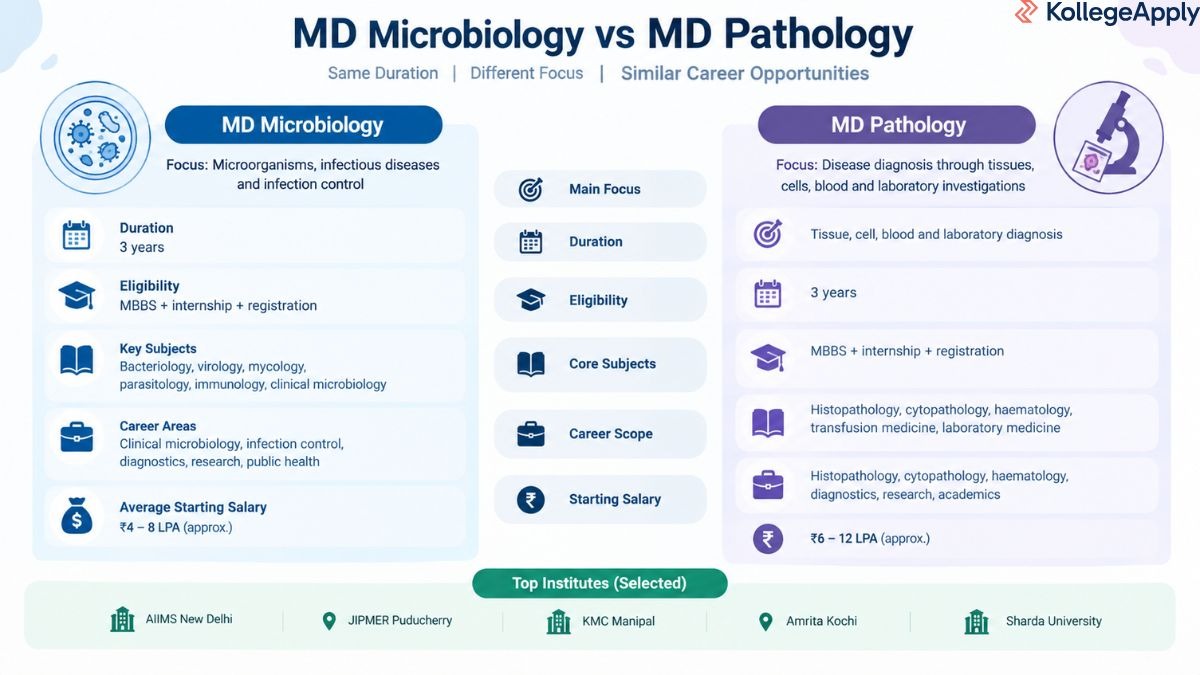
The two MD programmes overlap in laboratory medicine and diagnostic sciences, but their core competencies are distinct. NMC's postgraduate curriculum for MD Microbiology emphasises bacteriology, virology, mycology, parasitology, immunology, clinical microbiology, molecular methods, antimicrobial susceptibility and infection control. The MD Pathology curriculum emphasises histopathology, cytopathology, haematology, laboratory medicine, blood banking and diagnostic interpretation.
Note: The salary figures are indicative ranges from the respective course-level career data and should not be treated as fixed qualification-based salaries. Actual earnings vary by employer, location, experience, designation, academic seniority and private practice.
MD Microbiology: Course, Training and Syllabus
MD Microbiology is a three-year postgraduate medical specialisation focused on microorganisms and their role in human disease. The NMC competency-based curriculum covers fundamental and systematic microbiology along with clinical applications, laboratory diagnosis, infection prevention, antimicrobial susceptibility testing, molecular techniques and research. The training therefore combines laboratory work with clinical correlation rather than limiting the programme to theoretical study.
The practical component can include microscopy, staining, bacterial culture and identification, antimicrobial susceptibility testing, serology, mycological and parasitological investigations, mycobacterial diagnosis, virological investigations, molecular diagnostics, infection control and laboratory quality management.
MD Pathology: Course, Training and Syllabus
MD Pathology is also a three-year postgraduate medical degree, but its diagnostic focus is centred on disease processes in tissues, cells, blood and other laboratory specimens. The NMC curriculum specifically expects postgraduate trainees to develop competence in histopathology, cytopathology and haematology, along with working knowledge of blood banking, laboratory medicine, medical statistics and ancillary techniques.
AIIMS also provides specialised pathology training through areas such as onco-haematopathology, with MD Pathology and Laboratory Medicine trainees receiving departmental exposure. PGIMER's current academic schedules similarly show dedicated MD Pathology teaching and discussion activities.
MD Microbiology vs MD Pathology: Eligibility and Admission
Eligibility for both programmes begins with an MBBS degree from a recognised medical institution, completion of the prescribed compulsory internship and the applicable medical registration requirements. Admission to most postgraduate medical seats is through NEET-PG and the relevant counselling authority. Institutes of National Importance such as AIIMS and JIPMER use the INI-CET route for applicable MD/MS admissions. MCC conducts counselling for 50% All India Quota PG seats and specified central, deemed and other categories under its jurisdiction.
For 2026, the NEET-PG was conducted on August 30, 2026 as the examination date, with the prescribed internship completion requirements applying according to the examination bulletin. Candidates should always check the relevant year's NBEMS bulletin and counselling notices for final eligibility and dates.
MD Microbiology vs MD Pathology Colleges in India
The availability of both courses at major medical institutions makes MD Microbiology vs MD Pathology Colleges an important part of the comparison. The exact number of seats differs by institution and counselling session, so candidates should verify the current seat matrix rather than relying on an old college list. JIPMER's official curriculum page lists both MD Microbiology and MD Pathology, while its INI-CET prospectus has also listed seats for both disciplines. JIPMER's official curriculum listing specifically includes separate curricula for MD Pathology and MD Microbiology. Its prospectus has also documented both disciplines among MD courses.
Amrita provides a useful direct comparison because its official fee information lists both courses. For the 2025–26 Kochi structure, the annual tuition was listed at INR 9,00,000 for MD Microbiology and INR 16,00,000 for MD Pathology, apart from other applicable charges. Fees can change by admission year and category, so candidates should verify the latest institutional notification before admission.
MD Microbiology vs MD Pathology Fees
The MD Microbiology vs MD Pathology fees vary significantly across medical colleges and universities. The difference is particularly visible in deemed and private institutions, where tuition fees are set by the individual university. Official fee documents also use different formats: Amrita publishes annual tuition fees, Saveetha publishes annual total fees, Sharda lists the first-year fee, while Kasturba Medical College, Manipal publishes the complete three-year fee structure. Therefore, the fee basis is specified in the table rather than combining annual and total-course figures into a single range.
The following table uses fee figures published directly by the respective institutions for the relevant admission session. It includes colleges where official sources provide identifiable fees for MD Microbiology and/or MD Pathology, allowing candidates to compare the two programmes using institutional data rather than secondary education portals.
Kasturba Medical College, Manipal: The official Manipal Academy of Higher Education fee document for the 2026–27 batch lists a three-year total of INR 42,19,000 for MD Microbiology and INR 58,69,000 for MD Pathology for general-category students. The figures include the tuition and other fees specified in the institutional fee structure; a refundable caution deposit is separately listed.
Amrita School of Medicine: Amrita's official 2026–27 programme pages list annual tuition of INR 9,00,000 for MD Microbiology and INR 16,00,000 for MD Pathology at both Kochi and Faridabad. First-year other fees, hostel charges and admission processing charges are listed separately by the university.
Sharda University: The official Sharda fee portal lists INR 9,77,116 for MD Microbiology and INR 13,68,025 for MD Pathology for the first year. These are institutional fee figures for the 2026–27 fee structure.
Saveetha Medical College and Hospital: SIMATS' official admission page lists the annual total fee at INR 5,00,000 for MD Microbiology and INR 10,00,000 for MD Pathology for Indian and SAARC students.
MD Microbiology vs MD Pathology Fees: What the Difference Shows
The official college fee structures show that MD Pathology can carry a higher tuition fee than MD Microbiology at several private and deemed institutions, although the difference is college-specific rather than a universal rule. For example, Amrita lists annual tuition of INR 9 lakh for MD Microbiology compared with INR 16 lakh for MD Pathology, while Saveetha lists INR 5 lakh and INR 10 lakh respectively. At KMC Manipal, the published three-year totals are INR 42.19 lakh and INR 58.69 lakh respectively.
Candidates should also account for hostel, admission, registration, examination, caution deposit and other institutional charges wherever applicable. For example, Amrita separately publishes first-year other fees, hostel fees and admission processing charges, while KMC Manipal separately identifies its refundable caution deposit.
Note: Fees are for the specific academic years and categories stated by the respective institutions and may be revised for subsequent admission sessions. The figures above are reproduced from official institutional fee information and should not be treated as a nationwide average.
MD Microbiology vs MD Pathology Career Scope
The career scope of the two branches overlaps in hospitals, diagnostic laboratories, medical colleges, research institutions and public-health organisations, but the nature of work is different. MD Microbiology is closely connected with infectious-disease diagnosis, antimicrobial resistance, infection prevention, laboratory surveillance and public health. MD Pathology has broader exposure to tissue, cellular, blood and laboratory diagnosis, creating pathways in histopathology, cytopathology, haematology and laboratory medicine.
MD Microbiology Jobs vs MD Pathology Jobs
Both specialisations provide opportunities in academic, diagnostic and research settings, but job titles differ according to the nature of postgraduate training. MD Microbiology graduates commonly enter roles such as clinical microbiologist, medical microbiologist, infection-control specialist, research scientist and laboratory manager. MD Pathology graduates can work as pathologists, consultants, faculty members, laboratory heads and specialists in histopathology, cytopathology or laboratory medicine.
Government and academic employment generally follows the applicable recruitment notification, pay level and institutional eligibility requirements. Candidates should check the individual vacancy notification for qualification, registration, experience and other conditions.
MD Microbiology vs MD Pathology Salary
MD Microbiology vs MD Pathology salary varies according to employer, city, experience, job designation, academic position and additional expertise. The qualification alone does not determine earnings. Based on the course-level salary data used for the respective articles, MD Microbiology commonly begins around INR 4–8 LPA, while MD Pathology is represented by an indicative fresher range of around INR 6–12 LPA. Experienced professionals in both fields can earn more depending on role and setting.
The MD Microbiology salary figures are indicative market ranges. MD Pathology salary also varies significantly depending on whether the doctor works in a hospital, diagnostic centre, academic institution or private practice. Neither range should be treated as a guaranteed CTC.
Can MD Microbiology Do DM Infectious Disease?
Yes, MD Microbiology can be eligible for DM Infectious Diseases at institutes where the notified eligibility criteria include MD Microbiology. This is not a universal rule for every institute, so candidates must check the specific year's INI-SS or super-specialty prospectus.
For example, the AIIMS INI-SS prospectus has listed MD in Medicine, Paediatrics, Microbiology or Tropical Medicine as eligible qualifications for DM Infectious Diseases. The JIPMER prospectus for the January 2026 session also specified MD/DNB in Medicine, Paediatrics, Microbiology or Tropical Medicine for DM Infectious Diseases and noted a defined allocation involving Microbiology candidates.
Therefore, an MBBS graduate considering MD Microbiology who has a long-term interest in infectious diseases should check the eligibility conditions of the target DM/DrNB programme rather than assuming that every infectious-disease super-specialty accepts the same feeder branches.
Further Study After MD Microbiology vs MD Pathology
Further education after either MD can take different forms depending on the candidate's academic or professional interests. MD Microbiology graduates can explore eligible super-specialty routes such as infectious diseases or virology where the relevant institution permits MD Microbiology. MD Pathology graduates can pursue eligible advanced programmes such as haematopathology or histopathology.
AIIMS/JIPMER super-specialty documents provide examples of this institution-specific eligibility. JIPMER's current postgraduate prospectus lists MD Microbiology for DM Infectious Diseases, while its documents also show MD Pathology as a feeder qualification for areas such as haematopathology and histopathology. Eligibility is programme-specific and can change between admission sessions.
MD Microbiology vs MD Pathology: Which One Should You Choose?
The comparison is more useful when candidates match each course with the type of work they want to perform after residency. Neither branch follows exactly the same professional pathway. MD Microbiology is more closely associated with microorganisms, infectious diseases, antimicrobial resistance, infection control and laboratory microbiology, whereas MD Pathology provides broader training in tissue, cellular, blood and laboratory diagnosis.
Candidates should also compare the specific college rather than only the branch name. Patient and specimen volume, laboratory infrastructure, faculty strength, research activity, equipment, resident workload, stipend, hostel facilities, fees and exposure to advanced diagnostic techniques can materially affect postgraduate training.
FAQs on MD Microbiology vs MD Pathology
Which is better, pathology or microbiology?
Both have different career profiles. Microbiology focuses on infections and laboratory microbiology; pathology focuses on tissue, cytology, blood and laboratory diagnosis.
Is MD microbiology a good branch?
MD Microbiology offers careers in clinical microbiology, infection control, diagnostics, research, public health, pharma and medical education.
Can MD microbiology do DM infectious disease?
Yes, some institutes such as AIIMS list MD Microbiology as eligible for DM Infectious Diseases.
Is MD pathology a good branch?
MD Pathology offers careers in histopathology, cytopathology, haematology, diagnostics, research, academics and laboratory medicine.
What is the MD Microbiology vs MD Pathology salary?
Indicative entry ranges are around INR 4–8 LPA for Microbiology and INR 6–12 LPA for Pathology.
What is the duration of MD Microbiology and MD Pathology?
Both MD Microbiology and MD Pathology are three-year postgraduate medical programmes after MBBS.
Which has more histopathology exposure?
MD Pathology has substantially greater histopathology exposure because tissue diagnosis is a core part of its curriculum.
Which branch focuses more on infectious diseases?
MD Microbiology has a stronger focus on microorganisms, infectious diseases, antimicrobial susceptibility and infection control.
Are MD Microbiology and MD Pathology admissions through NEET-PG?
Most seats use NEET-PG and counselling. Participating Institutes of National Importance use INI-CET.
What should I compare before choosing between the two?
Compare syllabus, college, laboratory exposure, fees, stipend, faculty, research opportunities, career interests and eligibility for further specialisation.