The MD Microbiology syllabus covers the study of microorganisms, infectious diseases, laboratory diagnosis, antimicrobial susceptibility, immunology, infection prevention and control, molecular diagnostics and research. Across medical colleges and universities, the three-year postgraduate curriculum combines theoretical learning with practical laboratory training, clinical correlation, seminars, case discussions, research and dissertation work. The exact sequence of subjects, departmental rotations and assessment methods may vary by institution.
The MD Microbiology course progressively develops competencies in bacteriology, mycology, virology, parasitology, immunology and applied clinical microbiology. Students are also trained in specimen collection and processing, microscopy, culture and identification of microorganisms, antimicrobial susceptibility testing, serological investigations, molecular techniques, laboratory quality management and infection-control practices. The KGMU MD Microbiology curriculum is used as a reference in this article to provide additional detail on how these areas may be organised into theory papers, year-wise training and practical rotations.
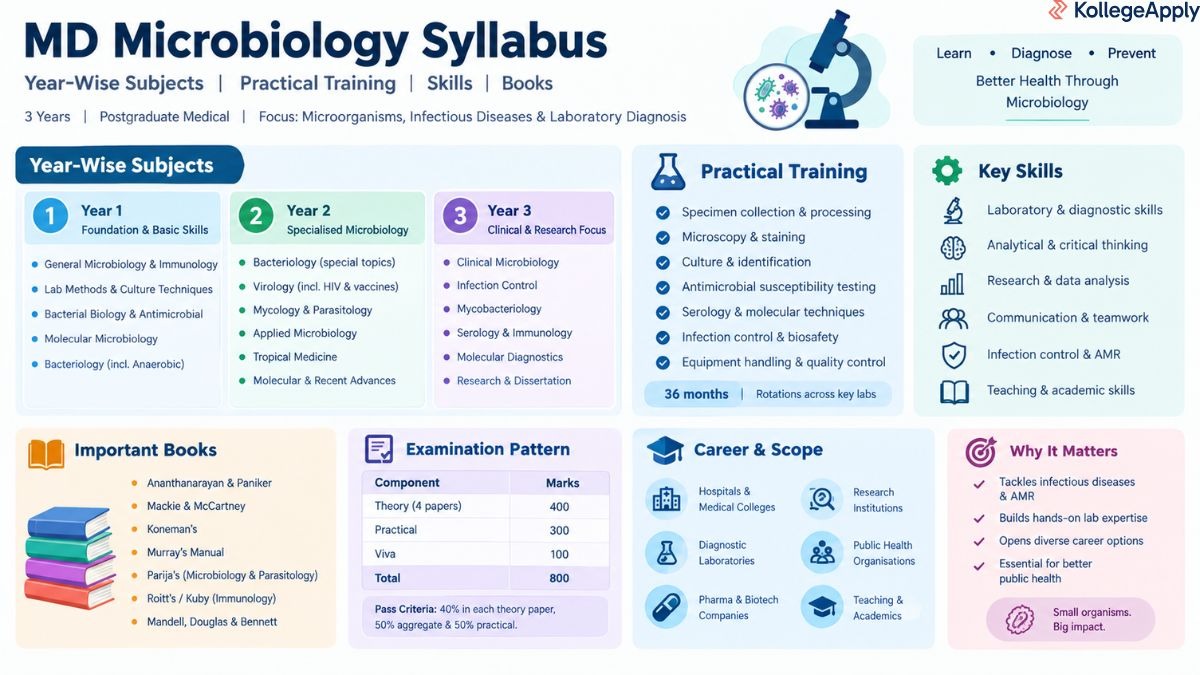
Table of Contents
- MD Microbiology Syllabus Year-Wise
- Electives in MD Microbiology Syllabus
- Practical Training / Internship in MD Microbiology
- Research and Dissertation in MD Microbiology
- Skills Developed Through MD Microbiology Syllabus
- MD Microbiology Teaching and Academic Training
- MD Microbiology Books
- MD Microbiology Syllabus: Examination Pattern
- FAQs on MD Microbiology Syllabus
MD Microbiology Syllabus Year-Wise
The MD Microbiology syllabus is generally structured across three years of postgraduate training, with increasing emphasis on clinical application, laboratory diagnosis, specialised microbiology and research. While the broad subject areas remain similar across institutions, individual medical colleges may distribute topics and practical rotations differently. The KGMU curriculum provides a detailed example of this progression, including four broad theory areas and specialised laboratory exposure across the residency.
MD Microbiology Syllabus: Major Theory Papers
The major areas of the MD Microbiology syllabus generally include General Microbiology and Immunology, Bacteriology, Mycology, Virology, Parasitology and Applied Microbiology. Recent advances, molecular diagnostics, infection control, epidemiology, antimicrobial resistance and research methodology are also incorporated into postgraduate training. The following four-paper structure is based on the KGMU curriculum and is presented as an institutional reference rather than a uniform format followed by every medical college.
Year 1 MD Microbiology Syllabus
The first year of MD Microbiology generally builds foundational knowledge and laboratory competencies required for postgraduate clinical microbiology training. Areas commonly introduced include general microbiology, immunology, bacterial biology, specimen collection and processing, microscopy, culture methods, biosafety, sterilisation, quality assurance and basic molecular techniques. The KGMU curriculum provides a detailed example of how these foundational areas may be organised during the initial stage of residency.
Year 2 MD Microbiology Syllabus
The second year generally expands the study of medically important microorganisms and their laboratory diagnosis. Depending on the institution, students may receive detailed training in systematic bacteriology, virology, mycology, parasitology, antimicrobial therapy, vaccines, molecular biology and applied microbiology. The KGMU curriculum, for example, gives substantial coverage to these areas along with tropical infections, hospital-acquired infections and recent developments in microbiology.
Year 3 MD Microbiology Syllabus
The third year generally focuses on applying microbiological knowledge to clinical diagnosis, infection prevention, laboratory management and research. Students develop greater independence in interpreting laboratory findings, performing specialised investigations and correlating microbiological results with clinical conditions. The KGMU curriculum provides an example of advanced exposure through clinical microbiology, infection control, bacteriology, mycobacteriology, mycology, parasitology, serology, molecular diagnostics and dissertation-related activities.
Electives in MD Microbiology Syllabus
The availability and structure of electives in MD Microbiology can vary between medical colleges and universities. Some institutions may provide focused exposure through departmental rotations, specialised laboratories or advanced areas of clinical microbiology rather than offering conventional elective papers. The KGMU curriculum does not specify a separate set of elective subjects; instead, it provides specialised exposure through areas such as molecular diagnostics, infection control, mycobacteriology, serology, clinical microbiology, virology, mycology and parasitology. These areas are therefore presented below as examples of specialised training rather than compulsory electives across all MD Microbiology programmes.
KGMU's official curriculum also provides dedicated rotations through these areas, allowing students to develop focused laboratory competencies rather than selecting conventional elective papers.
Practical Training / Internship in MD Microbiology
Practical laboratory training is a central component of MD Microbiology across postgraduate medical programmes. Students progressively develop skills in specimen collection and transport, sample processing, microscopy, culture, identification of microorganisms, antimicrobial susceptibility testing, serology, molecular diagnostics, biosafety, quality control and infection prevention. The duration and organisation of laboratory rotations can differ between institutions. The KGMU curriculum provides a detailed 36-month rotation schedule that illustrates one way in which this practical training may be organised.
MD Microbiology Rotation Schedule
Practical Skills Covered
The curriculum specifically lists techniques such as Gram staining, Ziehl-Neelsen staining, Albert staining, KOH preparation, germ tube testing, Giemsa staining, ELISA-based testing and antimicrobial susceptibility testing. Students may receive hands-on exposure to:
- Collection and transportation of clinical specimens
- Direct smear preparation, staining and microscopy
- Culture and isolation of microorganisms
- Bacterial identification
- Antimicrobial susceptibility testing
- Minimum inhibitory and bactericidal concentration testing
- ESBL and MBL screening
- Methicillin and vancomycin resistance screening
- Mycobacterial culture and sensitivity
- Fungal examination and identification
- Parasitological investigations
- Serological and immunological tests
- Infection-control activities
- Quality control and proficiency testing
- Operation and maintenance of laboratory equipment
Research and Dissertation in MD Microbiology
Research is an important component of the MD Microbiology syllabus. KGMU requires postgraduate students to undergo a research methodology workshop during the first year. This training supports the planning and execution of the dissertation under faculty guidance.
The curriculum requires the dissertation process to begin within six months of admission, including topic selection, departmental review, scientific committee approval and ethics committee approval. The dissertation must be submitted before the scheduled professional examination within the prescribed timeline.
Students are also expected to participate in academic activities such as journal clubs, seminars, conferences, workshops and research presentations. KGMU specifies that a postgraduate student should send at least one research paper for publication during residency and present at least one poster or paper at a conference.
Skills Developed Through MD Microbiology Syllabus
The MD Microbiology course develops a combination of laboratory, clinical, research, communication and teaching skills. KGMU's programme outcomes specifically emphasise competence as a clinical microbiologist, effective communication with allied departments, infection-control participation and collaborative research.
The programme outcomes also include planning and evaluating teaching assignments, conducting research, establishing clinical microbiological services and participating in workshops, seminars and journal clubs.
MD Microbiology Teaching and Academic Training
Teaching is integrated into the MD Microbiology syllabus rather than being limited to classroom lectures. KGMU requires postgraduate students to participate in undergraduate teaching and provides training in teaching methods and the use of audiovisual aids.
The academic schedule includes journal reviews, subject seminars, group discussions, clinical case presentations, case studies, problem-based learning, laboratory experiments and pedagogy. The curriculum also requires regular journal club, seminar presentation and practical exercise activities.
MD Microbiology Books
Students pursuing MD Microbiology generally use a combination of standard textbooks, diagnostic microbiology references, specialised books and institutional resources. Recommended books may vary between universities and departments depending on the curriculum and teaching requirements. The KGMU curriculum includes references covering general microbiology, diagnostic microbiology, mycology, parasitology, virology, immunology, infectious diseases and infection control; these books are therefore included as useful reference titles rather than as a compulsory national reading list.
MD Microbiology Syllabus: Examination Pattern
The MD Microbiology examination pattern can vary according to the applicable regulatory framework and the university or medical college conducting the postgraduate examination. Assessment generally evaluates theoretical understanding as well as practical and clinical laboratory competencies. The KGMU curriculum provides a detailed example of an assessment structure involving theory papers, practical examination and viva, which is presented below as an institutional reference rather than a pattern applicable identically to every MD Microbiology programme.
The practical examination covers areas including clinical bacteriology, bacteriological techniques, virology, mycology, parasitology, immunology/serology, slide identification and pedagogy.
FAQs on MD Microbiology Syllabus
What is included in the MD Microbiology syllabus?
The MD Microbiology syllabus covers bacteriology, virology, mycology, parasitology, immunology, applied microbiology, molecular diagnostics and infection control.
Is the MD Microbiology syllabus semester-wise?
KGMU presents the MD Microbiology syllabus across three years of residency rather than separate semester-wise subjects.
What are the main MD Microbiology subjects?
Major MD Microbiology subjects include General Microbiology, Immunology, Bacteriology, Mycology, Virology, Parasitology and Applied Microbiology.
Does MD Microbiology include practical training?
Yes, MD Microbiology includes rotations in bacteriology, mycology, virology, parasitology, immunology, infection control and molecular diagnostics.
What skills are taught in MD Microbiology practicals?
Students learn microscopy, culture, organism identification, antimicrobial susceptibility testing, serology, infection control and laboratory quality procedures.
Is research included in the MD Microbiology course?
Yes, The MD Microbiology course includes research methodology, dissertation work, academic presentations and research publication activities.
What books are recommended for MD Microbiology?
KGMU lists Ananthanarayan & Paniker, Bailey & Scott, Koneman, Murray, Parija, Roitt, Kuby and other specialised microbiology references.
What is the MD Microbiology career scope?
MD Microbiology graduates can work in hospitals, diagnostic laboratories, medical colleges, infection control, research, public health and pharmaceutical organisations.
Does MD Microbiology include infection control?
Yes. Infection control covers hospital-acquired infection surveillance, prevention, environmental sampling, quality indicators and related laboratory practices.
Does MD Microbiology include molecular diagnostics?
Yes, The MD Microbiology syllabus covers molecular techniques, diagnostic PCR, molecular diagnosis and genotyping of microorganisms and viruses.