MD Pathology jobs are available across medical colleges, government hospitals, private hospitals, diagnostic laboratories, research institutions and specialised pathology centres. MD Pathology is a three-year postgraduate medical degree focused on the diagnosis of disease through laboratory investigation of tissues, cells, blood and other clinical specimens. The MD Pathology course also includes practical training in areas such as histopathology, cytopathology, haematology, transfusion medicine and laboratory medicine.
After completing MD Pathology, graduates can work as pathologists, consultants, medical teachers, laboratory specialists or pursue research and further subspecialisation. Government recruitment, academic positions and private diagnostic practice offer different career pathways. The MD Pathology Jobs salary depends on experience, designation, institution, location, diagnostic expertise and whether the doctor works in employment or private practice.
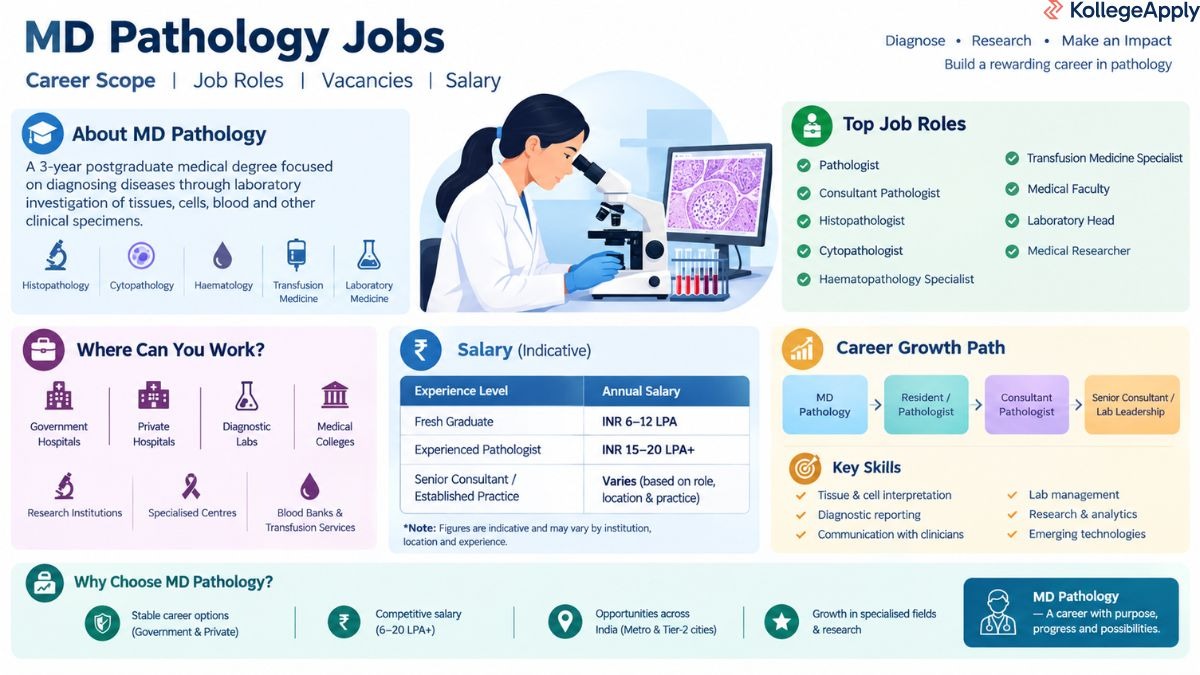
Table of Contents
- What Can We Do After MD Pathology?
- MD Pathology Job Roles
- Where Can MD Pathology Graduates Work?
- Government Jobs for MD Pathology
- MD Pathology Vacancies
- MD Pathology Jobs Salary
- Career Growth After MD Pathology Jobs
- Skills Required for MD Pathology Jobs
- Higher Studies and Specialisation After MD Pathology
- Factors Affecting MD Pathology Jobs and Salary
- MD Pathology Jobs FAQs
What Can We Do After MD Pathology?
MD Pathology graduates can choose between clinical diagnostic practice, academic medicine, laboratory management, research and further specialised training. The three-year MD programme provides exposure to multiple pathology disciplines, allowing graduates to build careers in hospitals, medical colleges, diagnostic services and research-oriented institutions. Those interested in teaching can pursue faculty positions subject to applicable institutional and regulatory requirements, while others may develop expertise in areas such as molecular pathology or specialised laboratory diagnostics. The main career pathways after MD Pathology include:
- Clinical Pathology: Work in hospital or diagnostic settings and interpret laboratory and pathological findings.
- Histopathology: Examine tissue specimens and biopsy material for disease diagnosis.
- Cytopathology: Evaluate cells obtained from various body sites and specimens.
- Haematopathology: Focus on diseases involving blood and blood-forming tissues.
- Transfusion Medicine: Work with blood banking, transfusion services and related laboratory procedures.
- Academic Medicine: Teach medical students and participate in postgraduate training and research.
- Laboratory Management: Supervise diagnostic laboratories, quality processes and technical operations.
- Research: Participate in medical research, diagnostic development and laboratory-based studies.
- Private Practice: Establish or join a pathology diagnostic practice, subject to applicable regulations and requirements.
MD Pathology Job Roles
The job title and responsibilities of an MD Pathology graduate vary according to the type of institution and level of experience. In a medical college, the role may combine diagnostic work with teaching and research, whereas a diagnostic centre may place greater emphasis on specimen interpretation, reporting and laboratory supervision. Doctors may also progress into consultant or laboratory leadership positions after gaining relevant experience.
Where Can MD Pathology Graduates Work?
MD Pathology graduates can work in institutions where diagnostic pathology services form part of patient care, academic medicine or research. Medical colleges provide opportunities that combine pathology practice with teaching and research, while hospitals and diagnostic laboratories generally focus on diagnostic services. Government institutions can also recruit postgraduate medical specialists through their respective recruitment systems. Relevant workplaces include:
- Government medical colleges
- Government hospitals
- Private medical colleges
- Private hospitals
- Diagnostic laboratories
- Pathology and reference laboratories
- Cancer and specialised diagnostic centres
- Blood banks and transfusion services
- Medical research institutions
- Pharmaceutical and biotechnology research organisations
For example, medical institutions such as Christian Medical College Vellore and All India Institute of Medical Sciences, New Delhi have academic and diagnostic pathology departments where pathology forms part of broader medical education, patient care and research.
Government Jobs for MD Pathology
Government jobs for MD Pathology are available through medical colleges, government hospitals, autonomous medical institutions and other public healthcare organisations. Depending on the recruitment rules, positions may be advertised under designations such as Assistant Professor, Specialist, Senior Resident or other medical specialist categories. Eligibility, experience requirements and appointment conditions vary between recruiting institutions. Government-sector opportunities may involve:
- Teaching and academic responsibilities in government medical colleges
- Diagnostic services in government hospitals
- Senior residency positions after postgraduate training
- Specialist appointments in public healthcare institutions
- Laboratory and pathology services in specialised government centres
- Research positions in government-funded medical institutions
Candidates should check the official recruitment notification of the concerned institution for qualification, registration, experience, age, pay level and other eligibility requirements because these conditions can change between recruitments.
MD Pathology Vacancies
MD Pathology vacancies are not released through one common recruitment schedule. Medical colleges, hospitals, government institutions and diagnostic organisations publish vacancies independently according to their staffing requirements. Consequently, candidates should verify the official recruitment notice before applying rather than relying on general vacancy estimates.
For government and academic positions, candidates can monitor recruitment pages of institutions such as AIIMS and other government medical colleges. For academic posts, the notification may specify requirements related to postgraduate qualifications, teaching experience, medical registration and applicable regulatory norms. Before applying for an MD Pathology vacancy, candidates should verify:
- Job designation
- Required MD/MS qualification
- Medical registration requirements
- Required teaching or clinical experience
- Age limit, where applicable
- Pay scale or remuneration
- Nature and duration of appointment
- Application deadline
- Selection procedure
- Documents required
MD Pathology Jobs Salary
The MD Pathology Jobs salary varies substantially according to experience, job designation, employer, location and type of practice. The corresponding MD Pathology salary page indicates an indicative range of approximately INR 6–12 LPA for fresh graduates and INR 15–20 LPA or more for experienced professionals. These figures should be treated as broad career-level estimates rather than a fixed salary applicable to every pathologist.
Salary can also differ between salaried employment and independent or partnership-based diagnostic practice. Government positions generally follow the applicable pay structure, while private-sector compensation depends on the employer, responsibilities and experience.
Note: To check out the detailed salary, check out the MD Pathology Salary guide.
Career Growth After MD Pathology Jobs
Career growth in pathology can follow clinical, academic, laboratory-management or research pathways. Early-career doctors may initially focus on diagnostic reporting and supervised clinical responsibilities before moving into consultant-level positions. With experience, pathologists can develop expertise in specialised diagnostic areas, assume laboratory leadership responsibilities or build an independent diagnostic practice. A typical career progression can include:
MD Pathology → Pathologist/Resident-level Role → Consultant Pathologist → Senior Consultant/Laboratory Leadership
For academic careers, the pathway can instead involve postgraduate teaching and faculty appointments according to the applicable rules and institutional requirements.
Skills Required for MD Pathology Jobs
Employers look for more than the MD qualification when recruiting pathology specialists. Accurate interpretation of specimens, understanding of disease processes, communication with treating clinicians and careful laboratory practices are important components of professional pathology work. As diagnostic medicine increasingly incorporates advanced laboratory methods, familiarity with specialised diagnostic techniques and quality systems can also support career development. Important skills include:
- Histopathology and tissue interpretation
- Cytopathology
- Haematology
- Laboratory medicine
- Transfusion medicine
- Diagnostic reporting
- Microscopy and specimen evaluation
- Quality assurance and laboratory management
- Communication with clinicians
- Research and academic skills
- Understanding of emerging diagnostic technologies
Higher Studies and Specialisation After MD Pathology
After MD Pathology, doctors can continue developing expertise through fellowships, focused training, research or other recognised academic pathways, depending on the area of interest and eligibility. Specialisation can help professionals build focused expertise in areas such as cytopathology, haematopathology, molecular pathology, dermatopathology or other advanced diagnostic fields.
The appropriate pathway depends on the doctor's intended career: clinical practice, academic medicine, laboratory leadership, research or specialised diagnostic practice. Candidates should verify recognition and eligibility requirements with the relevant medical or academic institution before enrolling in a programme.
Factors Affecting MD Pathology Jobs and Salary
Several factors determine both job availability and earning potential after MD Pathology. The qualification provides the foundation, but professional growth is influenced by the type of institution, diagnostic expertise, years of experience and the career path selected. Private practice and senior consulting can also have very different income structures from fixed salaried employment. Key factors include:
- Experience: Compensation generally increases as professionals move into senior and consultant roles.
- Specialisation: Focused expertise in advanced pathology areas can expand professional opportunities.
- Employer: Government institutions, medical colleges, hospitals and diagnostic centres follow different recruitment and compensation structures.
- Location: Demand and available healthcare infrastructure differ between cities.
- Academic Experience: Teaching and research can support progression in medical colleges.
- Private Practice: Income can vary considerably depending on the scale and structure of the practice.
- Diagnostic Expertise: Advanced laboratory and diagnostic skills can influence professional responsibilities.
MD Pathology Jobs FAQs
What can we do after MD Pathology?
After MD Pathology, doctors can work as pathologists, consultants, faculty, laboratory specialists, researchers or pursue specialised training.
Is MD Pathology a doctor?
Yes, MD Pathology is a postgraduate medical degree after MBBS for doctors specialising in pathology and laboratory diagnosis.
What is the average salary of an MD pathologist in India?
Indicative MD Pathology salaries range from about INR 6–12 LPA for freshers and INR 15–20 LPA or more with experience.
What are the government jobs for MD Pathology?
Government opportunities include specialist, senior resident and academic roles in government hospitals and medical colleges, subject to recruitment rules.
What are the common MD Pathology job roles?
Common roles include pathologist, consultant pathologist, faculty member, laboratory head, researcher and specialised pathology professional.
Are MD Pathology vacancies available in government hospitals?
Yes, Government hospitals and medical institutions periodically release pathology vacancies based on their staffing requirements.
Is MD Pathology a good career option after MBBS?
MD Pathology offers careers in diagnostic medicine, hospitals, laboratories, academics, research and pathology practice.
What affects MD Pathology Jobs salary?
Salary depends on experience, designation, employer, location, diagnostic expertise and type of practice.
Can MD Pathology graduates work in medical colleges?
Yes, MD Pathology graduates can pursue academic and teaching roles subject to applicable eligibility and institutional requirements.
What is the highest paid pathology specialty?
Earnings vary by specialty, experience, employer, location and practice model, so there is no single universally highest-paid pathology specialty.