MD Pathology is a three-year postgraduate medical degree that combines theoretical pathology with extensive laboratory and diagnostic training. The MD Pathology syllabus covers general and systemic pathology, surgical pathology, cytopathology, haematology, transfusion medicine, laboratory medicine, immunopathology, molecular biology and other diagnostic techniques. Training also includes research, seminars, journal clubs and practical work in pathology laboratories.
The course is structured around competency development rather than a simple semester-wise subject list. Students progressively learn specimen handling, grossing, microscopy, staining, cytology, bone marrow examination, laboratory investigation, quality control and interpretation of diagnostic findings. The MD Pathology syllabus also supports teaching and research skills, while individual medical colleges may organise postings and additional exposure according to their facilities.
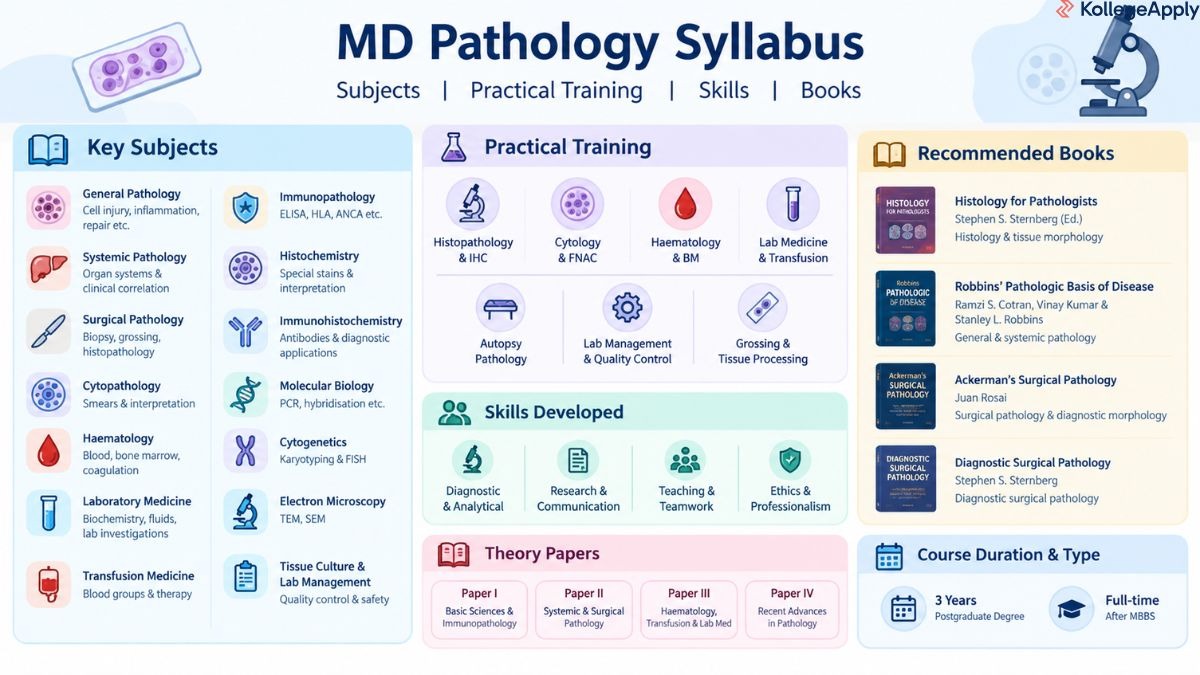
Table of Contents
MD Pathology Syllabus
The NMC MD Pathology syllabus provides the broad competency-based framework followed for postgraduate training. It covers the knowledge, practical abilities and professional competencies expected from an MD Pathology postgraduate. Colleges can organise teaching and clinical postings according to institutional requirements, but the core areas remain centred on diagnostic pathology, laboratory medicine, research and related techniques.
The NMC curriculum also expects students to develop the ability to correlate clinical findings with pathology, select appropriate specimens and investigations, interpret diagnostic material, undertake research and communicate professional opinions. The major areas covered in the NMC-based MD Pathology syllabus are given below.
MD Pathology Theory Papers
The NMC curriculum specifies four theory papers for the postgraduate examination. These papers broadly connect the major areas taught during the MD Pathology course. The NMC also specifies practical and oral assessment covering areas such as histopathology, cytopathology, autopsy, gross pathology, basic sciences, teaching exercises and viva voce.
MD Pathology Syllabus in College Specific Curriculum
The MD Pathology syllabus in individual colleges can provide greater detail on how the NMC curriculum is implemented through postings, laboratory assignments, teaching activities and practical competencies. For example, the GITAM MD Pathology syllabus, follows the broad NMC framework and organises the three-year programme through different pathology postings rather than formal semesters.
GITAM MD Pathology Course Structure
GITAM states that the three-year MD training may be arranged through postings to different laboratories or assignments for specified periods. The recommended postings cover 35 months, while the schedule can be modified according to institutional needs, available facilities and additional training requirements.
GITAM MD Pathology Syllabus: Major Areas
The college-specific curriculum covers the following areas in greater practical detail:
- General Pathology: Normal cellular and tissue structure, disease-related cellular changes, causes and pathogenesis of disease, and responses to injury.
- Systemic Pathology: Normal organ structure and function, disease mechanisms, gross and microscopic alterations, and clinical correlation.
- Surgical Pathology: Gross examination, tissue processing, histomorphology, diagnosis and clinico-pathological correlation.
- Autopsy Pathology: Autopsy techniques, identification of major lesions and preparation of anatomic diagnosis reports.
- Cytopathology: Specimen collection, smear preparation, staining, screening and interpretation of cytological material.
- Haematology: Blood and bone marrow disorders, haemograms, peripheral smears, bone marrow examination, coagulation and special investigations.
- Laboratory Medicine: Urinalysis, body-fluid examination, organ-function tests, clinical biochemistry and laboratory investigation strategies.
- Transfusion Medicine: Blood groups, blood components, pre-transfusion testing, transfusion therapy, infections and adverse reactions.
- Immunopathology: ELISA, radioimmunoassay, HLA typing, immunoelectrophoresis, immunofluorescence, ANA and ANCA.
- Immunohistochemistry: Principles, procedures, antibody-based staining systems and diagnostic applications.
- Molecular Biology: PCR, Southern blot, Northern blot, Western blot and hybridisation.
- Cytogenetics: Karyotyping and FISH.
- Electron Microscopy: TEM, SEM and recognition of normal and abnormal cellular organelles.
- Histochemistry: Enzyme histochemistry and special stains.
- Research & Statistics: Medical statistics, research methodology and interpretation of experimental or patient data.
Electives in MD Pathology Syllabus
The NMC MD Pathology curriculum does not prescribe a single nationwide list of elective subjects. Instead, the training framework allows laboratory postings and additional exposure to be arranged according to the facilities and requirements of the institution. Therefore, electives or focused rotations can differ between medical colleges.
These areas should be treated as possible focused training exposures rather than a fixed NMC elective list. GITAM similarly includes these subjects within its basic sciences and pathology training structure rather than identifying them as separate compulsory electives.
Practical Training / Internship in MD Pathology
MD Pathology includes substantial practical training throughout the postgraduate programme. It is important to distinguish this from the MBBS internship: MD Pathology itself is a three-year postgraduate residency/training programme, so the curriculum does not describe a separate one-year internship after admission. Instead, practical competencies are developed progressively during postgraduate postings.
The curriculum requires skills to progress from practice on models or simulated settings to supervised performance and finally independent performance. GITAM also specifies practical competencies in grossing, paraffin and frozen sections, staining, FNAC, bone marrow aspiration, autopsy and laboratory procedures.
Skills Developed Through MD Pathology Syllabus
The MD Pathology syllabus develops diagnostic, laboratory, research and communication competencies rather than focusing only on theoretical pathology. The NMC curriculum specifically expects postgraduates to interpret clinical and laboratory information, select suitable specimens, provide diagnostic opinions and participate in teaching and research.
Books for MD Pathology Syllabus
The NMC curriculum recommends using the latest editions of standard pathology textbooks. The recommended reading specifically includes major references covering histology, general pathology and surgical pathology.
FAQs on MD Pathology Syllabus
What is covered in the MD Pathology syllabus?
The MD Pathology syllabus covers general and systemic pathology, histopathology, cytology, haematology, laboratory medicine, transfusion medicine and molecular techniques.
Is the MD Pathology syllabus semester-wise?
The NMC curriculum is competency-based and organised through training and postings, rather than a fixed four-semester structure.
How long is the MD Pathology course?
MD Pathology is a three-year postgraduate medical training programme with extensive theoretical and practical laboratory exposure.
Does MD Pathology include practical training?
Yes, MD Pathology includes practical work in histopathology, cytopathology, haematology, laboratory medicine, transfusion medicine and autopsy pathology.
Are electives compulsory in MD Pathology?
The NMC syllabus does not prescribe one fixed elective list. Focused training can vary according to the medical college and available facilities.
Which books are recommended for MD Pathology?
NMC recommends standard texts including Robbins’ Pathologic Basis of Disease, Ackerman’s Surgical Pathology and Histology for Pathologists.
What skills does the MD Pathology syllabus develop?
It develops diagnostic, microscopy, grossing, cytology, laboratory, research, teaching, quality-control and professional communication skills.
What are the career options after MD Pathology?
MD Pathology graduates can work in hospital pathology departments, diagnostic laboratories, medical colleges, research and laboratory-management roles.
Does MD Pathology include molecular pathology?
Yes, Molecular biology is included in the curriculum, with training exposure to techniques such as PCR, blotting and hybridisation.
Is MD Pathology focused only on histopathology?
No, The MD Pathology syllabus also includes cytopathology, haematology, laboratory medicine, transfusion medicine and advanced diagnostic techniques.