
• Updated on 28 Oct, 2026 by Simran
What's new?
CAT Latest news and articles
CAT score or marks is basically the actual marks which the candidate gets in the exam where as percentile is calculated using the normalization process relative to other candidates. CAT marks (raw score) are calculated using the official marking scheme, which awards 3 marks for each correct answer, deducts 1 mark for each incorrect multiple-choice question (MCQ), and awards 0 marks for incorrect TITA questions or unattempted questions. The raw score is then converted into a CAT scaled score through a normalisation process to account for differences in difficulty across exam slots. Based on the scaled score, candidates receive a CAT percentile, which indicates the percentage of candidates who scored equal to or below them. For example, a 99 percentile means a candidate performed better than approximately 99% of the candidates who appeared for the exam.
- Candidates scoring 115–125 marks can expect a CAT percentile of 99.9 or above, while those scoring 100–110 marks can expect around 99.5 percentile and those scoring 85–95 marks can expect around 99 percentile.
- Candidates scoring 75–80 marks can expect around 98 percentile, 65–70 marks around 95 percentile, 55–60 marks around 90 percentile, 45–50 marks around 85 percentile, 40–45 marks around 80 percentile, 35–40 marks around 75 percentile, 30–35 marks around 70 percentile, and 25–30 marks around 60–65 percentile.
- The marks required to achieve a particular CAT percentile vary each year depending on the exam’s difficulty level and the normalisation process. For instance, a score of around 101 marks was required to achieve the 99th percentile in CAT 2020, whereas the requirement dropped to approximately 76 marks in CAT 2023 before rising to around 95 marks in CAT 2024.
Note : TITA is (Type In The Answer) is a type of question in the CAT exam where candidates must enter the answer manually instead of selecting an option from multiple choices.
CAT Marks Vs Percentile 2026 ( Expected)
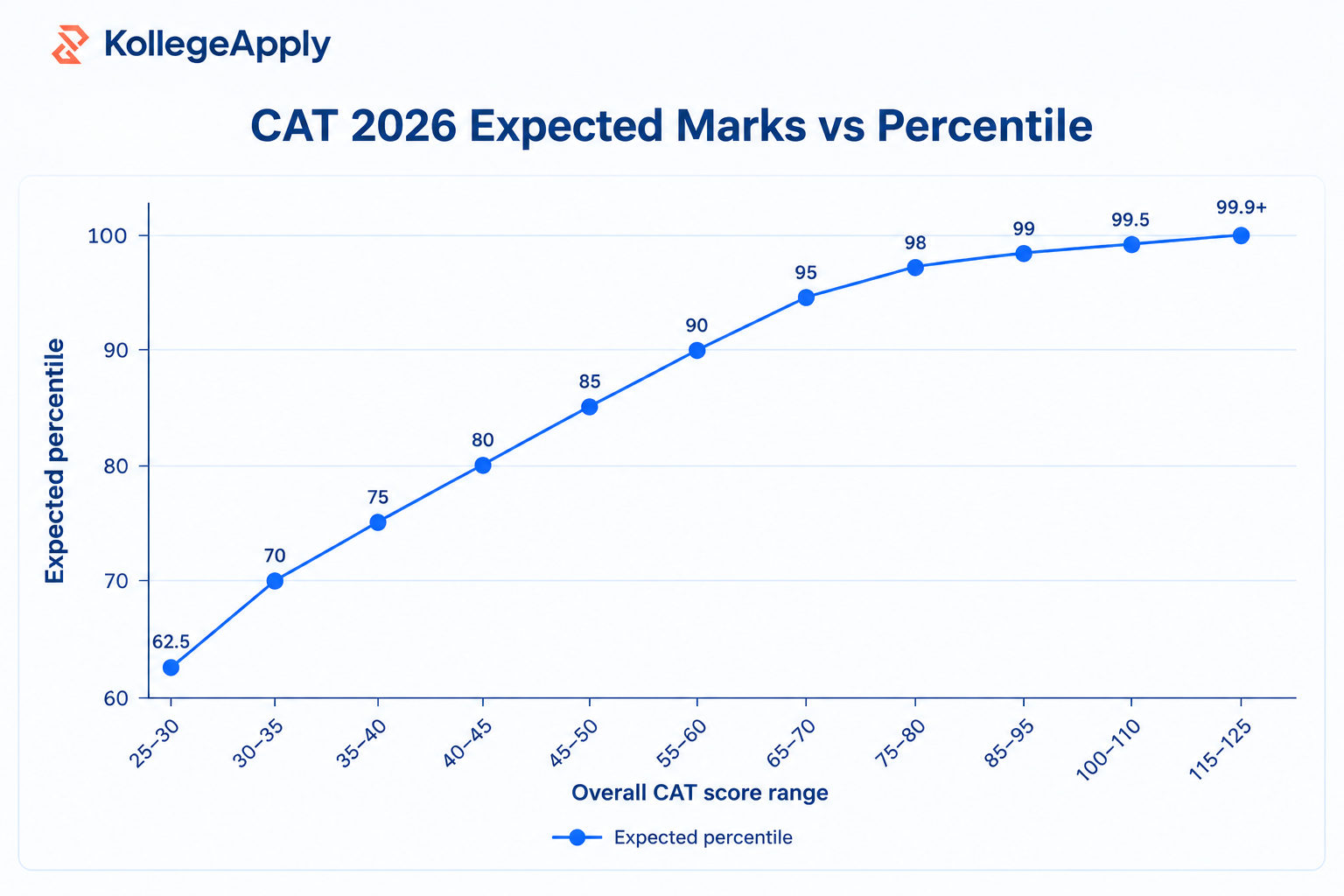
| Overall CAT score (out of 204) | Expected CAT percentile |
| 115–125 | 99.9+ |
| 100–110 | 99.5 |
| 85–95 | 99 |
| 75–80 | 98 |
| 65–70 | 95 |
| 55–60 | 90 |
| 45–50 | 85 |
| 40–45 | 80 |
| 35–40 | 75 |
| 30–35 | 70 |
| 25–30 | 60–65 |
CAT Approximate Marks vs Percentile according to the previous year are:
| Percentile | CAT 2025 | CAT 2024 | CAT 2023 | CAT 2022 | CAT 2021 | CAT 2020 |
| 99 | 85 | 95 | 76 | 90 | 98 | 101 |
| 95 | 62 | 70 | 54 | 61 | 73 | 76 |
| 90 | 51 | 58 | 44 | 49 | 60 | 63 |
| 80 | 38 | 44 | 38 | 36 | 45 | 48 |
CAT 2026 Score Normalization
CAT 2026 will be conducted in three sessions on November 29, 2026, morning, afternoon and evening. Since the difficulty level may vary across sessions, comparing candidates solely on their raw scores could put those who attempt a more difficult paper at a disadvantage. Normalisation helps ensure a fair comparison by adjusting scores across sessions to a common scale.
The IIM conducting CAT applies a linear normalisation process to the raw scores of each section independently. This process considers the mean and standard deviation of scores for each session, along with the corresponding statistics calculated across all sessions.
-
Session-wise calculation: The mean and standard deviation of raw scores are calculated separately for VARC, DILR and QA in each of the three sessions.
-
Overall reference baseline: The mean and standard deviation for each section are also calculated using the combined data from all three sessions.
-
Score scaling: A linear transformation is applied to each candidate’s section-wise raw score to obtain a scaled score based on the normalisation process.
-
Total scaled score: The three section-wise scaled scores are added to calculate the overall scaled score, which is used to determine the candidate’s overall percentile.
Scaled Section Score = Mg + (SDg ÷ SDi) × (Ri − Mi)
where,
- Mg: Mean raw score for that section across all three sessions combined (global mean).
- SDg: Standard deviation of raw scores for that section across all sessions combined (global SD).
- Ri: Your raw score in that section (in your session).
- Mi: Mean raw score for that section in your specific session.
- SDi: Standard deviation of raw scores for that section in your specific session.
Example of CAT score normalisation
Suppose a candidate scores 40 marks in VARC in the morning session. Assume the following illustrative values:
| Parameter | Value |
| Candidate’s raw score | 40 |
| Session mean | 30 |
| Session standard deviation | 10 |
| Overall mean | 32 |
| Overall standard deviation | 12 |
Substituting these values into the formula the answer is 44. Therefore, the candidate’s raw VARC score of 40 is converted to a scaled score of 44 under these illustrative figures.
Note: These values are hypothetical and are used only to explain the calculation. The actual scaled score depends on the official session-wise and overall statistics used for CAT normalisation.
How CAT Percentile is Calculated?
Your CAT percentile is different from your scaled score. While the scaled score reflects your performance after normalisation, the percentile indicates your relative performance compared with other candidates. For example, a 97 percentile means you performed as well as or better than approximately 97% of the candidates who appeared for CAT.
CAT calculates percentiles at two levels: section-wise percentiles for VARC, DILR and QA, and an overall percentile based on the total scaled score. Both are reported on the CAT scorecard.
CAT Percentile Formula:
Percentile = (Number of students who obtained a scaled score ≤ your scaled score ÷ Total number of students who appeared across all sessions) × 100
Worked Example: Calculating the Overall CAT Percentile
Suppose 3,00,000 candidates appeared for CAT 2026 across all three sessions. If 2,91,000 candidates obtained a total scaled score less than or equal to yours, your overall percentile would be calculated as follows:
Therefore, your overall CAT percentile would be 97.0.
The same principle is applied separately to the scaled scores in VARC, DILR and QA to calculate section-wise percentiles. Since section-wise and overall percentiles are calculated independently, a candidate may achieve a high percentile in one section but a lower overall percentile if their performance in the other sections reduces their total scaled score.
FAQs on CAT Marks Vs Percentile
How is the CAT 2026 score calculated?
CAT 2026 raw scores are calculated using the official marking scheme: candidates receive 3 marks for each correct answer, lose 1 mark for an incorrect MCQ, and receive 0 marks for incorrect TITA questions and unattempted questions. Raw scores are then normalised to obtain scaled scores.
What is the difference between CAT marks, scaled scores and percentiles?
CAT marks refer to the raw score calculated using the marking scheme. The scaled score adjusts raw scores to account for differences in difficulty across exam sessions. The percentile indicates a candidate’s relative performance compared with other test-takers.
How many marks are required to score 99 percentile in CAT 2026?
Based on estimates from previous CAT exams, candidates may need approximately 85–95 marks to achieve the 99 percentile in CAT 2026. However, the actual score requirement will depend on the exam’s difficulty level, candidates’ performance and normalisation.
How does normalisation work in CAT 2026?
CAT normalisation adjusts section-wise raw scores using the mean and standard deviation of scores in the candidate’s session and across all sessions. This process helps compare candidates on a common scale despite differences in question paper difficulty.
How is the CAT percentile calculated?
CAT percentile is calculated by comparing a candidate’s scaled score with the scores of other candidates who appeared for the exam. For example, a 97 percentile indicates performance equal to or better than approximately 97% of test-takers. CAT reports both overall and section-wise percentiles.
Exam Calendar
Explore exam calendars tailored to your interest