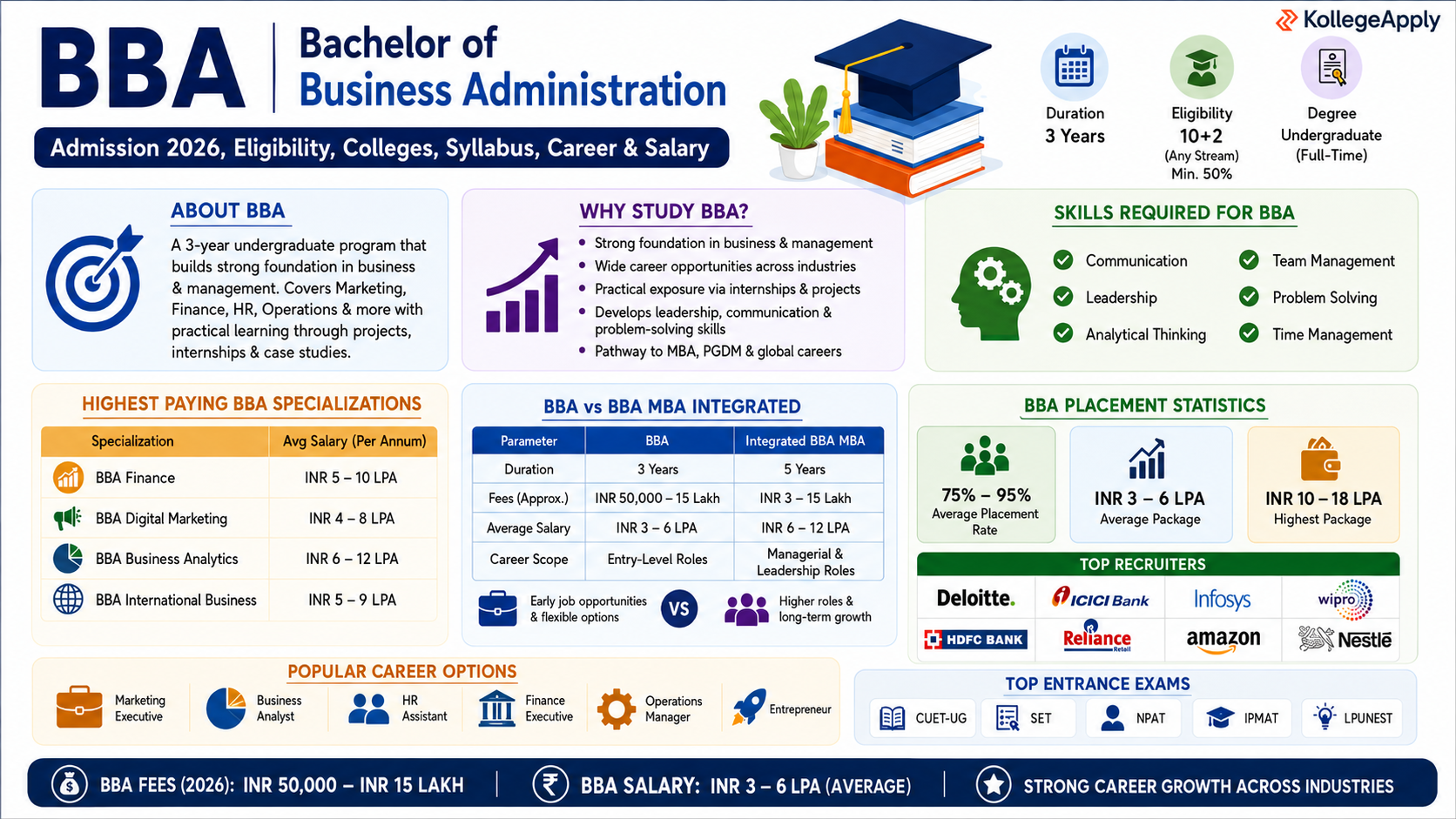
BBA or Bachelor of Business Administration is a 3-year undergraduate course that is structured to provide foundational knowledge in business and management. BBA degree covers core areas such as marketing, finance, operations, human resources, and entrepreneurship, while also developing leadership, communication, and decision-making skills.
The BBA syllabus combines theoretical knowledge with practical exposure through internships, projects, and case studies to prepare students for entry-level management roles or further studies like an MBA. The Bachelor of Business Administration course offers various specializations such as Digital Marketing, International Business, Finance, HR, and Supply Chain Management to students.
To be eligible for a Bachelor of Business Administration (BBA) course, candidates must have completed their 10+2 education from any stream with a minimum of 50% marks, although the exact requirement may vary by institution. The admission is either merit-based or conducted through popular entrance exams such as CUET-UG, NPAT, and SUAT.
Some of the top BBA colleges in India include NMIMS, Shaheed Sukhdev College of Business Studies, Christ University, Jamia Millia Islamia, Symbiosis and Amity University. In India, the overall BBA course fees in 2026 are expected to range between INR 50,000 and INR 15 lakh depending on the college type, specialization, facilities, and placement opportunities offered by the institute.
A BBA graduate can pursue a wide range of careers such as Marketing Executive, Business Analyst, HR Assistant, Finance Executive, and Operations Manager after a Bachelor of Business Administration in banking, IT, logistics, and retail sectors. They also have the option to pursue higher studies like an MBA or PGDM for enhanced career growth. The salary of a BBA graduate in India typically ranges from INR 3 – 6 LPA per annum at the entry level, depending on the job role, experience, company, skills, and location.
- BBA Key Highlights
- What is a BBA program?
- Why study the BBA program?
- What are the skills required for BBA?
- Is BBA Worth It in 2026?
- BBA Eligibility Criteria
- BBA Specialization
- What are the Highest Paying BBA Specializations?
- BBA Entrance Exams
- BBA Top Colleges
- BBA Fees in 2026: What to expect?
- BBA Syllabus
- BBA Admission Process 2026
- BBA VS BCom
- BBA Job Opportunities
- BBA Salary
- BBA Frequently Asked Questions
BBA Key Highlights
Candidates should know the complete details of the BBA course, including the specializations, top recruiters, top colleges, and other important information. The candidates will get the complete Bachelor of Business Administration course details in the highlights table given below:
What is a BBA program?
The Bachelor of Business Administration (BBA) is a popular undergraduate course that provides a strong foundation in business and management concepts. This three-year program covers key areas such as marketing, finance, human resources, operations, and entrepreneurship, helping students understand how businesses operate in the real world.
The core BBA subjects include accounting, economics, business law, organizational behavior, and strategic management. The course also blends theoretical learning with practical exposure. Many BBA programs emphasize soft skills such as communication, leadership, teamwork, and problem-solving, which are essential for success in today’s competitive business environment.
After completing a management degree, graduates can explore diverse career opportunities in sectors like business, government, and non-profit organizations, or even start their own ventures. Popular job roles include Business Analyst, Marketing Executive, HR Manager, and Financial Advisor. For those aiming for higher career growth, pursuing advanced studies such as an MBA (Master of Business Administration) or other specialized master’s programs can open doors to better opportunities and higher salaries.
Why study the BBA program?
BBA is a career-focused degree that builds strong foundations in business, management, and leadership skills. Here are some key reasons why students should pursue an undergraduate management course:
- BBA builds a solid understanding of business operations, management principles, and organizational behavior, helping students develop practical knowledge for real-world business environments.
- It offers diverse career opportunities, allowing graduates to explore roles in marketing, finance, HR, sales, operations, and entrepreneurship across industries, making it a versatile degree with a wide career scope.
- Students gain practical learning experience through case studies, internships, projects, and presentations. This helps them gain hands-on exposure to real business challenges, improving their problem-solving and decision-making skills.
- The course enhances essential soft skills like communication, leadership, teamwork, and critical thinking, which are highly valued by employers in today’s competitive job market.
- A business administration course serves as a strong foundation for pursuing an MBA or PGDM, while also preparing students for global career opportunities and entrepreneurial ventures.
- The BBA degree is globally recognized and provides opportunities for international careers and higher education abroad.
What are the skills required for BBA?
Students pursuing a business administration course must develop a strong combination of managerial, analytical, communication, and decision-making skills to adapt to dynamic business environments, handle organizational responsibilities, and build successful careers in management and leadership roles across industries.
- Strong communication skills help students deliver presentations, participate in discussions, and interact professionally with clients and teams.
- Leadership skills help BBA students manage teams, take responsibility, and make effective business decisions confidently.
- Analytical thinking enables students to evaluate business data, identify trends, and make strategic decisions efficiently.
- Team Management skills help students coordinate tasks, collaborate with teams, and achieve organizational goals effectively.
- Problem-Solving Skills help BBA students identify challenges and implement practical business solutions in workplace situations.
- Time Management skills help students balance academics, internships, projects, and activities while improving productivity.
Is BBA Worth It in 2026?
Yes, pursuing a BBA course in 2026 remains a valuable choice for students interested in management, finance, marketing, human resources, and entrepreneurship. With businesses increasingly adopting automation, digital transformation, and data-driven strategies, the demand for skilled management professionals continues to grow. An undergraduate business administration course program helps students build practical business knowledge, leadership abilities, and communication skills required in modern industries while improving their long-term career prospects.
The BBA salary per month for fresh graduates has improved significantly due to rising demand across corporate sectors. The BBA course salary per month generally ranges between INR 25,000 and INR 50,000 depending on specialization, internships, skills, and college reputation. It is usually higher for candidates specialising in finance, business analytics, digital marketing, and operations management. Leading recruiters from IT, banking, FMCG, consulting, and startup sectors offer strong placement opportunities for management-related roles.
The future scope of BBA is expected to remain strong because companies require professionals who understand digital business models, customer analytics, AI-driven operations, and evolving market trends. Career growth opportunities are extensive, as graduates can pursue MBA, PGDM, or professional certifications to secure higher-paying leadership roles. The increasing demand for skilled management professionals in domestic and international markets makes BBA a promising career option with excellent long-term growth potential.
BBA Eligibility Criteria
To be eligible for the admission into a BBA course, candidates must meet academic and general requirements set by universities, colleges, or institutions. The eligibility criteria are as follows:
- The candidates must have passed 10+2 or equivalent from a recognized institution or board in any stream (Science, Commerce, Arts, etc.).
- Most institutions require a minimum of 50% aggregate marks in the qualifying examination.
- A relaxation of 5% in marks is generally applicable for candidates from reserved categories (SC/ST/OBC), i.e., minimum 45% aggregate marks.
- Admission is based on merit (Class 12 marks), and marks on entrance exams like CUET-UG, IPU-CET, CET, among others.
- There is usually no strict age limit, but if applicable, they are defined by individual institutions.
BBA Specialization
Here are the top Bachelor of Business Administration specializations available in India along with a description of each:
What are the Highest Paying BBA Specializations?
Choosing the right BBA specialization can significantly influence career growth, placement opportunities, and long-term salary potential across industries. Some specializations offer better placement opportunities, higher salary packages, and strong industry demand in 2026. The following salaries represent average career growth potential after gaining industry experience.
BBA Entrance Exams
Admission to leading Bachelor of Business Administration colleges often requires candidates to qualify through entrance examinations that assess aptitude, reasoning, communication, and management skills. Candidates often need to clear entrance exams, some of the major accepted entrance exams along with their tentative dates (based on previous admission cycles and subject to official notification) are given below:
BBA Top Colleges
There are some of the best BBA colleges in India providing courses with varied specializations, strong placement, and industry experience. Some of the popular colleges are NMIMS, Christ University, Jamia Millia Islamia, and Amity with fees between INR 40,000 to 10 lakhs based on the college and location.
BBA Fees in 2026: What to expect?
While choosing a BBA program, understanding the fee structure is one of the most important factors for students and parents. In India, the overall BBA course fees in 2026 are expected to range between INR 50,000 - INR 15 lakhs depending on the college type, specialization, facilities, and placement opportunities offered by the institute. Government colleges generally have lower tuition fees, whereas private universities may charge higher amounts because of advanced infrastructure and industry-oriented learning.
There are several factors that influence the total BBA course fees in India. These include the reputation and ranking of the university, campus infrastructure, hostel and learning facilities, internship opportunities, industry collaborations, specialization chosen by the student, and placement support offered by the college. Institutes located in metropolitan cities may also have comparatively higher fee structures due to better corporate exposure and modern educational facilities.
Note: Students can also explore detailed insights about BBA salary trends, top BBA jobs, and specialization-wise career opportunities. Click on BBA Jobs and BBA Salary
BBA Syllabus
The BBA syllabus is almost the same across most institutes. However, differences may arise in the curriculum followed by each university and the elective subjects they offer. For reference, given below is the semester-wise syllabus for Bachelor of Business Administration at Guru Gobind Singh Indraprastha University, Delhi:
BBA Admission Process 2026
Students seeking admission to Bachelor of Business Administration (BBA) program at Lovely Professional University can follow the admission process outlined below to complete the application and enrollment procedure successfully:
Step 1: Visit the official Lovely Professional University admission portal and register by entering basic details like name, email ID, mobile number, and creating a login account.
Step 2: Log in and complete the application form for the BBA program by providing academic details, selecting your course, and uploading required documents such as 10th & 12th mark sheets and a passport-size photo.
Step 3: Admission to the BBA program is based on the entrance exam LPUNEST. However, candidates may also be considered based on merit in 10+2 or valid scores of CUET-UG, depending on eligibility criteria and admission guidelines.
Step 4: If opting for the entrance route, candidates must appear for LPUNEST, which tests English, reasoning, quantitative aptitude, and general awareness. The score is also used for scholarship evaluation.
Step 5: After results are declared, shortlisted candidates are invited for counselling and seat allotment based on entrance score, merit, and seat availability.
Step 6: Selected candidates receive an offer letter and must pay the admission fee within the given timeline to confirm their seat and complete the final admission process.
Required Documents
BBA VS BCom
Bachelor of Business Administration focuses on business administration, leadership, and management, whereas BCom focuses on finance, accounting, and economics. Both are 3-year courses, but BBA course is for marketing, HR, and management jobs, whereas BCom is appropriate for accounting, finance, and taxation jobs. Recruiters include MNCs, startups, banks, and finance companies. The table below highlights the difference between BBA and BCom:
Which is Better: BBA or Integrated BBA MBA?
- Students seeking early career opportunities, flexible higher education choices, and industry exposure after graduation often prefer a BBA program for its shorter duration and wider career flexibility.
- Students aiming for long-term managerial roles, leadership positions, and higher salary potential may choose the Integrated BBA MBA program for continuous management education and advanced business expertise.
BBA Job Opportunities
The Bachelor of Business Administration graduates can pursue varied entry-level positions such as Business Development Executive, Marketing Executive, Finance Analyst, and HR Assistant in industries ranging from banking to retail, IT, and logistics. Top recruiters include ICICI, Deloitte, Nestlé, Infosys, and start-ups. Apart from private sector opportunities, BBA graduates can also prepare for government jobs in banking, insurance, finance departments, SSC, UPSC, and public sector undertakings. The BBA salary generally ranges between INR 3–6 LPA depending on experience, position, skills and location.
BBA Salary
The salary opportunities after completing a BBA are diverse and continue to grow across sectors such as banking, marketing, finance, IT, consulting, retail, e-commerce, logistics, and human resources. The earning potential of BBA graduates depends on factors such as work experience, specialization, industry demand, technical skills, communication abilities, and the reputation of the recruiting company. Fresh graduates usually begin with entry-level roles, while experienced professionals can move into managerial and leadership positions with significantly higher salary packages.
Notes: Salary data mentioned in this article is based on industry trends, placement reports, and recruiter insights across major sectors.
BBA Placement Statistics
BBA placements in India have improved significantly due to growing demand for management professionals across banking, consulting, e-commerce, retail, finance, and IT sectors. Leading universities and business schools generally report strong placement opportunities depending on specialization, internships, and industry exposure.
According to recent recruiter trends, the average BBA salary package ranges between INR 3–6 LPA, while top institutions may offer packages between INR 10–18 LPA for highly skilled graduates. Recruiters increasingly prefer candidates with expertise in digital marketing, finance, business analytics, operations, and communication management.
BBA Frequently Asked Questions
What is a BBA degree for?
The full form of BBA is Bachelor of Business Administration, which builds strong basics in business, management, marketing, HR, and finance, preparing students for jobs or higher studies like MBA.
What are the subjects in BBA?
BBA subjects include Marketing Management, Financial Accounting, Human Resource Management, Business Economics, Business Law, Operations Management, and Entrepreneurship.
What is the duration of BBA?
BBA is generally a 3-year undergraduate degree divided into 6 semesters, although some integrated programs may last 5 years.
Which is better, BBA CA or BCA?
Bachelor of Business Administration in Computer Applications focuses on business with computer applications, while BCA is more technical. If you want to focus on management and IT then choose BBA CA, and BCA for pure Information Technological careers.
What is the BBA eligibility criteria?
To be eligible, a student must pass 10+2 from any stream with around 50% marks. Admission is based on merit or entrance exams like CUET-UG, NPAT, or university tests.
Is BBA better than MBA?
BBA is an undergraduate course, while MBA is postgraduate. BBA builds foundation, and MBA offers advanced knowledge. Both are best at different stages.
Is BBA good after 12th?
Yes, BBA is a great choice after 12th as it offers early career entry, business knowledge, and opportunities in marketing, finance, HR, and entrepreneurship.
What is the BBA scope?
BBA has wide scope in banking, marketing, HR, finance, Information Technology, and startups. Graduates can also pursue MBA for higher salaries and better job roles.
What is the BBA Salary?
Fresh Bachelor of Business Administration graduates earn around INR 3–6 LPA. Salary increases with skills, experience, job role, and higher studies like MBA or PGDM.
Name some of the best colleges for BBA ?
Some of the Top BBA Colleges include NMIMS, Christ University, SSCBS Delhi, Symbiosis, Jamia Millia Islamia, Amity University, Lovely Professional University and Chandigarh University.
Can I opt for the online BBA degree?
Yes, many universities offer online BBA programs. It is flexible, UGC-approved in some cases, and suitable for working professionals or distance learners.
What specializations should I opt for better career opportunities after the BBA course?
There are multiple popular BBA specializations which include Marketing, Finance, HR, International Business, Digital Marketing, and Entrepreneurship for better career growth.