The Diploma in Elementary Education (D.El.Ed.) is a two-year teacher training programme designed to prepare candidates for teaching at the primary and elementary levels. The D.El.Ed. syllabus focuses on developing teaching competencies, understanding child psychology, classroom management skills, and pedagogical techniques required to teach children from Classes I to VIII. The curriculum combines theoretical knowledge with practical exposure through teaching practice sessions, internships, and school-based activities.
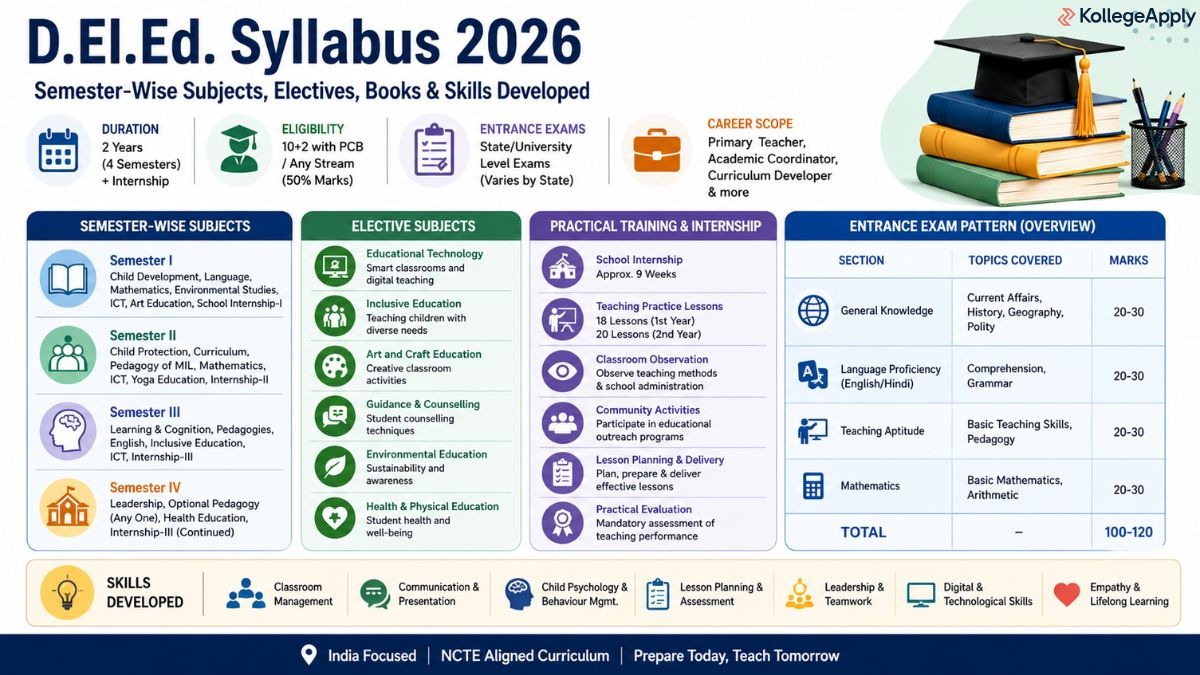
The D.El.Ed. syllabus 2026 includes subjects such as Child Development, Pedagogy, Language Education, Mathematics Education, Environmental Studies, Educational Technology, and School Internship. The program also offers practical training components, including classroom observations, teaching practice lessons, and community engagement activities. Upon completing the course, graduates can pursue careers as primary teachers, academic coordinators, curriculum developers, and education professionals in schools, NGOs, and EdTech companies.
- D.El.Ed. Syllabus Semester-Wise
- D.El.Ed. Syllabus in Private Universities
- Electives in D.El.Ed. Syllabus
- Practical Training and Internship in D.El.Ed. Syllabus
- What are the Skills Developed Through D.El.Ed. Syllabus?
- Books for D.El.Ed. Syllabus
- Preparation Tips for D.El.Ed. Syllabus
- D.El.Ed. Syllabus and Entrance Exam Pattern 2026
- D.El.Ed. Syllabus FAQs
D.El.Ed. Syllabus Semester-Wise
The D.El.Ed. syllabus semester-wise structure provided below is based on the curriculum prescribed by the State Council of Educational Research and Training (SCERT), Assam for its two-year Diploma in Elementary Education programme. The curriculum is designed to develop subject knowledge, pedagogical understanding, and practical teaching competencies required for elementary education. However, candidates should note that the subject structure, semester-wise papers, and assessment pattern may vary across universities, private colleges, and state education authorities, depending on the guidelines of the respective affiliating body and the National Council for Teacher Education (NCTE).
D.El.Ed. Syllabus in Private Universities
Private universities and teacher training colleges generally follow the NCTE-prescribed curriculum while incorporating additional practical training, communication skills, and educational technology modules. The year-wise syllabus followed by many private institutions is given below.
Electives in D.El.Ed. Syllabus
Many D.El.Ed. Colleges also offer elective and skill-based subjects to enhance students' practical teaching abilities and provide specialised knowledge in areas such as inclusive education, educational technology, guidance and counselling, environmental education, and art-integrated learning. The availability of these electives may vary depending on the institution, university curriculum, or state education authority.
Practical Training and Internship in D.El.Ed. Syllabus
Practical training forms a core component of the D.El.Ed. syllabus, enabling students to develop essential teaching competencies through hands-on classroom experience. The programme emphasises school internships, teaching practice sessions, lesson planning, classroom management, and participation in various school-based activities, ensuring that aspiring teachers gain the practical exposure needed to effectively manage and teach at the elementary education level.
What are the Skills Developed Through D.El.Ed. Syllabus?
The D.El.Ed. syllabus is designed to develop a strong foundation in teaching methodologies, child development, and classroom management. Along with theoretical knowledge, the programme helps students build practical, interpersonal, and professional skills that are essential for becoming effective elementary educators. Some of the key skills developed through the D.El.Ed. courses are listed below.
Books for D.El.Ed. Syllabus
The D.El.Ed. curriculum combines theoretical learning with practical teaching components, making it important for students to refer to comprehensive study materials. The following books can help candidates strengthen their subject knowledge, improve pedagogical understanding, and prepare for examinations and internships effectively.
Preparation Tips for D.El.Ed. Syllabus
The D.El.Ed. syllabus covers a wide range of topics, including child development, pedagogy, teaching methodologies, and practical training. A well-planned preparation strategy can help students perform better in semester examinations and develop the skills required for a successful teaching career. Some useful preparation tips for D.El.Ed. students are listed below:
- Understand the Semester-Wise Syllabus: Review the complete syllabus and examination pattern to identify important subjects and topics for each semester.
- Build Strong Concepts in Pedagogy and Child Development: Focus on core subjects such as Child Psychology, Educational Psychology, and Teaching Methodologies, as they form the foundation of elementary education.
- Prepare Effective Notes: Create concise notes, flowcharts, and summaries for important concepts to make revision easier before examinations.
- Refer to NCERT Books and Recommended Study Materials: Use standard textbooks and reference books to strengthen conceptual understanding and teaching competencies.
- Practise Lesson Planning and Teaching Demonstrations: Regularly prepare lesson plans and participate in micro-teaching sessions to improve classroom presentation and instructional skills.
- Participate Actively in Internships and Practical Training: Make the most of school internships, classroom observations, and teaching practice sessions to gain hands-on teaching experience.
- Revise Regularly and Solve Previous Years' Papers: Practising previous years' question papers and sample papers can help students understand the examination pattern and improve time management skills.
- Stay Updated with Educational Policies and Teaching Trends: Keep track of developments such as the National Education Policy (NEP) 2020, Foundational Literacy and Numeracy (FLN), and digital teaching practices to enhance professional knowledge.
Tip: Consistent study, practical teaching experience, and regular revision are the keys to mastering the D.El.Ed. syllabus and building a successful career in elementary education.
D.El.Ed. Syllabus and Entrance Exam Pattern 2026
Most D.El.Ed. Entrance exams in India follow a similar examination pattern to assess candidates' aptitude for teaching and their basic academic skills. The question paper generally consists of objective-type questions from subjects such as General Knowledge, Language Proficiency, Teaching Aptitude, and Mathematics. The total number of questions and marks may vary depending on the conducting authority, but the overall structure remains largely similar across state-level and university-level entrance examinations. Understanding the exam pattern helps candidates prepare strategically and focus on important sections.
D.El.Ed. Syllabus FAQs
What is the D.El.Ed. course syllabus?
The D.El.Ed. course syllabus includes child development, pedagogy, language education, mathematics, environmental studies, educational technology, and practical teaching training.
How many subjects are in DCET?
The number of subjects varies by institution, but the D.El.Ed. syllabus generally includes around 20-24 theory and practical papers across two years.
What are the subjects in DElEd 2026?
The D.El.Ed. syllabus 2026 includes Child Development, Pedagogy, Mathematics Education, Language Education, ICT, Health Education, and School Internship.
Is the D.El.Ed. syllabus the same in all colleges?
No, the D.El.Ed. syllabus may differ slightly across universities and states, although most institutions follow NCTE guidelines.
Does the D.El.Ed. syllabus include internships?
Yes, the D.El.Ed. course syllabus includes school internships, classroom observations, and teaching practice sessions.
What is the duration of the D.El.Ed. course?
The D.El.Ed. programme is a two-year diploma course generally divided into four semesters.
Which books are best for the D.El.Ed. syllabus?
NCERT books, Child Development and Pedagogy by Disha Experts, and Educational Psychology by S.S. Chauhan are widely recommended.
What is the salary after completing the D.El.Ed. course?
The average starting salary after D.El.Ed. ranges from INR 2.5-5 LPA and increases with experience and qualifications.
Can I become a government teacher after D.El.Ed.?
Yes, D.El.Ed. graduates can apply for government teaching jobs after qualifying CTET or State TET examinations.
Is the D.El.Ed. syllabus difficult?
The D.El.Ed. syllabus is manageable with regular study and practical participation as it focuses on teaching skills and child development concepts.