Diploma in Pharmacy, commonly known as D Pharma or D.Pharm, is a two-year diploma programme designed to build foundational knowledge of pharmaceutical sciences, medicines, healthcare practices and pharmacy services. The D Pharma Syllabus combines theoretical learning with practical sessions to help students understand subjects such as pharmaceutics, pharmaceutical chemistry, pharmacology, pharmacognosy, hospital and clinical pharmacy. The course is suitable for students who want to enter the pharmacy profession and explore careers in retail pharmacies, hospitals, pharmaceutical companies and healthcare-related services.
The D Pharma Syllabus 1st Year focuses primarily on the scientific and professional foundations of pharmacy, while the D Pharma Syllabus 2nd Year develops students' understanding of medicines, patient care, pharmacy practice and specialised pharmaceutical subjects. The programme also includes practical training and project or field-based learning components prescribed under the course structure. Students may further explore higher education opportunities after completing the diploma. Understanding the syllabus, recommended D Pharma books, practical requirements and career options can help aspirants plan their academic journey more effectively.
D Pharma Syllabus 1st Year
The first year of the D Pharma programme introduces students to the core principles required for pharmaceutical education. The subjects combine pharmaceutical science with chemistry and foundational healthcare knowledge, while practical classes allow students to apply theoretical concepts in laboratory settings.
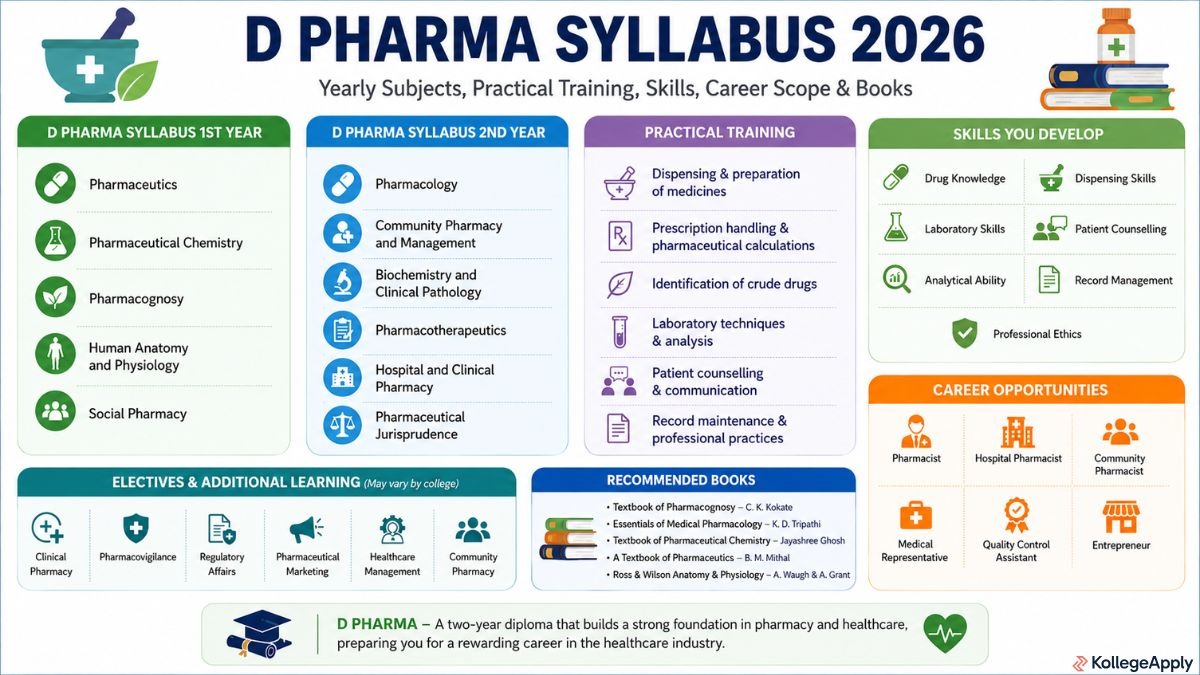
D Pharma Syllabus 1st Year: Subject-Wise Overview
The D Pharma Syllabus 1st Year is designed to create a strong academic base before students move towards advanced pharmacy practice. Along with classroom instruction, laboratory work helps learners understand pharmaceutical preparations, chemicals, medicinal materials and basic healthcare concepts.
- Pharmaceutics – Introduces students to the preparation, dispensing and handling of medicines. Major areas generally include dosage forms, prescription interpretation, pharmaceutical calculations, packaging materials and basic dispensing practices.
- Pharmaceutical Chemistry - This subject develops an understanding of pharmaceutical substances and the chemical principles involved in their identification and use. Students also learn about important inorganic compounds, impurities and analytical concepts relevant to pharmacy.
- Pharmacognosy - Focuses on medicines obtained from natural sources. Students study medicinal plants, crude drugs, their sources, identification and pharmaceutical importance.
- Human Anatomy and Physiology - Helps pharmacy students understand the structure and normal functioning of the human body. Knowledge of organ systems provides an important foundation for later subjects such as pharmacology.
- Social Pharmacy - Connects pharmaceutical education with public health and healthcare delivery. Students learn about health-related challenges, community healthcare and the professional responsibilities of pharmacists.
D Pharma Syllabus 2nd Year
The second year moves towards advanced pharmaceutical knowledge and pharmacy practice. Students study the effects and uses of medicines, drug-related chemistry, pharmaceutical formulations and patient-oriented pharmacy services, supported by practical and professional training.
D Pharma Syllabus 2nd Year: Subject-Wise Overview
The D Pharma Syllabus 2nd Year focuses more strongly on medicines and their use in patient care. The curriculum helps students connect pharmaceutical knowledge with practical responsibilities in community, hospital and clinical pharmacy environments.
- Pharmacology – Explains how medicines act on the body and how they are used in the prevention and treatment of diseases. Students learn about drug classes, therapeutic effects and possible adverse reactions.
- Community Pharmacy and Management - This subject focuses on the role of pharmacists in community settings. Important areas include patient counselling, prescription-related services, inventory management and responsible pharmacy operations.
- Biochemistry and Clinical Pathology - Students learn about important biochemical processes in the human body and commonly used clinical investigations. The subject helps build an understanding of laboratory values and disease-related changes.
- Pharmacotherapeutics - Connects medicines with disease management. Students study the principles of selecting and using appropriate drug therapy for commonly encountered health conditions.
- Hospital and Clinical Pharmacy - Introduces professional services provided by pharmacists in healthcare institutions. Topics include medication management, patient safety, clinical responsibilities and pharmacy services in hospitals.
- Pharmaceutical Jurisprudence - Familiarises students with laws, regulations and ethical principles associated with the pharmacy profession and the manufacture, sale and distribution of medicines.
Practical Training / Internship in D Pharma
Practical learning is an essential component of the D Pharma Syllabus because pharmacy education requires students to understand how pharmaceutical concepts are applied in professional settings. Laboratory sessions and practical exercises help students gain familiarity with pharmaceutical preparations, medicines, instruments and standard procedures.
The course structure also includes practical exposure and training requirements that help students understand professional pharmacy environments. Depending on institutional arrangements and applicable regulations, practical training may involve exposure to community pharmacies, hospitals or other approved pharmacy settings. Key areas of practical learning may include:
- Preparation and dispensing of pharmaceutical products
- Pharmaceutical calculations and prescription-related exercises
- Identification and evaluation of crude drugs
- Chemical analysis and laboratory procedures
- Understanding of basic clinical and patient-care services
- Medication handling and storage practices
- Patient counselling and communication
- Pharmacy record maintenance and professional procedures
Electives in D Pharma Syllabus
The standard D Pharma Syllabus is primarily structured around prescribed core subjects and practical components. Unlike many undergraduate degree programmes, D Pharma may not offer a wide range of formal elective papers within the standard curriculum.
However, institutions may provide additional learning opportunities, value-added courses, workshops or specialised exposure in areas relevant to pharmacy practice. The availability of such options can vary by college.
Note: Students should check the specific college curriculum to understand whether additional electives or certificate-based learning options are available.
What are the skills developed through the D Pharma Syllabus?
The D Pharma Syllabus is not limited to subject knowledge. Through theory classes, laboratory work and practical exposure, students develop technical, analytical and professional skills required for pharmacy-related roles. The following skills can be useful for students seeking employment immediately after the diploma as well as those planning to continue their education in pharmacy:
Career Scope After D Pharma
The career scope after D Pharma includes opportunities across pharmacy, healthcare services, medicine dispensing and the pharmaceutical industry. Career options may depend on professional registration requirements, employer expectations, practical experience and the candidate's additional qualifications.
Books for D Pharma Syllabus
Choosing the right D Pharma books can make subject-wise preparation easier, especially when students need to balance theory, practical work and examination revision. The books below are widely used as standard references in Indian pharmacy education and are relevant to major subjects covered in the D Pharma Syllabus 1st Year and D Pharma Syllabus 2nd Year. Students should always check their college or university recommendations and buy the latest suitable edition.
These D Pharma books are useful for building a strong understanding of the core subjects covered in the D Pharma Syllabus 1st Year and D Pharma Syllabus 2nd Year. Students can use them as reference books alongside their prescribed textbooks, class notes and practical manuals.
D Pharma Syllabus FAQs
What is the duration of the D Pharma course?
D Pharma is generally a two-year diploma programme with academic and practical training components prescribed under the applicable course structure.
What is covered in the D Pharma Syllabus?
The D Pharma Syllabus covers pharmaceutics, chemistry, pharmacology, pharmacognosy, pharmacy practice, healthcare and related practical learning.
What are the main subjects in D Pharma Syllabus 1st Year?
D Pharma Syllabus 1st Year includes Pharmaceutics, Pharmaceutical Chemistry, Pharmacognosy, Human Anatomy and Physiology, and Social Pharmacy.
What is taught in D Pharma Syllabus 2nd Year?
D Pharma Syllabus 2nd Year includes Pharmacology, Pharmacotherapeutics, Community Pharmacy, Hospital Pharmacy, Biochemistry and Jurisprudence.
Does D Pharma include practical training?
Yes, the D Pharma Syllabus includes laboratory and practical learning to develop pharmaceutical, dispensing and professional pharmacy skills.
Are there electives in the D Pharma course?
Formal electives may vary, but colleges can offer additional learning in clinical pharmacy, pharmacovigilance, management or regulatory areas.
Which D Pharma books should students use?
Students should use syllabus-aligned D Pharma books, practical manuals and updated reference texts recommended by their college or faculty.
What jobs can I get after D Pharma?
After D Pharma, students can explore pharmacy, hospital, community pharmacy, pharmaceutical sales, manufacturing and distribution-related roles.
Can I pursue higher education after D Pharma?
Yes, D Pharma graduates may pursue B.Pharm and other pharmacy or healthcare-related programmes, subject to applicable eligibility requirements.
Is the D Pharma Syllabus suitable for a pharmacy career?
Yes, the D Pharma Syllabus provides foundational pharmaceutical knowledge, practical exposure and skills relevant to entry-level pharmacy careers.