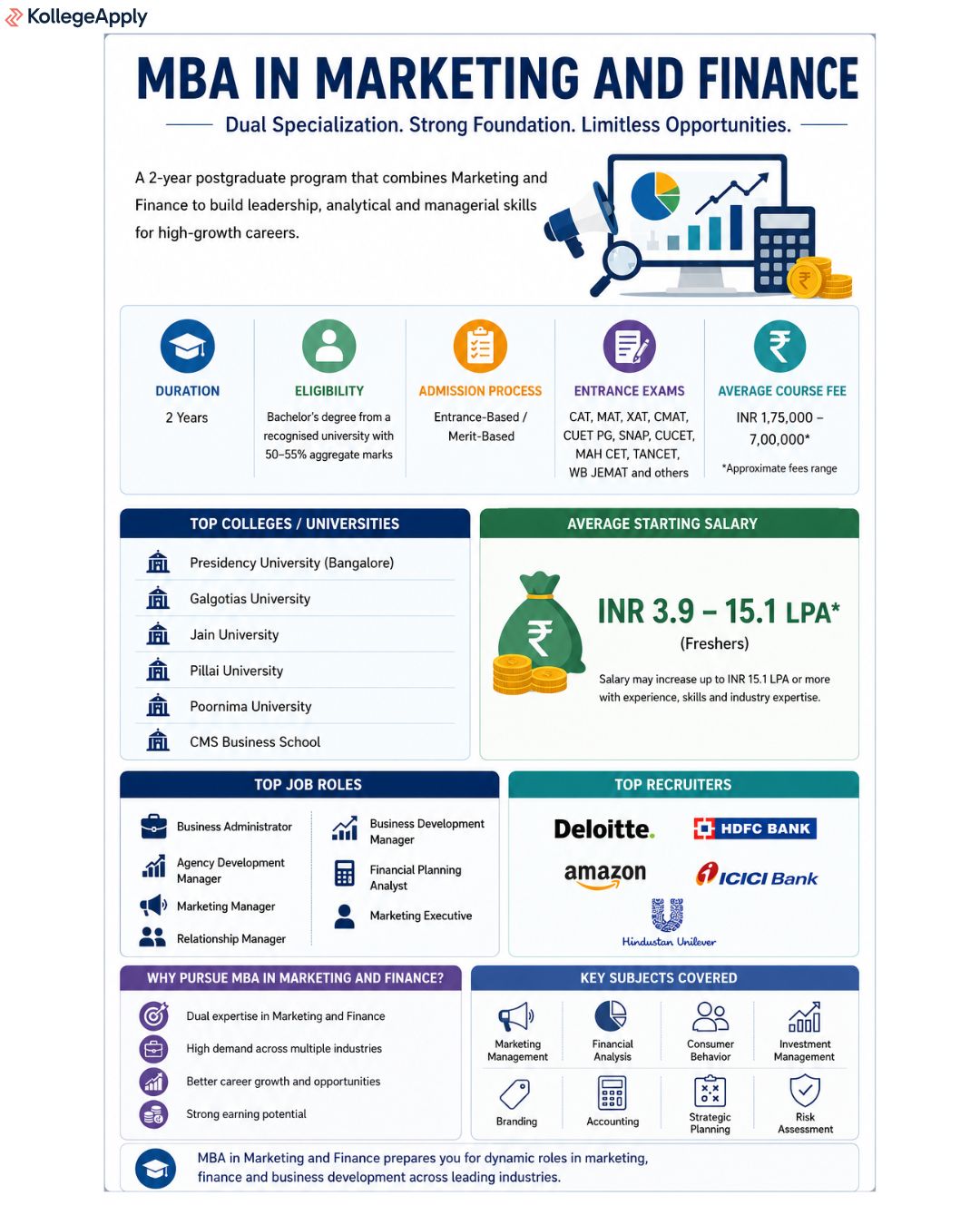
MBA in Marketing and Finance is a 2-year postgraduate program that offers dual specialization in Marketing and Finance, helping students develop strong leadership, analytical, and managerial skills. The program covers MBA Marketing and Finance subjects such as marketing management, financial analysis, consumer behavior, investment management, branding, accounting, strategic planning, etc.
Finance and Marketing MBA requires candidates to meet certain eligibility criteria for admission. The basic requirement is a bachelor's degree from a recognized university with a minimum aggregate of 45–50% marks, though the percentage may vary depending on the institution. Admission is primarily based on entrance examinations such as CAT, MAT, XAT, CMAT, NMAT, and GMAT. Additionally, several universities consider candidates' academic performance, work experience (if applicable), and overall profile during the selection process.
Students interested in learning about MBA in finance and marketing scope in India should primarily focus on the colleges offering this program. Choosing a reputed college ensures quality education through an industry-relevant curriculum covering MBA marketing and finance subjects, along with better placement opportunities. Some of the colleges offering this PG course include CMS Business School, Pillai University, and Poornima University. The average course fee ranges between INR 1,75,000 - INR 7,00,000, depending on the institution, placement facilities, infrastructure, and location.
Graduates of this program can work across a wide range of industries in roles related to marketing, finance, and business development. Young professionals can start their careers with an average salary of INR 3.9 LPA, which can increase to INR 15.1 LPA or more with experience, skills, and industry expertise. Some of the common job roles include Business Administrator, Financial Planning Analyst, Marketing Executive, Business Development Manager, and Marketing Manager.
Table of Contents
- MBA in Marketing and Finance Course Highlights
- What is MBA in Marketing and Finance?
- Why Pursue MBA in Marketing and Finance?
- Who Should Pursue MBA in Marketing and Finance?
- Is MBA in Marketing and Finance Worth It in 2026?
- What is the Eligibility Criteria of MBA Marketing and Finance?
- MBA in Marketing and Finance Entrance Examinations
- MBA in Marketing and Finance Colleges and Fees
- MBA in Marketing and Finance Admission Process
- MBA in Marketing and Finance Syllabus
- What Skills are Required for MBA in Marketing and Finance?
- What is the salary after MBA in Finance and Marketing?
- Top Recruiters for MBA in Marketing and Finance
- MBA in Marketing and Finance Vs MBA Finance
- MBA in Marketing and Finance FAQs
MBA in Marketing and Finance Course Highlights
It is important for prospective students to gather all the necessary information related to the MBA in Marketing and Finance course before applying. These details help students make informed decisions and determine whether an MBA in Finance and Marketing is the right fit for their career goals. The basic details about the MBA Marketing and Finance program are mentioned in the table below:
What is MBA in Marketing and Finance?
MBA Marketing and Finance is a dual-specialization postgraduate management program that combines two major business domains, marketing management and financial management. The course helps individuals to understand how businesses generate revenue, manage customer relationships, analyse financial performance, and make strategic decisions for growth.
Unlike single-specialisation MBA programs, this course offers interdisciplinary exposure. The candidates can learn branding, sales strategy, consumer behaviour, and digital marketing alongside investment analysis, financial planning, taxation, portfolio management, and risk assessment. This combination makes graduates suitable for cross-functional managerial roles in companies.
The course also focuses on practical business exposure through Live projects, Summer internships, Industry workshops, Case studies, Corporate presentations, Financial simulations and Market research assignments. With the rise of fintech companies, e-commerce businesses, digital banking, and data-driven marketing, professionals who can understand both market expansion and financial sustainability are in high demand.
Why Pursue MBA in Marketing and Finance?
Students choose MBA Marketing and Finance because it offers broader career flexibility compared to single-specialisation MBA programs. The combination of marketing and finance prepares candidates for both revenue-generating and analytical business roles. Some of the key reasons to pursue the course are:
- Dual specialization offers career flexibility in marketing, finance, analytics, consulting, sales, and business strategy across multiple industries.
- Higher employability in banking, fintech, FMCG, e-commerce, retail, consulting, and technology sectors due to cross-functional business expertise.
- Better career versatility than single-specialization MBAs with knowledge of branding, finance, profitability, consumer behaviour, and growth strategy.
- Strong demand for professionals skilled in AI-driven marketing, CRM analytics, performance marketing, and financial decision-making roles.
- Practical exposure through internships, live projects, Power BI, Excel, Google Analytics, CRM tools, and financial modelling software.
Who Should Pursue MBA in Marketing and Finance?
An MBA Finance Marketing dual specialization is ideal for students who want to build expertise in both marketing and financial management. The course is suitable for candidates seeking versatile career opportunities across industries such as banking, consulting, FMCG, retail, e-commerce, and fintech. Students who should consider pursuing this program include:
- Graduates who want to develop skills in both marketing strategies and financial decision-making.
- Candidates aspiring to build careers in banking, consulting, business development, brand management, or financial analysis.
- Working professionals looking to enhance their managerial skills and accelerate career growth.
- Entrepreneurs and business owners who want to understand customer acquisition, financial planning, and business expansion.
- Individuals interested in cross-functional managerial roles that combine analytical thinking with strategic marketing.
Is MBA in Marketing and Finance Worth It in 2026?
Yes, an MBA Marketing and Finance is considered a valuable management degree in 2026 due to increasing industry demand for multi-skilled professionals. Companies are looking for managers who understand both customer behaviour and financial performance. The course is especially beneficial for students interested in:
- Banking and financial services
- Digital marketing
- Corporate sales
- Investment consulting
- Retail management
- Brand management
- Fintech startups
- E-commerce platforms
The integration of AI-driven marketing tools, business analytics, and financial technologies has also increased the relevance of this specialization. Graduates with practical exposure in analytics, CRM tools, investment planning, and digital campaigns often secure competitive salary packages.
What is the Eligibility Criteria of MBA Marketing and Finance?
Candidates seeking admission to MBA in Marketing and Finance must fulfill the eligibility criteria prescribed by the respective colleges and universities. The basic requirements generally include educational qualifications, minimum aggregate marks, and valid entrance examination scores for admission consideration.
- Candidates must hold a Bachelor’s degree in any discipline from a recognized university or institution.
- Applicants are generally required to secure a minimum aggregate score of 50–55% in graduation. A relaxation of marks may be provided for reserved category candidates, depending on the institute’s guidelines..
- Must qualify for national/ state-level entrance exams such as CAT, MAT, XAT, MAH-CET, CUET PG, and others as per applicability.
- A few colleges also conduct their entrance exams, such as SNAP, CUCET, and JET. Candidates must qualify in these exams to get entrance to the MBA programs.
MBA in Marketing and Finance Entrance Examinations
Admission to MBA Marketing and Finance is primarily based on national-level management entrance examinations accepted by universities across India. Some of the most popular entrance exams include CAT, CMAT, and NMAT, which evaluate candidates on aptitude, reasoning, language skills, and quantitative ability. The table below provides the conducting bodies, tentative exam dates, and application fees for these entrance examinations:
MBA in Marketing and Finance Colleges and Fees
Several universities across India offer an MBA in Marketing and Finance with industry-oriented curricula, internship opportunities, and placement support. Popular institutions such as Jain University (Online), Galgotias University, Pillai University, Presidency University, and Poornima University are among the preferred choices for aspirants. The table below compares these colleges based on their NIRF rankings, locations, and approximate course fees to help candidates choose the institute that best aligns with their career goals:
MBA in Marketing and Finance Admission Process
The admission process for the MBA Marketing and Finance course generally includes multiple stages such as entrance examination qualification, application submission, and participation in the university selection process. Candidates are shortlisted based on their academic background, entrance exam scores, and overall performance in the evaluation rounds conducted by the university. For reference, the step-by-step admission process for at Jain University (Bangalore) is mentioned below:
Step 1: Candidates must meet the eligibility criteria by completing a Bachelor’s degree from a recognized university with the required minimum aggregate marks.
Step 2: Applicants need to appear for required management entrance examinations such as CAT, MAT, XAT, CMAT, ATMA, NMAT, or the university’s entrance process.
Step 3: Eligible candidates should fill out the online MBA application form available on the official university website and submit the required academic documents.
Step 4: Shortlisted candidates are invited for further selection rounds, which may include a group discussion (GD), personal interview (PI), and written assessment conducted by the university.
Step 5: The university evaluates candidates based on entrance exam scores, academic performance, communication skills, and overall performance in the selection rounds.
Step 6: Selected candidates receive the admission offer from the university and must complete the fee payment process within the given timeline to confirm their admission.
Documents Required:
MBA in Marketing and Finance Syllabus
The MBA in Marketing and Finance syllabus covers a combination of managerial, financial, and marketing-related subjects that help students build analytical, strategic, and decision-making skills. The curriculum is structured to provide knowledge of financial management, investment planning, consumer behavior, branding, market analysis, and business strategy. The detailed list of MBA Marketing and Finance subjects and syllabus offered by Jain University, Bangalore is provided below:
What Skills are Required for MBA in Marketing and Finance?
Students pursuing MBA in Marketing and Finance should develop a combination of analytical, communication, and strategic management skills. Strong problem-solving abilities, leadership qualities, financial understanding, and effective interpersonal skills are essential for building a successful career in marketing and finance domains. In addition, Industry certifications in digital marketing, Excel, Power BI, financial modelling, and CRM tools can further improve employability.
Important Skills Required
- Strong Communication Skills: Helpful for interacting with clients, presenting ideas clearly, and managing branding or sales activities effectively.
- Analytical and Problem-Solving Ability: Important for understanding market trends, evaluating business performance, and making informed financial decisions.
- Leadership and Team Management: Essential for handling managerial responsibilities, guiding teams, and coordinating business operations efficiently.
- Financial Understanding: Knowledge of budgeting, investment planning, and financial analysis helps in making strategic business decisions.
- Strategic Thinking: Enables professionals to plan marketing campaigns, identify growth opportunities, and contribute to long-term business success.
- Negotiation and Interpersonal Skills: Useful for client handling, business development, partnerships, and achieving favorable business outcomes.
- Knowledge of Digital Marketing: Familiarity with online marketing tools, social media strategies, and digital campaigns is highly beneficial in today’s business environment.
- Data Interpretation Skills: Helps in analyzing financial reports, customer behavior, and market data to support forecasting and decision-making.
What is the salary after MBA in Finance and Marketing?
Graduates with an MBA in Marketing and Finance can explore career opportunities across marketing, finance, consulting, banking, and business development. Some of the popular job roles include Marketing Manager, Financial Analyst, Business Development Manager, Brand Manager, Relationship Manager, and Investment Analyst. Depending on the role, experience, and employer, professionals can earn competitive salary packages. The table below highlights some of the common job roles, their experience requirements, and average salary ranges:
Top Recruiters for MBA in Marketing and Finance
Several multinational companies and leading Indian corporations recruit MBA Marketing and Finance candidates for strategic, analytical, and managerial roles across various industries. These professionals are hired for positions related to marketing management, financial planning, business development, sales strategy, and client relationship management, offering strong career growth and competitive salary opportunities.
MBA in Marketing and Finance Vs MBA Finance
MBA Marketing and Finance (dual specialization) provides the opportunity for a variety of jobs in both marketing and finance, and is therefore appropriate to students who desire versatility and cross-functional career prospects. Whereas MBA Finance offers comprehensive knowledge on financial spheres, which is of value when pursuing careers in specialized finance with an expected development and rewarding salary.
MBA in Marketing and Finance FAQs
What is MBA in Marketing and Finance?
MBA in Marketing and Finance is a dual-specialization postgraduate management program that combines marketing strategies, branding, sales, financial planning, investment analysis, and business management.
What are the eligibility criteria for MBA in Marketing and Finance?
Candidates need a bachelor’s degree with minimum qualifying marks and valid scores in exams like CAT, MAT, XAT, or CMAT for MBA in Marketing and Finance admission.
Is MBA in Marketing and Finance a good career option?
Yes, MBA in Marketing and Finance offers strong career growth in banking, FMCG, consulting, digital marketing, and finance with diverse managerial opportunities.
What are the top job roles after MBA in Marketing and Finance?
Graduates can work as Marketing Manager, Financial Analyst, Brand Manager, Relationship Manager, Business Development Manager, or Investment Analyst.
What is the average MBA marketing salary?
The average salary after MBA in Marketing and Finance starts from INR 3.9 LPA for freshers and increases INR 15.1 or more with experience, skills, and industry exposure.
Which colleges offer MBA in Marketing and Finance?
Some of the top colleges offering MBA in Marketing Finance are JAIN University, Presidency University, Galgotias University, and CMS Business School offer MBA in Marketing and Finance.
Is MBA in Marketing and Finance better than MBA Finance?
MBA in Marketing and Finance is ideal for students seeking flexible careers in both marketing and finance, while MBA Finance focuses mainly on financial expertise.
What skills are important for MBA in Marketing and Finance?
Important skills for MBA in Marketing and Finance include communication, leadership, analytical thinking, digital marketing, financial analysis, and teamwork.
What are the 4 types of MBA?
The common types of MBA programs are Full-Time MBA, Part-Time MBA, Executive MBA, and Online MBA, each designed for different career needs and schedules.
What are the career scope after MBA in Marketing and Finance program?
MBA in Marketing and Finance candidates can build careers in banking, retail, consulting, e-commerce, FMCG, fintech, and corporate management sectors.
Can MBA Marketing and Finance graduates work abroad?
Yes, MBA in Marketing and Finance graduates can work abroad in consulting, fintech, banking, digital marketing, analytics, and multinational companies with relevant skills and experience.
Which industries hire dual-specialization MBA graduates most?
MBA in Marketing and Finance graduates are highly recruited in fintech, banking, FMCG, e-commerce, consulting, retail, technology, and digital marketing sectors.