An MBA in Data Analytics is a two-year program that equips learners with the skills and knowledge to use data visualization tools for handling dynamic data. The course is offered in both offline and online/distance modes. The curriculum covers core business subjects such as Finance, Marketing, and Leadership, along with specialized areas like Business Intelligence, Predictive Modeling, and Big Data Analytics.
To be eligible for admission to an MBA in Data Analytics in India, a student must have completed their graduation with a minimum of 50% aggregate marks (this may vary by institute, and relaxation may be provided for students belonging to reserved categories). Admissions are primarily based on entrance exams conducted at state, national and university levels.
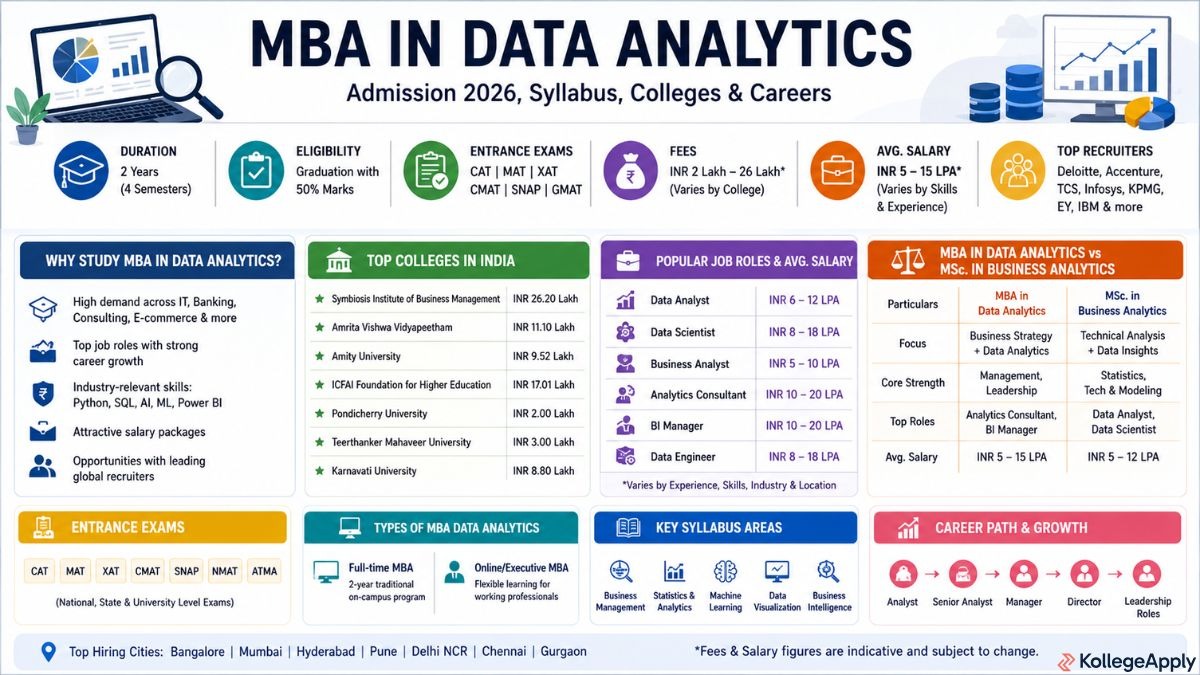
Some of the top colleges offering MBA in Data Analytics include Symbiosis Institute of Business Management, Amrita Vishwa Vidyapeetham, Amity University, ICFAI Foundation for Higher Education, Pondicherry University, and Teerthanker Mahaveer University, among others. The average fees for these colleges range between INR 2,00,000 to INR 26,00,000 that varies on the basis of the type of colleges, locations, and infrastructure.
The average salary for MBA in Data Analytics graduates generally ranges from INR 5 LPA to INR 15 LPA, depending on skills, employer, and location. Professionals in senior or specialized analytics roles such as Analytics Consultant, Business Intelligence Manager, and Data Scientist can earn INR 18 LPA to INR 20 LPA or more with relevant experience. Common job roles include Data Analyst, Data Engineer, Business Intelligence Analyst, and Supply Chain Analyst.
- MBA in Data Analytics Key Highlights
- What is an MBA in Data Analytics?
- Why Study MBA in Data Analytics?
- Is an MBA in Data Analytics Worth It in 2026?
- MBA in Data Analytics Eligibility Criteria
- Types of MBA Data Analytics Courses
- MBA in Data Analytics Entrance Exams
- How to Prepare for MBA Data Analytics Entrance Exams?
- MBA in Data Analytics Top Colleges in India
- MBA in Data Analytics Fees
- MBA in Data Analytics Admission Process
- MBA in Data Analytics Syllabus
- MBA in Data Analytics vs MSc. in Business Analytics
- MBA in Data Analytics Jobs & Salary
- MBA in Data Analytics FAQs
MBA in Data Analytics Key Highlights
The MBA in Data Analytics is a two-year postgraduate management program that combines business management with data analytics, artificial intelligence, and business intelligence. Admission is offered through national-level MBA entrance examinations such as CAT, MAT, XAT, CMAT, SNAP, and GMAT, although some universities also offer merit-based admissions. Graduates can pursue careers as Data Analysts, Business Analysts, Data Scientists, Analytics Consultants, and BI Specialists, with an average MBA in Data Analytics salary of INR 5–15 LPA, depending on their skills, experience, employer, and location. The table below highlights the key details of the program.
What is an MBA in Data Analytics?
An MBA in Data Analytics is a postgraduate program that combines business management with data-driven decision-making. It helps students learn how to analyze large amounts of data and extract useful insights. The course builds skills needed to support strategic business decisions.
The program includes core subjects like marketing, finance, and operations. It also covers tools and technologies such as Python, R, statistics, machine learning, and business intelligence. This combination prepares students to solve real business problems using data.
Graduates are in demand across industries like IT, finance, healthcare, e-commerce, and consulting. Common job roles include Business Analyst, Data Analyst, Data Scientist, and Analytics Consultant. The program is suitable for those with strong analytical thinking and interest in business and technology.
Why Study MBA in Data Analytics?
An MBA in Data Analytics equips students with the knowledge to combine business strategy with data-driven decision-making. As organizations across industries increasingly rely on analytics, AI, and business intelligence, the demand for skilled professionals continues to grow. The program offers excellent career prospects, competitive salary packages, and opportunities to work with leading global organizations. Some of the key reasons to pursue an MBA in Data Analytics are:
- High Industry Demand: MBA in Data Analytics is a highly in-demand course with strong career opportunities across sectors like Banking, IT, Media, Consulting, and more.
- Excellent Career Opportunities: Graduates can pursue diverse job roles, including Data Analyst, Business Analyst, Data Scientist, Analytics Consultant, Business Intelligence (BI) Specialist, Data Engineer, and Risk Analyst, with strong opportunities for career growth.
- Opportunities with Top Recruiters: Leading companies such as Accenture, Deloitte, IBM, TCS, Infosys, KPMG, EY, PwC, HSBC, Amazon, and Genpact actively recruit MBA in Data Analytics graduates for business intelligence, analytics, and consulting roles.
- Industry-Relevant Technical Skills: Students gain hands-on experience with tools and technologies such as Python, SQL, R, Tableau, Power BI, Machine Learning, Artificial Intelligence, and Cloud Analytics, making them industry-ready.
- Strong Salary Potential: The program offers impressive salary packages typically ranging from INR 5 LPA to INR 15 LPA, depending on skills, knowledge, and experience.
Is an MBA in Data Analytics Worth It in 2026?
Pursuing an MBA in Data Analytics in 2026 can be a worthwhile investment for graduates who want to build a career at the intersection of business management and data-driven decision-making. As organizations continue to adopt artificial intelligence, big data, cloud computing, and business intelligence solutions, the demand for professionals who can interpret data and develop business strategies is expected to remain strong across industries.
The program offers a balanced curriculum that combines management subjects with analytical tools and technologies, preparing graduates for roles in consulting, IT, banking, healthcare, e-commerce, and manufacturing. Fresh graduates generally earn INR 5 LPA to INR 8 LPA, while experienced professionals can earn INR 15 LPA to INR 20 LPA or more, depending on their skills, employer, and location. With increasing digital transformation and data-centric business models, an MBA in Data Analytics continues to provide strong career prospects, competitive salaries, and long-term growth opportunities in 2026.
Note: Salary growth is one of the major reasons candidates choose this specialization. For a detailed breakdown of MBA in Data Analytics salary by experience, job role, industry, and city, refer to our MBA in Data Analytics Salary article.
MBA in Data Analytics Eligibility Criteria
Candidates seeking admission to an MBA in Data Analytics must fulfil the eligibility requirements prescribed by the respective university or business school. While the exact criteria may vary across institutions, most colleges require applicants to have a bachelor's degree and a valid entrance examination score. Some institutes may also consider work experience and academic performance during the selection process. The common eligibility criteria are given below:
- Educational Qualification: Candidates must hold a bachelor's degree from a recognised university with a minimum of 50% aggregate marks or an equivalent CGPA. Reserved category candidates may receive relaxation as per the institution's admission policy.
- Academic Background: Most universities accept graduates from any discipline. However, candidates with backgrounds in Engineering, Mathematics, Statistics, Computer Science, Information Technology, Economics, or related quantitative fields may have an advantage due to the analytical nature of the program.
- Entrance Examination: Applicants are generally required to qualify for a national or university-level management entrance examination such as CAT, XAT, CMAT, MAT, GMAT, SNAP, or other accepted entrance tests, depending on the institution.
- Selection Process: Many institutes shortlist candidates based on entrance exam scores, followed by Group Discussion (GD), Personal Interview (PI), and Written Ability Test (WAT) or equivalent admission rounds.
- Work Experience: Prior work experience is not mandatory for most MBA in Data Analytics programs. However, some premier business schools may give preference or additional weightage to candidates with relevant professional experience during the admission process.
Types of MBA Data Analytics Courses
An MBA in Data Analytics is offered in different study modes to cater to the needs of fresh graduates as well as working professionals. While the curriculum generally covers business management, data analytics, business intelligence, and analytical tools, the duration, flexibility, and learning approach vary depending on the mode of study. The major types of MBA in Data Analytics courses are discussed below.
- Full-time MBA in Data Analytics: A traditional 2-year, full-time course where students focus on data analytics and related business courses.
- Online/Executive MBA in Data Analytics: This program is specially designed for working professionals to earn a degree in data analytics through online coursework. Provides flexibility in terms of class timings and covers almost similar syllabus as full-time MBA in Data Analytics.
MBA in Data Analytics Entrance Exams
To gain admission to the MBA Data Analytics program, various entrance exams are conducted at the state, national, and university levels. A few entrance exams for selecting the most eligible students for the MBA Data Analytics course in India are given below:
How to Prepare for MBA Data Analytics Entrance Exams?
Preparing for an MBA in Data Analytics entrance exam requires a well-planned strategy, regular practice, and a thorough understanding of the exam pattern. Most MBA entrance examinations assess candidates on quantitative aptitude, logical reasoning, verbal ability, and data interpretation. Consistent preparation and effective time management can significantly improve the chances of securing admission to top MBA colleges.
- The first step is understanding the exam format and syllabus clearly. However, as the syllabus is subject to change, it is better to download the syllabus from exam portals or official websites of respective colleges and universities.
- Develop a strong foundation in quantitative skills and review concepts as per the syllabus. As most of the exams are MCQ-based and time-bound, it would be beneficial to practice tips and tricks for completing the exam in a given time.
- Go through multiple online mock tests and also go through previous years' question papers to get an idea of the question pattern. Track your performance by focusing on time management, accuracy, and identifying areas of improvement.
- As few entrance exams have negative markings for wrong answers, candidates must answer questions only if they are 100% sure about it.
- Enroll in online coaching sessions or review study materials available in the market for better preparation.
MBA in Data Analytics Top Colleges in India
There are several reputed universities and business schools offer MBA in Data Analytics programmes with industry-oriented curricula, modern analytics laboratories, and strong placement support. Admission to these institutes is generally based on national-level entrance examinations such as CAT, XAT, MAT, CMAT, NMAT, SNAP, CUET (PG), or institute-specific tests, followed by a personal interview or group discussion. The MBA in Data Analytics fees vary from around INR 2 lakh to INR 26 lakh or more, depending on the institution, infrastructure, faculty, and placement opportunities. Some of the top colleges include Symbiosis Institute of Business Management (Pune), Amrita Vishwa Vidyapeetham, Amity University, and Karnavati University. The table below highlights their location, approximate fees, NIRF ranking, and admission process.
MBA in Data Analytics Fees
The MBA in Data Analytics fees in India vary depending on the type of institution, its reputation, infrastructure, faculty, and placement opportunities. Government and public institutions generally offer the program at a lower cost than private business schools, while premier institutes may charge higher fees due to their academic excellence and strong industry connections. Candidates should compare the total program cost along with placement records, return on investment (ROI), and available scholarships before selecting a college.
MBA in Data Analytics Admission Process
Admission to an MBA in Data Analytics is generally based on entrance exam scores, academic performance, and the selection process followed by individual institutes. While the exact admission procedure may vary across universities, most colleges follow a similar sequence of application, evaluation, and final admission. Candidates should carefully review the admission guidelines, eligibility requirements, and important dates published by their preferred institutions before applying. The general step-by-step process for taking admission in the MBA Data Analytics course is given below:
Step 1: First, start with researching and shortlisting colleges or universities offering an MBA in Data Analytics. Check eligibility criteria, course structure, specializations, and entrance exam requirements.
Step 2: Ensure you meet the eligibility criteria and prepare all required documents such as academic mark sheets, graduation certificate, ID proof, and other necessary records.
Step 3: Fill out the application form for the selected institution on the official website of the colleges and submit it along with the required registration fee.
Step 4: Appear for the entrance examination (if applicable) and wait for the result. Some institutes may also conduct group discussions or personal interviews.
Step 5: Shortlisting of candidates is done based on entrance exam scores and academic profile, followed by a written ability test (WAT) or written evaluation, and a personal interview, which may sometimes include a group discussion or group-based assessment.
Step 6: Check the admission results through the official portal or email. If selected, complete the admission confirmation process by document verification and paying the required fees.
Documents Required:
MBA in Data Analytics Syllabus
The subjects in the MBA Data Analytics program may vary depending on college or university, but generally, the curriculum stays similar for most of the colleges across India. The MBA in Data Analytics Syllabus, according to Pondicherry University, is given below.
Electives Subject
MBA in Data Analytics vs MSc. in Business Analytics
The comparison between the MBA Data Analytics and the Master of Science in Business Analytics is given below:
MBA in Data Analytics Jobs & Salary
Fresh graduates with an MBA in Data Analytics generally earn INR 5 LPA to INR 8 LPA. Professionals with 3–5 years of experience can earn INR 8 LPA to INR 15 LPA, while senior professionals in analytics and leadership roles may earn INR 20 LPA or more, depending on their skills, employer, and location. The table below presents some of the popular job roles, their responsibilities, and average salary packages for MBA in Data Analytics graduates. Salaries may vary depending on experience, employer, location, and skills.
Note: Salary figures are indicative averages based on industry trends in India. Actual salaries may vary depending on the employer, job role, skills, experience, location, institute, and prevailing market conditions.
MBA in Data Analytics FAQs
Is an MBA in data analytics good?
Yes, MBA in Data Analytics is a great choice as it offers high-demand skills, strong career growth, and salaries ranging from INR 5–15 LPA across top industries.
What are the 4 types of MBA?
The 4 main types of MBA in data analytics are Full-time MBA, Part-time MBA, Executive MBA, and Online/Distance MBA, depending on learning mode and experience level.
Is there any MBA in data analytics?
Yes, MBA in Data Analytics is a 2-year postgraduate program combining business management with data analytics, Business Intelligence tools, and decision-making skills.
Who is eligible for an MBA in data analytics?
The graduates with at least 50% marks from a recognized university are eligible for MBA in Data Analytics, along with valid entrance exam scores such as CAT, MAT, XAT, CMAT, among others.
What are the top colleges and fees for MBA in Data Analytics?
Some of the top colleges include SIBM, Amity University, and Amrita Vishwa Vidyapeetham. MBA in Data Analytics fees range from INR 2 lakh to INR 26 lakh depending on the institute.
What are the subjects included in MBA in Data Analytics Syllabus?
The MBA in Data Analytics syllabus includes subjects such as Python, R, Machine Learning, Business Intelligence, SQL, Statistics, Data Visualization, and Big Data.
Is it possible to pursue an MBA in Data Analytics without appearing for an entrance exam?
Most colleges require entrance exams like CAT or MAT for MBA in Data Analytics. However, some private universities offer direct or merit-based admission based on graduation marks and interviews.
What are the other courses that can be pursued after completing an MBA in Data Analytics?
After MBA in Data Analytics, you can pursue PhD, Data Science certifications, AI/ML, Big Data, Cloud Computing, or executive programs for better career growth and specialization .
What are the job roles after MBA in Data Analytics?
Graduates can work as Data Analyst, Business Analyst, Data Scientist, BI Analyst, or Data Engineer in various industries. These roles involve analyzing data, generating insights, and supporting data.
Is an MBA in Data Analytics better than an MBA in Business Analytics?
MBA in Data Analytics is more technical and tool-focused whereas, an MBA in Business Analytics focuses more on strategy and business decisions.
What is the monthly MBA in Data Analytics salary?
MBA in Data Analytics graduates generally earn INR 40,000 to INR 1.6 lakh or more per month, depending on their experience, job role, employer, and location.