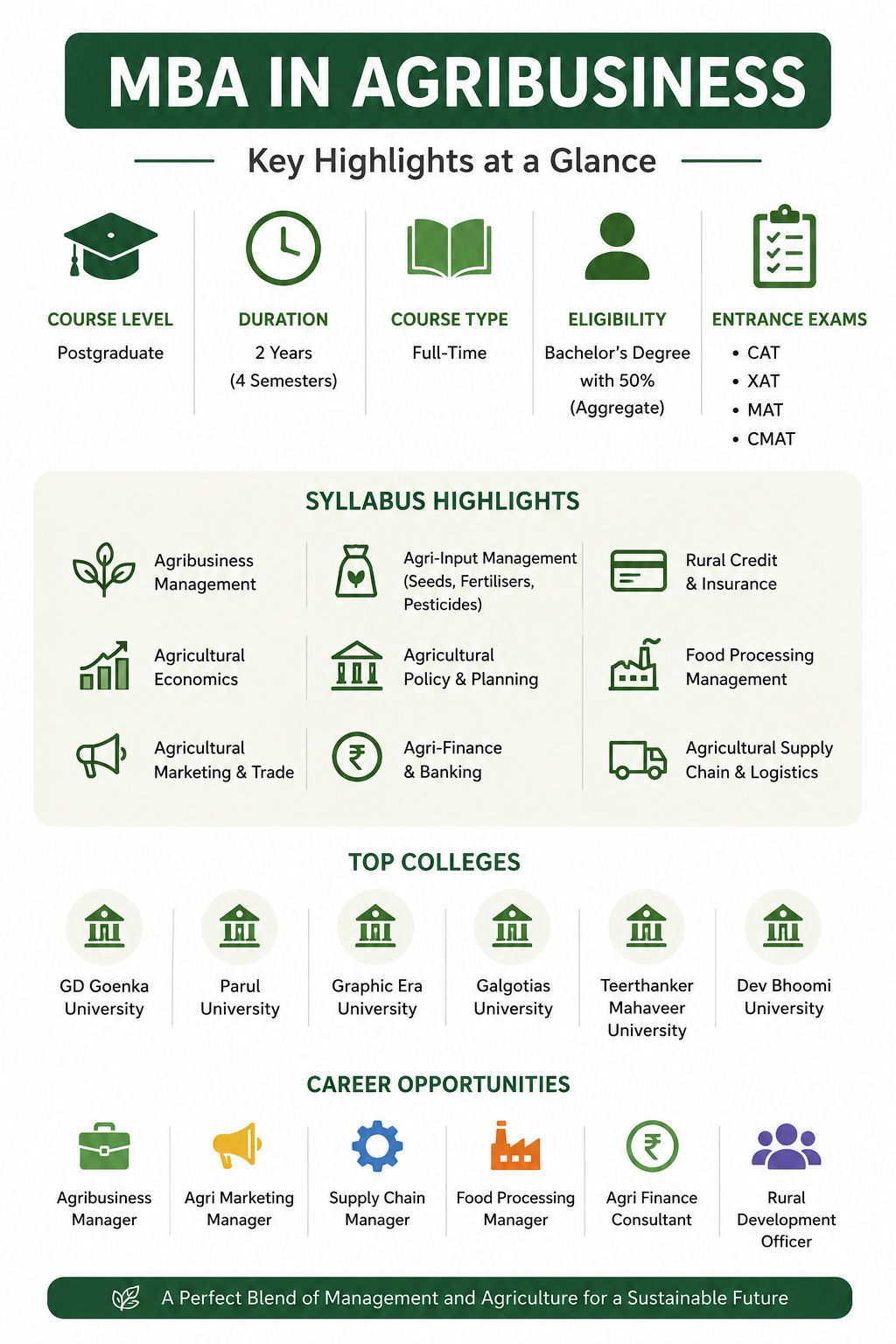
MBA in Agribusiness is a postgraduate course spread over a period of two years. Students study various MBA in Agribusiness subjects across four equal semesters. The course is primarily focused on addressing the complex challenges and opportunities present in the agriculture industry. Numerous topics are covered in the curriculum, including agricultural economics, supply chain management, sustainability, and market analysis. Practical learning also forms an important part of the course, where students gain exposure through industry projects, field visits, and internships with top agribusiness organizations.
It is crucial for candidates to fulfil the eligibility criteria set by their desired university. Generally, the admission requirements include possessing a bachelor’s degree in fields such as BSc Agriculture, Horticulture, Forestry, or related disciplines. Scoring a minimum aggregate of 50% marks or above is also important for consideration into the MBA in Agribusiness course. Components such as presenting valid entrance exam scores like CAT, MAT, XAT, etc., along with personal interview rounds, are also an important part of the admission process.
After completing the course from some of the best colleges for MBA in Agribusiness, graduates can explore diverse career path opportunities. Freshers can find employment opportunities in the government sector, PSUs, private agribusiness companies, agri-tech firms, retail companies, and many other industries. Various job roles such as Agribusiness Manager, Agri Marketing Manager, Supply Chain Manager, Food Processing Manager, and related positions are available for graduates.
Table of Contents
- MBA in Agribusiness Key Highlights
- What is an MBA in Agribusiness?
- Why pursue an MBA in Agribusiness?
- Is an MBA in Agribusiness Worth It in 2026?
- MBA in Agribusiness Eligibility Criteria
- MBA in Agribusiness Entrance Exams
- MBA in Agribusiness Colleges
- How Does the MBA in Agribusiness Admission Process 2026 Work?
- What is the Syllabus of MBA in Agribusiness?
- MBA in Agribusiness Career
- MBA in Agribusiness vs MBA in Finance
- MBA in Agribusiness FAQs
MBA in Agribusiness Key Highlights
First and foremost, students must gather all the necessary information related to the program before making the decision to take admission into an MBA in Agribusiness course. Course duration, course fees, syllabus covered, job opportunities, eligibility criteria, and admission process are some of the important components included in the course highlights. Refer to the table given below to learn more about MBA in Agribusiness:
What is an MBA in Agribusiness?
Students interested in pursuing a postgraduate degree focused on providing deep knowledge of agricultural science along with management concepts can pursue an MBA in Agribusiness. The program integrates traditional managerial knowledge with agricultural science, rural development, and business strategies. Candidates enrolled in the program gain access to both theoretical and practical learning opportunities, along with internships and industry exposure.
Individuals interested in the field of agriculture will study various MBA in Agribusiness subjects, including core management subjects, agriculture and agribusiness topics, and rural studies. Some examples of the topics covered include Agribusiness Management, Agricultural Economics, Agricultural Marketing, and Trade. The program also paves the way for several career opportunities such as Export and Trade Manager, Agri-Entrepreneur, Agricultural Consultant, and many more.
Why pursue an MBA in Agribusiness?
Interested candidates aiming to pursue an MBA in Agribusiness must carefully understand all the pros and cons of the program before making a decision. This particular MBA degree not only provides theoretical and practical knowledge but also helps in developing skilled professionals for the agriculture and agribusiness industry. There are some pointers given below to learn more about the reasons to pursue this course:
- The agriculture sector is growing rapidly, and the demand for skilled agribusiness professionals is also increasing significantly.
- This MBA degree creates pathways for several career opportunities ranging from the agricultural field to food processing, farm management, supply chain management, and related industries.
- Graduates of the MBA in Agribusiness course contribute to the sustainable development of agriculture by helping improve productivity, reduce wastage, and create awareness about environmentally friendly practices.
- Many freshers completing the MBA in Agribusiness course can also explore job opportunities outside India in the global agriculture and food business sector.
Is an MBA in Agribusiness Worth It in 2026?
MBA in Agribusiness continues to remain a profitable career option in 2026 due to the rapid growth of the agriculture and food processing sectors. This program provides students with a combination of business knowledge and agricultural expertise, helping them understand modern farming practices, supply chain systems, rural development, and agribusiness operations. With increasing investments in agri-tech, sustainability, and food management, the demand for skilled agribusiness professionals is rising steadily across India and globally.
The degree also offers diverse career opportunities in sectors such as food processing, agricultural marketing, farm management, agri-tech companies, export management, and government organizations. Graduates can secure roles with competitive salary packages while also contributing towards sustainable agricultural development. For students interested in both management and agriculture, pursuing an MBA in Agribusiness in 2026 can be a rewarding decision with strong long-term career growth and global opportunities.
MBA in Agribusiness Eligibility Criteria
It is important to adhere to the MBA in Agribusiness eligibility criteria set by the university for the acceptance of applications from interested students. Aspirants are generally required to present their educational documents as proof of their eligibility to pursue the course. To learn more about the eligibility criteria for MBA in Agribusiness, refer to the table given below:
- Students must complete their bachelor’s degree from a recognised university.
- Aspirants are generally required to hold a degree in disciplines such as Agriculture, Horticulture, Forestry, or another related field.
- Securing a minimum aggregate of 50% marks or above is important for consideration into the program.
- Appearing for entrance exams such as CAT, MAT, XAT, GMAT, etc., and presenting a valid scorecard is also an essential part of the admission process.
- Many universities also require candidates to participate in group discussions or personal interview rounds as part of the final selection process.
MBA in Agribusiness Entrance Exams
Colleges offering the MBA in Agribusiness course to prospective students generally require a valid scorecard from an accepted entrance examination. There are several exam options available, including national-level, state-level, and university-specific entrance tests. Exams such as CAT, MAT, XAT, CMAT, and several similar entrance tests are commonly accepted for admission into the course. Since the number of seats is usually limited and the competition remains high, securing a good score in these examinations becomes essential for admission. Check out the table given below to learn more about MBA in Agribusiness entrance exams:
MBA in Agribusiness Colleges
Best colleges for MBA Agribusiness require several components during the admission process for granting entry to interested students. Scoring a good rank in entrance examinations along with maintaining strong academic performance are some of the important factors considered by universities and colleges. Students can choose to pursue the course from both public and private institutions, and the right college should be selected according to the student’s educational goals and budget. A few of the popular colleges offering MBA in Agribusiness in India are tabulated below:
How Does the MBA in Agribusiness Admission Process 2026 Work?
It is essential for students to carefully read through the admission process involved in MBA in Agribusiness colleges before applying. In order to gain admission into the desired college, students are generally required to register themselves on the admission portal and then proceed with further steps such as appearing for entrance examinations, participating in personal interview rounds, submitting the required documents, and completing the fee payment process. A reference to the admission process of Teerthanker Mahaveer University is provided below to help students better understand the procedure:
Step 1: For admission into TMU, candidates are required to qualify for entrance examinations such as CAT, XAT, or MAT and obtain a valid score. In some cases, the university may also consider admission based on merit secured in the qualifying examination.
Step 2: Candidates must visit the official admission portal of Teerthanker Mahaveer University and fill out the online application form carefully with the required details.
Step 3: Applicants are required to upload important documents such as mark sheets, identity proof, photographs, and other necessary certificates. After document submission, candidates must pay the application fee through the online payment mode.
Step 4: Based on entrance exam scores or academic merit, shortlisted candidates are invited for the next rounds of the selection process. This stage generally includes a personal interview and group discussion.
Step 5: The final admission decision is made after evaluating the candidate’s entrance exam score, academic performance, work experience (if applicable), and performance in the interview/group discussion rounds. Selected candidates can then complete the admission formalities and confirm their seats.
Documents Required
What is the Syllabus of MBA in Agribusiness?
MBA in Agribusiness is an advanced course focused on core management subjects along with agricultural studies. Students study the curriculum across four semesters along with electives, projects, internships, and several practical learning components. To gain an in-depth understanding of the syllabus, a reference to the syllabus structure of University of Mysore is given below:
MBA in Agribusiness Career
There are various career paths that freshers can pursue after graduating from an MBA in Agribusiness colleges. Graduates can find employment opportunities in several government and non-government organizations, including rural banking institutions, agri-product trading companies, farming technology manufacturing firms, food processing industries, and related sectors. Self-employment opportunities such as establishing agri-clinics and agribusiness ventures are also available for graduates. To gain a better understanding of the career opportunities after MBA in Agribusiness, students can refer to the table provided below:
Top Recruiters hiring MBA in Agribusiness graduates
MBA in Agribusiness graduates can explore employment opportunities across multiple sectors including government organisations, PSUs, private agribusiness companies, agri-tech firms, retail businesses, and banking institutions. The course opens pathways for both managerial and technical roles in the agriculture industry. Some of the top recruiters hiring MBA in Agribusiness graduates are listed below:
Government Sector
- Ministry of Agriculture & Farmers Welfare
- NABARD
- State Agriculture Departments
- APEDA
- Food Corporation of India (FCI)
- National Dairy Development Board (NDDB)
- ICAR-affiliated Institutions
- State Cooperative Banks
Public Sector Undertakings (PSUs)
- IFFCO
- KRIBHCO
- NAFED
- Central Warehousing Corporation (CWC)
- State Warehousing Corporations
Private Agribusiness Companies
- ITC Limited
- Godrej Agrovet
- Mahindra Agribusiness
- Tata Chemicals
- Rallis India
Agri-Tech & Retail
- BigBasket
- Reliance Fresh (Agro Division)
- AgroStar
- Ninjacart
- DeHaat
Banking & Agri-Finance
- SBI (Agri Business Unit)
- HDFC Bank (Agri Finance)
- ICICI Bank
- Regional Rural Banks
- NBFCs focused on Agri-Finance
MBA in Agribusiness vs MBA in Finance
There are several specialisations offered in MBA programs, and students can choose the course that aligns better with their career goals and interests. Marketing, Human Resource Management, Entrepreneurship, Operations, and Finance are some of the popular specialisations in the management field. MBA in Finance is one such degree that remains highly in demand due to the growing opportunities in the banking and financial sector. Check out the table given below to understand the differences between MBA in Agribusiness and MBA in Finance:
MBA in Agribusiness FAQs
What is MBA in Agribusiness?
MBA in Agribusiness is a postgraduate management program focused on agriculture, agribusiness operations, and rural business management.
Is MBA in Agribusiness worth it in 2026?
Yes, MBA in Agribusiness is worth it in 2026 due to rising opportunities in agri-tech, food processing, and rural business sectors.
What is the eligibility for MBA in Agribusiness?
MBA in Agribusiness aspirants generally need a bachelor’s degree with at least 50% marks along with a valid entrance exam score.
Which entrance exams are accepted for MBA in Agribusiness?
Exams such as CAT, MAT, XAT, CMAT, and NMAT are commonly accepted for MBA in Agribusiness admission.
What is the syllabus of MBA in Agribusiness?
The MBA in Agribusiness syllabus includes Agribusiness Management, Agricultural Economics, Rural Marketing, Supply Chain Management, and Food Marketing.
What is the career scope after MBA in Agribusiness?
MBA Agribusiness graduates can work in agribusiness firms, agri-tech companies, food processing industries, rural banking, and government organisations.
What is the salary after MBA in Agribusiness?
Freshers can earn around INR 3–5 LPA, while experienced professionals may earn INR 10–20 LPA or more.
Which are the best colleges for MBA Agribusiness?
Some popular colleges for MBA in Agribusiness include GD Goenka University, Parul University, Graphic Era University, and TMU.
Who should pursue MBA in Agribusiness?
Students interested in agriculture, rural development, food business, and agribusiness management should pursue MBA in Agribusiness courses.