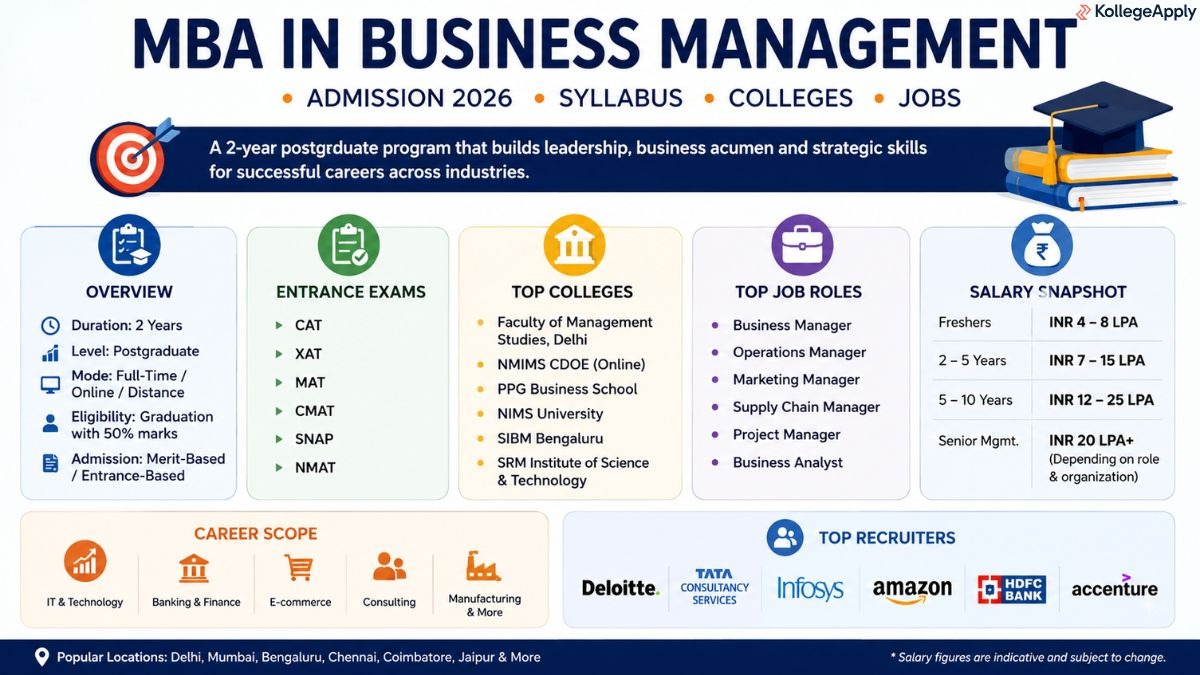
MBA in Business Management is a 2-year postgraduate program that focuses on leadership, business operations, strategic planning, finance, marketing, and organizational management. The course helps students develop managerial and analytical skills required to handle modern business challenges across industries. It also prepares students for leadership roles by providing practical exposure through case studies, internships, projects, and industry interactions
To be eligible for MBA in Business Management admission, candidates must hold a bachelor’s degree from a recognized university with at least 50% aggregate marks (varies by college). Admission is generally based on entrance exams such as CAT, XAT, MAT, CMAT, SNAP, and NMAT followed by Group discussion/Personal Interview rounds in some institutes.
MBA in Business Management offers career opportunities in sectors such as IT, banking, retail, consulting, healthcare, FMCG, and e-commerce. Graduates can work as Business Managers, HR Managers, Operations Managers, Marketing Managers, and Business Analysts, with entry-level salaries commonly falling in the broad range of INR 4–8 LPA. Graduates from reputed B-schools and candidates with strong skills or prior work experience may command higher packages.
- MBA in Business Management Course Highlights
- What is an MBA in Business Management?
- Why Pursue an MBA in Business Management?
- Is MBA in Business Management Worth It in 2026?
- MBA in Business Management Eligibility Criteria
- MBA in Business Management Entrance Exams
- MBA in Business Management Admission Process
- MBA in Business Management Colleges in India
- MBA in Business Management Syllabus
- What Skills are Required for MBA in Business Management?
- MBA in Business Management Jobs & Salary
- MBA in Business Management Salary
- Top Recruiters for MBA in Business Management
- MBA in Business Management Career Scope
- MBA in Business Management vs MBA in General Management
- MBA in Business Management FAQs
MBA in Business Management Course Highlights
MBA in Business Management course highlights provide a quick snapshot of the program’s key academic and career-related aspects. This section helps students understand the course at a glance and compare important features before exploring the detailed syllabus, admission process, colleges, fees, and career opportunities covered in the sections below.
What is an MBA in Business Management?
MBA in Business Management is a management specialization focused on business administration, organizational strategy, operations, and leadership. The course covers areas such as finance, marketing, human resources, business communication, and entrepreneurship.
The program combines classroom learning with internships, case studies, projects, and industry interaction to provide practical business exposure. Students gain knowledge related to decision-making, team management, strategic planning, and business development.
MBA in Business Management is suitable for candidates interested in corporate leadership, consulting, operations, entrepreneurship, and managerial roles across industries.
Why Pursue an MBA in Business Management?
MBA in Business Management provides broad exposure to different business functions rather than limiting students to a single functional area. It is designed to build a strong foundation in core business functions while improving problem-solving, teamwork, and strategic thinking abilities for managerial roles. Below are some of the major reasons why students choose MBA in Business Management:
- High Career Demand: Business management professionals are required across industries such as IT, banking, retail, healthcare, manufacturing, consulting, and e-commerce.
- Leadership Development: The course develops leadership, communication, team management, and strategic thinking skills.
- Diverse Career Opportunities: Graduates can work in operations, finance, HR, marketing, consulting, and project management roles.
- Entrepreneurial Skills: MBA in Business Management helps students understand business planning, startup management, and organizational growth.
- Strong Salary Packages: Top B-schools offer attractive placement packages and career growth opportunities.
- Global Career Opportunities: Graduates from recognised MBA programs can explore opportunities with multinational companies and organisations operating across international markets.
Is MBA in Business Management Worth It in 2026?
MBA in Business Management can be a good choice in 2026 for students seeking broad management knowledge and flexibility across business functions. However, its value depends significantly on the college, curriculum, placement record, total fees, internship exposure, alumni network, and the student's career goals. Candidates should compare the expected return on investment before selecting a program.
Organizations are actively hiring professionals who can handle business strategy, operations, project execution, team management, and customer relations. With the rise of startups, global businesses, and AI-driven operations, MBA graduates are expected to witness strong career growth across industries.
Candidates with leadership abilities, analytical thinking, communication skills, and problem-solving capabilities can achieve excellent professional growth after completing MBA in Business Management.
MBA in Business Management Eligibility Criteria
Candidates seeking admission to MBA in Business Management must meet the basic academic and entrance-related eligibility criteria prescribed by colleges and universities. The common eligibility requirements are listed below:
- Candidates should have a bachelor's degree from a recognised university or institution.
- Many colleges require a minimum of 50% aggregate marks in graduation.
- Reserved-category candidates may receive relaxation according to applicable institutional or government rules.
- Candidates in the final year of graduation may be eligible at several institutes, subject to the institute's conditions.
- Admission may require a valid score in CAT, XAT, MAT, CMAT, NMAT, SNAP or an institute-level entrance examination.
- Some institutions also conduct Personal Interviews, Written Ability Tests or other selection rounds.
- There is generally no common national upper-age restriction for MBA admission, but candidates should check the rules of the individual institute.
MBA in Business Management Entrance Exams
Most colleges and universities offer admission to MBA in Business Management through entrance exams conducted at the national, state, or institute level, followed by further selection rounds in some institutes.
MBA in Business Management Admission Process
The admission process for MBA in Business Management usually involves multiple stages, including entrance exam qualification, application form submission, group discussions or personal interviews, document verification, and final merit-based selection by the institute.
Step 1: Register and appear for MBA entrance exams such as CAT, XAT, MAT, CMAT, SNAP, or NMAT.
Step 2: Visit the official website of the desired college and fill out the application forms of respective colleges or universities.
Step 3: The colleges shortlist candidates based on entrance exam scores and academic performance.
Step 4: Shortlisted candidates participate in Group Discussion (GD) and Personal Interview (PI) rounds.
Step 5: Final selection is based on entrance score, academic profile, work experience, and interview performance.
Step 6: Selected candidates complete document verification and fee payment to confirm admission.
Documents Required
MBA in Business Management Colleges in India
Several Indian universities and management institutes offer MBA programs in Business Management, General Management, or closely related areas. Since program titles, curricula, eligibility criteria, and fees vary by institute, candidates should verify the exact program details before applying. Some of the top colleges offering Business Management MBA are listed below:
MBA in Business Management Syllabus
The MBA in Business Management syllabus is designed to provide students with comprehensive knowledge of management principles, finance, marketing, operations, human resources, and business strategy across four semesters. For reference, the semester-wise curriculum of NMIMS CDOE's MBA in Business Management program is given below:
Note: The above is an example of a Business Management curriculum based on the NMIMS CDOE program and should not be presented as the universal syllabus followed by every MBA institute.
What Skills are Required for MBA in Business Management?
An MBA in Business Management helps students build both technical and soft skills required for managerial and leadership positions across industries. These skills improve business understanding, decision-making abilities, and professional efficiency in dynamic corporate environments.
- Leadership Skills: Ability to lead teams, manage responsibilities, and motivate employees toward organizational goals.
- Communication Skills: Strong verbal and written communication skills for presentations, client handling, and workplace collaboration.
- Problem-Solving Abilities: Capability to identify business challenges and develop practical and effective solutions.
- Strategic Thinking: Understanding market trends and planning long-term business strategies for growth and competitiveness.
- Financial Analysis: Knowledge of budgeting, financial planning, and analyzing company performance using financial data.
MBA in Business Management Jobs & Salary
MBA in Business Management graduates have diverse career opportunities in sectors such as finance, marketing, human resources, operations, consulting, IT, retail, healthcare, and e-commerce, where they can take up managerial, analytical, and leadership roles. Some of the job roles along with salary prospects (that may vary on the basis of experience, skills, recruiters and location) are given below:
Note: Salary figures are indicative and may vary by institute, recruiter, location, experience, skills, job role and economic conditions.
MBA in Business Management Salary
The MBA in Business Management salary varies based on the candidate’s work experience, job role, organisation, and industry. Fresh graduates typically start with entry-level packages, while professionals with 2–5 years of experience can earn higher salaries as they take on greater responsibilities. With 5–10 years of experience, MBA graduates may move into managerial and strategic roles with higher compensation. Senior management professionals can earn INR 20 LPA or more, depending on their role, organisation, and expertise.
Top Recruiters for MBA in Business Management
MBA in Business Management graduates are recruited by leading multinational companies, consulting firms, banks, IT companies, FMCG brands, and e-commerce organizations for managerial, analytical, and leadership roles. Some of the top recruiters include:
MBA in Business Management Career Scope
The scope of MBA Business Management extends across multiple business functions because the program covers several areas of management rather than one narrow specialisation. The graduates may work in:
- IT and technology companies: Business analysis, project management, operations and business development.
- Banking and financial services: Relationship management, operations, sales, business development and management roles.
- Consulting: Business analysis, strategy, process improvement and client advisory.
- FMCG: Sales, marketing, brand management and distribution.
- E-commerce: Operations, category management, business development and supply chain.
- Healthcare: Hospital operations, administration and business development.
- Manufacturing: Operations, supply chain, procurement and project management.
- Startups: Business development, operations, product-related roles and entrepreneurship.
- Entrepreneurship: Graduates can apply their knowledge of finance, marketing, operations and strategy to launch or manage a business.
MBA in Business Management vs MBA in General Management
MBA in Business Management and MBA in General Management can have substantial overlap because both cover core areas such as finance, marketing, HR, operations, and strategy. The actual distinction depends on the institute's curriculum, electives, and program structure. The comparison below highlights the key differences between the two programs.
MBA in Business Management FAQs
What is an MBA in Business Management?
MBA in Business Management is a two-year postgraduate program covering finance, marketing, HR, operations, strategy and business management.
What is the salary after an MBA in Business Management?
Freshers may earn around INR 4–8 LPA, while salary can increase significantly with experience, skills, role and institute.
Is MBA tougher than CA?
CA and MBA have different curricula and assessment structures. CA is more accounting and taxation focused, while MBA focuses on management and business.
Which type of MBA is best for business?
Business or General Management is suitable for broad business careers, while specialised MBAs are better for specific functional career goals.
What are the major MBA in Business Management subjects?
Common subjects include marketing, finance, HR, operations, business analytics, strategic management, accounting and organisational behaviour.
Can I do an MBA in Business Management after BCom?
Yes. BCom graduates can apply for MBA programs if they meet the institute's eligibility and entrance requirements.
Is MBA in Business Management good for the future?
It can be valuable for candidates seeking broad management, business development, operations and leadership careers.
Can I pursue MBA in Business Management online?
Yes. Several universities offer online or distance MBA programs, subject to program and regulatory requirements.
Which entrance exams are accepted for MBA Business Management?
Common exams include CAT, XAT, MAT, CMAT, NMAT, SNAP and institute-level MBA entrance tests.
Which industries hire MBA Business Management graduates?
Graduates can work in IT, consulting, banking, FMCG, healthcare, manufacturing, retail, e-commerce and other industries.