
• Updated on 11 Sept, 2026 by Diksha Kumari
What's new?
IBSAT Latest news and articles
IBSAT syllabus 2026 consists of topics from 4 sections: Verbal Ability, Reading Comprehension, Quantitative Aptitude, and Data Adequacy & Interpretation. The VARC section is also split into two sections: Verbal Ability and Reading Comprehension. IBSAT 2026 will be conducted in the last week of December 2026. Hence, candidates should aim to complete their syllabus by October 2026 and focus on sample papers and mock tests afterwards.
As per the official notification, IBSAT syllabus 2026 is similar to other national-level management exams such as CAT, which makes it easier for candidates to prepare for IBSAT along with other exams.
- IBSAT Syllabus 2026 PDF
- IBSAT Verbal Ability Syllabus 2026
- IBSAT Reading Comprehension Syllabus 2026
- IBSAT Quantitative Aptitude Syllabus 2026
- IBSAT Data Adequacy & Interpretation Syllabus 2026
- IBSAT Exam Pattern Overview 2026
- How to Prepare for IBSAT Syllabus 2026?
- Preparation Resources for IBSAT Syllabus 2026
- IBSAT Syllabus 2026 FAQs
IBSAT Syllabus 2026 PDF
IBSAT syllabus PDF consists of topics from which questions will be asked in the exam. The syllabus PDF will help candidates understand the question paper before starting their preparation. Candidates can click on the link below for the IBSAT 2026 Exam Syllabus PDF Download and refer to it while preparing for the exam:
Candidates should also check the IBSAT Eligibility Criteria 2026 to ensure they meet the required academic qualifications.
IBSAT Verbal Ability Syllabus 2026
The verbal ability section is the largest section in IBSAT 2026 and also carries the highest weightage in the exam. The IBSAT Verbal Ability Syllabus 2026 consists of the following sub-topics:
1. Synonyms (Questions 1 to 5): For synonyms, candidates will be given one word and 5 options. Candidates have to choose the correct synonym for the word. Some of the common words that are asked for IBSAT synonym questions include Alleviate, Benevolent, Tranquil, Hostile, Vigorous, etc. Hence, candidates should aim to have a strong advanced-level vocabulary for IBSAT 2026.
2. Antonyms (Questions 6 to 10): This is similar to synonyms questions where candidates are given 5 options of a word, and they need to choose the correct antonym. Some of the common words that are asked for in IBSAT antonym questions include Scarce, Abundant, Reluctant, Obsolete, Lucid, etc.
3. Analogies (Questions 11 to 15): For Analogies in IBSAT, candidates need to find word pair relationships. Some of the common examples that are asked in the exam include Book : Read :: Food : Eat, Fish : Water :: Bird : Air, etc. Hence, candidates must be able to identify the underlying relationship between these words.
4. Fill in the Blanks (Questions 16 to 20): In Fill in the Blanks questions, candidates are given a sentence with one or more blanks and 5 options to choose from. Candidates need to select the word that best completes the sentence based on its meaning and context. These questions test vocabulary, grammar, and contextual understanding. Candidates should focus on improving their vocabulary and understanding how words are used in different contexts.
5. Spotting Errors (Questions 21 to 25): In Spotting Errors questions, candidates are given a sentence that may contain a grammatical or usage error. Candidates need to identify the part of the sentence that contains the error from the given options. These questions generally test concepts such as subject-verb agreement, tenses, articles, prepositions, pronouns, and sentence structure. Hence, candidates should revise important English grammar rules while preparing for IBSAT 2026.
6. Sentence Improvement (Questions 26 to 30): In Sentence Improvement questions, candidates are given a sentence with an incorrect or inappropriate part and 5 options to choose from. Candidates need to select the option that makes the sentence grammatically correct and improves its overall meaning. These questions test candidates' knowledge of grammar, vocabulary, sentence structure, and contextual usage.
7. Para-jumbles (Questions 31 to 35): In Para-jumbles questions, candidates are given a set of sentences in a jumbled order and need to arrange them in the correct sequence to form a meaningful paragraph. Candidates should identify the opening sentence, establish logical connections between sentences, and determine the concluding sentence. Regular practice of reading comprehension and paragraph-based questions can help candidates improve their ability to solve para-jumbles.
8. One-Word Substitution (Questions 36 to 40): In One-Word Substitution questions, candidates are given a phrase or description and 5 options, from which they need to choose the word that best represents its meaning. These questions primarily test vocabulary and knowledge of commonly used words. Candidates should learn frequently used one-word substitutions and revise their meanings regularly for better performance in IBSAT 2026.
9. Idioms and Phrases (Questions 41 to 50): In Idioms and Phrases questions, candidates are given an idiom or phrase and 5 options, and they need to identify its correct meaning. These questions test candidates' understanding of commonly used expressions and their contextual meanings. Candidates should practise frequently used idioms and phrases and understand their meanings rather than relying only on the literal meaning of the words.
Key Verbal Ability topics for IBSAT 2026 preparation: Candidates should aim to prepare for key topics including Grammar, Vocabulary, Para jumbles, sentence formation, synonyms, antonyms, idioms, analogies, and one-word substitution.
Candidates who meet the required eligibility criteria can proceed with the IBSAT Registration 2026 process and complete the application form before the deadline.
IBSAT Reading Comprehension Syllabus 2026
The Reading Comprehension section of the IBSAT syllabus 2026 will likely consist of 4-5 long passages. There will be 6-8 questions asked from the passage. Some of the passage topics included in the IBSAT reading comprehension syllabus include economics, science, business, current affairs, and philosophy. The topics included in the syllabus include
Preparation tip: Candidates should focus on improving reading speed, comprehension, and vocabulary while preparing for this section. Regularly solving RC passages can help candidates identify the main idea quickly and answer inference- and context-based questions more accurately.
Candidates can check the IBSAT Admit Card 2026 details to know when and how to download the admit card for the examination.
IBSAT Quantitative Aptitude Syllabus 2026
The IBSAT Quantitative Aptitude section tests candidates on basic mathematical concepts and their application to numerical problems. The questions cover topics from arithmetic, algebra, geometry, number systems, and other areas of quantitative aptitude. Candidates should focus on understanding basic concepts, learning important formulas, and practising questions regularly to improve their speed and accuracy.
Preparation tip: Candidates should first strengthen their fundamentals in arithmetic and algebra, as these topics form an important part of quantitative aptitude preparation. Regular practice of calculations and timed questions can also help candidates improve their speed while solving the IBSAT Quantitative Aptitude section.
Candidates should check the IBSAT Exam Centres 2026 while filling out the application form and select a suitable test city.
IBSAT Data Adequacy & Interpretation Syllabus 2026
The IBSAT Data Adequacy & Interpretation section tests candidates on their ability to analyse data, interpret information, and use logical reasoning to arrive at the correct answer. The questions may be based on tables, graphs, charts, and data sufficiency, along with logical reasoning concepts. Candidates should focus on improving their calculation skills and ability to interpret data accurately within a limited time.
Candidates should practise tables, graphs, charts and data sufficiency questions regularly to improve their ability to interpret information quickly. Solving questions under a time limit can also help candidates improve calculation speed and accuracy for the IBSAT Data Adequacy & Interpretation section.
IBSAT Exam Pattern Overview 2026
The IBSAT Exam Pattern 2026 consists of four sections: Verbal Ability, Reading Comprehension, Quantitative Aptitude, and Data Adequacy & Interpretation. The exam contains a total of 140 questions, which candidates have to attempt within 120 minutes. Understanding the exam pattern helps candidates plan their preparation and manage their time effectively during the examination.
IBSAT 2026 Section Wise Exam Pattern
Candidates are given 120 minutes to answer all 140 questions. The exam does not have negative marking, so candidates can attempt questions without losing marks for incorrect answers. Candidates should nevertheless focus on accuracy and time management to maximise their overall score.
How to Prepare for IBSAT Syllabus 2026?
To prepare for the IBSAT syllabus 2026, to be conducted in December 2026, candidates should follow the following 3 phases:
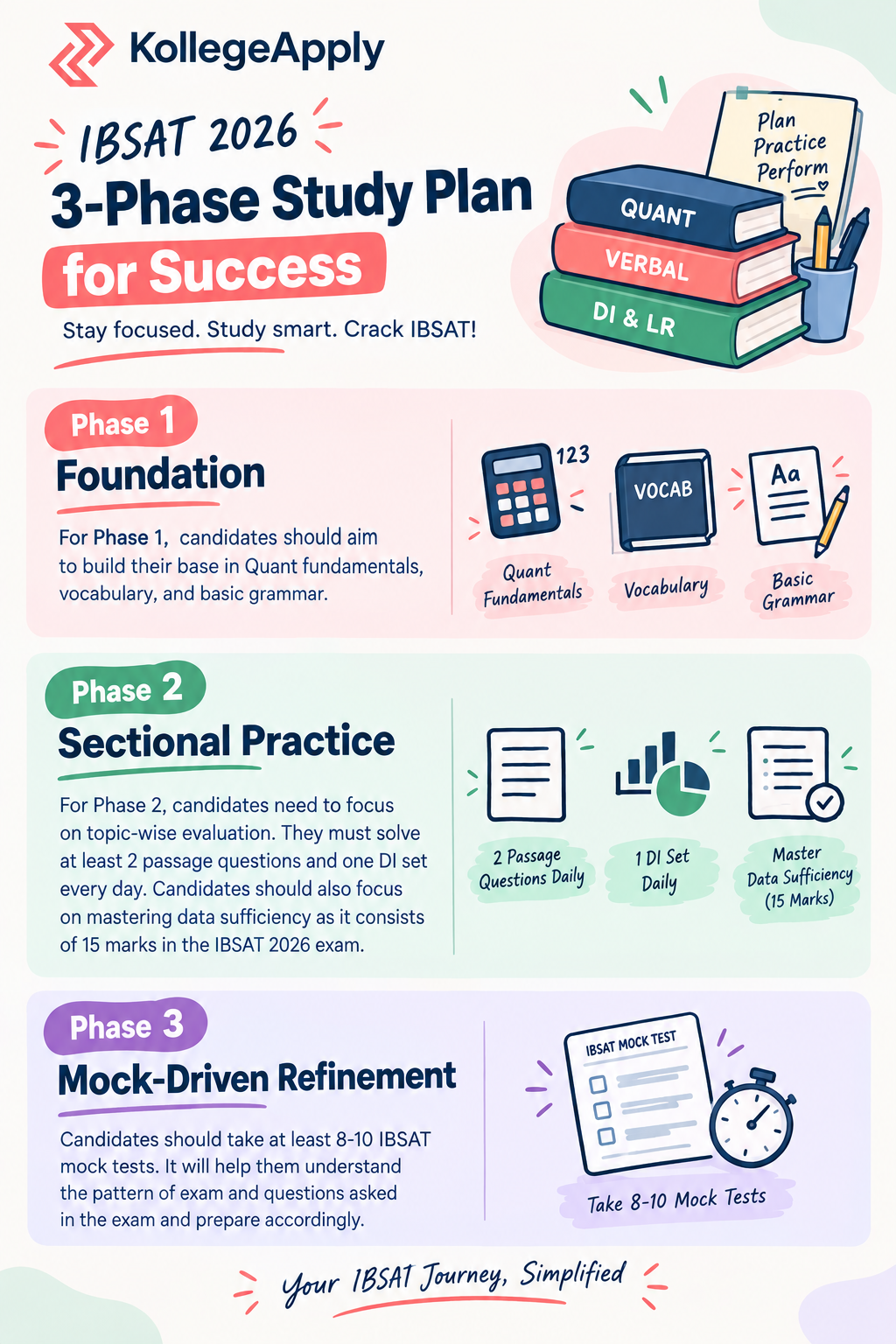
Note that 70% of the Quant and Verbal Ability syllabus for IBSAT overlaps with exams like CAT, XAT, NMAT, and SNAP. Hence, candidates can also focus on these exams' syllabus to score well in the exam. Candidates can check these exams' syllabi to refer to from the links given below:
Preparation Resources for IBSAT Syllabus 2026
Candidates who are preparing for IBSAT must not just rely on the syllabus. Given below are some of the important resources that applicants should refer to along with the IBSAT syllabus 2026:
- IBSAT Exam Dates 2026: Candidates should keep track of the IBSAT Exam Date 2026 to plan their preparation schedule and complete revision and mock tests before the examination.
- IBSAT Mock Test 2026: IBSAT mock tests help candidates practise the exam pattern, improve time management, and identify their strengths and weaknesses.
- IBSAT Question Paper 2026: Solving IBSAT question papers helps candidates understand the types of questions asked and practise different topics covered in the syllabus.
- IBSAT Books 2026: Candidates can refer to recommended IBSAT books to strengthen their concepts and get additional practice questions for each section.
- IBSAT Preparation Tips 2026: Candidates preparing for IBSAT should use a combination of study material, practice resources, and mock tests to improve their preparation.
IBSAT Syllabus 2026 FAQs
What is the syllabus of IBSAT 2026?
The IBSAT 2026 syllabus is divided into four sections: Verbal Ability, Reading Comprehension, Quantitative Aptitude, and Data Adequacy & Interpretation. The syllabus covers topics related to English language, comprehension, mathematics, data interpretation, and logical reasoning.
How many sections are there in IBSAT 2026?
There are four sections in the IBSAT 2026 exam: Verbal Ability, Reading Comprehension, Quantitative Aptitude, and Data Adequacy & Interpretation. Candidates should prepare all four sections as they are part of the 140-question exam.
Is the IBSAT syllabus similar to CAT?
Yes, there is considerable overlap between the IBSAT and CAT syllabus, particularly in areas such as Quantitative Aptitude, Verbal Ability, Reading Comprehension and Data Interpretation. However, the number of questions and exam structure are different.
What are the important topics in IBSAT Quantitative Aptitude?
Important Quantitative Aptitude topics include Number System, Percentages, Profit and Loss, Averages, Ratio and Proportion, Time and Work, Time-Speed-Distance, Algebra, Geometry, Mensuration, Probability and Permutation & Combination.
What topics are covered in IBSAT Verbal Ability?
The Verbal Ability section includes topics such as vocabulary, grammar, sentence completion, fill in the blanks, para jumbles, sentence correction, idioms, analogies and contextual usage. Regular reading and vocabulary practice can help improve performance in this section.
What is included in the IBSAT Reading Comprehension syllabus?
The Reading Comprehension section tests a candidate's ability to understand and analyse passages. Important areas include main idea, supporting details, inference, conclusion, author's tone, vocabulary in context, and passage structure.
What topics are covered under Data Adequacy and Interpretation in IBSAT?
The section includes Data Sufficiency, Data Interpretation, tables, bar graphs, line charts, pie charts, Venn diagrams, and logical reasoning-based questions. Candidates should practise interpreting data quickly and determining whether the information provided is sufficient to answer a question.
How many questions are asked in IBSAT 2026?
IBSAT 2026 consists of 140 questions. Verbal Ability has 50 questions, while Reading Comprehension, Quantitative Aptitude and Data Adequacy & Interpretation have 30 questions each.
Is there negative marking in IBSAT 2026?
No, IBSAT does not have negative marking for incorrect answers. Candidates can therefore attempt questions without losing marks for wrong responses.
How much time is given to complete the IBSAT exam?
Candidates get 120 minutes (2 hours) to attempt all 140 questions. Effective time management is therefore important while preparing for the exam.
Exam Calendar
Explore exam calendars tailored to your interest