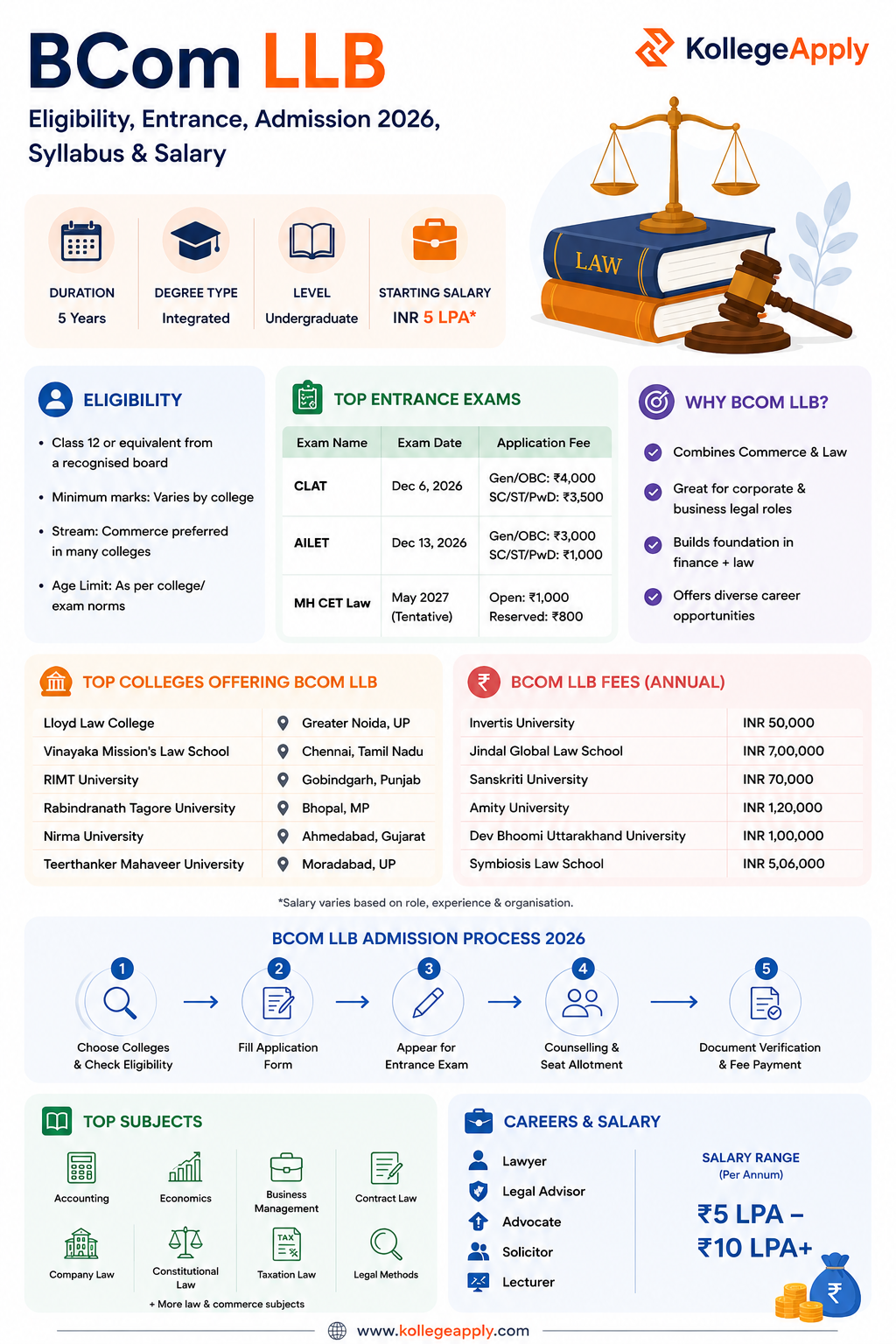
The BCom LLB course is a five-year integrated undergraduate law programme that combines the study of Commerce and Law. The BCom LLB degree is designed for students who want to understand both business and legal concepts through subjects such as accounting, economics, business management, constitutional law, contract law, company law and taxation. The interdisciplinary nature of the course helps students understand how legal principles are applied in business and corporate environments.
For BCom LLB eligibility, candidates generally need to complete Class 12 or an equivalent examination from a recognised board. The required minimum marks may vary by university, while admission to many leading law colleges is based on entrance examinations. Common BCom LLB entrance exams include CLAT, AILET, MH CET Law and university-level entrance tests. Some institutions may follow their own selection process. For example, Jindal Global Law School requires candidates to have completed Class 12 with at least 45% marks and uses LNAT-UK for selection to its five-year BCom. LL.B. programme.
After completing a BCom in LLB, graduates can explore career opportunities across law firms, corporate organisations, banks, financial institutions, accounting and auditing firms, legal consultancies and government organisations. Common job roles include corporate lawyer, legal advisor, advocate, solicitor, compliance professional and legal consultant. Depending on the role, organisation, location and experience, the BCom LLB salary can start at around INR 5 LPA and may reach INR 10 LPA or more for experienced professionals and specialised roles.
Table of Contents
- BCom LLB Key Highlights
- What is BCom LLB For?
- Why is BCom LLB Important?
- Is BCom LLB Difficult?
- What is the Eligibility Criteria of BCom LLB?
- What are the Entrance Exams Required for BCom LLB?
- What are the Colleges Offering BCom LLB?
- What is the Fees of BCom LLB?
- What is the BCom LLB Admission Process 2026?
- What is the BCom LLB Syllabus?
- What is the BCom LLB Salary?
- Which is Best, BA LLB or BCom LLB?
- BCom LLB FAQs
BCom LLB Key Highlights
The BCom LLB course integrates commerce-related subjects with legal education over five years. Students study business and accounting concepts alongside core law subjects, practical training, moot courts, internships and other academic activities. JGLS, for example, structures its B.Com. LL.B. (Hons.) programme around law, arts and humanities, clinical courses and compulsory internships. Check out the table given below to learn more about the highlights:
What is BCom LLB For?
The BCom LLB course is meant for students who want to build a career at the intersection of commerce, business and law. Instead of completing a separate B.Com degree followed by an LLB, students can study both disciplines together through an integrated five-year programme. This makes the course particularly relevant for students interested in corporate and commercial legal work.
The BCom LLB degree provides knowledge of financial and business concepts along with legal principles. Students can develop an understanding of areas such as accounting, taxation, company law, contracts, corporate regulations and commercial transactions. The combination can be useful for careers in corporate law, banking, financial services, compliance, legal consultancy and business-related legal practice.
Why is BCom LLB Important?
The importance of BCom LLB comes from its combination of two closely connected fields: commerce and law. Businesses regularly deal with contracts, taxation, company regulations, financial transactions, employment laws and regulatory requirements. A professional who understands both business operations and legal principles can therefore work across several business and legal functions.
The course can also provide broader career flexibility than studying law without a commerce background. Students can develop legal reasoning alongside financial and business knowledge and gain practical exposure through internships, moot courts and clinical activities. For example, JGLS includes internships across corporate taxation, law firms, start-ups, advisory and legal consultancy, capital markets, finance, auditing and accounting firms.
Why choose BCom LLB?
- Combines commerce and legal education in one integrated degree.
- Builds knowledge of accounting, finance, business and law.
- Useful for corporate and commercial legal careers.
- Provides exposure to company, taxation and financial laws.
- Develops legal research, reasoning and communication skills.
- Can open opportunities in law firms and corporate organisations.
- Useful for careers in banking and financial services.
- Provides a foundation for higher studies in law and related areas.
- Includes practical components such as internships and moot courts at many institutions.
- Helps students understand business issues from a legal perspective.
Is BCom LLB Difficult?
The BCom LLB course can be challenging because students have to study two academic areas together. Commerce subjects such as accounting, economics, financial management and business statistics require numerical and analytical understanding, while law subjects involve reading, interpretation, legal reasoning, research and writing. The workload can therefore be higher than that of a single-discipline undergraduate programme.
However, BCom LLB is not necessarily difficult for students who are interested in both business and law and maintain a consistent study routine. The course becomes easier when students regularly revise legal concepts, practise case analysis, understand accounting fundamentals and develop strong reading and writing skills. Practical activities such as moot courts and internships can also help students connect classroom learning with real-world situations.
What is the Eligibility Criteria of BCom LLB?
The BCom LLB eligibility criteria can vary between universities, so students should check the requirements of the institution they want to join. Generally, candidates must have completed Class 12 or an equivalent examination from a recognised board. The minimum percentage requirement may also differ. To learn more, students can view the table given below:
What are the Entrance Exams Required for BCom LLB?
Admission to the BCom LLB course may be offered through national-level, state-level or university-specific entrance examinations. Some of the important exams students may consider include CLAT, AILET, MH CET Law and university-level entrance tests. The exact exam accepted depends on the institution, so candidates should verify the admission requirements before applying.
For the 2026-27 admission cycle, the following entrance examination information can be used as a reference:
Note: Exam dates and fees may be revised by the respective examination authorities. Students should check the latest official notification before applying.
What are the Colleges Offering BCom LLB?
Several universities and law institutions offer integrated BCom LLB programmes. Students should compare eligibility, entrance requirements, fees, curriculum, internships, placements and location before selecting a college. Some of the BCom LLB offering colleges in India are Lloyd Law College, VMLS, RIMT University, and many more. Prospective candidates can check out the table given below to learn more:
What is the Fees of BCom LLB?
The BCom LLB fees vary significantly depending on the institution, location, facilities and fee structure. Among the selected institutions, the annual fee ranges from around INR 50,000 to INR 7,00,000. Students should also check whether registration, examination, hostel, security deposit and other institutional charges are included separately.
Fee structures can change by academic year. Students should verify the latest fee structure with the respective institution before admission.
What is the BCom LLB Admission Process 2026?
The BCom LLB admission process 2026 generally involves checking eligibility, selecting suitable colleges, completing the application form, appearing for the required entrance examination, participating in counselling or the institution's selection process, and completing document verification and fee payment. The exact process can vary between universities.
The following is a step-by-step admission process based on the IIMT Group of Colleges reference to help students understand the usual admission procedure:
Step 1: Search for Available Institutions
Students should first research colleges offering the BCom LLB course. While comparing institutions, candidates should consider eligibility criteria, entrance requirements, course structure, faculty, infrastructure, fees, internships and career opportunities.
Step 2: Fill the Entrance/Application Form
Candidates should complete the relevant entrance or university application form within the prescribed deadline. Students should enter their academic and personal information carefully and use the correct details from their original documents.
Step 3: Appear for the Admission Test
Depending on the institution, students may need to appear for exams such as CLAT, AILET, MH CET Law or a university-level entrance examination. The entrance score may be used as part of the selection process.
Step 4: Counselling and Seat Allotment
After the entrance examination results are declared, eligible candidates may participate in counselling or the institution's seat-allotment process. Students can select their preferred course or institution based on their rank, eligibility and seat availability.
Step 5: Document Verification and Fee Payment
After selection, candidates need to submit the required documents for verification and pay the applicable admission or course fee within the prescribed deadline. The admission is generally confirmed after successful document verification and fee payment.
Documents Required for BCom LLB Admission
Students may be asked to provide the following documents during the admission process:
- Class 10 mark sheet and certificate
- Class 12 mark sheet and certificate
- Entrance examination scorecard/rank card
- Transfer certificate
- Migration certificate, wherever applicable
- Character certificate
- Passport-size photographs
- Valid identity proof
- Category certificate, if applicable
- Domicile certificate, if applicable
- Other documents specified by the college or university
What is the BCom LLB Syllabus?
The BCom LLB syllabus combines commerce, business and legal subjects over five years. The exact BCom LLB subjects vary across universities, but students generally study accounting, economics, business management, financial management and statistics along with legal methods, contracts, constitutional law, company law, taxation, criminal law, property law and other legal subjects.
For example, Chandigarh University's B.Com + Bachelor of Law curriculum includes subjects such as Business Accounting, Business Organisation & Management, Business Economics, Law of Torts, Law of Contract, Legal Methods and Research Methodology, Corporate Accounting, Marketing and Constitutional Law.
Below is the Chandigarh University BCom LLB syllabus for reference to help students understand the curriculum:
The detailed Chandigarh University curriculum shows the combination of commerce subjects such as accounting, management, economics and financial management with law subjects such as contracts, constitutional law, company law, taxation, criminal law, intellectual property and cyber law.
What is the BCom LLB Salary?
The BCom LLB salary depends on factors such as job profile, organisation, location, specialisation, skills and professional experience. Graduates entering the legal and corporate sectors may begin with salaries around INR 5 LPA, while professionals with relevant experience and specialised knowledge can earn INR 10 LPA or more. Check out the table given below to learn more about the salaries offered to the fresh BCom LLB graduates:
Note: Salary figures are indicative and can vary according to experience, employer, location, specialisation and individual performance.
Which is Best, BA LLB or BCom LLB?
Both BA LLB and BCom LLB are five-year integrated law programmes, but they differ in their academic focus. BA LLB combines law with arts and humanities subjects such as political science, sociology, history and economics, whereas BCom LLB combines legal education with commerce, accounting, business and finance-oriented subjects. The better option depends on the student's interests and preferred career direction. Students interested in learning about the difference between the two course can view the table given below:
BCom LLB FAQs
What is BCom LLB?
BCom LLB is a five-year integrated undergraduate degree that combines Bachelor of Commerce and Bachelor of Laws. It provides students with knowledge of commerce, accounting, business and finance along with legal subjects.
What is the full form of BCom LLB?
The full form of BCom LLB is Bachelor of Commerce and Bachelor of Laws.
Is BCom LLB a 5-year course?
Yes. BCom LLB is generally a five-year integrated undergraduate law course completed after Class 12.
What is the eligibility for BCom LLB?
Candidates generally need to complete Class 12 or an equivalent examination from a recognised board. The minimum marks and other eligibility requirements vary between universities.
Which entrance exam is required for BCom LLB?
Depending on the college, students may need to appear for entrance examinations such as CLAT, AILET, MH CET Law or a university-level entrance test.
What are the main BCom LLB subjects?
BCom LLB subjects generally include accounting, economics, business management, financial management, company law, contract law, constitutional law, taxation law, criminal law, property law and other legal subjects.
What is the BCom LLB course fee?
The fee varies widely between institutions. Among the selected colleges in this article, the annual fee ranges from around INR 50,000 to INR 5,06,000, while some institutions may charge higher fees.
What is the starting salary after BCom LLB?
BCom LLB graduates can start with salaries of around INR 5 LPA, depending on their job role, employer, location, skills and experience.
What are the career options after BCom LLB?
Graduates can work as lawyers, advocates, legal advisors, solicitors, corporate lawyers, legal consultants, compliance professionals and in-house counsels. They can also explore opportunities in law firms, companies, banks, financial institutions, accounting firms and government organisations.
Which is better, BA LLB or BCom LLB?
The better option depends on the student's interests. BA LLB is more suitable for students interested in arts, humanities and social sciences, while BCom LLB is a strong option for students interested in commerce, accounting, business, finance and corporate law.