The Diploma in AI and ML is a technical programme that introduces students to Artificial Intelligence, Machine Learning, programming, data analytics and intelligent computing. Depending on the institute, the course may be offered as a three-year diploma after Class 10. The curriculum generally covers Python, mathematics, statistics, databases, machine learning, deep learning, neural networks, computer vision and Natural Language Processing (NLP), along with practical laboratory work and projects.
The Diploma in Artificial Intelligence and Machine Learning eligibility varies by institute and programme type. Generally, candidates applying for three-year polytechnic programmes are eligible after Class 10. Admission may be based on Class 10 merit, state-level polytechnic entrance exams, institute-level entrance tests or direct admission. Eligibility and admission requirements should therefore be checked with the respective institute before applying.
The course can prepare students for entry-level roles in software development, data analytics, AI applications, machine learning support and automation. Career prospects depend on practical skills, programming knowledge, projects and experience. While diploma holders can begin with junior-level technology roles, advanced positions such as AI Engineer and Machine Learning Engineer commonly prefer candidates with a bachelor's degree and strong technical and mathematical skills. Salary also varies by role, employer, location and experience, with entry-level diploma holders generally earning less than graduates in specialised AI/ML roles.
Table of Contents
- Diploma in AI and ML Course Highlights
- What is Diploma in AI and ML?
- Why Pursue Diploma in AI and ML?
- Is Diploma in AI and ML Worth It in 2026?
- Diploma in AI and ML Eligibility Criteria
- Diploma in AI and ML Entrance Exams
- Diploma in AI and ML Colleges in India
- Diploma in AI and ML Admission Process
- Diploma in AI and ML Syllabus
- What Skills are required for a Diploma in AI and ML?
- Diploma in AI and ML Jobs & Salary
- What is the Salary After Diploma in AI and ML?
- Top Recruiters for Diploma in AI and ML
- Diploma in AI and ML vs Diploma in Computer Science
- Diploma in AI and ML FAQs
Diploma in AI and ML Course Highlights
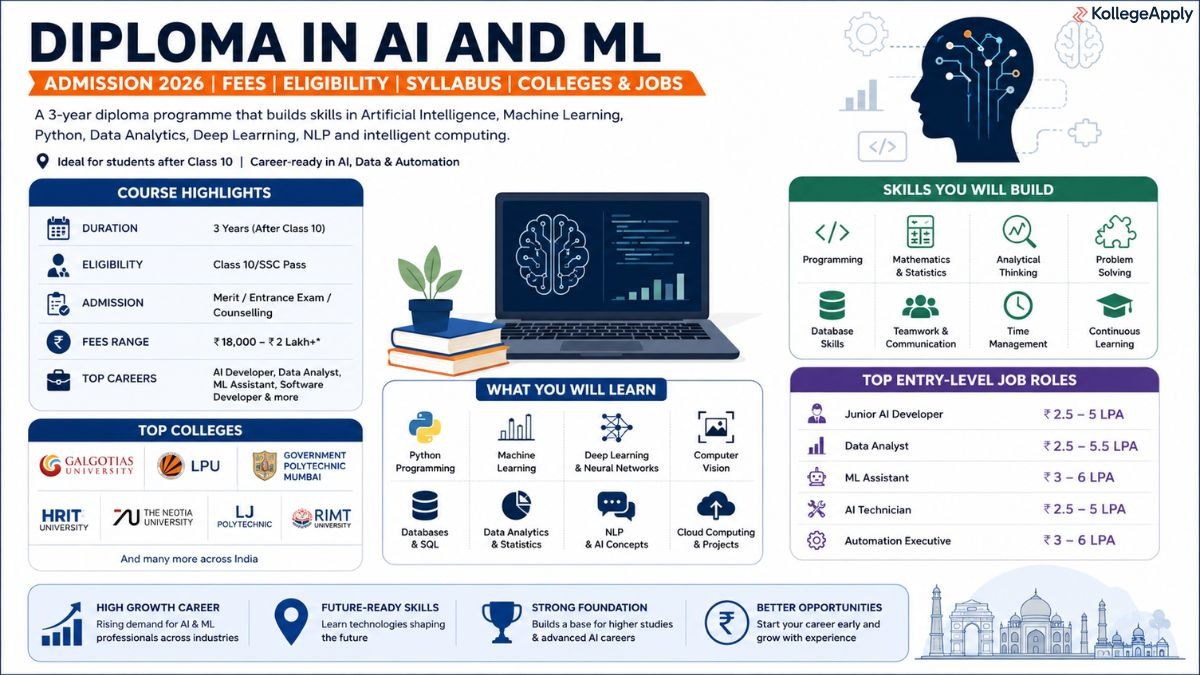
Before applying for a Diploma in AI and ML, students should understand the course duration, eligibility, admission route, curriculum, fees and career prospects. The programme is available in different formats across institutes, so specific requirements may differ. The table below provides a concise overview of the key aspects of the course.
What is Diploma in AI and ML?
The Diploma in AI and ML full form is Diploma in Artificial Intelligence and Machine Learning, which is a specialised technical programme that introduces students to Artificial Intelligence, Machine Learning, programming, data analytics and intelligent computing. The course explains how computers process information, identify patterns, make predictions and perform tasks that require human-like intelligence. The curriculum generally covers Python programming, data structures, databases, statistics, probability, machine learning algorithms, neural networks, deep learning, computer vision and Natural Language Processing (NLP). Depending on the institute, students may also study cloud computing, automation and data analytics.
An Artificial Intelligence diploma course combines theoretical concepts with practical learning through computer laboratory sessions, programming assignments, internships and AI/ML projects. The programme is suitable for students interested in coding, technology, data and problem-solving and can prepare them for entry-level opportunities in software development, data analytics, AI support and automation. Students planning careers in advanced areas such as AI research, Machine Learning Engineering or Data Science may benefit from pursuing a bachelor's degree and developing strong programming, mathematical and project-based skills after completing the diploma.
Why Pursue Diploma in AI and ML?
A Diploma in AI and ML can be a suitable choice for students who want to build an early foundation in programming, data analysis and Artificial Intelligence technologies. The course combines computer science fundamentals with practical exposure to Machine Learning and related tools, helping students develop technical skills that can support entry-level employment as well as further education. Key reasons to pursue the programme include:
- Growing technology demand: AI and ML are increasingly used in software, finance, healthcare, retail, manufacturing, education and other sectors.
- Early technical exposure: Students can start learning programming, data analysis and AI concepts at diploma level.
- Practical skill development: Laboratory exercises and projects help students apply theoretical concepts to real-world problems.
- Multiple career options: Graduates can explore entry-level roles in software, data, automation, testing and AI support.
- Scope for higher studies: A diploma can provide a foundation for further study in computer science, AI, data science or related areas.
- Entrepreneurship opportunities: Students with programming and AI skills can develop applications, automation solutions and technology-based products.
Is Diploma in AI and ML Worth It in 2026?
A Diploma in AI and ML can be worthwhile in 2026 for students who want an early entry into emerging technology and are willing to continuously upgrade their skills. AI is being integrated into software development, business analytics, cybersecurity, healthcare, manufacturing and digital services, increasing the importance of AI-related technical knowledge.
However, students should have realistic expectations about placements and salary. A diploma can prepare candidates for junior technical and support roles, but many advanced AI and ML positions require a bachelor's or master's degree along with programming, mathematics and project experience. Current AI Engineer salary data also shows that compensation varies widely according to experience, company and role.
The future scope is stronger for candidates who combine the diploma with Python, SQL, cloud computing, statistics, Git, machine learning frameworks and practical projects. Generative AI, computer vision, NLP and AI automation are also expanding the range of skills that students can develop after learning the fundamentals.
Diploma in AI and ML Eligibility Criteria
The Diploma in AI and ML eligibility criteria vary depending on the course structure, institute and admission route. Students applying for a conventional three-year polytechnic diploma are generally eligible after Class 10, while some post-12th or specialised programmes may have additional subject requirements. For example, Galgotias University lists Class 10 with at least 40% marks for its diploma programme, while RIMT University accepts Class 10/SSC qualification. LPU's specific AI and ML diploma route has a different eligibility structure requiring 10+2 with Physics, Mathematics and English. Candidates should check the specific eligibility conditions prescribed by the institute before applying.
- Minimum qualification: Most three-year engineering diplomas accept candidates who have passed Class 10/SSC or an equivalent examination.
- Required marks: The minimum percentage varies by institution and state. Some colleges may require around 40% or higher.
- Subject requirements: Mathematics and science requirements may apply to specific diploma programmes.
- After 12th: Several institutions also provide admission routes for Class 12 students, although the eligibility structure differs.
- Lateral entry: Some states/institutions provide direct second-year admission to eligible candidates with Class 12, ITI or equivalent qualifications.
Diploma in AI and ML Entrance Exams
There is no single national entrance examination exclusively for all Diploma in AI and ML colleges in India. Admission depends on the state, institution and programme. State polytechnic examinations such as JEECUP can be relevant for participating institutions, while some colleges use merit-based admission or their own tests.
Note: Exam dates and fees are tentative and vary by state and year; candidates should always confirm details on the respective official state technical education board websites.
Diploma in AI and ML Colleges in India
Students can pursue a Diploma in AI and ML from government polytechnics, universities and private technical institutes across India. The availability, duration, curriculum, eligibility and fee structure of these programmes may vary by institution. The table below highlights selected institutes offering relevant AI/ML diploma-level programmes, along with their location, indicative fees and available ranking information.
Diploma in AI and ML Admission Process
The Diploma in AI and ML admission process varies by institute and may involve state-level polytechnic counselling, entrance examinations, merit-based selection or direct admission. Government polytechnics generally follow the admission rules of the respective state authority, while private universities and institutes may conduct their own admission process. Candidates should check the official admission notification for eligibility, important dates, required documents and fee details before applying.
Step 1: Entrance Exam Registration - Candidates applying through a state polytechnic system should register for the applicable entrance examination within the specified dates.
Step 2: Application Form Filling - Students must enter personal, academic and category details and upload the required documents. The information should match official academic records.
Step 3: Examination or Merit Assessment - Depending on the institute, admission may be based on an entrance test, Class 10 merit, Class 12 merit or an institutional assessment.
Step 4: Shortlisting - Eligible candidates are shortlisted based on entrance rank, academic merit, eligibility and seat availability.
Step 5: Counselling / Choice Filling - Candidates may select preferred colleges and AI/ML diploma programmes during state-level counselling.
Step 6: Merit List and Seat Allotment - The counselling authority or institution publishes merit lists and/or seat-allotment results.
Step 7: Document Verification - Selected candidates must verify their original documents at the designated centre or through the institute's online process.
Step 8: Fee Submission - Candidates confirm their admission by paying the prescribed tuition and other applicable fees.
Documents Required
- Class 10 mark sheet and certificate
- Class 12 mark sheet, where applicable
- Transfer certificate
- Migration certificate, where applicable
- Entrance examination scorecard/rank card
- Passport-size photographs
- Government-issued identity proof
- Category certificate, if applicable
- Domicile certificate, if required
- Income/EWS certificate, where applicable
- Medical fitness certificate, if required
Diploma in AI and ML Syllabus
The syllabus of an AI ML diploma varies by university and state technical board. However, most programmes progress from computing and programming fundamentals to artificial intelligence, machine learning, deep learning and industry projects. Galgotias University's published curriculum, for example, includes Python, AI, Machine Learning, databases, deep learning, cloud computing and industrial projects.
What Skills are required for a Diploma in AI and ML?
A Diploma in AI and ML requires students to develop a balanced set of technical, analytical and professional skills. Since the field involves programming, data handling, model development and practical problem-solving, students should focus on building strong fundamentals along with hands-on experience. The following skills can help students perform better academically and prepare for entry-level opportunities in AI, Machine Learning and related technology fields.
- Programming: Python is particularly useful for AI and machine learning development.
- Mathematical Skills: Algebra, statistics and probability help students understand ML models.
- Analytical Thinking: AI work requires interpreting data and identifying patterns.
- Problem Solving: Students should be able to break complex problems into manageable tasks.
- Database Skills: SQL and database concepts are useful for handling structured data.
- Machine Learning Skills: Understanding classification, regression, clustering and model evaluation is important.
- Communication: Technical concepts need to be explained clearly to teammates and clients.
- Teamwork: AI projects commonly involve developers, analysts, engineers and domain experts.
- Time Management: Projects often involve coding, testing, debugging and documentation.
- Continuous Learning: AI evolves rapidly, making regular learning of new tools and techniques essential.
Diploma in AI and ML Jobs & Salary
A Diploma in AI and ML can lead to entry-level technology and support positions, particularly when candidates have strong practical skills. Job titles and salary levels vary by employer, location, experience and whether the candidate continues to higher education.
Note: Salary figures are indicative rather than guaranteed.
What is the Salary After Diploma in AI and ML?
The Diploma in AI and ML Salary depends on the student's programming ability, projects, internship experience, employer, city and highest qualification. Diploma holders may initially enter junior roles, while candidates who complete a bachelor's degree and gain specialised AI/ML experience can target higher-level positions.
Note: Higher salary ranges generally correspond to professionals who gain substantial experience, specialised skills and/or higher qualifications after the diploma.
Top Recruiters for Diploma in AI and ML
AI and machine learning skills are applicable across several industries. Diploma holders can initially target entry-level technology positions and later progress after gaining experience or completing higher qualifications. Recruiter requirements vary by role. A diploma may satisfy eligibility for some junior technical positions, while advanced AI and ML engineering vacancies commonly ask for a bachelor's or higher qualification.
Diploma in AI and ML vs Diploma in Computer Science
The Diploma in AI and ML and Diploma in Computer Science both provide technical foundations, but their specialisations are different. AI/ML is more focused on data-driven intelligence and model development, while Computer Science provides broader exposure to software and computing.
Diploma in AI and ML FAQs
Which Diploma is best for AI?
A Diploma in AI and ML is suitable for students seeking focused training in artificial intelligence, machine learning and related technologies.
What are AI ML course fees?
Diploma in AI and ML fees often range from about INR 18,000 to INR 2 Lakh, depending on the institute and course format.
Can I learn AI in 3 months?
Yes, a Diploma in AI and ML foundation can start in 3 months, but job-ready AI skills generally require longer study and projects.
Can I do a Diploma in AI after 12th?
Yes. Some institutes offer a Diploma in AI and ML after Class 12, although eligibility and duration vary by institution.
What is the Diploma in AI and ML course duration?
A Diploma in AI and ML generally takes 3 years in the polytechnic route, while shorter diploma formats are also available.
What is Diploma in AI and ML Salary in India?
Diploma in AI and ML Salary may start around INR 2.5–6 LPA and increase with experience, skills and higher qualifications.
Is Diploma in AI and ML available online?
Yes, Diploma in AI and ML online programmes are available, but students should verify recognition, curriculum and practical training.
Can I get a job after Diploma in AI and ML?
Yes. A Diploma in AI and ML can support entry-level roles in software, data, automation and AI support.
Is Diploma in AI and ML good after 10th?
Yes. A Diploma in AI and ML can provide early exposure to programming, data and AI technologies after Class 10.
What should I study after Diploma in AI and ML?
After a Diploma in AI and ML, students can pursue a bachelor's degree or strengthen skills through certifications, internships and advanced AI projects.