M.Tech in Environmental Engineering jobs cover technical, consulting, research, project management and regulatory roles related to water and wastewater treatment, air pollution control, solid and hazardous waste management, environmental monitoring, EIA and sustainability. Graduates can work with engineering consultancies, infrastructure companies, manufacturing industries, water-treatment organisations, research institutions and government or regulatory bodies. The programme can also provide a pathway to research and higher academic study.
The M.Tech in Environmental Engineering scope is closely linked to the technical specialisations developed during the programme. For example, NIT Surathkal identifies career pathways in engineering, research, planning and consulting, industry, public health, regulatory agencies, policy making and education. NIT Trichy similarly states that its programme is designed for environmental management, effluent treatment, emission control and contaminated-environment remediation, with electives covering monitoring, modelling, EIA, pollution control and hazardous waste management.
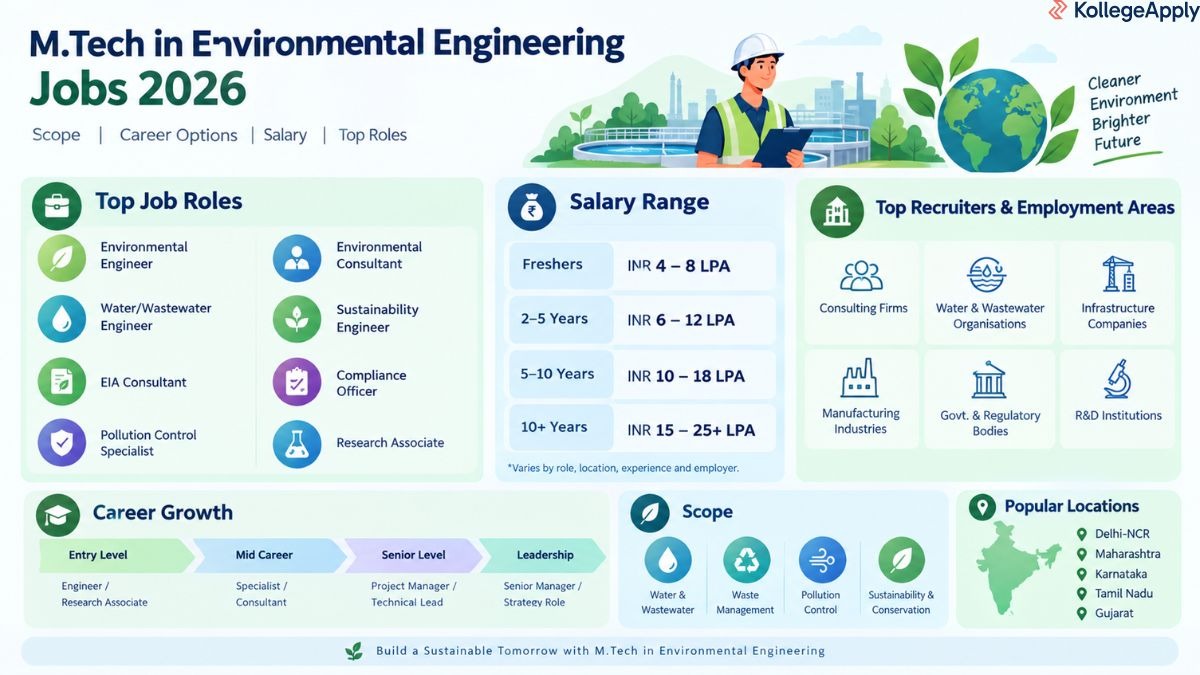
Table of Contents
- What Jobs Can I Get With an M.Tech in Environmental Engineering?
- M.Tech in Environmental Engineering Scope
- Environmental Engineering Jobs for Freshers
- Govt Jobs for M.Tech Environmental Engineering
- Environmental Engineering Jobs in Private Sector
- M.Tech in Environmental Engineering Jobs Salary
- M.Tech in Environmental Engineering Salary by Job Role
- Career Growth After M.Tech in Environmental Engineering
- Skills Required for M.Tech in Environmental Engineering Jobs
- What to Do After M.Tech in Environmental Engineering?
- Top Recruiters and Employment Areas for Environmental Engineers
- M.Tech in Environmental Engineering Jobs FAQs
What Jobs Can I Get With an M.Tech in Environmental Engineering?
An M.Tech graduate can choose from engineering, consulting, water management, environmental assessment, sustainability, pollution control and research-oriented roles. The exact job title depends on the candidate's specialisation, internship or project experience and the requirements of the employer. NITK's programme objectives specifically identify engineering, research, planning and consulting, industry, public health, regulatory agencies, policy making and education as potential professional areas.
M.Tech in Environmental Engineering Scope
The scope of M.Tech in Environmental Engineering extends beyond conventional environmental engineer roles because the degree develops specialised knowledge in treatment technologies, monitoring, assessment, modelling and environmental management. NIT Trichy's programme includes environmental monitoring and modelling, EIA, environmental biotechnology, industrial air and water pollution control, ecology, clean technology and hazardous waste management as areas for deeper study.
Environmental Engineering Jobs for Freshers
Freshers with an M.Tech can enter environmental engineering through junior technical, consulting, treatment-plant, monitoring, research and assessment roles. Practical exposure can be particularly useful because the curriculum at institutes such as NITK includes laboratory-based environmental quality and monitoring work, including water and wastewater analysis, while NIT Trichy emphasises field, laboratory and computing skills.
Govt Jobs for M.Tech Environmental Engineering
Govt jobs for M.Tech Environmental Engineering can arise through pollution-control boards, environmental agencies, government departments, public-sector organisations and research institutions. However, an M.Tech does not automatically qualify a candidate for every government engineering vacancy. Eligibility is determined by the recruitment notification, which may specify a particular engineering discipline, degree, experience or examination.
The Central Pollution Control Board (CPCB), for example, has recruited for Scientist 'B' in Environmental Engineering, demonstrating that environmental-engineering qualifications can be relevant to technical government recruitment. Its recruitment material has also specified written examinations and other selection stages depending on the post.
Government Career Routes
Candidates should track official recruitment portals rather than assuming that a particular vacancy is available every year. UPSC currently lists Engineering Services Examination among its examinations, while individual recruitment advertisements specify the disciplines and qualifications required for each post.
Environmental Engineering Jobs in Private Sector
Private-sector environmental engineering jobs are available across consulting, infrastructure, manufacturing,water treatment, waste management, energy, construction and sustainability-related functions.
The type of work depends heavily on the organisation: a consultancy may focus on EIA and compliance, while an industrial employer may require pollution-control, waste-management and environmental monitoring expertise.
NITK's stated programme objectives include professional roles in industry and planning/consulting, while NIT Trichy specifically identifies industry, consultancy services and academic/R&D organisations related to environmental management, effluent treatment, emission control and remediation as relevant employment areas.
M.Tech in Environmental Engineering Jobs Salary
The M.Tech in Environmental Engineering jobs salary varies with experience, job role, specialisation, employer, location and project responsibility. As covered in the separate salary article, an indicative entry-level range is around INR 4–8 LPA, while experienced professionals in specialised technical, consulting or project-management roles may reach INR 10–20 LPA or more. These figures are indicative rather than guaranteed salaries.
Note: Salary varies by employer, location, specialisation, role, technical expertise and experience. CTC may include fixed and variable components and should not be treated as monthly take-home pay.
For the detailed salary range based on experience, skills, job roles & location, check out the MTech in Environmental Engineering Salary guide.
M.Tech in Environmental Engineering Salary by Job Role
Job-role-based salary can differ substantially because an entry-level environmental engineer and an experienced project manager have different responsibilities and experience requirements. Roles involving specialised treatment design, environmental consulting, regulatory compliance, large projects or technical leadership may have different compensation structures. The following ranges are indicative and should be read alongside the detailed salary article.
Career Growth After M.Tech in Environmental Engineering
Career progression generally depends on technical specialisation, project exposure, professional responsibility and the type of organisation. Graduates may begin with execution, monitoring, design-support or research responsibilities and later move into senior consulting, technical-specialist, project-management or leadership positions. NITK's programme outcomes emphasise advanced technical skills, research capability, technical reporting and multidisciplinary teamwork, which are relevant to progression into more responsible roles.
Skills Required for M.Tech in Environmental Engineering Jobs
The skills required depend on the chosen career path, but strong candidates generally combine environmental engineering fundamentals with practical tools and communication abilities. IIT Roorkee's Environmental Engineering curriculum includes areas such as water quality management, industrial and hazardous waste management, environmental impact and risk assessment, GIS, air pollution control and solid waste management. NITK also includes environmental quality monitoring and analysis in its programme.
Technical Skills
- Water and wastewater treatment
- Environmental monitoring and sampling
- Air pollution control
- Solid and hazardous waste management
- Environmental Impact Assessment
- Environmental risk assessment
- GIS and spatial analysis
- Environmental modelling
- Pollution-control technologies
- Environmental data analysis
- Treatment-plant design and process understanding
- Environmental legislation and compliance
- Research methodology and technical reporting
Professional Skills
- Technical report writing
- Client communication
- Presentation skills
- Problem-solving
- Data interpretation
- Project coordination
- Team management
- Research and analytical thinking
- Time management
- Multidisciplinary collaboration
What to Do After M.Tech in Environmental Engineering?
After M.Tech in Environmental Engineering, graduates can choose employment, government recruitment, research, consulting or higher studies depending on their career goals. Those interested in technical practice can target environmental, water, wastewater, EIA or pollution-control roles. Candidates interested in research can pursue project-based research or doctoral studies; NITK, for example, offers M.Tech by Research in Environmental Engineering. Main Options After M.Tech are:
- Join environmental engineering jobs in consulting, industry or infrastructure.
- Work in water and wastewater treatment and environmental infrastructure.
- Enter EIA and environmental consulting.
- Apply for government and regulatory recruitment where eligibility matches.
- Pursue research and R&D in environmental technologies.
- Move into sustainability and environmental management.
- Pursue a PhD for advanced research or academic careers.
- Develop specialised expertise in GIS, modelling, pollution control or treatment technologies.
Top Recruiters and Employment Areas for Environmental Engineers
Environmental engineering graduates can find opportunities across organisations that require environmental assessment, pollution control, water management, waste management or sustainability expertise. Instead of limiting the career search to a fixed recruiter list, candidates should evaluate employers according to the technical work they offer and the specialisation required.
M.Tech in Environmental Engineering Jobs FAQs
What jobs can I get with a masters in Environmental Engineering?
You can work as an Environmental Engineer, Consultant, EIA Consultant, Water Engineer, Sustainability Specialist or Research Associate.
What to do after MTech in Environmental Engineering?
You can enter environmental engineering jobs, government recruitment, consulting, research, sustainability roles or pursue a PhD.
What is the highest salary of an environmental engineer?
There is no fixed maximum. Senior specialists and project managers may earn INR 15–25+ LPA in suitable organisations.
Is Environmental Engineering a good career?
It offers careers in water, wastewater, consulting, pollution control, EIA, sustainability, research and environmental management.
Are there govt jobs for MTech Environmental Engineering?
Yes, Opportunities can arise in CPCB, state pollution-control boards and other government organisations, subject to vacancy-specific eligibility.
What are Environmental Engineering jobs for freshers?
Freshers can apply for Environmental Engineer, Junior Consultant, Water/Wastewater Engineer, EIA and Research Associate roles.
What is the MTech in Environmental Engineering jobs salary?
Indicative salaries range from INR 4–8 LPA for freshers and may reach INR 15–25+ LPA with experience.
What skills are needed for environmental engineering jobs?
Key skills include water treatment, EIA, GIS, environmental monitoring, pollution control, modelling, compliance and technical reporting.
Can M.Tech Environmental Engineering graduates work in research?
Yes, Graduates can work in R&D and research projects or pursue doctoral studies in environmental engineering.
Which sectors hire environmental engineers?
Consulting, water treatment, infrastructure, manufacturing, waste management, sustainability, government and research sectors hire environmental engineers.