M.Tech. in Environmental Engineering programme is designed to develop skilled professionals with advanced knowledge for tackling new-age environmental issues. M.Tech in Environmental Engineering is a two-year programme offered to students at the postgraduate level. The course is divided into four equal semesters, with a focus on both theoretical concepts and practical training via projects and internships.
Students who desire to pursue a M.Tech in Environmental Engineering programme must make sure to meet the minimum entry requirements. MTech in Environmental Engineering eligibility requires students to possess a bachelor’s degree in Civil, Chemical, or any relevant engineering field from a recognised university. Attaining a minimum of 50% aggregate marks or above is also necessary. Students must present a valid entrance score such as GATE, CUET PG, BITS HD, etc.
Graduates of M.Tech. in Environmental Engineering can explore career opportunities as environmental engineers, consultants, wastewater engineers, etc. Fresh graduates can also work in government roles in pollution control boards and urban development. Opportunities in research institutes and NGOs are also available for interested candidates. Some of the top recruiters for M.Tech in Environmental Engineering graduates are TATA Consulting Engineers, AECOM, TERI, Siemens, and many more.
Table of Contents
- M.Tech. in Environment Engineering Key Highlights
- What is M.Tech. in Environment Engineering?
- Why Study M.Tech. in Environment Engineering?
- Is M.Tech in Environment Engineering Worth It in 2026?
- M.Tech. in Environment Engineering Eligibility Criteria
- M.Tech. in Environment Engineering Entrance Exams 2026
- M.Tech. in Environment Engineering Colleges
- M.Tech. in Environment Engineering Admission Process 2026
- M.Tech. in Environment Engineering Syllabus
- M.Tech. in Environment Engineering Job Opportunities
- M.Tech. in Environment Engineering Vs MTech Mechanical Engineering
- FAQs on M.Tech. in Environment Engineering
M.Tech. in Environment Engineering Key Highlights
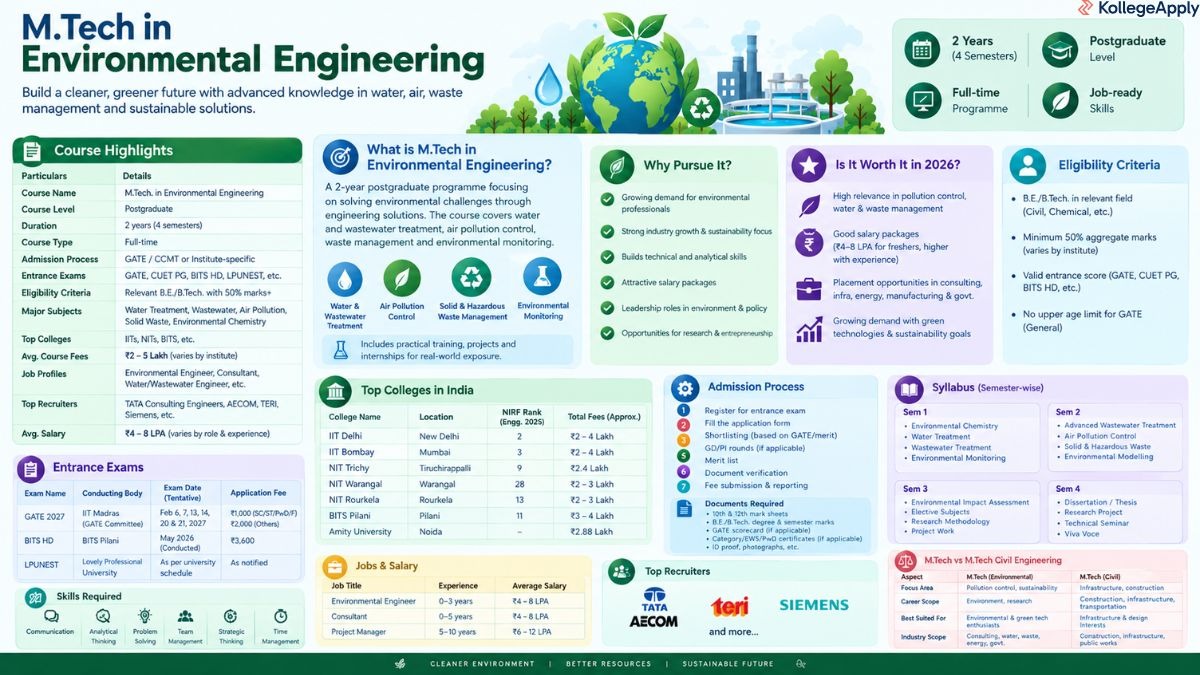
Candidates seeking admission to universities or colleges offering M.Tech. in Environment Engineering must stay aware of all the required information before applying. The table below highlights the key information related to the M.Tech. in Environment Engineering programme for better understanding:
What is M.Tech. in Environment Engineering?
M.Tech. in Environmental Engineering is a study of several elements like air pollution, water bodies, wildlife, recycling waste, disposing waste, and many more related aspects. This two-year program is a branch of civil engineering. M.Tech in Environmental Engineering complies with the standards of AICTE as well. MTech in Environmental Engineering helps in producing skilled professionals to control climate change and safeguard the environment.
Students pursuing M.Tech. get the opportunity to learn various industry-relevant MTech environmental engineering subjects such as Water Treatment and Supply, Wastewater Treatment, Environmental Monitoring Laboratory, Air Pollution Control, Solid Waste Management, etc. M.Tech in Environmental Engineering syllabus consists of a mix of core subjects along with various electives. Students will also be learning deeply through laboratory and practical training.
Why Study M.Tech. in Environment Engineering?
Students aiming for M.Tech. in Environment Engineering admission can gain opportunities to work across a wide range of industries while developing industry-relevant skills. To better understand the significance of Environment Engineering field, check out the key points highlighted below:
- Growing environmental requirements: Industries and infrastructure projects require professionals who understand pollution control, environmental assessment and compliance.
- Specialised technical skills: The programme develops expertise in water treatment, wastewater treatment, air pollution control, waste management and environmental monitoring.
- Multiple work sectors: Graduates can explore consulting, infrastructure, manufacturing, water management, sustainability, research, government and NGO-related roles.
- Research opportunities: Environmental engineering offers research areas such as advanced wastewater treatment, emerging contaminants, air quality, climate resilience and waste management.
- Government-sector opportunities: Graduates can pursue relevant technical and environmental roles through government recruitment and public-sector organisations, subject to their recruitment rules.
- Scope for specialisation: Electives and dissertation work allow students to develop expertise in areas such as environmental impact assessment, GIS, environmental modelling, hazardous waste and treatment-plant design.
Is M.Tech in Environment Engineering Worth It in 2026?
M.Tech in Environmental Engineering remains relevant because environmental management is closely connected with water security, pollution control, waste management, industrial compliance and sustainable infrastructure. Current curricula at IIT Delhi, NIT Trichy and NIT Warangal include emerging and applied areas such as environmental impact assessment, treatment-plant design, environmental modelling and sustainable environmental management.
Career outcomes depend strongly on the institute, technical specialisation, work profile and employer. For example, NIT Warangal reported an average CTC of INR 6 LPA for its M.Tech Environmental Engineering students in the 2024–25 placement data, while IIT Bhubaneswar reported an average CTC of INR 7 LPA for Environmental Engineering in its 2026 placement data. These figures are institute-specific and should not be treated as a guaranteed industry-wide salary.
Technological developments are also expanding the field into environmental monitoring, GIS, data-driven modelling, advanced oxidation processes, circular economy, life-cycle assessment and emerging-contaminant treatment. This creates opportunities for graduates who combine environmental engineering knowledge with digital, analytical and project-management skills.
M.Tech. in Environment Engineering Eligibility Criteria
MTech in Environmental Engineering Eligibility plays a crucial role in a student’s admission into their desired college. Students aiming for admission must meet the specified requirements, as they assess the academic capabilities needed for the course. To gain better insights on the topic, students can check the pointers given below to learn more:
- Candidates generally need a B.E./B.Tech. or equivalent bachelor's degree in a relevant engineering discipline.
- Civil Engineering is a common qualifying discipline for Environmental Engineering programmes.
- Some institutes also accept degrees in Environmental Engineering, Chemical Engineering, Biotechnology or Mechanical Engineering.
- Some programmes may accept relevant M.Sc. qualifications.
- The minimum percentage varies by institution. Many institutes specify minimum 50% or above or an equivalent CGPA, while some programmes may have different requirements.
- A valid GATE score is generally required for regular M.Tech admission at IITs and NITs where GATE-based admission applies.
- Candidates applying through university-level admission may be considered through the institute's own entrance test, merit or interview process.
- There is generally no upper age limit for appearing in GATE 2027.
- Reserved-category relaxation, wherever applicable, follows the rules of the concerned institute or admission authority.
GATE 2027 itself permits candidates who are studying in the third year or higher of an eligible undergraduate programme or who have completed an approved degree in Engineering, Technology, Architecture, Science, Commerce, Arts or Humanities to appear for the examination. However, eligibility to appear for GATE should not be confused with eligibility for a particular M.Tech programme.
M.Tech. in Environment Engineering Entrance Exams 2026-27
There are several entrance exams in India that create a pathway for students to pursue M.Tech in Environmental Engineering. Entrance exams such as GATE and CUET PG are nationally recognised, while exams like BITS HD and LPUNEST are conducted by universities themselves. To gain a better understanding of MTech Environmental Engineering entrance exams, refer to the table given below:
GATE 2027 registration is currently open, with regular registration scheduled to close on September 27, 2026, and extended registration with late fee scheduled to close on October 5, 2026. The examination is scheduled for February 6–7, 13–14 and 20–21, 2027, with results scheduled for March 19, 2027. Dates are subject to change.
Note: Candidates should not assume that every entrance exam is accepted by every college. Admission criteria are programme- and institute-specific.
M.Tech. in Environment Engineering Colleges
Students must note that there are several colleges offering MTech in Environmental Engineering without GATE. However, students are still required to meet the M.Tech. in Environmental Engineering eligibility criteria to secure admission. Check out the table given below to learn more:
To read the detailed colleges related information, check out our M.Tech in Environmental Engineering colleges guide.
M.Tech. in Environment Engineering Admission Process 2026
Admission to M.Tech. in Environment Engineering is generally dependent on entrance examinations. Students seeking admission must go through an admission process that includes application, entrance exam, and documents verification stages. For a better understanding of the admission procedure, the steps for admission at MIT WPU are provided below as a reference.
- Step 1: Initially, students must register on the official admission portal, generate login credentials, and complete the application form by filling in the required details and paying the application fee of INR 2,000.
- Step 2: Candidates must appear for the MIT WPU CET entrance exam as per the schedule and complete all required admission-related assessments.
- Step 3: After the declaration of results, shortlisted candidates will receive a provisional admission offer on their registered email or student dashboard.
- Step 4: Candidates need to pay the first instalment of the programme fee to secure their admission within the given timeline.
- Step 5: Complete the process by submitting required documents and details. Admission is confirmed after successful document verification and fee payment.
Required Documents
M.Tech. in Environment Engineering Syllabus
M.Tech Environmental Engineering syllabus plays a crucial role in building a strong career path for enrolled students. It includes several core subjects along with elective options to better align with the future goals of the candidates. The table below highlights the MTech Environmental Engineering syllabus forNIT Hamirpur:
Electives
Click on M.Tech in Environment Engineering Syllabus guide for detailed curriculum and related books.
M.Tech. in Environment Engineering Job Opportunities
Students pursuing M.Tech. in Environmental Engineering get the opportunity to work in government sectors, NGOs, research centres, startups, and more. The demand for skilled MTech Environmental Engineers is increasing as concerns around climate change and environmental challenges continue to grow globally.
Graduates of MTech Environmental Engineering can expect to earn an average salary between INR 4 LPA and INR 8 LPA. With increasing experience and expertise, professionals can raise their salary to INR 15 LPA or above. Check out the following table to learn more about the career paths after MTech Environmental Engineering:
M.Tech in Environment Engineering Salary
M.Tech Environmental Engineering graduates can work across consulting, infrastructure, water treatment, manufacturing, sustainability, government, research and environmental services. Job titles and salary levels vary according to technical specialisation, employer and experience.
Note: Salary figures are indicative rather than guaranteed. Institute-specific placement data can differ substantially from wider market ranges.
M.Tech. in Environment Engineering Vs MTech Mechanical Engineering
Students should carefully evaluate both programmes before making a decision, as each offers distinct career paths and skill sets. The comparison below highlights the key differences to help students choose the right course based on their interests and goals:
FAQs on M.Tech. in Environment Engineering
What is the duration of M.Tech in Environment Engineering?
M.Tech in Environment Engineering generally takes two years and is divided into four semesters with theory, practicals, projects and research work.
What is the eligibility for M.Tech in Environment Engineering?
Candidates generally need a relevant B.E./B.Tech. degree. Accepted disciplines and minimum marks vary across institutes and programmes.
Is GATE compulsory for M.Tech in Environment Engineering?
GATE is required for many IIT and NIT seats, but some universities offer institute-level admission routes without GATE.
Can I pursue M.Tech Environmental Engineering without GATE?
Yes, selected universities offer admission through their own entrance tests, merit or other selection methods, subject to programme rules.
What is taught in M.Tech in Environmental Engineering syllabus?
The syllabus covers water treatment, wastewater, air pollution, waste management, environmental chemistry, monitoring, modelling and environmental assessment.
What is the salary after M.Tech in Environment Engineering?
The average entry-level salary after M.Tech. in Environment Engineering ranges somewhere between INR 4–8 LPA for freshers. With experience and expertise, it can go up to INR 15 LPA or higher.
What can I do after M.Tech in Environmental Engineering?
Graduates can pursue environmental consulting, water management, sustainability, pollution control, research, government and doctoral studies.
Which GATE paper is required for Environmental Engineering?
The accepted GATE paper depends on the institute. CE, ES, CH, BT and ME may be accepted for different Environmental Engineering programmes.
Is M.Tech in Environmental Engineering available in Odisha?
Yes. IIT Bhubaneswar and NIT Rourkela offer postgraduate Environmental Engineering programmes or specialisations in Odisha.
Which M.Tech has the highest salary?
Salary varies by specialisation, employer and role. M.Tech CSE, AI, semiconductor and related fields can have different salary patterns from environmental engineering.